Kids Sunglasses: Factory vs Trading Company for Pricing, MOQ, and Response Speed?
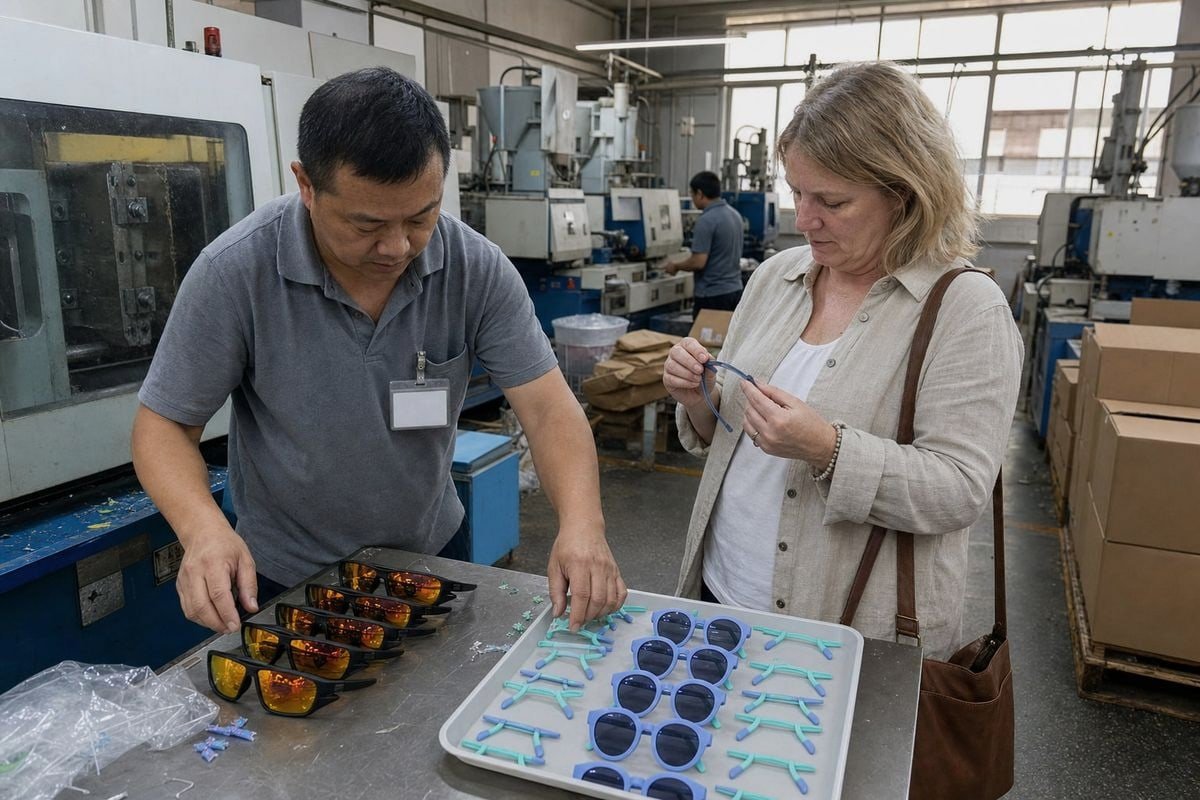
Choosing between a factory and a trading company for kids sunglasses is confusing. I’ve watched buyers overpay, miss seasons, and get burned — problems our production line sees fixed every week.
For kids sunglasses, factories win on unit price, customization, and quality control, while trading companies win on quote speed and low-friction mixed orders. Factory sourcing typically cuts 10–30% off pricing; trading companies offer lower MOQs but add markup and reduce transparency over safety compliance.
That is the short answer. But the real decision depends on your order size, your customization needs 1, and how much risk you can absorb. Let me break down each factor.
How do I know if I'm buying from a real factory or just a trading company in disguise?
A buyer from Australia once told me she had "visited her factory" — then sent me photos of a showroom with no آلات الحقن 2 in sight. That happens more often than you would think.
Verify a real factory by requesting a live video tour of the injection molding workshop, checking the business license scope for "manufacturing," asking mold-level technical questions, and confirming the audit address matches the quoted address. Trading companies typically dodge production-floor video calls and technical material questions.
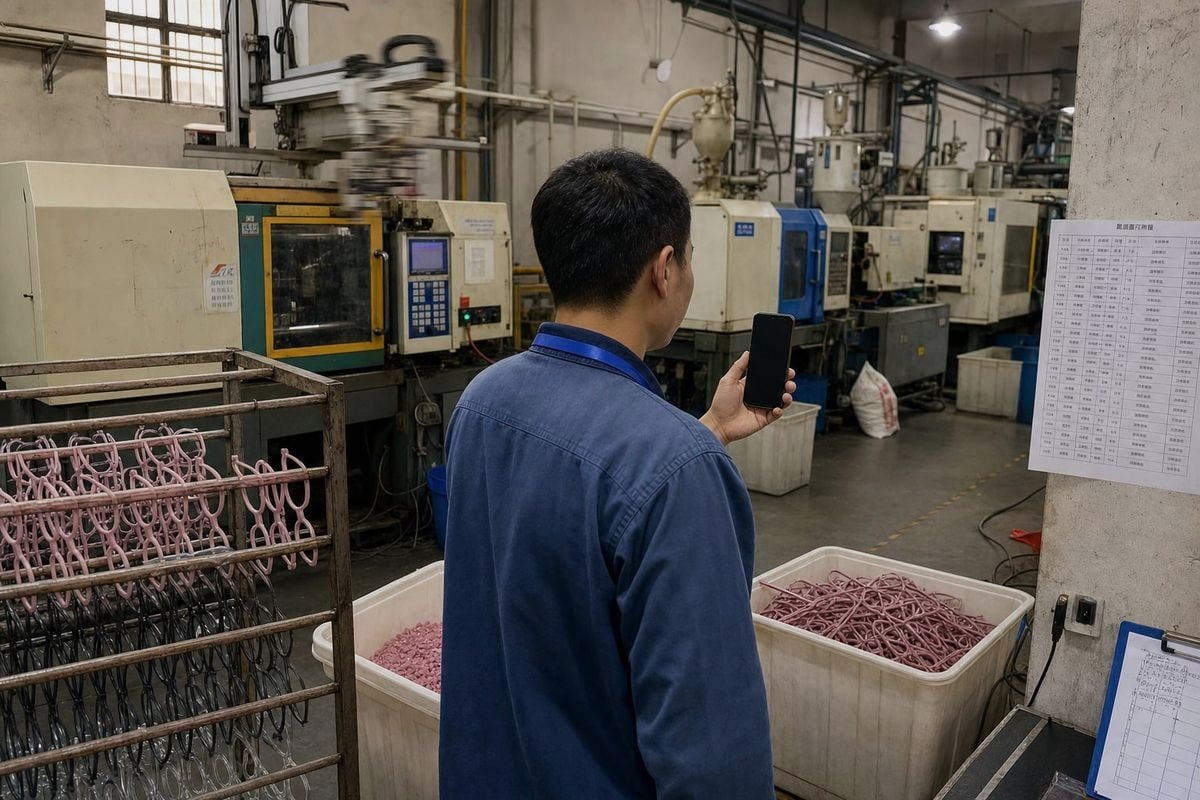
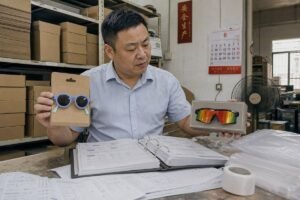
In our Taizhou workshop, we host video calls straight from the production floor. A genuine manufacturer has nothing to hide. A trading company disguised as a factory will stall, redirect, or show you stock photos. Here is how I recommend you separate the two before you commit money.
Five verification checks that actually work
- Ask for a live video walkthrough. Request to see injection molding machines, lens cutting, and assembly lines in real time — not pre-recorded clips. Our team does this on a normal workday so buyers hear the machines running.
- Check the business license. A Chinese business license lists the registered scope. Look for manufacturing (生产/制造), not just trade (贸易). A sourcing agent vs manufacturer distinction often shows up right there.
- Ask deep technical questions. Ask about TPEE flexible frames versus TR90, mold cavity counts, or how hinge screws are torque-tested. A trader will need to "check with the factory." An engineer answers on the spot.
- Match the audit address. If a supplier shares a third-party audit report, confirm the plant address matches the address on the quote and the license.
- Request an unedited defect sample. Real factories can show you rejected parts from quality control inspection. Traders rarely have access to scrap bins.
Quick comparison of tell-tale signs
| إشارة | Real Factory | Trading Company |
|---|---|---|
| Video tour of workshop | Offered readily | Delayed or refused |
| Material questions (TPEE, TR90) | Answered instantly | "Let me confirm" |
| License scope | Manufacturing | Trading / export |
| Mold and tooling knowledge | Detailed | Vague |
| Product range | Focused (eyewear only) | Very wide, mixed categories |
One more clue: catalog breadth. If a supplier sells kids sunglasses, water bottles, and phone cases from the same account, you are almost certainly looking at a trader. After fifteen years making نظارات الأطفال 3 and nothing else, our catalog is deep — about 800 existing styles — but it is all eyewear. Specialization is the fingerprint of a real plant.
Why does working directly with a factory usually mean better pricing and lower MOQs?
There is a trade-off I discuss with almost every new buyer: a trader's quote arrives fast, but it always carries a hidden layer. When we quote from our own line, that layer simply does not exist.
Direct factory sourcing removes the intermediary markup — typically 10–30% of unit cost — because you pay only for materials, labor, molds, and margin. Factories with large existing style libraries can also offer surprisingly low MOQs on stock molds, since no new tooling investment is required.
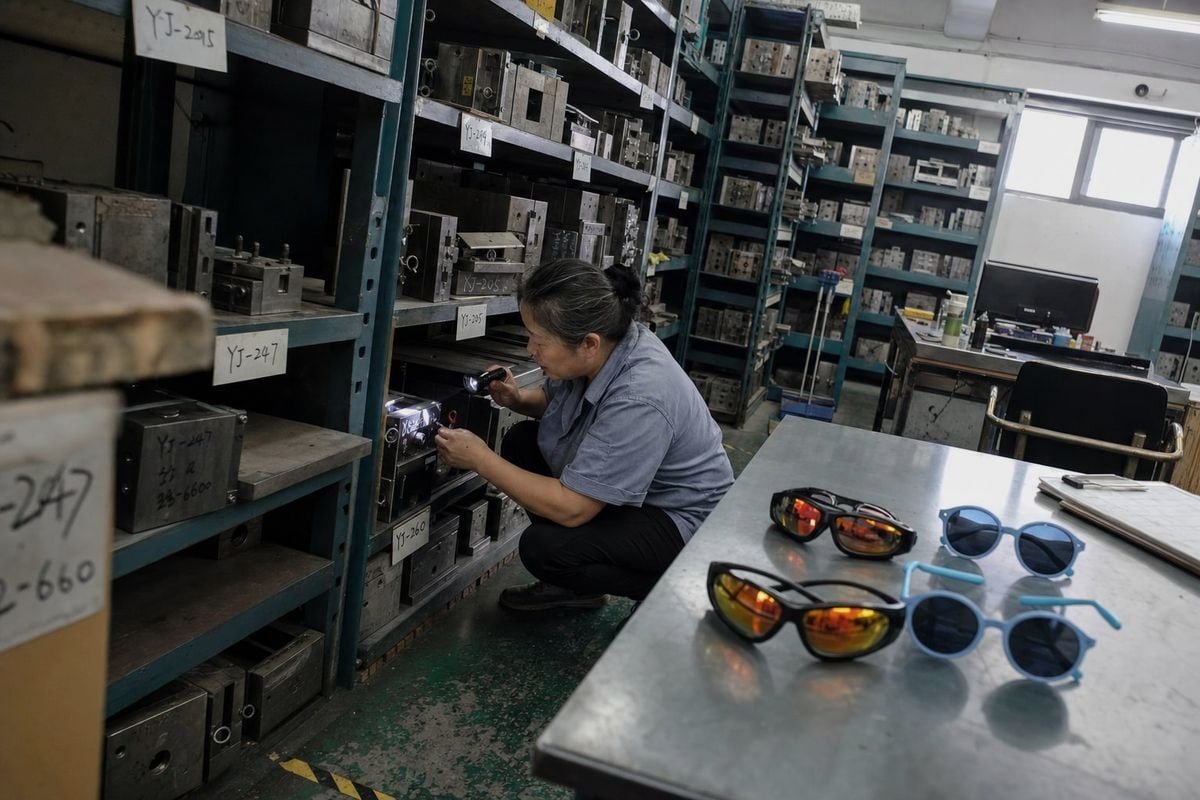
Let me be honest about a common objection first. Many buyers believe trading companies always offer lower MOQs, and marketplace listings 4 seem to prove it — you can find children's sunglasses at 10–15 piece minimums, often priced from US$0.45 to US$1.75. But those low MOQs usually reflect ready stock or consolidated inventory, not custom production. A low MOQ does not automatically mean you are close to the source, and it definitely does not mean the product passed proper safety testing for children.
How a kids sunglasses price is actually built
Wholesale unit cost 5 is not a mystery. It stacks up from real inputs:
| Cost driver | What it means for kids sunglasses |
|---|---|
| Frame material | TPEE and TR90 cost more than basic PC, but bend without snapping on a child's face |
| Lens type | UV400 is baseline; polarized lenses add cost |
| Mold complexity | New custom molds add tooling fees; existing molds add nothing |
| Finishing | Matte rubberized coatings, two-tone frames, mirror gradients |
| التعبئة والتغليف | Retail-ready boxes, cases, private label branding inserts |
| حجم الطلب | Stepped pricing — larger quantities unlock lower per-unit tiers |
When a trading company sits between you and the plant, every one of those lines carries a coordination fee. On a mid-range frame — broadly the US$3.50–US$6.00 band in China — that markup compounds fast across a 5,000-piece order.
Why the MOQ story favors factories more than people expect
Here is where our model matters. Because we already hold roughly 800 open styles — from playful two-tone round frames in periwinkle and mint to sport wraparound shields with mirrored gradient lenses — a new brand can launch without paying for a single mold. That lets us keep MOQs reasonable on stock designs while still offering full OEM/ODM manufacturing services when a buyer wants custom colors, logos, lenses, or packaging. Typical supplier spreads in our region range from 300 pieces up to 2,000 pieces depending on customization depth. Custom Pantone colors and printed temples push MOQ up; stock molds pull it down. That is MOQ psychology in one sentence: every unique element you add must justify a machine setup.
How fast should I expect responses and samples when sourcing kids sunglasses from a factory?
Early in my export career, I lost an order because my quote took four days while a trader replied in four hours. That lesson reshaped how our sales team works — and it taught me that speed has two very different meanings in sourcing.
Expect a professional kids sunglasses factory to reply to inquiries within 24–48 hours, deliver stock samples in 3–7 days, custom samples in 7–20 days, and complete bulk production in 25–45 days. Trading companies often quote faster, but factories control the actual production timeline.
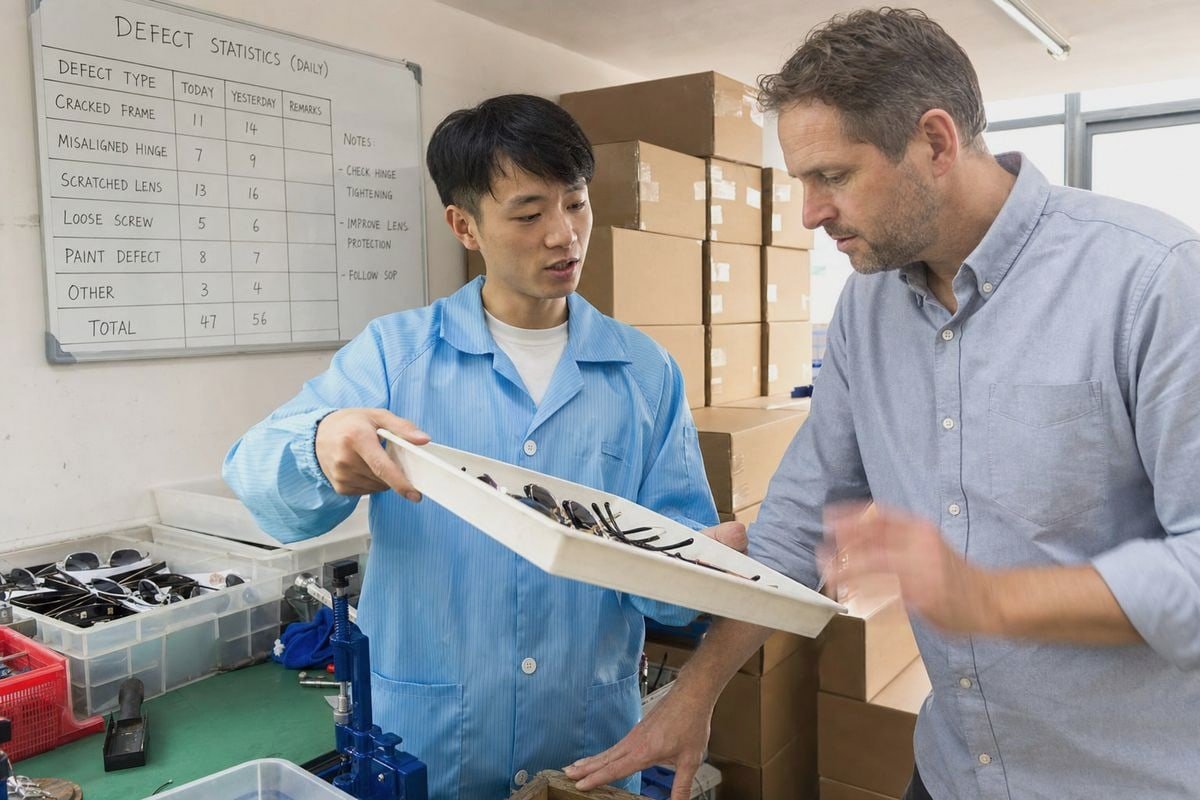
Response speed and production speed are not the same metric, and confusing them costs buyers real money. A trading company's core business is communication, so their first reply is often quick and polished. But once your order is confirmed, they must relay every question, change, and problem through the actual plant. Each relay adds a day. A factory may take slightly longer to answer a first inquiry — our engineers sometimes need to check a mold or a material spec — but after confirmation, you are locked directly into line capacity with no middle layer slowing decisions.
Realistic timeline benchmarks
| المرحلة | Factory (direct) | Trading company |
|---|---|---|
| First quote | 24–48 hours | Often same day |
| Stock sample | 3–7 days | 5–10 days (sourced from plant) |
| Custom sample | 7–20 days | 10–25 days (relayed) |
| Bulk order lead times | 25–45 days | Depends on the plant they book |
| Mid-production changes | Same-day decision | 2–4 days of relay |
Judge speed by the right stage
My advice is simple: judge a supplier's speed at the stage that matters for your business. If you need ten quotes for comparison shopping this week, a trader's fast inbox helps. If you need 10,000 pieces delivered before the summer season with zero surprises, direct communication with the production planner matters far more. In our 5S-managed workshop, sample requests go straight from the sales desk to the sample room — no external phone calls, no waiting for a third party's factory contact to wake up. Also worth noting: some modern plants now use rapid prototyping 6 to compress custom sampling dramatically, which keeps narrowing the traditional speed gap that traders once owned. When you evaluate suppliers, ask for their sample calendar in writing and hold them to it. A supplier who commits to dates before payment usually respects dates after payment.
A European buyer once came to us after a trader quietly switched the plant behind her order between shipments. The second batch used a stiffer, cheaper frame material. Her retailer noticed. Her customers noticed. Her review scores paid the price.
The biggest hidden risks are undisclosed factory switching, unverifiable safety test reports, markup buried in vague quotes, no direct traceability for CPSIA compliance standards, and slower defect resolution. In children's products, broken traceability is not an inconvenience — it is a recall risk.

To be fair, trading companies do offer real value in specific cases. Some act as a compliance buffer, pre-vetting test reports for multiple markets — CE, UKCA, FDA registration 7 for eyewear — and shielding small brands from paperwork. Some hold exclusive-rights molds or pre-book production capacity for peak season. If you need mixed styles in PC, TR90, and TPEE from several lines in one consolidated shipment, a good trader genuinely simplifies your life. The risks appear when the layer between you and the plant becomes a curtain instead of a bridge.
The five risks that hurt kids' brands most
- Silent factory switching. Traders chase margin. If their plant raises prices, your next batch may come from a different line with different tolerances — and you may never be told. For children's eyewear, where frame flexibility and hinge safety matter, consistency is everything.
- Second-hand test reports. A trader may show you a valid report — for a different mold, batch, or plant. Always confirm the report's applicant name and product photos match your actual goods. CPSIA compliance standards 8 for the US and EN standards for Europe are batch-sensitive.
- Opaque quality control inspection. When defects appear, a trader negotiates with the plant on your behalf, and their priority is preserving their supplier relationship, not your refund. A direct factory owns the defect and the fix.
- Buried markup on changes. The initial quote may look competitive. Then every revision — new packaging, an extra color, a logo change — arrives with padded fees, because each change passes through two margins.
- No line of sight during production. With direct factory sourcing, you can request in-process photos, mid-production inspections, and pre-shipment checks from the people actually making the goods. Through a trader, you see what they choose to show you.
My practical rule for buyers of children's products: whichever partner type you choose, insist on knowing the actual production address in writing, and reserve the contractual right to third-party inspection at that address. A partner who accepts that clause — as we do — has aligned incentives. A partner who resists is telling you something important.
الخلاصة
Factories win on price, customization, and traceability; traders win on quote speed and mixed orders. For kids sunglasses, where safety and consistency rule, verify your source — then choose the partner that fits your MOQ, budget, and timeline. Our door in Taizhou is open for that conversation.
ملاحظات ختامية
1. Comprehensive Wikipedia definition of mass customization in manufacturing. ↩︎
2. Authoritative description of the primary manufacturing equipment used to produce plastic sunglass frames. ↩︎
3. Comprehensive overview of corrective and protective products worn on or over the eyes. ↩︎
4. Explanation of digital platforms where multiple third-party vendors list and sell products. ↩︎
5. Reliable Wikipedia entry defining unit cost in production and accounting. ↩︎
6. Stable, authoritative Wikipedia entry for technical manufacturing definitions. ↩︎
7. Official FDA requirements for domestic and foreign establishments to register their medical device facilities. ↩︎
8. Official US government resource for safety regulations regarding lead and phthalates in children’s products. ↩︎
مقالات أخرى قد تعجبك
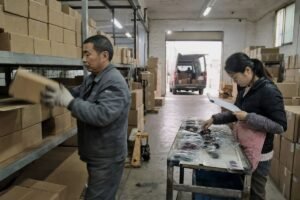
August 1, 2026
هل يجب على المصنع التعامل مع تغليف ووضع ملصقات نظارات الأطفال الشمسية، أم استخدام مورد مخصص؟
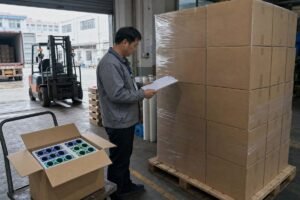
August 1, 2026
مستودع خاص مقابل الوفاء المباشر من المورد: أيهما يقلل تكاليف الإرجاع لعلامات نظارات الأطفال الشمسية؟
August 1, 2026
مباشر إلى ميناء المستودع أو التخزين الخارجي: أيهما يوفر أكثر على شحن نظارات الأطفال الشمسية؟
هل تبحث عن شريك موثوق به للنظارات للأطفال؟
استكشف أكثر من 800 نمط جاهز ودعم OEM/ODM كامل مصمم خصيصًا لعلامتك التجارية.
اتصل بنا English
  Español de México
  Deutsch
  Français
  日本語
日本語  العربية
  Português do Brasil