How to Tell If a Supplier’s Stock Molds Meet Your Kids’ Sunglasses Needs?
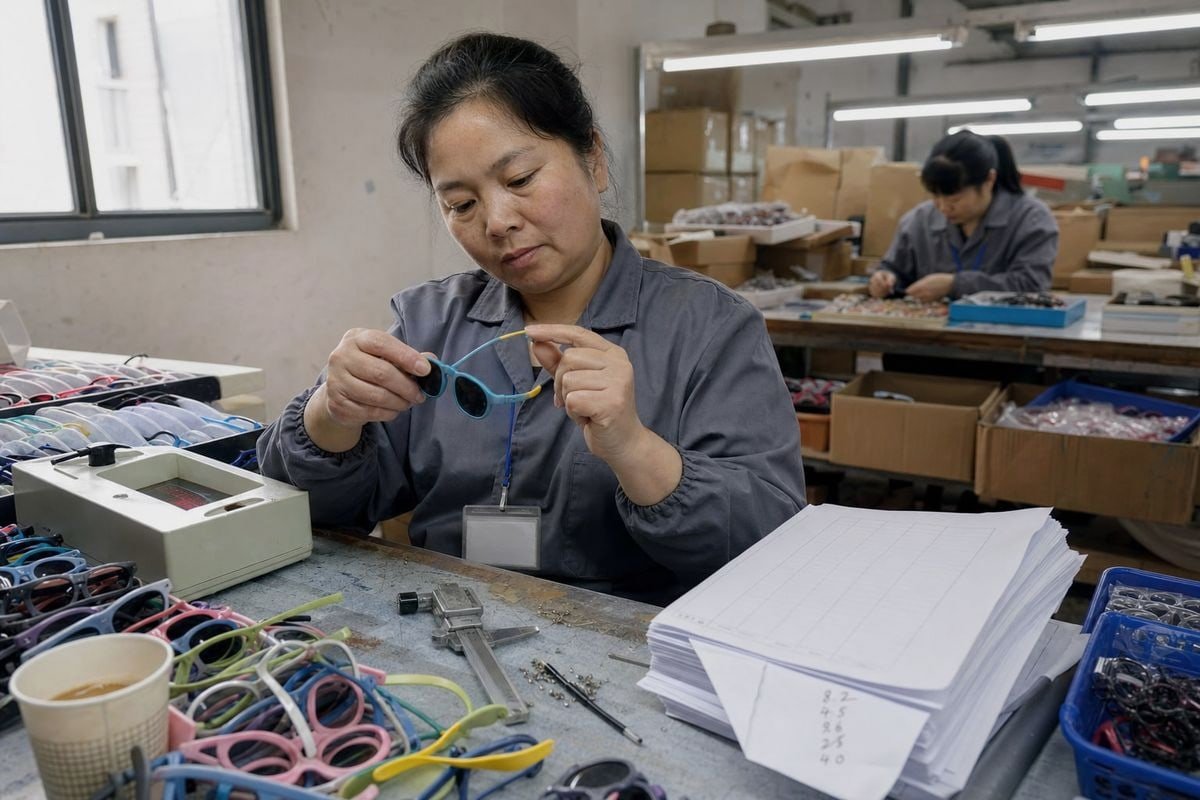
Choosing a supplier’s stock molds for kids’ sunglasses sounds easy — until a shipment arrives with rigid frames, popped lenses, and returns piling up. I’ve seen it happen from our factory floor in Taizhou.
A supplier’s stock molds meet your kids’ sunglasses needs if they produce child-specific frame dimensions, use flexible BPA-free materials like TPEE or TR90, deliver verified UV400 protection, avoid loose small parts, and come backed by test reports, samples, and consistent factory quality control.
That answer covers a lot of ground. Let me break it down piece by piece, using what we’ve learned making children’s eyewear for fifteen years.
How can I check if a supplier's ~800 existing styles actually fit my brand's needs?
A buyer from Australia once told me she felt paralyzed scrolling through our catalog of roughly 800 existing styles. Big libraries help — but only if you filter them properly.
Filter a large stock catalog by your target age group's frame dimensions, your required materials, your compliance market, and your brand aesthetic. Then request physical samples of your top three to five styles and test fit, flexibility, and finish before committing to any order.
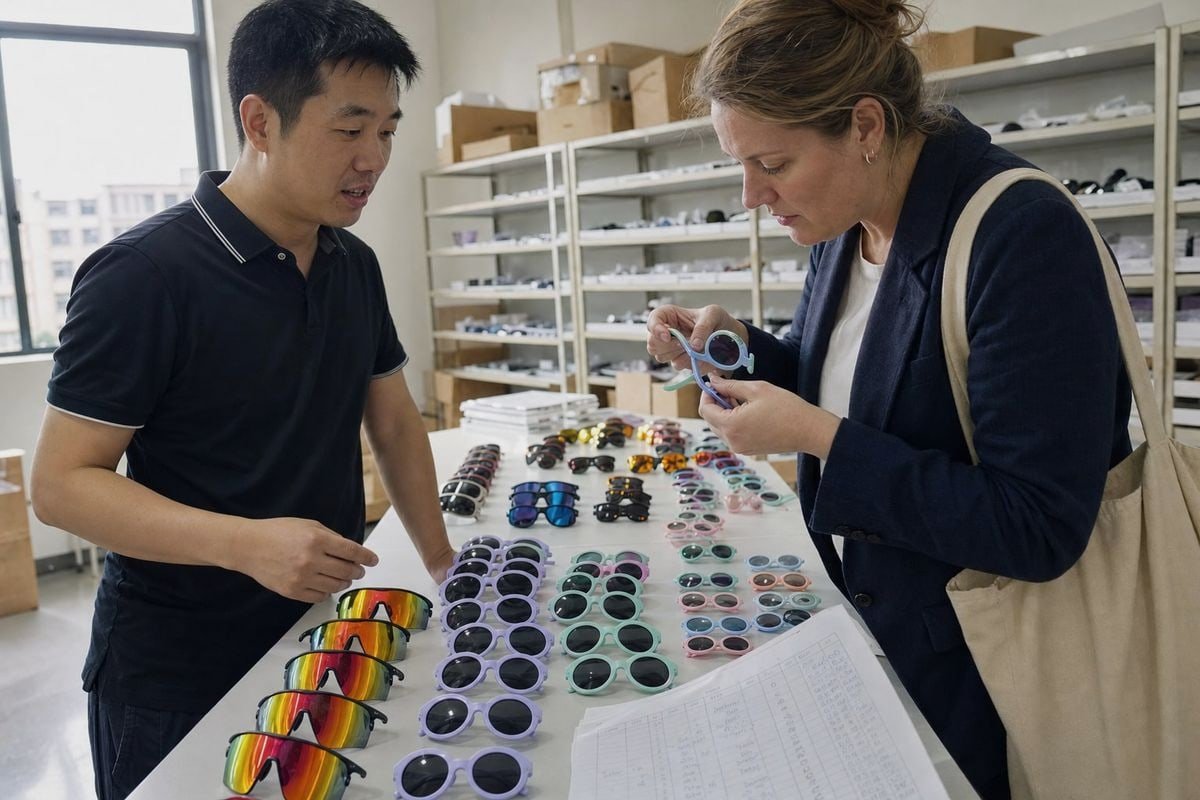
A large stock mold library is the main reason new brands can launch without heavy tooling costs. But a catalog is not a strategy. You need a filtering process. At our factory, we walk buyers through it in a set order, because the order matters. If you filter by looks first, you waste time falling in love with styles that will never fit a four-year-old's face.
Step-by-step filtering process
- Define your age range first. A style built for ages 7–10 will not fit a toddler, no matter how cute it looks.
- Filter by frame material. For active kids, we steer buyers toward إطارات مرنة من TPEE 1 or TR90 fronts with TPEE temples. Rigid acetate-style stock molds get filtered out early.
- Filter by compliance market. If you sell in Europe, you need شهادة CE 2 support. In the US, CPSIA compliance matters for children's products. Ask which stock styles already have test history for your market.
- Filter by aesthetic and lens type. Sport wraparound shields with mirrored gradient lenses suit outdoor and adventure brands. Round pastel two-tone frames suit lifestyle and baby brands.
- Sample the shortlist. Never approve from photos. Bend the temples, press the bridge, check edge smoothness.
Match style categories to your brand
| Your brand type | Best-fit stock style category | Key checks |
|---|---|---|
| Outdoor / sports kids brand | Wraparound single-shield, mirrored lens | Side coverage, lens retention, grippy temple tips |
| Lifestyle / fashion kids brand | Round or square pastel frames | Soft-touch finish, hinge security, color options |
| Baby / toddler brand | Extra-small flexible frames | Bendability, no small detachable parts, chew-safe material |
| Promotional / gift buyers | Simple classic shapes | Logo space, packaging options, low minimum order quantity |
One more tip from experience: ask the supplier which of their stock styles reorder most often. High-reorder molds usually mean the fit and durability already survived real retail testing.
What should I look for in stock mold quality before committing to an order?
During a QC review last year, our engineers rejected an aging mold because its parting lines had started leaving faint burrs on the temple edges. That tiny flaw taught our team a lasting lesson: judge the mold, not just the sample.
Check the mold's condition, not only the finished product. Look for smooth parting lines with no flash, consistent wall thickness, a deep secure lens groove, durable hinge design, and evidence the mold hasn't exceeded its useful shot count causing dimensional drift.
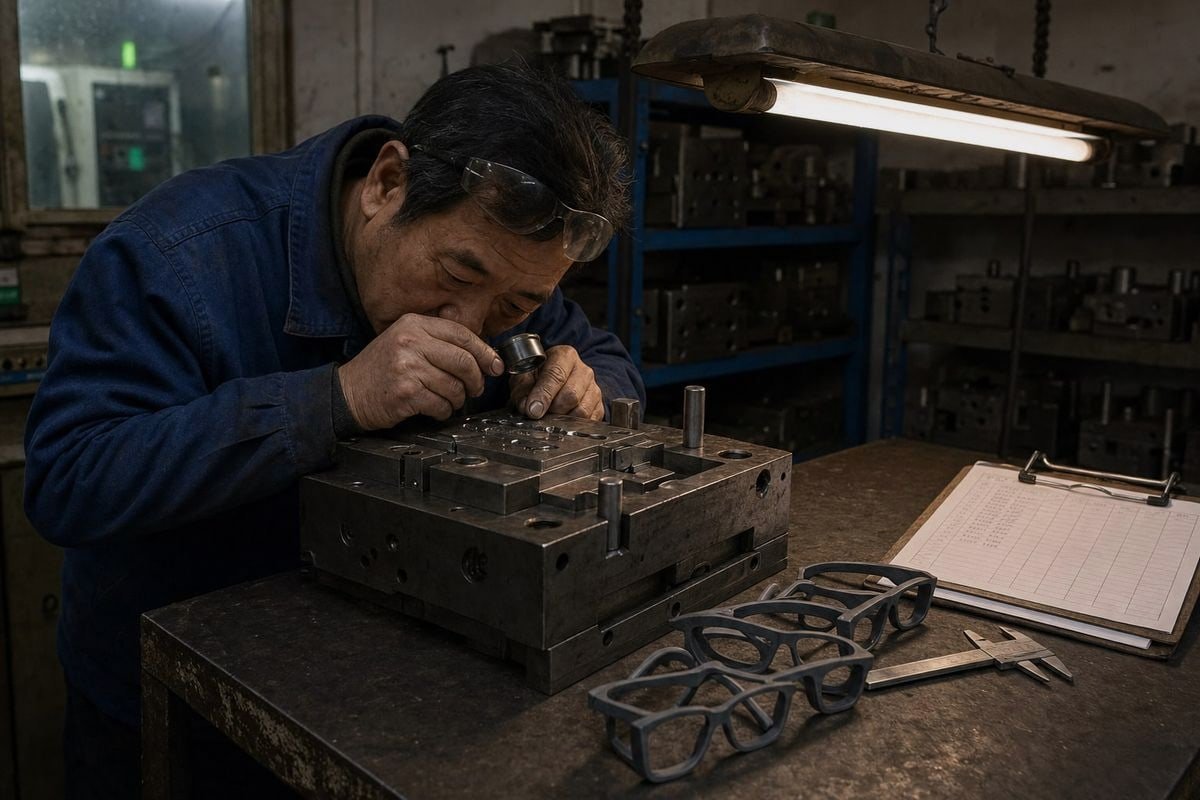
A beautiful sample can come from a tired mold. That's the trap. Suppliers usually send you a "golden sample" pulled from the mold's best days. Your job is to figure out whether production units six months from now will match it. In our 5S-managed workshop, we track each mold's condition precisely because dimensional drift is real: a high-volume mold that has run too many cycles can produce frames with loose lens grooves, rattling lenses, and inconsistent fit.
Physical checks on the sample
Run your fingers along every edge. Any roughness at the parting line means flash — microscopic burrs that irritate a child's sensitive skin and drive returns. Check that the lens sits deep and tight in its groove. Shallow grooves in worn stock molds can let عدسات مقاومة للصدمات 3 pop out when a child drops or squeezes the frame. Flex the temples repeatedly. A good kids' mold paired with the right material should tolerate hundreds of bends without whitening or cracking.
Questions to ask the factory
| سؤال | لماذا هو مهم |
|---|---|
| What is the mold's shot count and remaining life? | High counts risk dimensional drift and lens rattle in later batches |
| What materials does this mold run best with? | Some molds handle TPEE and TR90 well; others were built for brittle plastics |
| Can the gates handle recycled or bio-based resins? | Higher-viscosity sustainable materials can cause internal stress fractures in unsuitable molds |
| Does the mold support in-mold texturing? | Matte or anti-slip surfaces molded directly avoid peeling rubberized coatings |
| How do you inspect edge smoothness in production? | Reveals whether QC catches flash before packing, not after complaints |
Also ask whether the factory is the actual mold owner. A real manufacturer can answer shot-count and maintenance questions immediately. A trading company usually cannot, and that hesitation tells you a lot.
Can I customize colors, logos, and lenses on an existing stock mold design?
Here's a trade-off we discuss with buyers almost weekly: how much brand identity can you build on a shared mold before a new mold becomes worth the tooling costs? The answer is usually "more than you think."
Yes. On an existing stock mold you can customize frame and temple colors, add printed or laser-engraved logos, choose UV400, polarized, mirrored, or gradient lenses, and design private label packaging — all without paying tooling costs or waiting for new mold development.
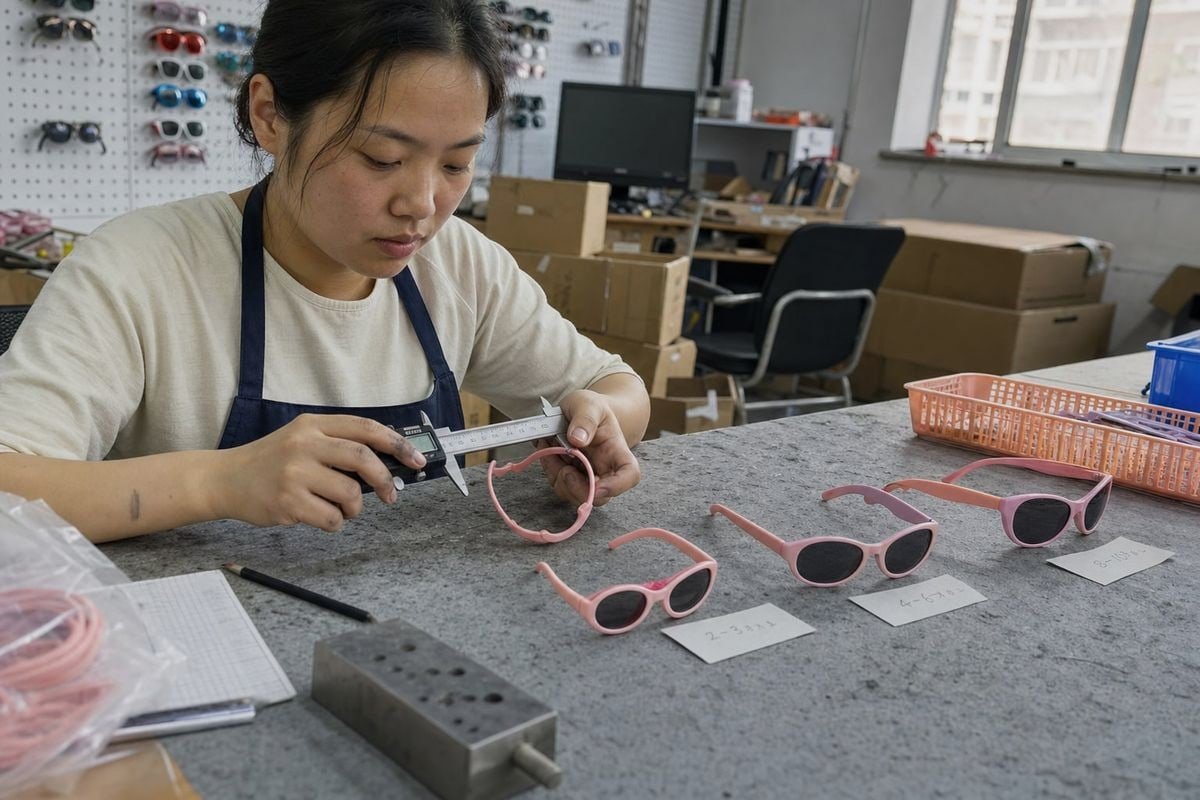
The mold defines shape and dimensions. Almost everything else is flexible. When our team runs a التصنيع بالعلامة الخاصة 4 project on a stock mold, the buyer's finished product often looks nothing like the catalog photo. Take a two-tone round frame: swap the periwinkle front and mint temples for your brand's palette, engrave your logo on the temple, upgrade to polarized lenses, and pack it in your retail box. Same mold, completely different product.
What you can change on a stock mold
- Colors: solid, two-tone, matte, glossy, soft-touch, translucent, and rubberized finishes.
- Logos: pad printing, silk-screen printing, or laser engraving on temples or lenses.
- Lenses: UV400 protection as standard, plus polarized, mirrored gradient (like an orange-to-teal shield lens), or category-specific tints.
- Hardware and tips: rubberized temple tips for grip, alternative hinge finishes.
- Packaging and accessories: boxes, pouches, cases, straps, hang tags, and inserts for retail-ready presentation.
What you cannot change without new tooling
- Frame dimensions — lens width, bridge width, temple length are fixed by the mold.
- The overall silhouette and lens groove geometry.
- Structural features like integrated spring-hinge cavities, if the mold lacks them.
Stock mold customization vs. new mold
| العامل | Customized stock mold | New exclusive mold |
|---|---|---|
| Tooling costs | لا شيء | Significant upfront investment |
| Lead time to first order | Weeks | Months |
| الحد الأدنى لكمية الطلب | Lower, often negotiable | أعلى، لتبرير الأدوات |
| تمييز العلامة التجارية | Colors, logos, lenses, packaging | Full shape exclusivity |
| الدفع الآمن عبر المنصة | Market testing, first collections | Established brands scaling a proven style |
Our advice to most first-time buyers: launch on customized stock molds, learn what sells, then invest in an exclusive mold for your hero style once the data supports it.
How do I know if a stock mold is truly safe and comfortable for children's faces?
Early in our export history, a European buyer returned a competitor's samples to us with one comment: "These are just shrunken adult glasses." She was right, and that lesson shaped how we design every kids' mold since.
A stock mold is child-safe when it matches pediatric face proportions — flatter nose bridges and correct temple length — uses flexible BPA-free materials like TPEE or TR90, secures all small parts, blocks UVA and UVB with documented UV400 testing, and avoids sharp edges or pinch points.
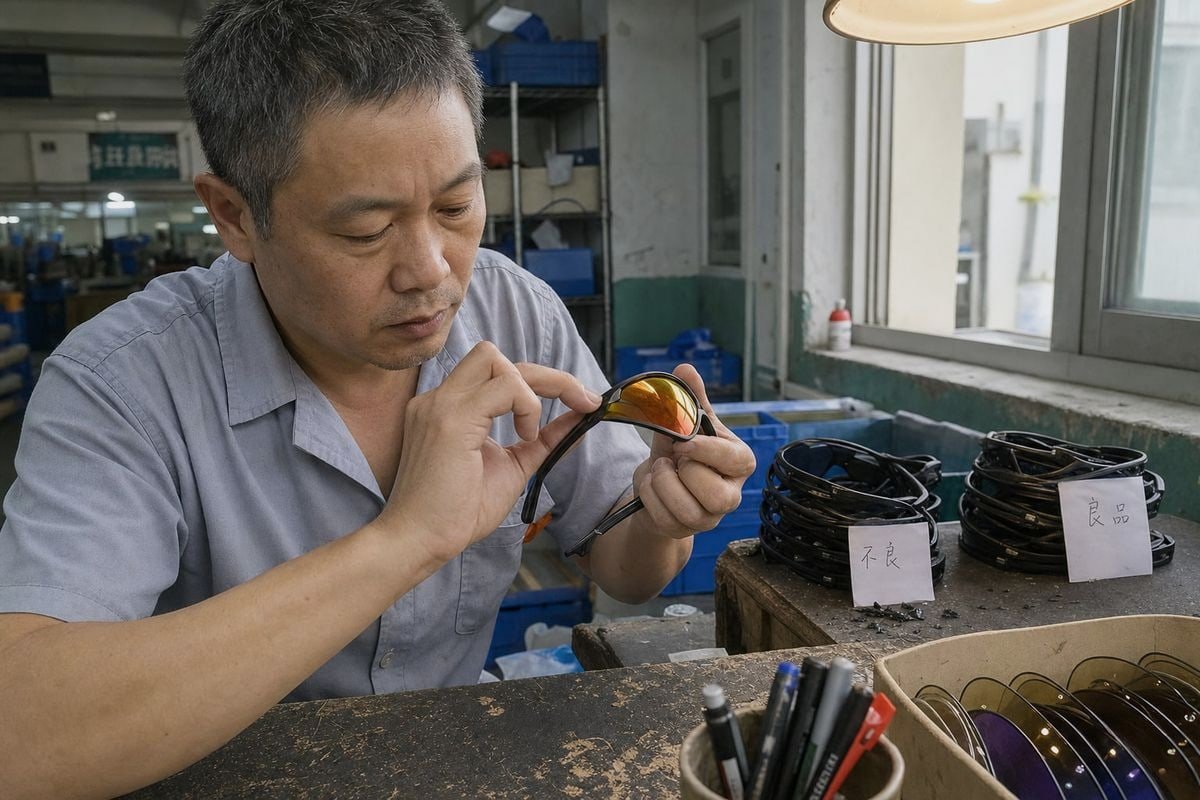
Children are not small adults. Their nose bridges are flatter, their ears sit lower, and their faces grow fast. A stock mold scaled down 70% from an adult design will slide down a child's nose and press on the temples. Real kids' molds account for pediatric craniofacial anatomy 5 from the start. So the first safety check is fit: ask for full frame dimensions and compare them against your target age band.
Age-to-size reference
As a rough guide, lens sizes of 40–42mm suit ages 2.5–4, 43–45mm suit ages 4–7, 45–47mm suit ages 7–10, and 47–52mm suit ages 10–16. On a real face, the eyes should sit centered in the lenses, and the frame should never touch the cheeks or eyelashes. Also benchmark against your regional market — anthropometric averages differ, and a "universal" size can create a fit dead zone for your specific demographic.
Material and small-parts safety
Flexibility is the core safety feature. TPEE and TR90 bend under stress instead of snapping into sharp splinters, which matters when a child sits on their sunglasses or twists them during play. Confirm the material is BPA-free and coatings are lead-free, with third-party chemical reports — ideally batch-specific, since toddlers chew frames. Then audit small parts: hinge screws, decorative add-ons, and nose pads can become choking hazards 6 if they loosen. Screwless or integrated hinge designs reduce this risk. For الامتثال لـ CPSIA 7 in the US and CE certification in Europe, documentation should exist before you order, not after.
التحقق من العدسة
Dark tint is not protection. A nearly black lens with no UV filter is actually worse, because it dilates the pupil while letting UV in. Demand UV400 test reports for the actual lens batch, ask how the factory tests, and verify claims independently through third-party inspection when possible.
الخلاصة
Judge stock molds by fit, materials, verified UV protection, small-parts safety, and documented factory QC — not catalog photos or price. Do that, and stock molds become your fastest, safest launch path.
ملاحظات ختامية
1. Describes the properties of TPEE, a flexible material used in high-quality children’s sunglass frames. ↩︎
2. Official European Commission page explaining the safety and health requirements for products sold in the EU. ↩︎
3. FDA guidelines on the safety and testing requirements for impact-resistant lenses in eyewear. ↩︎
4. Explains the process of manufacturing products to be sold under a retailer’s own brand name. ↩︎
5. Authoritative Wikipedia page detailing the growth and development of craniofacial structures in children. ↩︎
6. Official safety guidelines regarding small parts that pose risks to young children. ↩︎
7. Official US government site detailing safety requirements for children’s products. ↩︎
مقالات أخرى قد تعجبك

هل تبحث عن شريك موثوق به للنظارات للأطفال؟
استكشف أكثر من 800 نمط جاهز ودعم OEM/ODM كامل مصمم خصيصًا لعلامتك التجارية.
اتصل بنا English
  Español de México
  Deutsch
  Français
  日本語
日本語  العربية
  Português do Brasil