Does Kids Sunglasses Support OEM Brand Customization?
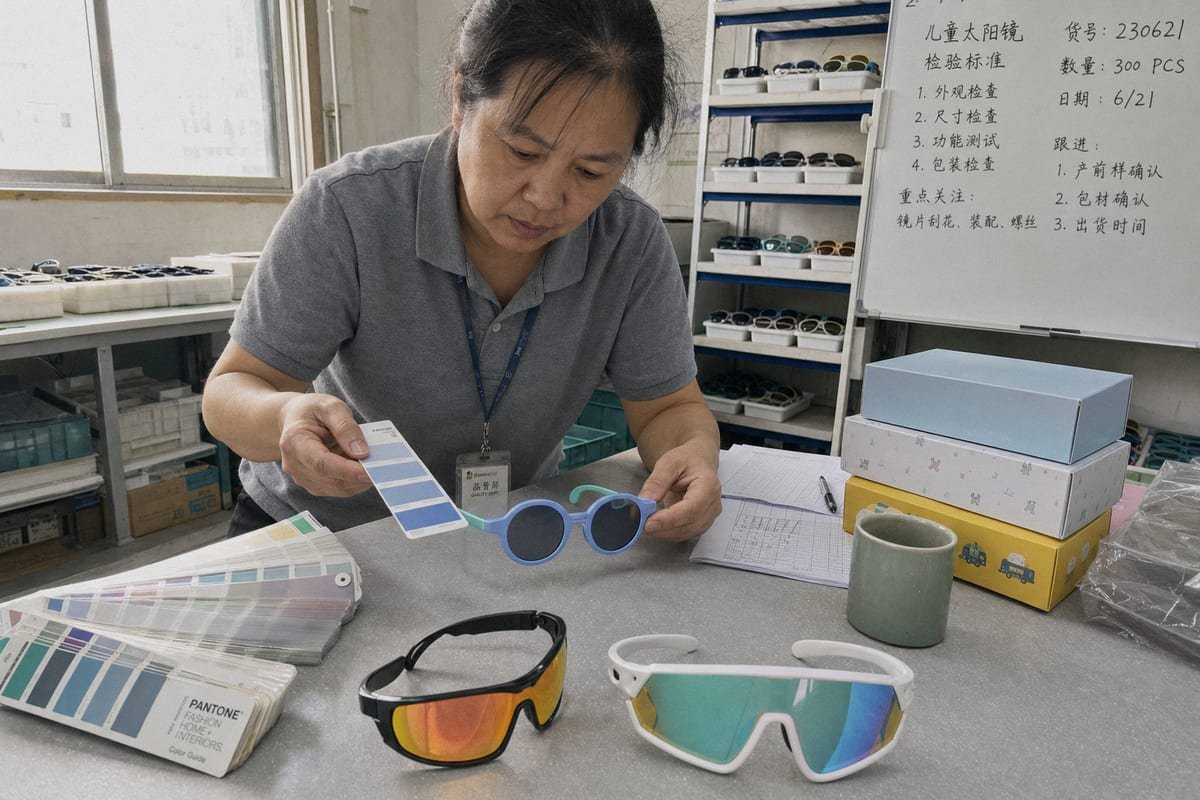
Buyers ask me about kids sunglasses OEM brand customization almost weekly. Many worry their brand will drown in a sea of identical products. That fear is valid — and solvable on our production line.
Yes, kids sunglasses fully support OEM brand customization. Brands can customize logos, frame colors, lens types, temple details, and packaging on existing molds, or develop fully private-label designs. Options range from low-MOQ logo branding to complete custom mold development with safety-certified materials.
The real question is not whether OEM works. It is how deep the customization goes, what it costs, and how to keep children safe while building your brand. Let me walk you through each part.
What OEM Customization Options Can I Choose for Kids Sunglasses?
Last month, a buyer from Australia sent us a pastel mood board and asked how much of it we could actually produce. The honest answer surprised her: nearly all of it.
OEM customization for kids sunglasses typically covers custom logo printing, laser engraving, Pantone-matched frame colors, temple detailing, lens upgrades such as UV400 protection or polarized lenses, and customized packaging. Buyers choose between branding existing molds or developing entirely new private label eyewear designs.
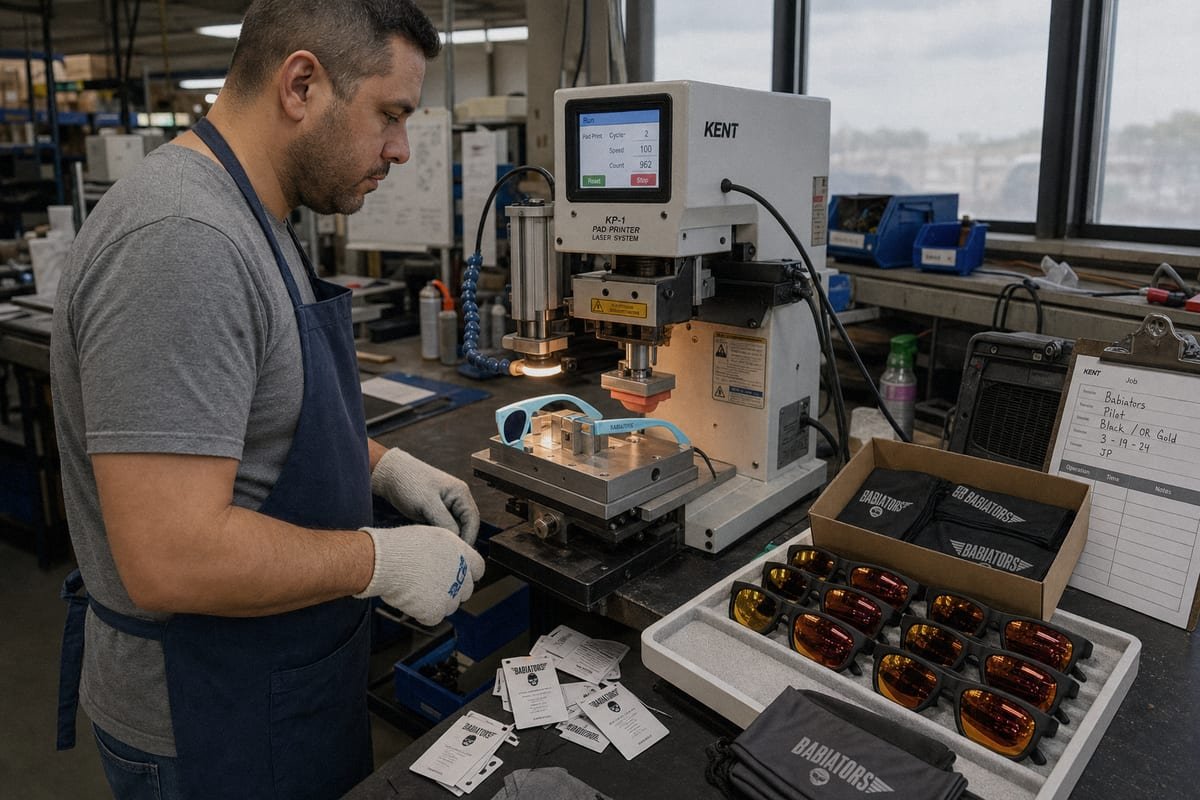
The range of options is wider than most first-time buyers expect. In our Taizhou workshop, we group customization into four layers. Each layer adds cost and lead time, so I always advise buyers to start with what their market actually needs.
Frame and Material Customization
Frames carry most of the brand identity. We work mainly with إطارات مرنة من TPEE 1 and TR90, because children twist, drop, and sit on their sunglasses. A soft periwinkle-blue frame with mint-teal temples, for example, works beautifully in matte TPEE. For sportier lines, a glossy wraparound shield frame 2 in black or white gives an athletic look. Pantone color matching is standard on custom orders, so your frame colors can match your existing product line exactly.
Lens Customization
Lenses matter even more for children than for adults. UV400 protection should be your baseline, not an upgrade. Beyond that, you can specify polarized lenses, mirrored gradient coatings (like an orange-to-gold sport lens), tint depth, and impact-resistant materials.
Branding and Packaging
| Customization Area | Common Options | حالة الاستخدام النموذجية |
|---|---|---|
| Logo application | Silk-screen printing, laser engraving, debossing, temple printing | All order levels |
| Frame color | Pantone matching, two-tone schemes, matte or glossy finish | Semi-custom and above |
| عدسة | UV400, polarized, mirrored, gradient tints | تمييز العلامة التجارية |
| التعبئة والتغليف | Branded pouches, custom boxes, hang tags, inserts | برامج جاهزة للبيع بالتجزئة |
| Mold | Fully new frame shapes, custom temple geometry | Premium private label |
Customized packaging often delivers the biggest retail impact per dollar. A branded microfiber pouch and a well-designed box can elevate a stock frame into a premium shelf product.
How Do I Start an OEM Kids Sunglasses Project With a Manufacturer?
The smoothest projects I have handled over fifteen years all began the same way: the buyer arrived with a clear brief, not just a budget. Preparation shapes everything downstream.
Starting an OEM kids sunglasses project involves six steps: share your concept and target age range, confirm the design or CAD file, receive a quotation, approve pre-production samples, proceed to bulk production, and complete final quality inspection before shipping. Sampling typically takes seven to ten days.
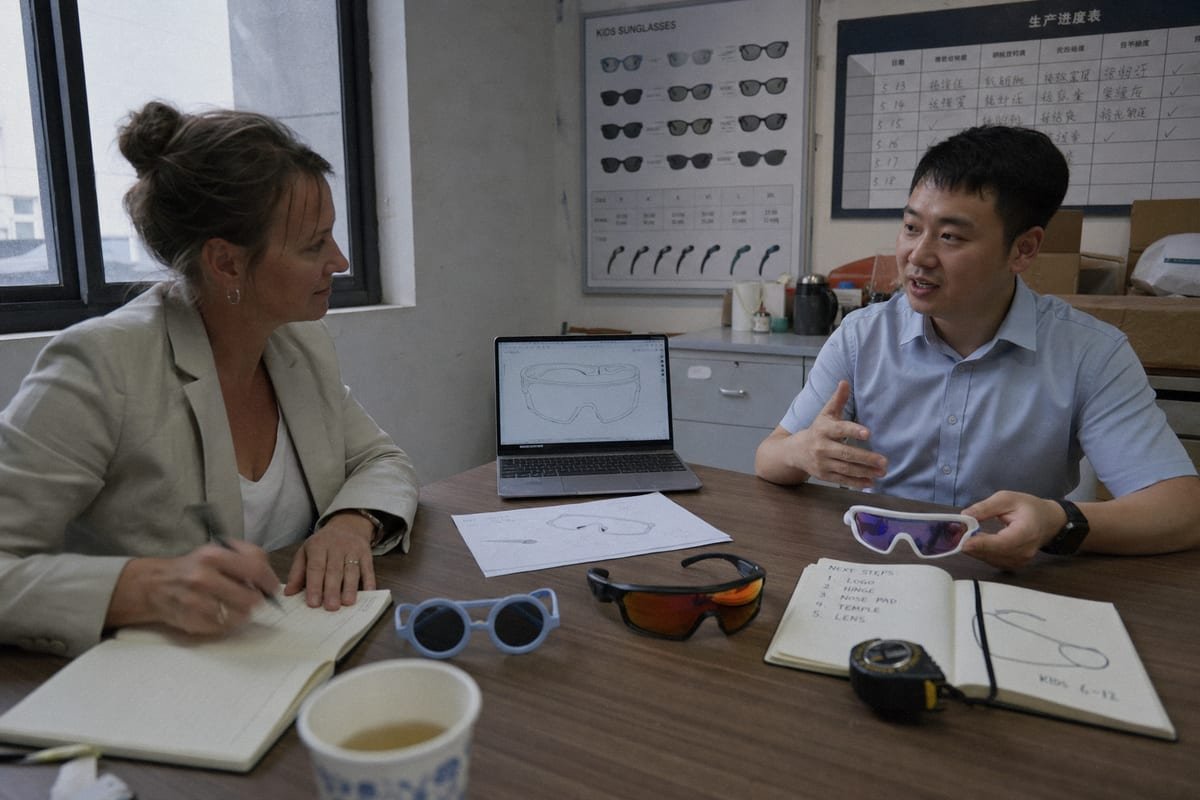
A structured process protects both sides. When we onboard a new brand at our factory, we follow a sequence that removes guesswork. Here is how it works in practice.
The Six-Step OEM Workflow
- Concept submission. You send your target age range, style direction, material preference, and logo files. Photos or sketches are enough at this stage.
- Design confirmation. We match your concept to existing styles or prepare CAD drawings for new designs. This is where ODM manufacturing can help — our design team proposes options if you only have a rough idea.
- Quotation. Pricing depends on materials, lens specs, decoration methods, packaging, and volume. Ask for the quote to itemize these clearly.
- Sampling. We produce physical samples, usually within seven to ten days for existing molds. Fully new designs take longer, sometimes several weeks.
- Bulk production. After sample approval, production begins. Typical lead times run 45 to 90 days depending on complexity.
- Inspection and shipping. Pre-shipment QC checks fit, finish, hinge strength, and lens performance against the approved sample.
What to Prepare Before Contacting a Supplier
Bring your target age range, preferred colors, vector logo files 3, packaging expectations, destination market, and an honest estimated order volume. When a buyer tells me their sunglasses will sell in the EU, for example, I immediately know which safety certification standards 4 apply. That single detail changes material choices, testing plans, and documentation. Vague briefs create slow projects; specific briefs create fast ones.
What Is the Minimum Order Quantity for OEM Kids Sunglasses?
MOQ is the trade-off I discuss most often with new brands. Lower quantities reduce risk, but they also limit how custom your product can be. There is no free lunch here.
Minimum Order Quantity for OEM kids sunglasses typically ranges from 300 to 1,200 pieces per style. Ready-stock items with logo branding may have no MOQ or very low minimums, while fully custom molds usually require 600 to 1,000 pieces to justify tooling costs.
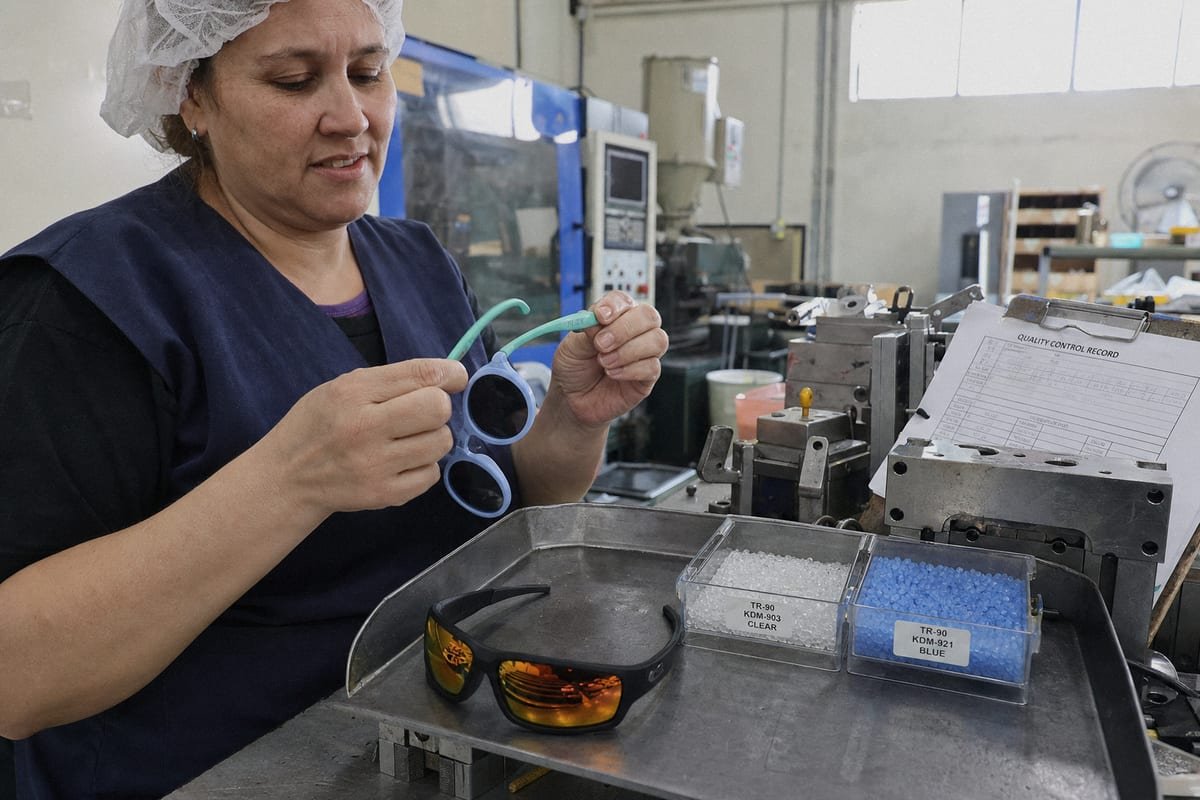
MOQ is not an arbitrary number. It reflects real production economics: mold amortization, color-change setup on injection machines, minimum lens coating runs, and packaging print minimums. Understanding these drivers helps you negotiate intelligently instead of just asking for a lower number.
MOQ by Customization Level
| Customization Level | الحد الأدنى لكمية الطلب النموذجي | Tooling Cost | الأفضل لـ |
|---|---|---|---|
| Ready stock, no branding | No MOQ / very low | لا شيء | Market testing |
| Ready stock with custom logo printing | 100–300 pieces | لا شيء | New brand launches |
| Semi-custom (Pantone colors, custom packaging) | 300–600 pieces | منخفض | العلامات التجارية المتنامية |
| Full OEM mold / private label | 600–1,200 pieces | كبير | العلامات التجارية الراسخة |
How to Lower Your Effective Risk
There are smart ways to work within MOQ limits. Many suppliers, ourselves included, allow you to split one MOQ across multiple colorways of the same style. That means a 600-piece order could cover three colors at 200 pieces each. Another strategy is to launch on existing molds first. Our library of roughly 800 existing styles exists precisely so importers and new children's brands can test the market without heavy mold investment. Once a style proves itself at retail, you reinvest the profit into a fully custom mold with confidence. I have watched brands try to skip this step, pour their budget into unproven tooling, and end up warehousing unsold inventory. The staged approach is slower but far safer.
How Can I Ensure Quality Control When Customizing Kids Sunglasses?
A hinge screw taught me one of my most expensive lessons. Years ago, a batch passed visual inspection but a supplier-sourced screw loosened after repeated flexing. We caught it in stress testing — barely. Kids' eyewear demands more vigilance than adult fashion frames.
Ensure quality control by verifying material safety documentation, requiring compliance with standards like CPSIA and CE, approving golden samples, conducting in-process inspections of hinges and lens alignment, and performing pre-shipment checks on UV400 protection, flexibility, fit, and packaging accuracy.
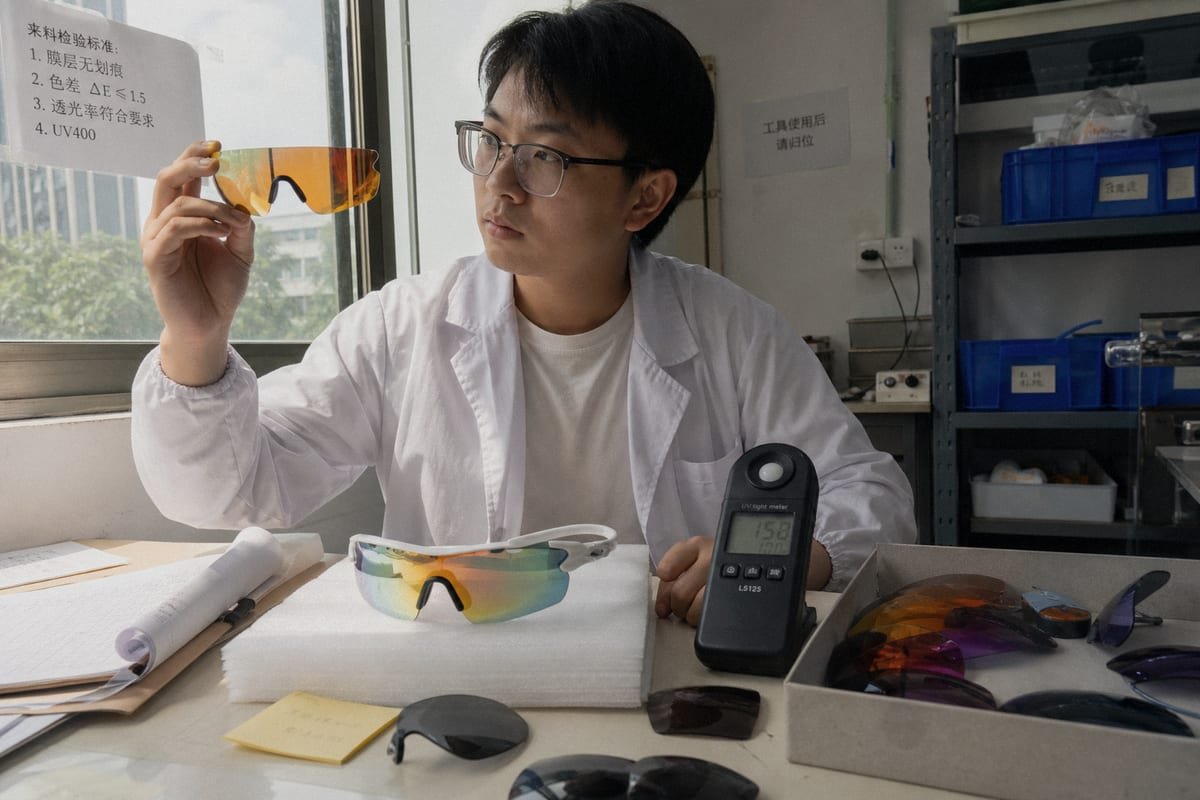
Quality control for children's products is different in kind, not just degree. A child will chew a temple tip, bend the frame backward, and drop the glasses on concrete — sometimes all in one afternoon. Your QC plan needs to assume this behavior, not hope against it.
The Three Stages of QC
In our 5S-managed workshop, we split quality control into three checkpoints. Skipping any one of them raises your defect risk sharply.
| مرحلة مراقبة الجودة | What Gets Checked | لماذا هو مهم للأطفال |
|---|---|---|
| المواد الواردة | TPEE/TR90 material certificates, lens blanks, pigments, screws | Confirms BPA-free, skin-safe materials before production starts |
| In-process | Hinge torque, lens seating, color consistency, logo placement | Catches defects early when correction is cheap |
| ما قبل الشحن | UV400 verification, flex testing, fit check, packaging accuracy | Final gate before your brand name ships to customers |
Documentation You Should Demand
Never accept safety claims at face value. Ask your wholesale sunglasses supplier for test reports matching your destination market: CPSIA for the US, علامة CE 5 for the EU, and equivalent standards elsewhere. UV400 protection should be backed by lens test data 6, not just a sticker. In our experience exporting to twenty-plus countries, serious buyers always request documentation, and serious factories always have it ready. If a supplier hesitates or offers only verbal assurances, treat that as a red flag.
The Golden Sample Rule
Approve a physical sample, sign it, and make it the contractual reference for mass production. Every pre-shipment inspection should compare finished goods against that golden sample — color, flexibility, lens tint, logo position, and packaging. This single practice resolves most quality disputes before they start.
الخلاصة
Kids sunglasses absolutely support OEM brand customization — from custom logo printing on existing molds to full private-label development. Plan your MOQ, verify safety documentation, and partner with a factory that treats children's eyewear seriously.
ملاحظات ختامية
1. Authoritative Wikipedia entry for thermoplastic elastomers (TPEE) used in flexible eyewear frames. ↩︎
2. Wikipedia entry describing various sunglass styles, including the wraparound shield design. ↩︎
3. Adobe’s guide explaining the importance of vector formats for high-quality branding and printing. ↩︎
4. Updated to the correct international safety standard for sunglasses (ISO 12312-1:2022). ↩︎
5. European Commission’s official guide to CE marking requirements for products sold in the EU. ↩︎
6. Intertek’s overview of professional laboratory testing services for eyewear lens performance and safety. ↩︎
مقالات أخرى قد تعجبك

هل تبحث عن شريك موثوق به للنظارات للأطفال؟
استكشف أكثر من 800 نمط جاهز ودعم OEM/ODM كامل مصمم خصيصًا لعلامتك التجارية.
اتصل بنا English
  Español de México
  Deutsch
  Français
  日本語
日本語  العربية
  Português do Brasil