How to Require CPSIA Tracking Labels on Kids’ Sunglasses from China Suppliers?
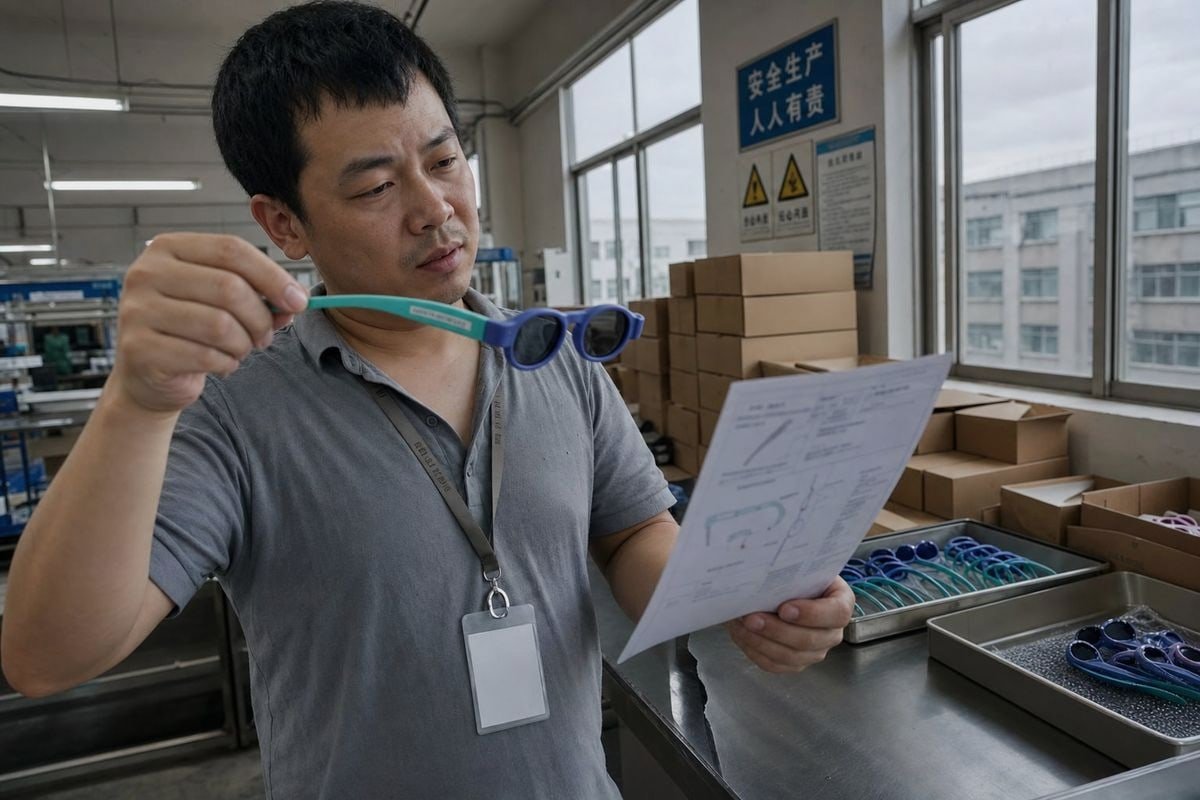
CPSIA tracking labels on kids’ sunglasses trip up more importers than almost anything else we see on our production line in Taizhou. Miss them, and US Customs or Amazon can freeze your entire shipment.
To require CPSIA tracking labels on kids’ sunglasses from China suppliers, define the label fields yourself, send the factory ready-to-print artwork with a placement map, approve the pad-printed or laser-marked label on a pre-production sample, and verify permanence and legibility at final inspection before shipment.
That is the short answer. The rest of this guide breaks each step down. I will show you what to write in your purchase order, what to check at sampling, and which documents belong alongside the label.
What Information Must I Include on a CPSIA Tracking Label for Kids' Sunglasses?
A brand buyer 1 from Australia once sent us a label file that listed only her logo and "Made in China." We had to stop the order, because that label would not have survived a CPSC inquiry. The gap taught both of us how specific these labels must be.
A CPSIA tracking label for kids' sunglasses must show the importer or private labeler name, the manufacturing date and location, and a batch identification number that traces the product to one specific production run. There is no mandated format, but every field must be permanent, visible, and legible.
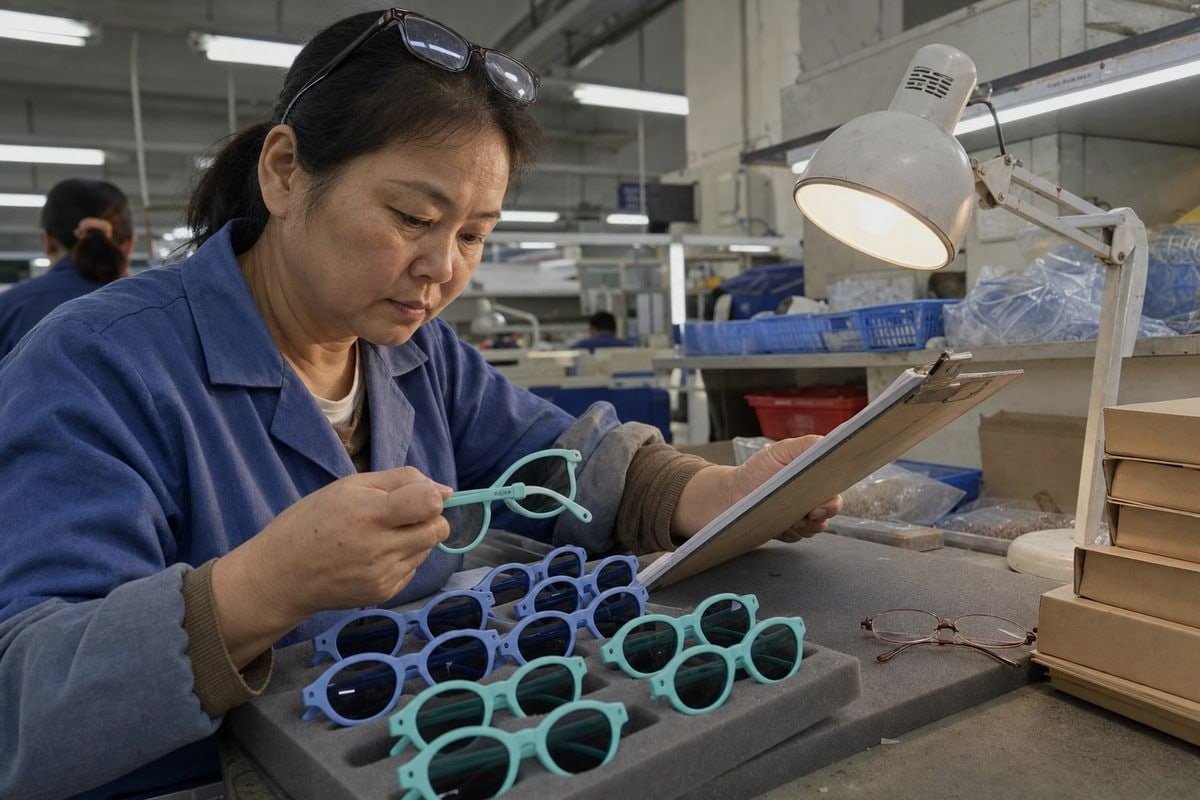
CPSIA Section 103 applies to children's products intended for kids 12 and under, and it has applied to products manufactured on or after August 14, 2009. Kids' sunglasses count as children's products when they are sized, styled, and marketed for children — like the rounded periwinkle-and-mint frames we mold in soft TPEE for toddlers. Sport shield styles for teens can sit in a gray zone, but if your listing says "kids," the requirement follows you.
The Four Core Fields
Here is how I ask buyers to structure their label data before we ever set up the pad-printing plate:
| Field | ماذا يعني | Practical Example for Sunglasses |
|---|---|---|
| Company name | The US مستورد مسجل 2 or private labeler — not our factory name | "SunnyKids LLC" |
| Manufacturing location | Country at minimum; city or province is better | "Taizhou, China" |
| Manufacturing date | Consistent format, at least month and year | "06/2025" |
| Batch identification number | A cohort code unique to one production run | "SK-TZ-2506-A" |
Why the Batch Code Matters Most
The batch identification number is the field buyers underestimate. If a recall ever happens, a specific batch code lets you pull only the affected units instead of your whole product line. Under 16 CFR 1107, any material change — a new frame pigment, a different lens coating, a new nose-pad supplier — should trigger a new batch code and updated third-party lab testing 3. So a batch code is not decoration. It is the thread connecting your label, your test reports, and your production records.
One more point of flexibility: CPSC guidance allows the information to be spread across more than one permanent mark. On a slim temple arm, we often split fields between the left and right temples, and that is acceptable as long as everything remains readable.
How Do I Confirm My China Supplier Can Print Permanent Tracking Labels Correctly?
There is a real trade-off we weigh on every kids' order: pad printing 4 is fast and cheap, but on flexible TPEE temples the ink can crack if the primer step is skipped. Laser marking costs more per unit but never peels. Your supplier should be able to explain this trade-off to you unprompted.
Confirm your supplier by sending ready-to-print vector artwork with a placement map, requiring a marked pre-production sample, and testing the label yourself with a rub test, tape test, and sunscreen-wipe test. A factory that cannot show you a permanent, legible sample should not get the order.
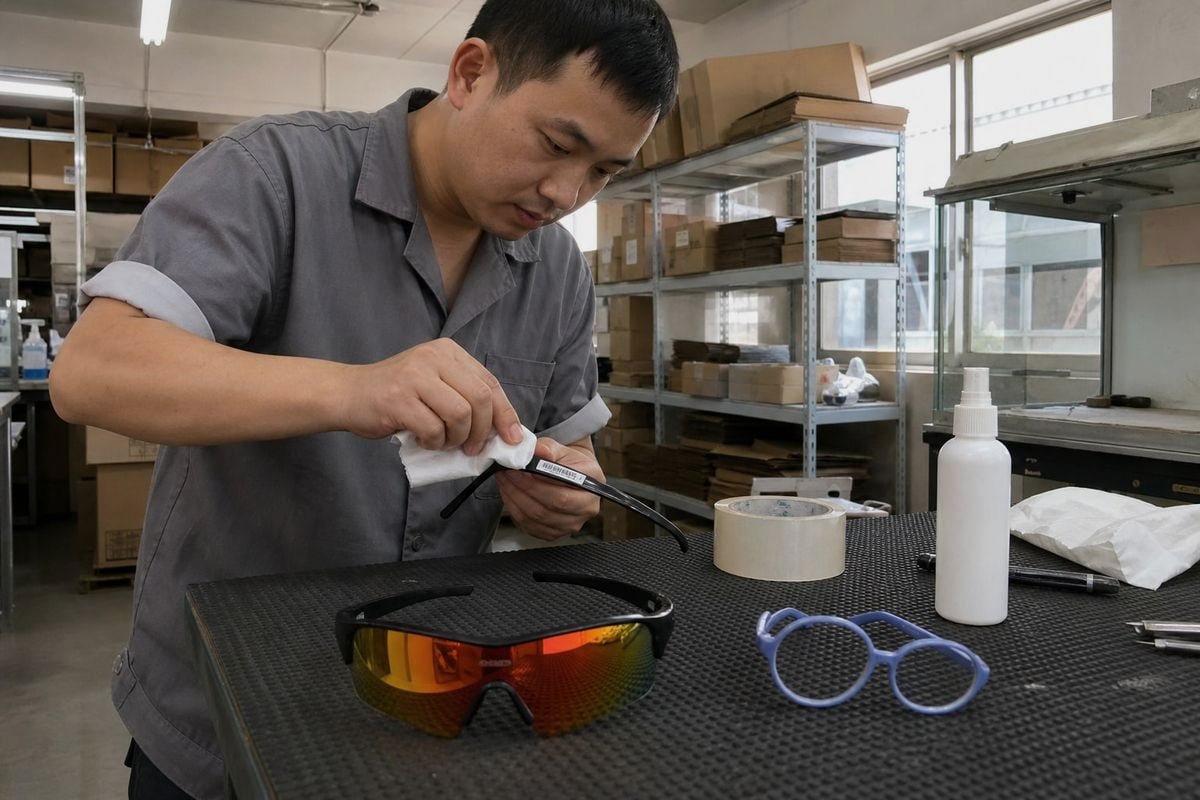
Permanent marking requirements are where most tracking-label failures actually happen. The information can be perfect, but if it wipes off after a summer of sunscreen and sweat, the label was never compliant. In our 5S-managed workshop, we treat label adhesion as a QC checkpoint, not an afterthought — and you should demand the same from any supplier.
A Step-by-Step Verification Workflow
- Send editable artwork, not a screenshot. Provide a vector file (.ai or .eps) with exact font sizes. Tiny fonts blur during pad printing, and blurred text fails legibility.
- Include a placement map. Mark exactly where each field goes — inner left temple, inner right temple, or packaging.
- Tie label approval to the pre-production sample. Do not approve color and fit while ignoring the marking. Sign off on the printed label itself.
- Ask how permanence is achieved. On TR90 frames we use pad printing with a curing pass; on soft TPEE we often recommend laser marking or a molded mark. A vague answer here is a red flag.
- Run your own abuse tests. Rub the mark 30 times with a damp cloth, press and peel adhesive tape, and wipe it with sunscreen. The mark must survive all three.
- Repeat the check at final inspection. Pull random units from sealed cartons and verify the batch code matches your purchase order and test reports.
What Separates a Capable Factory from a Risky One
A capable supplier keeps production records that link each batch identification number to raw-material lots 5 and dates. When we run an order, our team logs which resin batch and lens lot went into each run, so a buyer's code traces cleanly backward. A trading company reselling stock often cannot do this — and that gap is invisible until a recall or an Amazon audit exposes it.
Where Should the CPSIA Label Be Placed on the Frame, Lens, or Packaging?
Placement questions come up in nearly every development call we run with kids' brands. Sunglasses give you very little flat surface, and nobody wants compliance text printed across a mirrored gradient shield lens on the front of the product.
Place the CPSIA tracking label permanently on the inner temple arm of the frame — the industry-standard position — and repeat it on the retail packaging where practicable. Never print tracking data on the lens, and never rely on packaging alone when the frame can carry the mark.
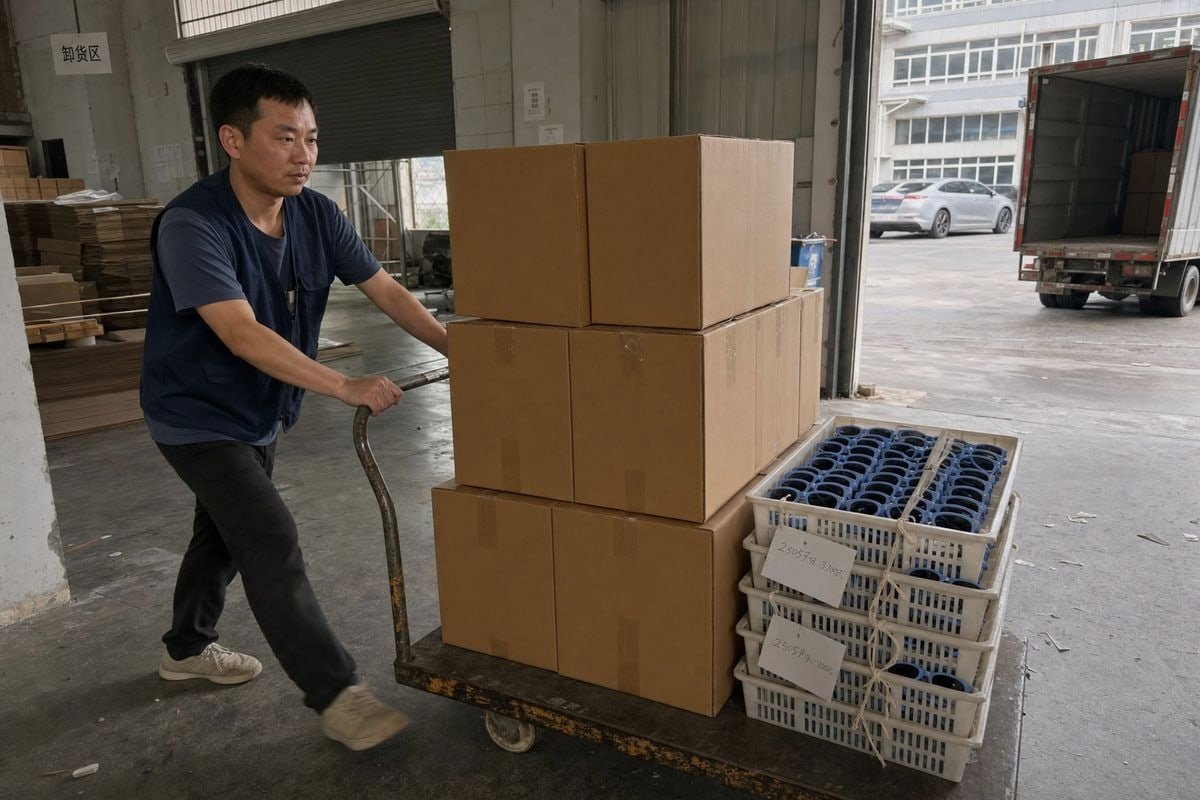
The rule says the label goes on the product and, to the extent practicable, on the packaging. Some buyers read this as "product or packaging — pick one." That reading is wrong, and it is a common objection we push back on. "To the extent practicable" creates flexibility for genuinely tiny items, not an exemption for sunglasses. A temple arm on a kids' frame — even a compact toddler frame — has enough room for a permanent mark, so CPSC expects it there. Packaging marking then adds a second layer of traceability, because a child's sunglasses get separated from the box on day one.
Placement Options Compared
| Location | Suitable? | Notes from Our Production Line |
|---|---|---|
| Inner temple arm | Best choice | Standard practice; pad printing or laser marking; hidden when worn |
| Inside of the frame front | Acceptable backup | Works on wraparound shield styles with thicker frames |
| Lens surface | لا | Damages optics, looks unprofessional, and coatings interfere with ink |
| Removable sticker on frame | لا | Fails the permanence requirement |
| Retail box or pouch | Required in addition, where practicable | Print on the box itself or a permanently affixed label, not a loose insert |
Handling Difficult Frame Shapes
Wraparound sport shields, like the black or white single-lens styles we produce for active kids, have curved temples that resist flat printing. In those cases we curve the pad-printing plate or split the fields across both temples — importer name and batch identification number on one side, manufacturing date and location on the other. CPSC guidance permits multiple permanent marks, so splitting is a legitimate solution, not a workaround. For our soft-touch TPEE toddler frames, a molded-in mark set during injection is the most durable option of all, because it can never rub off.
Whatever you choose, document it. Your placement map should live in the purchase order so every repeat run lands the mark in the same spot.
What Other Compliance Documents Should I Request Alongside CPSIA Tracking Labels?
A procurement manager in Japan once asked me why we insisted on discussing test reports before quoting her kids' line for the US market. My answer: a tracking label with no paperwork behind it is an empty promise. The label is one piece of a larger CPSC compliance package.
Alongside tracking labels, request a Children's Product Certificate (CPC), third-party lab test reports from a CPSC-accepted laboratory covering lead and phthalates testing, UV lens performance data, and batch-level production records. The label data, CPC, and test reports must match exactly.
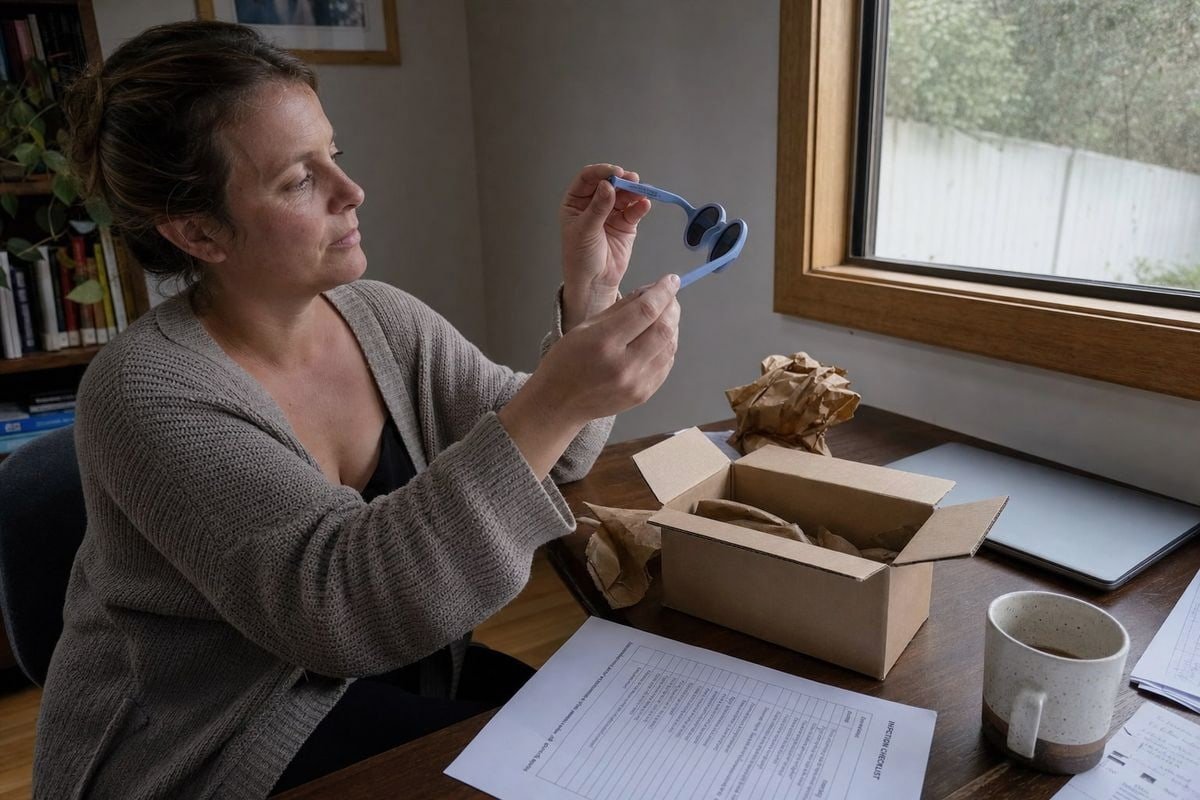
Product safety regulations for children's sunglasses go well beyond Section 103. As the importer of record, you must issue a شهادة منتجات الأطفال 6 (CPC) based on passing third-party lab testing. If the manufacturing date or location on your label contradicts the CPC, you have handed an auditor an easy finding. We have seen shipments delayed for exactly this mismatch — the goods were fine, but the paperwork disagreed with the print on the temple.
The Document Checklist
| وثيقة | ما يثبته | When to Request It |
|---|---|---|
| شهادة منتجات الأطفال (CPC) | Importer certifies compliance based on accepted testing | Draft before production; finalize before shipment |
| Third-party lab test reports | Lead and phthalates testing, plus applicable mechanical and material safety checks | Before mass production, and after any material change |
| UV400 lens test data | Lens UV protection performance matches your marketing claims | At sampling |
| Batch production records | Links each batch identification number to materials and dates | With every shipment |
| Label placement approval | The signed-off artwork and placement map | At pre-production sample stage |
Watch the Timelines and Platform Rules
Two deadlines deserve your attention. First, starting July 8, 2026, importers must eFile certificate data — including production dates and locations — with US Customs through the ACE system 7 at the time of entry. If your label data and CPC data disagree, that mismatch becomes visible to Customs automatically. Second, Amazon's 2025 compliance update requires annual document verification through approved TIC organizations, including label audits, so marketplace sellers face checks even without a CPSC inquiry.
One clarification buyers often ask about: ASTM F963 standards govern toys, so standard kids' sunglasses 8 are not tested against them unless the product has toy-like play features. Your lab will confirm the correct test scope. The safest habit is simple — build the label, the CPC, and the test reports as one matched set, batch by batch, and keep copies for years.
الخلاصة
CPSIA tracking labels protect your brand only if you specify, verify, and document them yourself. Define the fields, approve marked samples, match every batch to its paperwork — and your kids' sunglasses clear the US market with confidence.
ملاحظات ختامية
1. Official CPSC guidance on the mandatory tracking label requirements for children’s products under CPSIA. ↩︎
2. U.S. Customs and Border Protection guide for importers on basic trade and compliance requirements. ↩︎
3. CPSC requirements for third-party testing of children’s products by accredited laboratories. ↩︎
4. Wikipedia entry providing technical background on the pad printing process used for marking eyewear. ↩︎
5. Wikipedia explanation of batch production and traceability of raw materials in manufacturing. ↩︎
6. CPSC instructions for importers on creating and issuing the required Children’s Product Certificate. ↩︎
7. Official information on the ACE system used by US Customs for electronic filing of import data. ↩︎
8. Wikipedia overview of the Consumer Product Safety Improvement Act and its impact on children’s product safety. ↩︎
مقالات أخرى قد تعجبك
August 1, 2026
هل يجب على المصنع التعامل مع تغليف ووضع ملصقات نظارات الأطفال الشمسية، أم استخدام مورد مخصص؟
August 1, 2026
مستودع خاص مقابل الوفاء المباشر من المورد: أيهما يقلل تكاليف الإرجاع لعلامات نظارات الأطفال الشمسية؟
August 1, 2026
مباشر إلى ميناء المستودع أو التخزين الخارجي: أيهما يوفر أكثر على شحن نظارات الأطفال الشمسية؟
هل تبحث عن شريك موثوق به للنظارات للأطفال؟
استكشف أكثر من 800 نمط جاهز ودعم OEM/ODM كامل مصمم خصيصًا لعلامتك التجارية.
اتصل بنا English
  Español de México
  Deutsch
  Français
  日本語
日本語  العربية
  Português do Brasil