How to Inspect and Compare Kids Sunglasses Samples to Screen Out Unqualified Suppliers?
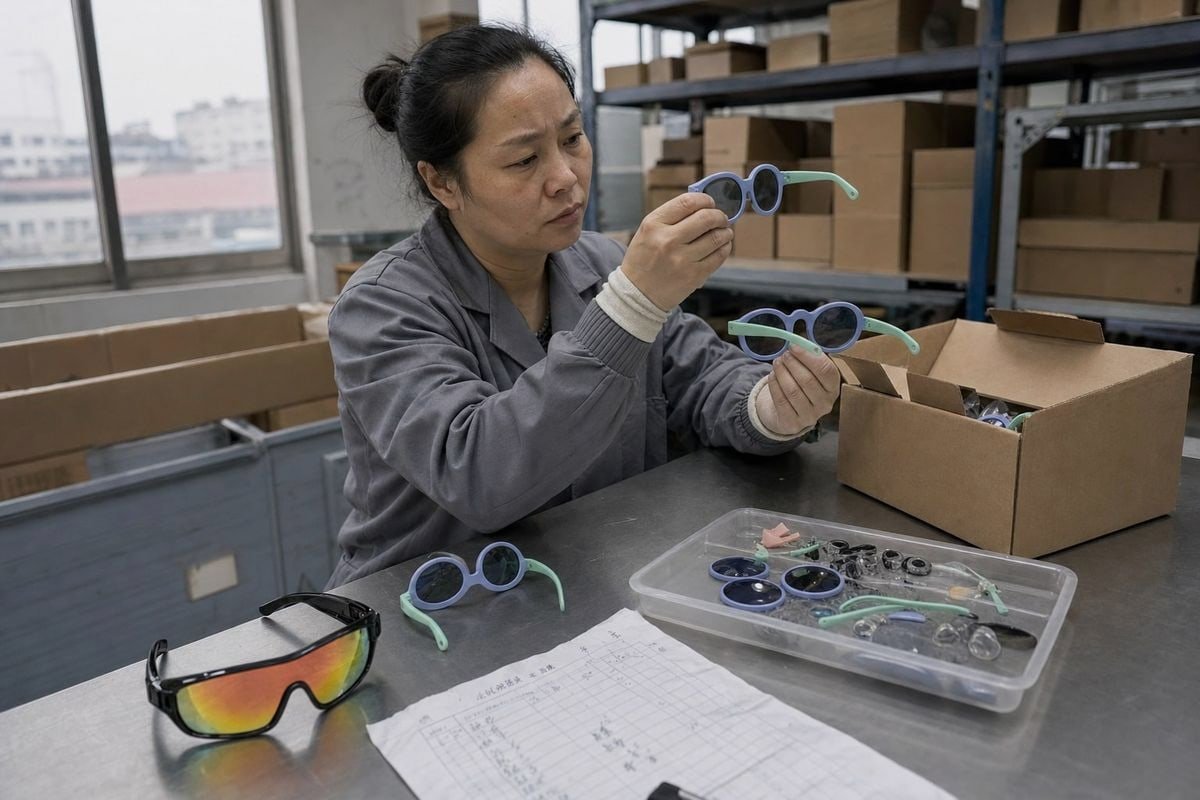
Every week, buyers tell me their kids sunglasses samples looked perfect — until bulk production arrived crooked, scratched, or unsafe. On our production line in Taizhou, I have seen why: one polished sample hides a weak factory.
Inspect kids sunglasses samples by checking safety first (rounded edges, secure lenses, UV400 protection), then comparing 2–3 units for dimensional consistency, testing frame flexibility and hinge durability, and demanding batch-specific certifications. Repeatable defects across samples reveal unqualified suppliers before you commit to bulk orders.
Think of the sample as the supplier interview. A single pretty pair proves nothing. In this guide, I will walk you through the exact inspection method I recommend to our own B2B buyers.
What Should I Check First When Inspecting Kids Sunglasses Samples for Safety?
A buyer from Australia once sent me a competitor's sample with a hinge screw that came loose in two twists. Her toddler could have swallowed it. That moment shaped how our QC team prioritizes every safety check.
Check child-contact safety points first: run your fingers along all edges for burrs, tug lenses to confirm they cannot pop out, twist hinges to verify screws and small parts stay attached, and confirm the frame flexes without snapping into sharp fragments.
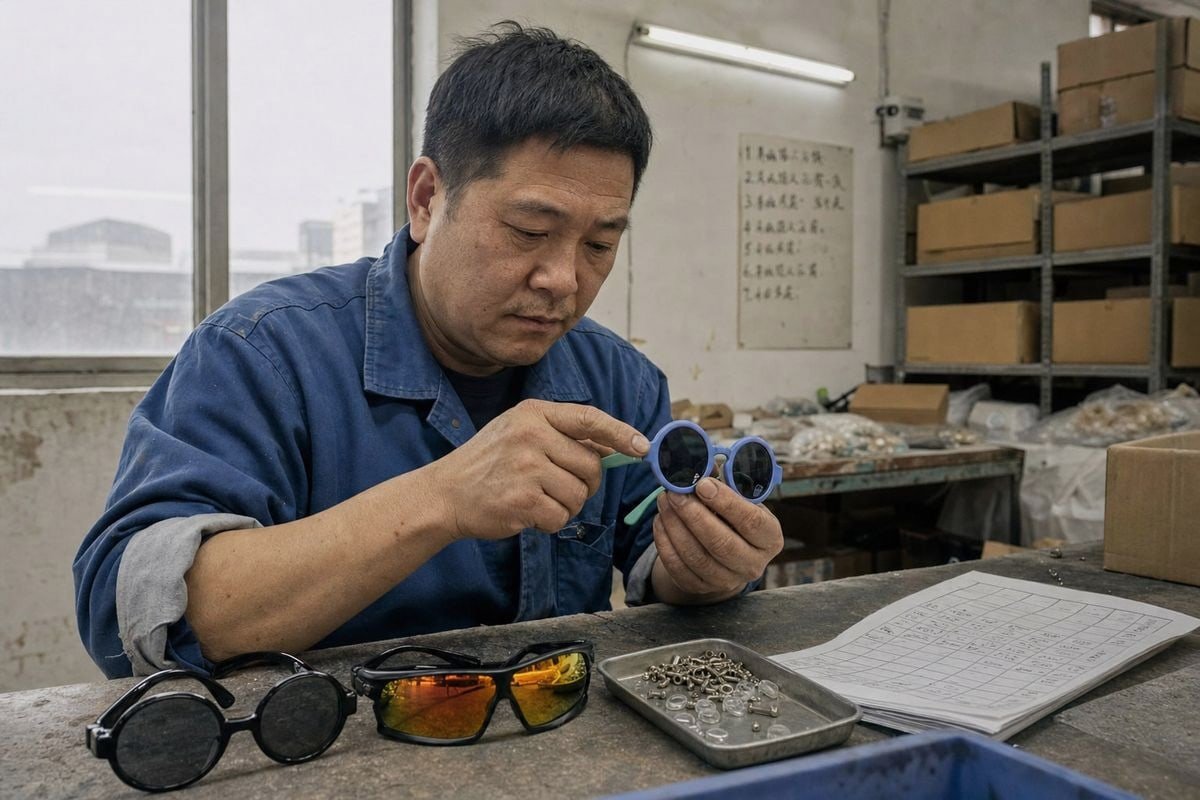
Safety is not one item on a checklist. For نظارات الأطفال 1, it is the entire first layer of inspection. Kids chew temples, sit on frames, and pull glasses off by one arm. Your sample must survive all of that without creating a hazard.
Start With the Physical Hazard Checks
I always tell buyers to inspect with their hands before their eyes. Run a fingertip along the lens edge, the inner temple, and the nose bridge. Any roughness you feel, a child will feel ten times more. Then place the sunglasses on a flat table. Wobble or tilt signals frame asymmetry, which causes pressure points on small faces.
Next, test small parts. Under EN 71 safety standards 2, detachable pieces like screws, decorative studs, or nose pads are a choking risk for younger children. Pull on them with reasonable force. If anything moves, the supplier's assembly process is weak.
Then Verify the Protection Claims
A sunglass that fails at UV protection is worse than no sunglass, because dark lenses dilate the pupil. Do not accept a "UV400" sticker at face value. Ask for spectrophotometer test data 3 or a report referencing the ISO 12312-1 standard. For the US market, lenses should also pass the drop ball impact test for impact resistance — active kids fall, and lenses must not shatter.
| Safety Check | How to Test | Pass Criteria |
|---|---|---|
| Edge finishing | Fingertip sweep on all contact surfaces | Smooth, no burrs or sharp seams |
| Lens retention | Press and tug lenses firmly | No pop-out, no looseness |
| Small parts | Pull screws, pads, decorations | Nothing detaches (EN 71-1 logic) |
| Frame breakage | Flex frame beyond normal wear | Bends, does not snap sharply |
| حماية UV400 | Spectrophotometer report | Blocks wavelengths to 400nm |
| مقاومة الصدمات | Drop ball impact test | Lens stays intact |
In our 15 years making children's frames, I have never seen a supplier who cuts corners on edge polishing but somehow excels at lens safety. Sloppiness travels together.
How Do I Compare Frame Materials Like TPEE and TR90 Across Different Suppliers?
The trade-off I weigh most often in development is flexibility versus structure. Our engineers pair TR90 fronts with TPEE temples for exactly this reason, and material comparison is where sample inspection gets genuinely technical.
Compare materials by flexing each frame 90 degrees or more, twisting temples along their axis, and checking surface texture and weight. Genuine TPEE flexible frames and TR90 return to shape instantly without whitening, cracking, or permanent deformation; cheap substitutes stress-mark or snap.
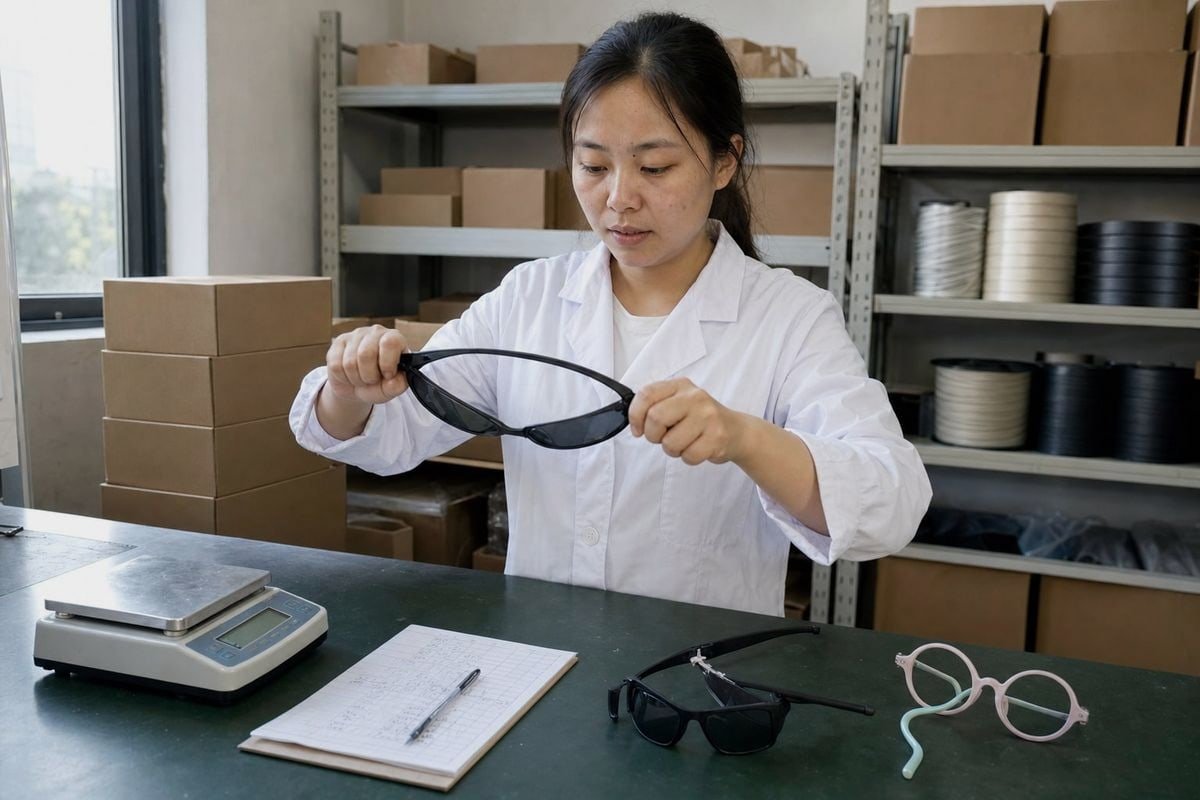
Material claims are the easiest place for an unqualified supplier to cheat. A cheap polycarbonate 4 or generic plastic frame can be labeled "TR90" on an invoice, and most buyers cannot tell the difference by looking. But you can tell by testing. Here is how I coach buyers to do it.
The Hands-On Flex and Torque Test
Hold the frame at both temples and bend it gently backward. Real TR90 5 is a nylon-based thermoplastic with memory. It should bow significantly and spring back to its original shape with no white stress lines at the hinges or bridge. Then twist one temple like you are wringing a towel. TPEE, the softer elastomer we use on child-contact temples, should feel rubbery, warm to the touch, and almost impossible to snap by hand.
Now repeat the same tests on samples from two or three suppliers side by side. Differences appear fast: one frame whitens at the flex point, another feels brittle in the cold, a third smells strongly of chemical release agents — a warning sign for material purity.
| خاصية | Genuine TR90 | Genuine TPEE | Cheap Substitute |
|---|---|---|---|
| Flex behavior | Bends far, snaps back | Extremely elastic, soft | Whitens or cracks |
| الوزن | خفيف جدا | Very light, slightly softer | Often heavier |
| Surface feel | Smooth matte or gloss | Soft-touch, slightly rubbery | Hard, sometimes tacky |
| Cold performance | Stays flexible | Stays flexible | Turns brittle |
| السلامة الكيميائية | BPA-free materials achievable | BPA-free materials achievable | Unverified resins |
Chemical Safety Is Part of the Material Question
Material comparison is not only mechanical. Ask each supplier whether their resin batches are tested for lead, phthalates, and BPA. For the US market, الامتثال لـ CPSIA 6 is mandatory for children's products, and batch-level lab reports matter more than a generic factory certificate. One overlooked check: pigment leaching. Kids chew temples, so rub a damp white cloth firmly on the colored surface. Color transfer means poorly stabilized pigments.
A clever consistency test I recommend: try swapping temples between two samples of the same SKU. If the hinges align and screw in cleanly, the supplier's tooling precision is real. If they do not fit, mold control is loose — and bulk production will drift.
Which Red Flags in a Sample Reveal an Unreliable or Unqualified Supplier?
Years ago, we lost a bid to a supplier whose single sample looked flawless. Six months later, that buyer came back to us with photos of a bulk shipment full of crooked lenses. The lesson stuck: one sample proves nothing; patterns prove everything.
Red flags include refusing to send 2–3 comparison units, visible variation in color or logo placement between identical samples, sharp or unfinished child-contact edges, loose or crooked lens seating, gritty hinge action, vague UV claims, and packaging that ignores your target market's labeling rules.
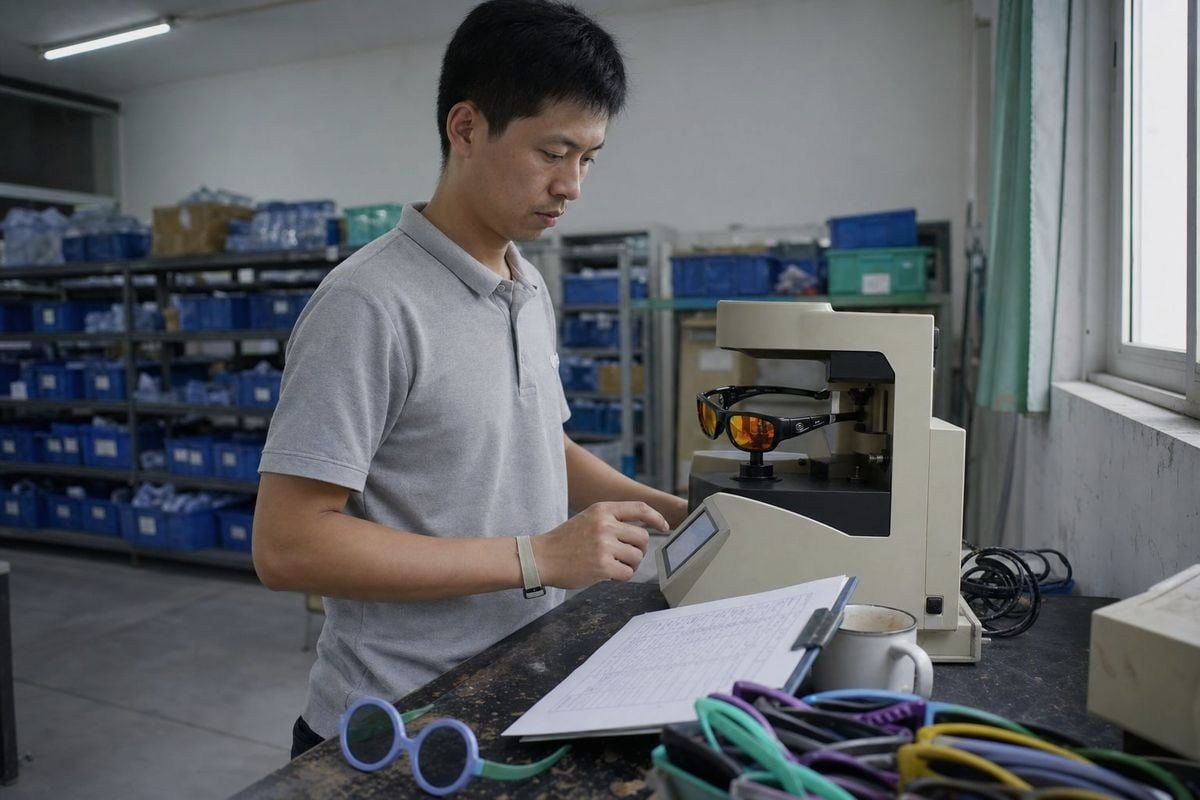
The fastest supplier screen is not a factory visit. It is a disciplined comparison of multiple samples of the same SKU, ideally pulled from different pre-production runs. A qualified factory can reproduce the same product repeatedly. An unqualified one can only hand-pick a hero sample.
The Consistency Test Exposes Everything
Ask every candidate supplier for two or three units of the same model. Then line them up and compare: color tone, tint depth, logo position, frame balance on a flat surface, and hinge tension. Open and close each temple twenty times. Hinge durability shows up here — smooth, even resistance is good; grinding, looseness, or a screw that backs out is a process-control failure. Measure lens width, bridge width, and temple length with calipers against the spec sheet. Do not trust your eye for dimensions.
| Area | Qualified Supplier | Unqualified Supplier |
|---|---|---|
| Sample consistency | Multiple units match closely | Each unit differs in color or balance |
| Finish | Polished, no glue marks or burrs | Rough edges, scratches, uneven tint |
| ملاءمة | Stable, no pinching or slipping | Slides down, presses temples |
| Lens quality | Clear, centered, distortion-free | Wavy optics, bubbles, loose seating |
| Claims | UV/impact claims backed by tests | Vague, unsupported statements |
| التعبئة والتغليف | Market-ready labels and barcodes | Missing or inconsistent marking |
Lens Optics Are the Most Common Failure Point
Hold each lens over printed text and move it slowly. Any waviness in the letters means poor optical quality that will strain a child's developing eyes. For polarized lens quality 7, rotate the sample 90 degrees against an LCD screen — the screen should darken noticeably. Also check for spectral uniformity: tilt the lens under a bright light and look for patchy areas of lighter tint, which create hot spots of higher light transmission.
Behavioral red flags matter just as much as physical ones. A supplier who dodges questions about their master sample system, cannot show a factory audit report, or answers "yes" to every request without discussing tolerances is telling you their process maturity is low.
What Documentation and Certifications Should I Request Alongside My Samples?
When we onboard a new brand customer — often a procurement manager in Europe or Japan — the document exchange usually tells me more about the future relationship than the sample itself. Buyers who ask for paperwork early tend to build serious, long-term programs.
Request batch-specific lab reports for UV400 and lens transmission (ISO 12312-1), impact test evidence, CPSIA or EN 71 chemical compliance for your market, a factory audit report or business license, the signed spec sheet with tolerances, and written confirmation of a retained master sample.
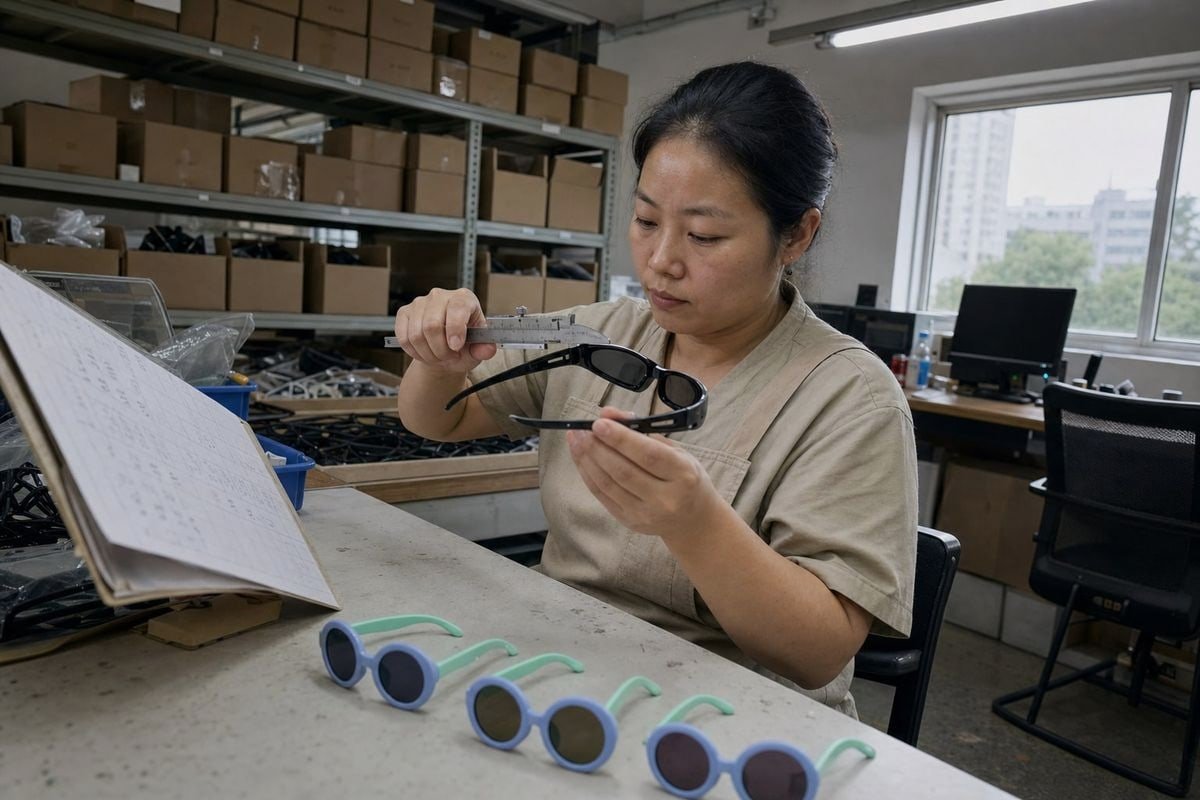
Paper does not replace inspection, but it filters suppliers fast. Traders and weak factories 8 recycle generic certificates. Real manufacturers produce documents tied to specific batches, specific materials, and specific tolerances. Here is the document stack I advise buyers to build before approving any bulk order.
The Core Document Checklist
- Optical test report. It should reference the ISO 12312-1 standard (or ANSI Z80.3 for the US) and show actual UV transmission curves, not just a pass/fail stamp.
- Chemical safety reports. For the US, CPSIA compliance covering lead and phthalates; for Europe, EN 71 safety standards migration testing. Insist the report date and material batch match your sample — a three-year-old certificate for a different resin is worthless.
- Impact resistance evidence. Drop ball impact test records if you sell into the US, since children's lenses face far more abuse than adult ones.
- Factory audit report. A recent third-party audit, or at minimum a business license and workshop photos, confirms you are dealing with an actual factory. We run a 5S-managed workshop with around 120 workers, and we share this openly because it separates factories from trading middlemen.
- Signed specification sheet. It must list dimensions with tolerances, material grades, coating specs, and packaging details. No tolerances means no accountability.
- Master sample confirmation. Get written agreement that the approved sample will be sealed, retained, and used as the reference for pre-shipment inspection.
One nuance I always share honestly: at very early development stages, not every supplier can provide fully lab-validated data for a brand-new style. That is acceptable — as long as they can show test reports for the same materials and lens stock, explain their internal QC routine, and commit to final-batch testing before shipment. Vagueness at that point, however, is disqualifying.
الخلاصة
One beautiful sample can hide a broken process — and cost you a recall. Inspect safety first, test materials hands-on, compare multiple units, and demand batch-specific proof. Screen the supplier, not just the sunglasses.
ملاحظات ختامية
1. General authoritative overview of eyewear types, including protective and corrective glasses for children. ↩︎
2. Authoritative testing laboratory overview of the European safety standards for toys and children’s products. ↩︎
3. Technical explanation of UV-Vis spectrophotometry used to verify lens transmission and UV protection levels. ↩︎
4. Scientific overview of polycarbonate, a common but less flexible material often substituted for TR90. ↩︎
5. Official manufacturer page for Grilamid TR90, the industry-standard material for high-quality flexible frames. ↩︎
6. Official U.S. government resource for the Consumer Product Safety Improvement Act requirements for children’s goods. ↩︎
7. Authoritative Wikipedia entry detailing the science and quality of polarized eyewear. ↩︎
8. ISO 9001 standard details, which define the quality management systems that substandard factories often lack. ↩︎
مقالات أخرى قد تعجبك
August 1, 2026
هل يجب على المصنع التعامل مع تغليف ووضع ملصقات نظارات الأطفال الشمسية، أم استخدام مورد مخصص؟

August 1, 2026
مستودع خاص مقابل الوفاء المباشر من المورد: أيهما يقلل تكاليف الإرجاع لعلامات نظارات الأطفال الشمسية؟

August 1, 2026
مباشر إلى ميناء المستودع أو التخزين الخارجي: أيهما يوفر أكثر على شحن نظارات الأطفال الشمسية؟
هل تبحث عن شريك موثوق به للنظارات للأطفال؟
استكشف أكثر من 800 نمط جاهز ودعم OEM/ODM كامل مصمم خصيصًا لعلامتك التجارية.
اتصل بنا English
  Español de México
  Deutsch
  Français
  日本語
日本語  العربية
  Português do Brasil