How to Get Factory-Attached Price Tags on Kids’ Sunglasses to Save Labor Costs?
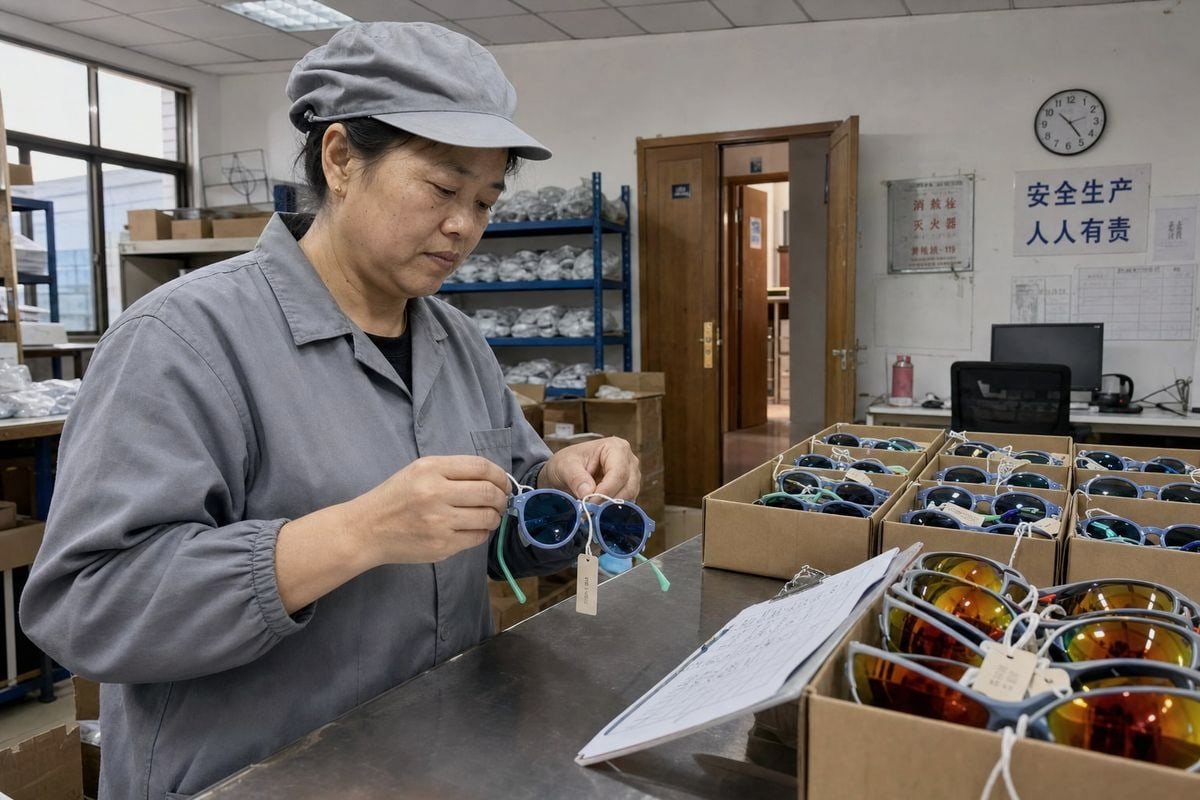
Factory-attached price tags on kids’ sunglasses solve a hidden cost problem I see constantly on our production line: buyers paying warehouse staff to tag thousands of units their factory could have tagged for pennies.
To get factory-attached price tags on kids’ sunglasses, write the tagging requirement into your purchase order, send print-ready tag files with SKU and barcode during sampling, specify the attachment method and placement, and approve a pre-production sample. Most OEM factories add this step at minimal cost.
The idea is simple. Move repetitive tagging work upstream to the factory EAN/UPC barcode 1. Below, I will walk you through how to set it up, which materials work, what you can customize, and what you actually save.
A buyer from Australia once asked me to add hang tags after production had finished. We managed it, but it cost three extra days. Timing is everything with factory tagging.
Submit your tag design files during the sampling phase, confirm the attachment spec in the purchase order, and let the factory print tags while frames are still in production. Tagging then happens during final packing, adding zero days to your lead time.

The key insight from fifteen years of running our workshop in Taizhou is this: tagging only delays orders when it arrives as a surprise. When it is planned from day one, it runs in parallel with production, not after it. Tag printing takes a few days. Frame injection, lens cutting, and assembly take weeks. If both start at the same time, the tags are sitting ready long before the sunglasses reach the packing tables.
The Timeline That Works
Here is the sequence we recommend to every brand we work with:
- At quotation stage — tell the factory you want factory-attached price tags. Ask for tagging as a separate quoted line item so the cost is visible.
- At sampling stage — send print-ready artwork files (SKU, barcode, price, logo) alongside your frame color approvals.
- At purchase order stage — write the tag spec into the PO: tag size, material, string length, attachment point, and quantity per SKU.
- At pre-production stage — approve a physical sample showing the exact tag placement on the actual frame.
- At packing stage — the factory attaches tags during final QC and packing, so every unit ships retail-ready.
What Slows Things Down
| Mistake | Typical Delay | How to Avoid It |
|---|---|---|
| Sending tag files after production starts | 3–7 days | Send artwork with sample approval |
| No specified attachment point | 2–4 days of back-and-forth | Mark placement on a photo in the spec sheet |
| Barcode errors found at packing | 5–10 days for reprints | Test-scan a printed proof before mass printing |
| Changing retail price mid-order | Full tag reprint | Lock pricing before PO, or print price-free tags |
In our experience exporting to twenty-plus countries, the buyers who never see delays are the ones who treat the tag like a component of the product, not an afterthought. It gets a spec, a sample, and an approval, just like the lens or the hinge.
What tag materials and attachment methods work best for kids' sunglasses without irritating skin or breaking during shipping?
One trade-off we weigh constantly on our packing line: a tag secure enough to survive ocean freight, but gentle enough that it never scratches a mirrored lens or a child's cheek.
Coated cardstock hang tags attached with soft cotton string or a fine plastic lock loop around the temple arm work best for kids' sunglasses. They resist shipping damage, avoid skin contact points, and remove cleanly without scratching lenses or leaving adhesive residue on frames.

Children's eyewear is not like adult eyewear when it comes to tagging. Kids grab, twist, and try on sunglasses in stores. Our TPEE 2 و TR90 3 frames are flexible by design, so a stiff tag jammed into a hinge can distort the temple arm during transit. And a mirrored gradient lens, like the orange-to-teal shield lenses we produce for sport styles, shows every scratch. The attachment method matters as much as the tag itself.
Comparing the Main Options
| الطريقة | Shipping Durability | Skin/Lens Safety | Retail Removal | الأفضل لـ |
|---|---|---|---|---|
| Cotton string hang tag | جيد | Excellent — soft, no sharp edges | Easy, scissors-free | Most kids' styles |
| Plastic lock loop (fine gauge) | ممتازة | Good — keep loop away from nose pads | Requires cutting | High-volume, rough freight routes |
| Adhesive label on polybag | ممتازة | Excellent — no product contact | Peel from bag | Price-flexible programs |
| Sticker directly on lens | ممتازة | Poor — residue and scratch risk | Messy | Not recommended for kids' eyewear |
| Pre-packed retail card | ممتازة | ممتازة | None needed | Shelf-ready hanging displays |
Placement Rules We Follow
On our packing line, we attach hang tags around the temple arm, never through the hinge and never touching the lens face. For wraparound shield styles, the tag hangs from the temple, folded away from the mirrored coating, with a small tissue insert between tag and lens inside the polybag. For round pastel frames with soft-touch rubberized finishes, we avoid adhesive labels on the frame entirely — matte soft-touch coatings can mark if a sticker sits on them for weeks in a hot container.
Tag material also matters for children's products. We recommend coated cardstock over laminated PVC tags. It prints cleanly, has no sharp corners when die-cut with rounded edges, and aligns better with the environmentally friendly positioning most kids' brands want today.
When we developed a private-label program for a European baby brand last year, their tags carried the brand logo, EAN barcode, size guide, and a QR code — all printed and attached on our line.
Yes. OEM factories can print your logo, EAN or UPC barcode, SKU, retail price, care instructions, and QR codes on factory-attached tags. You supply print-ready artwork; the factory prints, quality-checks scannability, and attaches tags during final packing.
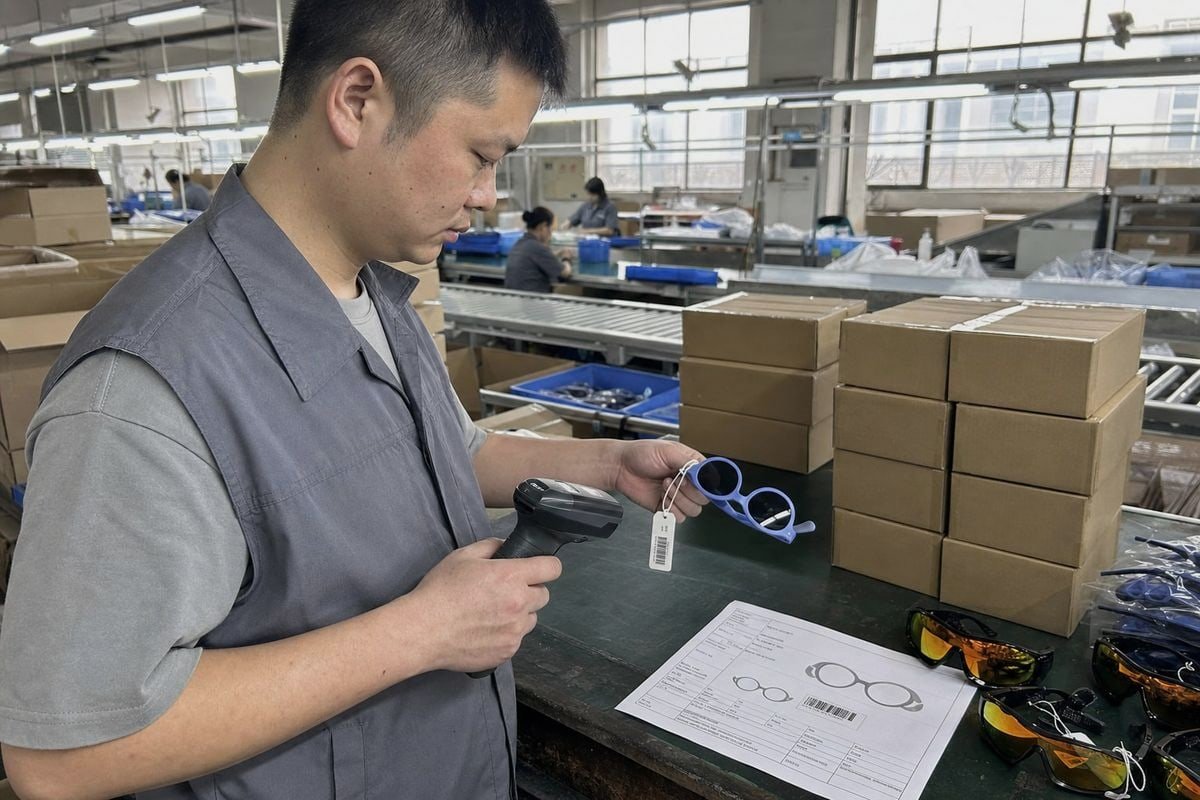
Full customization is standard in serious OEM/ODM programs 4, not a premium extra. At our factory, tags are treated the same way as custom temple logos or custom packaging: you send the artwork, we produce a proof, you approve, we print. The real questions are not whether customization is possible, but what belongs on the tag and how to keep it flexible across markets.
What You Can Put on a Factory Tag
- Brand logo and colors — front face, matched to your brand guide.
- EAN/UPC barcode — we always test-scan printed proofs 5 before mass printing, because a barcode that fails at the register creates enormous downstream cost.
- SKU and style number — essential for warehouse sorting when you order many styles at once.
- Retail price — pre-printed, or left blank for regional pricing.
- UV400 and lens information — buyers of kids' sunglasses expect UV protection stated clearly at point of sale.
- QR codes — linking to UV certificates, sizing guides, or your brand story. This adds customer value with zero added retail labor.
- Compliance text — kids' eyewear sold in many markets needs specific safety and warning labeling 6; the tag or packaging is often where it lives, so confirm your destination market's requirements early.
The Pricing Flexibility Question
Here is a decision worth thinking through carefully. If you sell in one market at one stable price, pre-print the price on the tag and enjoy full shelf-readiness. If you sell across multiple regions or change prices seasonally, ask the factory to print everything except the price, then apply small price stickers at your warehouse. You still eliminate most of the tagging labor — logo, barcode, attachment — while keeping pricing flexible. We run both models for different buyers, and the choice depends entirely on how often your prices move.
A lesson I learned from a distributor buyer: he timed his warehouse team tagging 5,000 units by hand, then asked us to quote the same work. The comparison ended the conversation quickly.
Factory-attached tagging typically costs a few cents per unit at the factory, versus significantly higher per-unit labor at Western warehouses or stores. Bundled with polybagging and barcoding, brands commonly cut total per-unit handling costs by 20–30 percent on volume orders.

The math favors factory tagging for a structural reason. Labor rates differ sharply between a Chinese production line and a warehouse or retail floor in Australia, Japan, or Europe. But the bigger saving is often invisible: the touchpoints you remove. Every time a pair of sunglasses is picked up, unbagged, tagged, rebagged, and re-boxed downstream, you pay for handling, you risk damage, and you risk pricing errors.
Where the Savings Come From
| Cost Area | Manual Downstream Tagging | Factory-Attached Tagging |
|---|---|---|
| Tagging labor per unit | High (Western wage rates) | Low (integrated into packing line) |
| Extra handling steps | Unpack, tag, repack every unit | None — units arrive shelf-ready |
| Pricing errors | Higher — manual entry per unit | Lower — one approved proof for all units |
| Damage during rework | Scratched lenses, bent temples | Minimal — product stays sealed |
| Speed to shelf | Days after receiving | Immediate |
Kids' sunglasses amplify these numbers. They are typically low-cost, high-SKU products. A children's brand might carry twenty styles in multiple colorways, ordered in the hundreds or thousands per SKU for a summer season. Small per-unit savings multiply fast across that volume. Standard sunglasses often cost only a few dollars per unit to manufacture in bulk, so downstream tagging labor can represent a surprisingly large share of your true landed unit cost.
How to Make the Saving Visible
Ask your factory to quote tagging as a separate line item. When we quote this way, buyers can compare our per-unit tagging cost directly against their own warehouse labor rate. Then look at the full landed cost 7 picture — factory price, tags, freight, duties — rather than EXW price alone. In almost every volume scenario we have quoted, factory tagging wins. The exceptions are very small orders or assortments where prices change so often that pre-printed tags create markdown rework. For those cases, use the hybrid model: factory-attached branded barcode tags, warehouse-applied price stickers.
الخلاصة
Manual tagging quietly drains labor budgets. Specify factory-attached price tags in your PO, approve samples early, choose gentle attachment methods, and your kids' sunglasses arrive shelf-ready — saving real money.
ملاحظات ختامية
1. GS1 defines global EAN/UPC barcode standards used for retail scanning and inventory tracking. ↩︎
2. Explains the thermoplastic elastomer material class used in flexible kids’ eyewear frames. ↩︎
3. TR90 is a nylon-based polymer; background helps explain frame flexibility properties. ↩︎
4. Background on OEM/ODM manufacturing model referenced for private-label tagging programs. ↩︎
5. GS1 barcode standards explain why test-scanning printed proofs prevents costly scanning failures. ↩︎
6. CPSC oversees children’s product safety and labeling requirements referenced for kids’ eyewear compliance. ↩︎
7. Defines landed cost, the total-cost concept buyers should compare beyond EXW factory price. ↩︎
مقالات أخرى قد تعجبك

August 1, 2026
هل يجب على المصنع التعامل مع تغليف ووضع ملصقات نظارات الأطفال الشمسية، أم استخدام مورد مخصص؟
August 1, 2026
مستودع خاص مقابل الوفاء المباشر من المورد: أيهما يقلل تكاليف الإرجاع لعلامات نظارات الأطفال الشمسية؟
August 1, 2026
مباشر إلى ميناء المستودع أو التخزين الخارجي: أيهما يوفر أكثر على شحن نظارات الأطفال الشمسية؟
هل تبحث عن شريك موثوق به للنظارات للأطفال؟
استكشف أكثر من 800 نمط جاهز ودعم OEM/ODM كامل مصمم خصيصًا لعلامتك التجارية.
اتصل بنا English
  Español de México
  Deutsch
  Français
  日本語
日本語  العربية
  Português do Brasil