How to Avoid Common Returns When Sourcing TR90 & TPEE Kids Sunglasses?
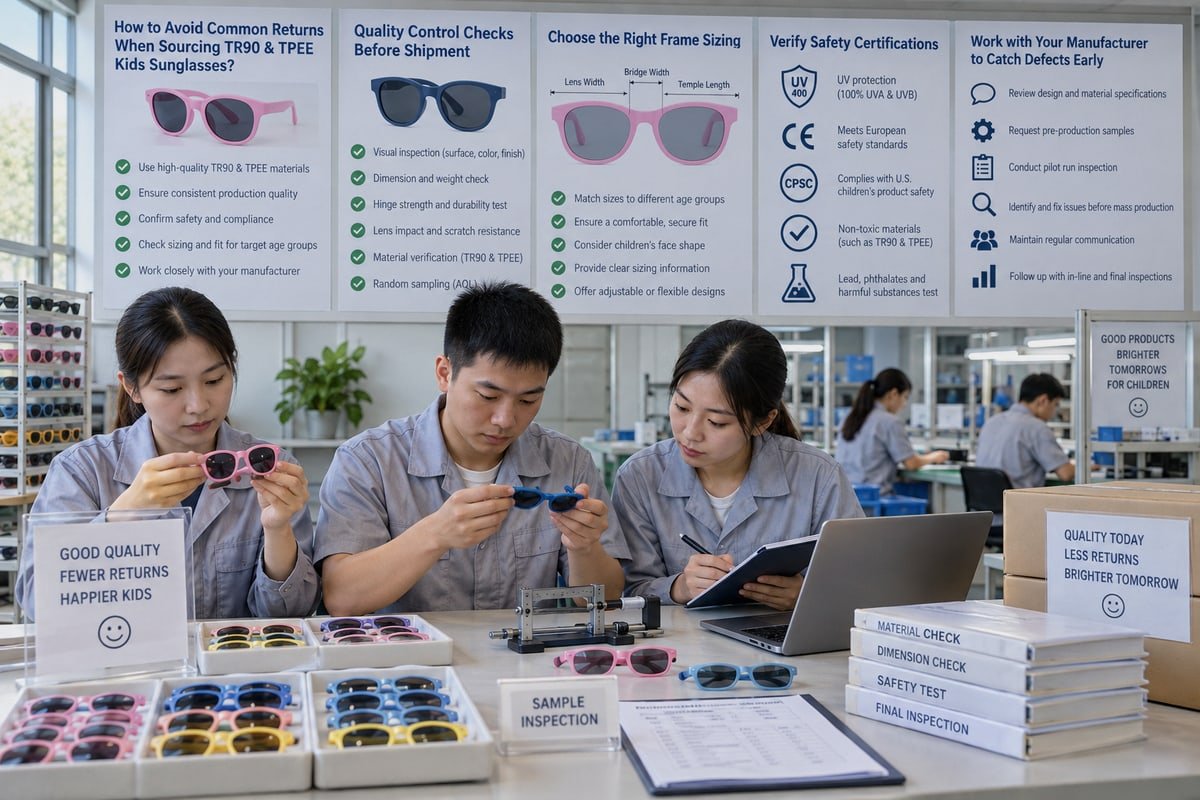
Returns on TR90 & TPEE kids sunglasses quietly eat margin, reviews, and shelf space. On our Taizhou line, we learned most of them are preventable before shipment.
To avoid common returns when sourcing TR90 & TPEE kids sunglasses, define exact age-band sizing, verify genuine material documentation, stress-test hinges and flex cycles, confirm UV400 and market compliance, and run pre-shipment quality control inspection on samples and bulk goods.
Below, I walk through the four questions buyers ask us most. Each one maps to a specific return driver. Fix them at the spec sheet, and your customer service team gets quieter.
What quality control checks can I request before shipment to reduce return rates?
Last summer a batch of translucent pink wayfarer frames showed paint flaking at the temple tips. Our cross-cut test caught it, not a customer's inbox.
Before shipment, request a flex-cycle and hinge stress test, cross-cut adhesion test on coated frames, UV400 lens verification, lens retention check, stress-whitening inspection at flex points, dimensional check against the approved sample, and an AQL-based final quality control inspection with a photo report.
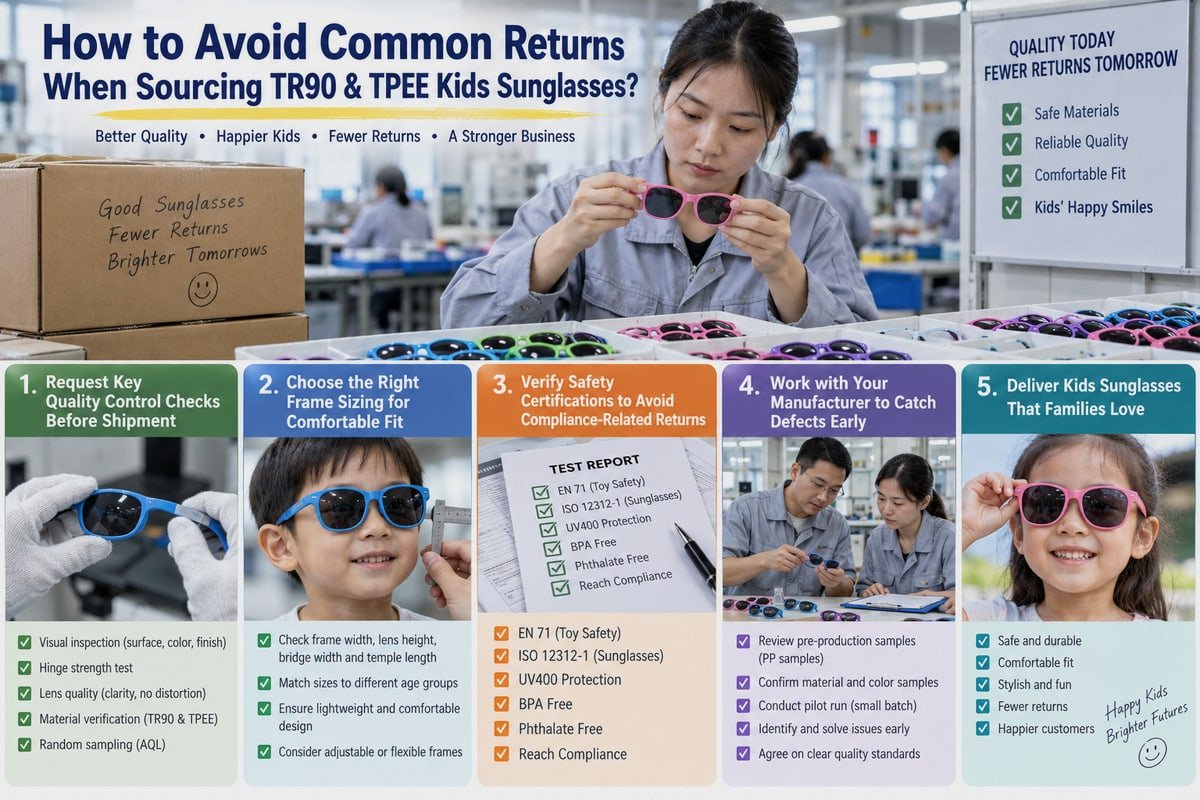
Buyers return kids' sunglasses for two main reasons. They broke, or they were uncomfortable. Every check I list below targets one of those two outcomes. I recommend you write these checks into your purchase order, not just into an email. That way both sides treat them as contract terms.
The checks that catch breakage
Flexible frame durability is the first thing to prove. TR90 should survive 5,000+ flex cycles in a bend test, compared with around 3,000 for polycarbonate. If a supplier cannot show you that kind of result on a sample, the resin may not be what they claim. Ask for the test on the actual frame shape, not on a flat test bar. The chunky slate-blue square frames we make for the 6–9 band flex differently from a thin wayfarer front.
Hinges fail more than fronts. A screwless hinge design, or an integrated molded hinge 1, removes the loose screw problem entirely. That matters twice for children. A loose screw means a floppy temple, and it is also a small-parts complaint. If your design uses metal rivet hinges, request a repeated open-close test and a pull test on the temple.
Stress whitening is the quiet defect. When TPEE cools unevenly in the mold, white marks appear later at the flex points. The frame looks fine on day one and looks damaged on day thirty. Ask your inspector to bend each sampled frame and look for whitening under bright light.
The checks that catch discomfort and appearance issues
| فحص | ما تمنعه | How to request it |
|---|---|---|
| Cross-cut adhesion test | Coating peels from sweat, sunscreen, salt water | Grid cut plus tape pull on painted or rubber-coated frames |
| Lens retention check | Lenses popping out during play | Push test on lens from behind; no movement allowed |
| UV400 lens verification | Lenses that fail home UV testers | Spectrometer reading per lens lot, documented |
| Polarization check | "Not really polarized" reviews | Cross-polarized film test on polarized TAC lenses |
| Dimensional check | Fit differs from approved sample | Frame width, bridge, temple length measured per AQL sample |
| Anti-slip audit | Glasses sliding off active kids | Confirm textured nose pads and temple tips match spec |
I also suggest impact resistance testing on the lens even when your market does not strictly require it. A child will drop these frames. A lens that shatters becomes a safety return, which is the most expensive kind.
Finally, ask for a photo report from the final quality control inspection. Our 5S-managed workshop produces one per shipment. It gives your team a record to compare against if a return does arrive.
How do I choose the right frame sizing so kids' sunglasses fit comfortably and don't get returned?
The trade-off we weigh on every kids' frame is simple: a wider front stays on a growing face longer, but a narrower one sits better today.
Choose frame sizing by age band, not by the label kids. Measure temple-to-temple face width and add 5–10 mm for total frame width, then specify lens width, bridge width, and temple length in millimeters, building separate SKUs for 0–2, 3–5, 6–9, and 10–14 years.
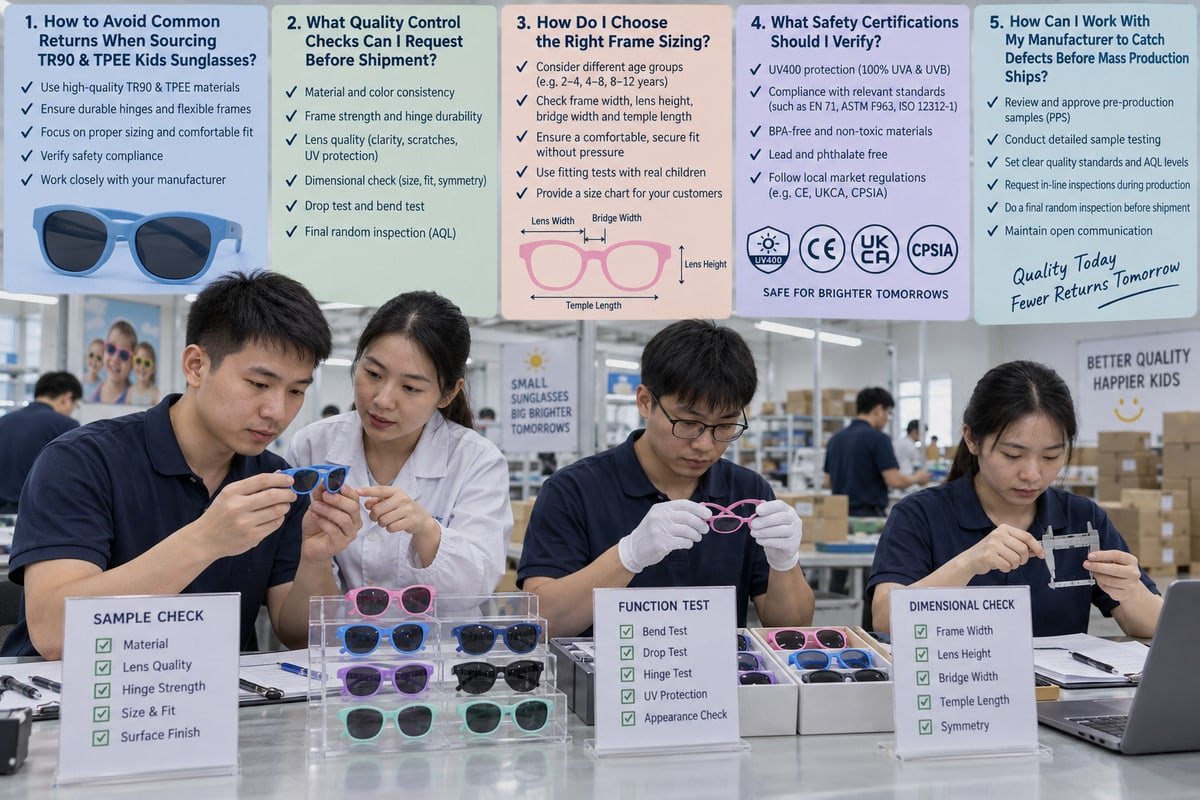
Fit is the hidden return killer. Many sourcing teams spend weeks debating resin and finish, then write "kids size" on the spec and move on. A frame that pinches or slides gets returned even if it is perfectly made. Here is how I break the sizing problem down with buyers.
Start with the age band, then pick the material
TR90 و TPEE solve different problems. Buyers often treat them as interchangeable. They are not.
- TPEE is softer and more forgiving. It suits toddlers and young children who chew, pull, and sit on their glasses.
- TR90 is lightweight with strong shape memory. It suits older, more active children and sport-style frames that need structure.
- واجهة TR90 مع أذرع TPEE gives a stable lens seat plus soft, bendable arms. We use this combination on many of our translucent styles.
Some buyers push back and say TR90 is simply the better material, so why bother with TPEE. My answer is the age band. A 2-year-old does not need shape memory. That child needs a hypoallergenic thermoplastic that bends flat without any hard edge against the skin. A 12-year-old on a bike needs a frame that snaps back to shape after a fall. Match the resin to the child, not to the marketing.
| الفئة العمرية | Recommended material | Fit priority | Return risk if ignored |
|---|---|---|---|
| 0–2 | TPEE, full soft frame | Head strap attachment, no pressure points | Lost, chewed, or refused by child |
| 3–5 | TPEE or TR90 front + TPEE temples | Low bridge fit, lightweight | Slides down nose, pinches |
| 6–9 | TR90 مع معابد مرنة | Anti-slip temple tips, secure lens seat | Falls off during play |
| 10–14 | TR90 sport or fashion shapes | Near-adult widths, stylish look | "Too small" or "looks babyish" |
Measure four numbers and publish them
Fit rests on four measurements: total frame width, lens width, bridge width, and temple length. Take a temple-to-temple face measurement from your target child, then add 5–10 mm. That gives you a comfortable total frame width. Compare the result against a known-good pair if you have one.
Bridge fit deserves its own line. Many young children have low nose bridges. A bridge that is too high leaves the frame resting on the cheeks, and the lenses touch eyelashes. That feels bad and gets returned as "uncomfortable." Ask for a keyhole or saddle bridge with built-in nose pad texture.
Weight matters too. A frame that feels like nothing on the face is a frame the child keeps wearing. Our lightest TR90 & TPEE kids sunglasses use thin temple walls with a soft-touch finish. When you publish the four numbers on your product page, the parent can measure at home. That single step cuts fit returns more than any material upgrade.
A procurement manager from Australia once asked us why her marketplace listing was flagged despite the frames being physically perfect. The answer was missing AS/NZS 1067 documentation.
Verify UV400 lens test reports, the sunglass standard for your market (EN ISO 12312-1 for CE, ANSI Z80.3 and FDA drop-ball impact for the US, AS/NZS 1067 for Australia), plus children's chemical safety such as CPSIA, BPA-free and phthalate-free material certificates, and MSDS for the resin.
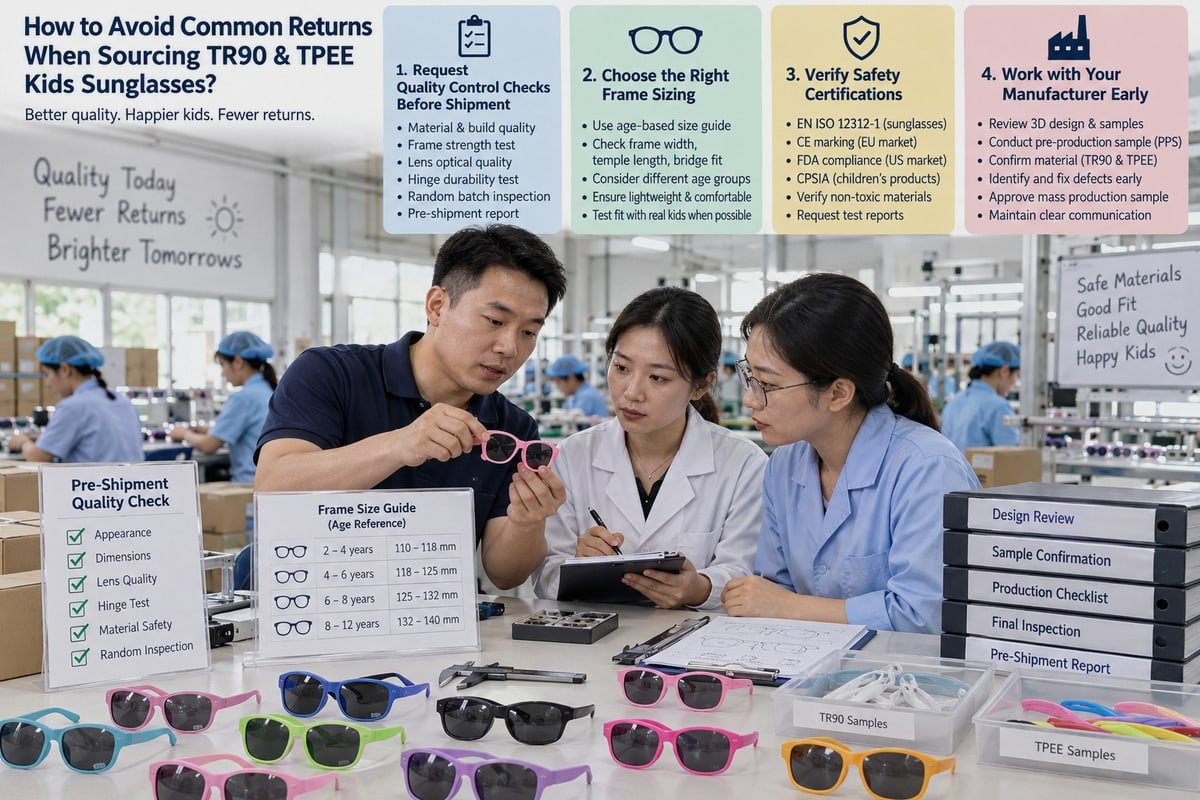
Compliance returns are strange. The product is fine. The paperwork is not. Retail buyers and marketplaces reject the listing, or a parent reads a review about missing certification and sends the pair back. I have shipped to buyers in 20+ countries, and the rules differ by market. Here is how I organize them.
Lens performance standards by market
UV400 protection standards are the baseline every customer expects. Do not assume it. Ask for a lens transmission report per lot. Parents now own cheap home UV testers, and a lens that fails one becomes a one-star review with photos.
| السوق | Sunglass standard | المتطلب الرئيسي | Supporting document |
|---|---|---|---|
| الاتحاد الأوروبي / المملكة المتحدة | EN ISO 12312-1 (CE) | UV filtering, lens category, robustness | Declaration of Conformity, test report |
| الولايات المتحدة | ANSI Z80.3 + FDA drop-ball | Impact resistance, UV transmittance | FDA certification requirements met via drop-ball test record |
| أستراليا / نيوزيلندا | AS/NZS 1067 | Lens category labeling, UV protection | Test report from accredited lab |
| اليابان | Aligns broadly with ISO practice | UV transmittance, importer labeling | Test report plus importer documentation |
The FDA point surprises some buyers. In the US, sunglasses fall under FDA rules for impact resistance, and the drop-ball test is the standard method. Impact resistance testing is not optional there. Our polarized TAC lenses go through this test before we release them to US-bound orders.
Children's product chemical safety
Kids' sunglasses are children's products, so toy-style chemical rules apply on top of eyewear rules. CPSIA compliance in the US covers lead, phthalates, and tracking labels. In Europe, REACH covers restricted substances. Ask for BPA-free materials and phthalate-free confirmation 2 on every TPEE component. A chemical odor from a cheap temple is a real return reason, and so is skin irritation. A hypoallergenic thermoplastic with documentation avoids both.
Prove the resin is real
Mislabeled material is the most direct path to returns. A frame sold as TR90 that is actually rigid generic nylon will not bend like the listing promises. Ask your supplier for the MSDS, the material trade name, and density data. Confirm whether you are getting genuine Grilamid TR90 3 or a generic equivalent. Both can be acceptable, but you must know which one you are selling. On our line we keep resin certificates on file for every style so buyers can attach them to their own compliance packs.
How can I work with my manufacturer to catch defects before mass production ships?
One lesson cost us a re-run early on: a lens that seats perfectly on a hand sample can pop loose when the mold runs hot in July.
Work with your manufacturer through a staged gate process: approve a golden sample, sign off material and lens specs, review a pilot run with a molding cooling audit, inspect the first-off pieces against tolerances, and hold a pre-shipment inspection before releasing mass production.
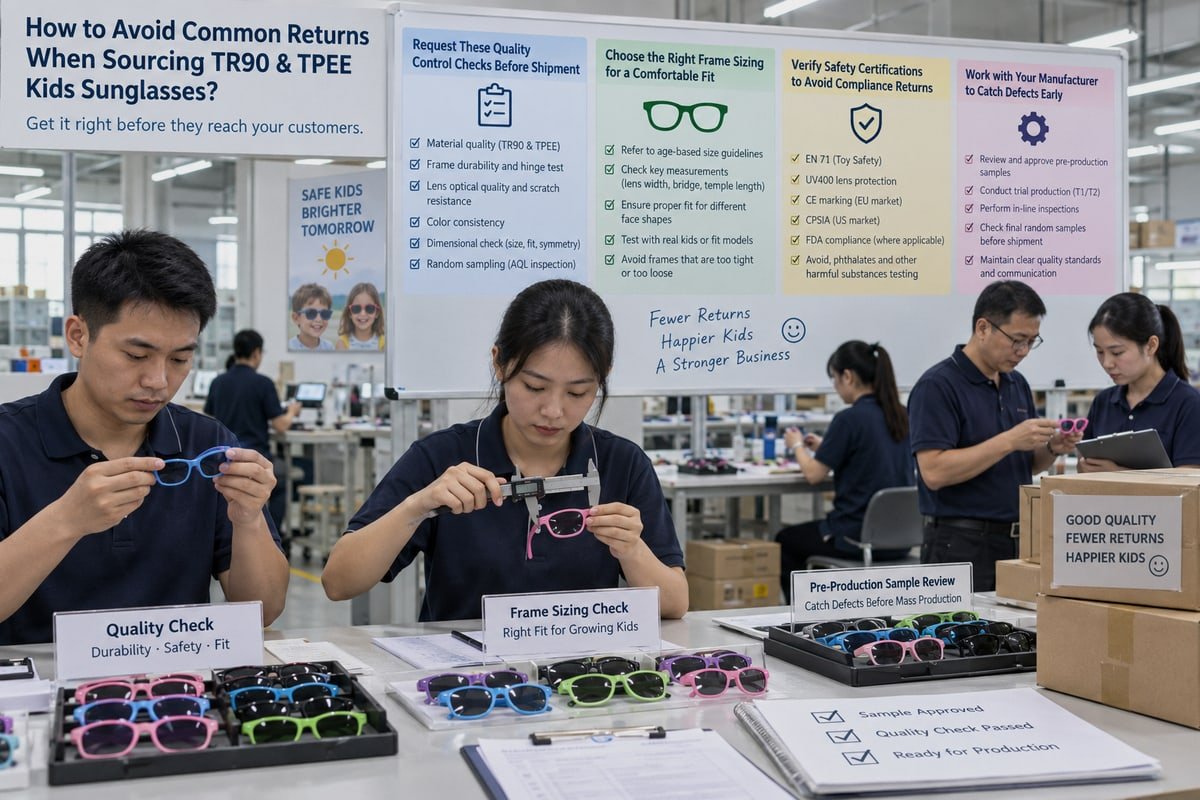
Defects are cheapest to fix before the mold heats up and most expensive after the container leaves. The way to catch them is a series of gates. Each gate has a clear owner and a clear pass condition. Here is the process I run with brand buyers, and it works whether you pick from our ~800 existing styles or develop a new mold.
The five-gate process
- Golden sample approval. You receive a physical sample. You test fit, spring-back, lens retention, and comfort on a real child if possible. You sign it, and it becomes the reference for everything after.
- Spec sign-off. Together we lock the resin grade, lens type, coating, hinge type, dimensions with tolerances, and packaging. A screwless hinge design or a rivet hinge must be named here, not assumed.
- Pilot run and cooling audit. We mold a small lot on the production tool. Our engineers check the cooling time and mold temperature, because uneven cooling is where stress whitening starts in TPEE. You get pilot pieces and photos.
- First-off inspection. The first bulk pieces are measured against the golden sample. Frame width, bridge, temple length, color match, and lens seating are all logged.
- فحص ما قبل الشحن. An AQL sample is pulled from packed cartons. Flex, hinge, adhesion, and UV checks are repeated. Nothing ships until you see the report.
This process is the practical difference between a real factory and a trading company. With about 120 workers and 15 years of eyewear experience under one roof, we can stop a line the same day a buyer flags a problem. A trader has to send an email and wait.
Small decisions that prevent post-launch returns
Three items belong in the spec even though they are not "defects." First, packaging. A reinforced case that doubles as a permanent hard case stops damaged-in-transit returns and raises perceived value on the shelf. Second, care instructions. TR90 is durable, but it is not indestructible. A closed car in summer can warp any thermoplastic frame. Print a heat warning on the insert, and a warped pair becomes a customer-care conversation instead of a product-failure return. Third, strap attachment points for the 0–2 band. Integrated loops let parents add an elastic head strap, which solves the lost-and-dropped problem for toddlers.
Some buyers argue that cheaper frames simply return more, so higher price fixes everything. It does not. A well-specified frame at a modest price with the right hinge and fit outperforms an expensive frame with a vague spec. Retail return windows range from 30 days to 90 days. The spec sheet decides what comes back inside that window.
الخلاصة
Returns start at the spec sheet. Define the age band, verify the resin, test hinges, document compliance, and inspect before shipping. Then TR90 & TPEE kids sunglasses stay sold.
Interested in sourcing the products mentioned in this article? See details and request a quote here:
ملاحظات ختامية
1. ISO 12312-1 specifies the mechanical requirements and physical properties for sunglasses, including frame and hinge durability. ↩︎
2. REACH regulations restrict hazardous chemicals like phthalates in consumer products to ensure safety and compliance. ↩︎
3. Official technical specifications for Grilamid TR90, the industry-standard Swiss-made transparent polyamide used in high-quality frames. ↩︎
مقالات أخرى قد تعجبك


هل تبحث عن شريك موثوق به للنظارات للأطفال؟
استكشف أكثر من 800 نمط جاهز ودعم OEM/ODM كامل مصمم خصيصًا لعلامتك التجارية.
اتصل بنا English
  Español de México
  Deutsch
  Français
  日本語
日本語  العربية
  Português do Brasil