How Do Phthalate, Heavy Metal, and Nickel Limits Apply to TR90 Kids Sunglasses?
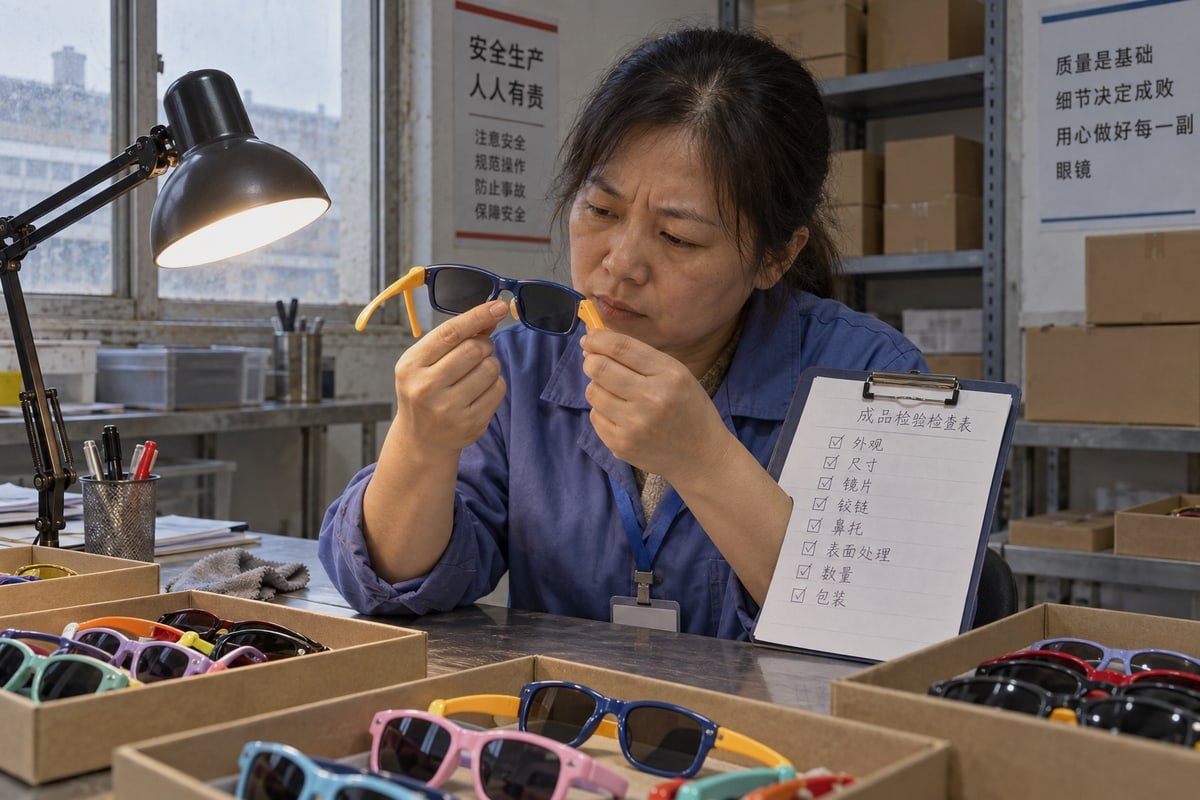
Every season, buyers send our Taizhou factory spec sheets that say only “TR90, nickel-free.” That one line hides the real phthalate, heavy metal, and nickel limits for TR90 kids sunglasses.
Os limites de ftalatos, metais pesados e níquel para óculos de sol infantis em TR90 aplicam-se ao produto acabado, não apenas à resina. Os ftalatos estão limitados a 0,1% nas partes macias acessíveis, o chumbo a 100 ppm no substrato e 90 ppm nos revestimentos, e a liberação de níquel a 0,5 μg/cm²/semana.
That is the short version. The long version is where most launches go wrong. Below, I walk through each limit, where the risk actually hides, and what paperwork you should ask for before you commit to an order.
Como verifico se os óculos de sol em TR90 realmente cumprem as restrições de ftalatos antes de fazer um pedido?
Last spring, a QC technician on our line flagged a batch of soft nose pads that felt tackier than usual. That small detail triggered a full phthalate check.
Verifique a conformidade quanto aos ftalatos solicitando uma lista de materiais, identificando cada parte macia acessível e solicitando um relatório de química por via úmida de terceiros que mostre que cada um dos oito ftalatos da CPSIA está abaixo de 0,1% (1000 ppm). Uma ficha técnica do material TR90 por si só não prova nada sobre plaquetas nasais, empunhaduras ou tiras.

Here is the part many buyers miss. TR90 is a trade name for a polyamide. Grilamid TR90 is a rigid, BPA-free thermoplastic. It does not need plasticizers to bend. So the frame front on its own carries very low phthalate risk. The U.S. CPSC even exempts certain polyamides from phthalate testing under its burden-reduction rules.
But that exemption has a catch. If a compounder adds plasticizers or specialized impact modifiers to the TR90, the exemption disappears. Then the material needs full batch testing. This is why we ask our resin suppliers for the exact grade and additive list, not just the words "TR90."
Where phthalates actually hide in kids' sunglasses
The real risk sits in the soft-touch parts. Phthalates make PVC soft. Children mouth their sunglasses. Soft parts touch skin all day. Several phthalates are classified as endocrine disruptors, which is why regulators treat children's items so strictly. The U.S. rule covers eight phthalates, including DEHP, DBP, and BBP, at a 0.1% limit in accessible plasticized parts.
| Componente | Material típico | Risco de ftalato | O que solicitar |
|---|---|---|---|
| Frente da armação | armação infantil de Grilamid TR90. A tinta descascou na dobradiça dentro de uma estação. Essa lição mudou a forma como construímos a cor. | Low, if unmodified | Resin grade and additive declaration |
| Hastes | TPEE ou TR90 | Baixo | Material declaration plus finished-product test |
| Plaquetas | Soft PVC or TPE | High if PVC | Wet chemistry (GC-MS) report per part |
| Temple grips / tips | Rubberized overmold | Médio a alto | Report naming the eight CPSIA phthalates |
| Straps and cases | Soft PVC, fabric coating | High if PVC | Separate accessory report |
Why our TPEE temples matter here
Many of our styles pair a TR90 front with TPEE templados. TPEE gains its flexibility from its block copolymer structure 1, not from added phthalate plasticizers. That is one reason we chose it for children's faces. Still, we do not rely on chemistry theory. We send finished samples, including nose pads and any accessories, to a third-party lab.
A simple verification sequence
- Ask for a component-level bill of materials.
- Mark every part a child can touch or mouth.
- Confirm which parts are soft or rubberized.
- Request wet chemistry results for those parts. XRF cannot see phthalates.
- Check that the report matches your colorway, nose pad, and strap options.
If a supplier only offers a resin datasheet, that is a red flag. It is not a phthalate test.
What heavy metal limits should I ask my supplier to test for in children's frames?
Every time we approve a new dual-tone colorway, like navy with yellow-orange temples, we weigh pigment vibrancy against the extra heavy metal screening it can require.
Ask your supplier to test total lead at 100 ppm in the TR90 substrate and 90 ppm in coatings, plus cadmium, mercury, and chromium. For Europe, request EN 71-3 migration testing across 19 elements, and confirm California Proposition 65 lead and cadmium levels for U.S. retail.
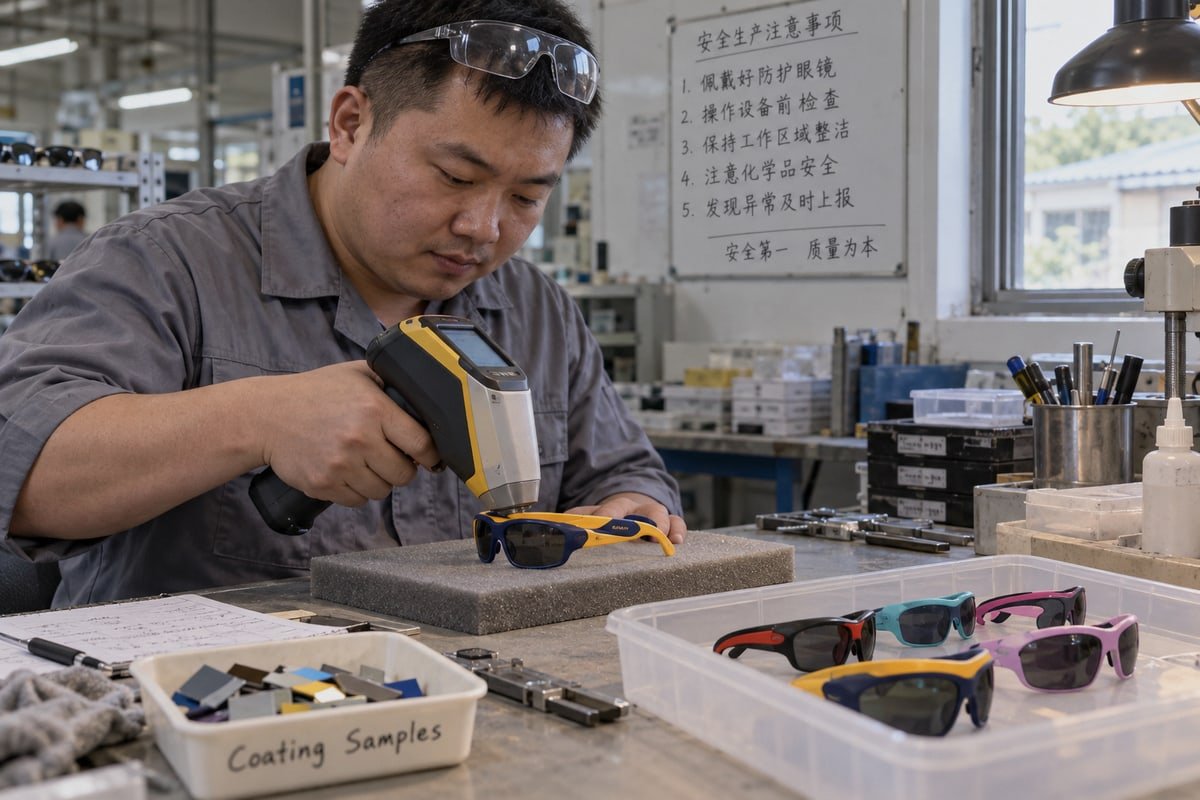
Heavy metals are not one rule. They are a set of rules that change with the market and with how the part is classified. That confuses many first-time importers. So I break it into two questions. First, how much metal is in the material? Second, how much can leach out?
Total content versus migration
Total content limits measure everything in the material. CPSIA compliance uses this approach. The lead limit is 100 ppm in the substrate and a stricter 90 ppm in any surface coating or paint. That matters for the glossy navy front and the matte yellow-orange temples on a sporty kids' style. Each finish is a coating or a colored resin, and each gets checked.
Migration limits measure what leaches out. The EN 71-3 standard takes this approach. It simulates a child chewing the material and checks 19 elements. ASTM F963 in the U.S. also sets soluble limits for coatings on toys. Sunglasses are not always classified as toys. But many buyers apply these standards anyway, because children treat sunglasses like toys.
| Regulation | Região | Abordagem | Key limits to request |
|---|---|---|---|
| CPSIA | U.S. | Total content | Lead 100 ppm substrate, 90 ppm coatings |
| ASTM F963 | U.S. | Soluble elements in coatings | Lead, cadmium, mercury, chromium, others |
| EN 71-3 | UE | Migration | 19 elements across three material categories |
| Regulamento REACH | UE | Content restrictions | Cadmium and lead in plastics and coatings |
| Conformidade com a Proposição 65 da Califórnia | U.S. | Warning thresholds | Lead and cadmium limits for retail listing |
Where the metals come from
Pure polyamide has no reason to contain lead. The risk enters through colorants, plating on a hinge accent, printed logos, and decorative inserts. Recycled TR90 adds a further concern. rTR90 carries a higher risk of legacy contamination from heavy metals and restricted flame retardants than virgin Swiss-grade resin. If a supplier offers recycled resin, ask for batch-level reports, not a one-time certificate.
Screening versus confirmation
We use XRF screening on incoming colored parts. It is fast and non-destructive. But XRF gives a screen, not a verdict. For final reports, the lab runs digestion and ICP analysis. Ask for that report, and ask that it names the colorway tested. A black frame report does not cover a yellow-orange temple.
One more trend worth watching. EU REACH is now targeting some UV stabilizers, such as UV-328, which resin makers add to prevent sun-induced brittleness. Lead and cadmium limits are no longer the whole heavy metal story for outdoor eyewear.
Why does nickel release testing matter if TR90 is a metal-free material?
A procurement manager from Germany once asked us why we bothered with nickel release reports on a plastic frame. Her question is fair, and the answer sits in the hinge.
Nickel release testing matters because TR90 resin is nickel-free, but screws, hinges, spring parts, logo plates, and metal-core temples are not. Under REACH, any metal part in prolonged skin contact must release less than 0.5 μg/cm²/week, and EN 16128 defines how sunglasses are tested.
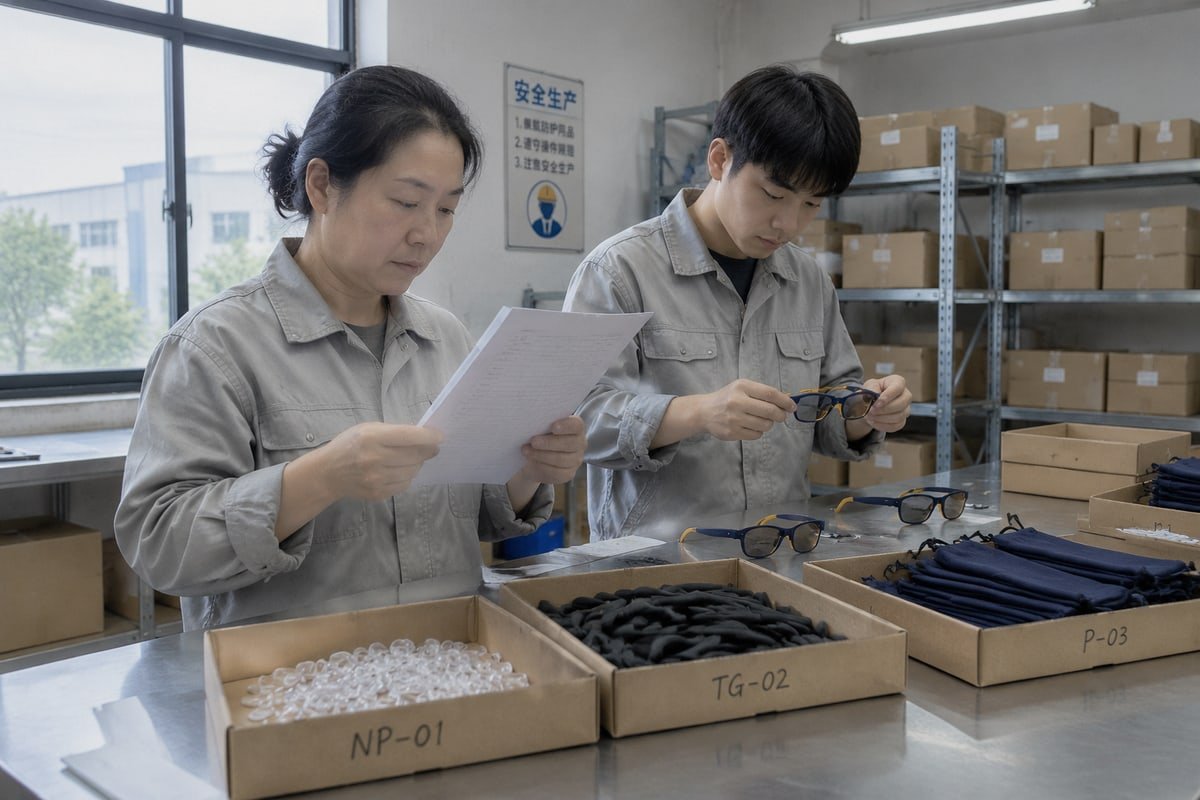
Nickel allergy is common, and it starts in childhood. This is the main reason hypoallergenic eyewear frames in TR90 and TPEE sell well to parents. The base material earns that claim. The finished product still has to prove it.
Look at a typical kids' oval frame with a small silver accent at the hinge. That accent might be a metal pin, a plated screw head, or a decorative insert. Each one can contain nickel. A child wears sunglasses at the temple, right against the skin, for hours. That counts as prolonged skin contact under the REACH regulation.
The numbers that apply
| Contact type | Nickel release limit | Aplica-se a |
|---|---|---|
| Prolonged skin contact | 0.5 μg/cm²/week | Temples, hinges, screws, nose bridge hardware |
| Pierced body parts | 0.2 μg/cm²/week | Jewelry, not eyewear |
| Coated metal parts | 0.5 μg/cm²/week after two years of simulated wear | Plated hinges and logo plates |
How the test actually works
I explain this to buyers as a simple sequence.
- The lab identifies every metal part that can touch skin.
- Coated parts go through a wear simulation first, because plating can wear off.
- Each part sits in artificial sweat for one week.
- The lab measures nickel in the solution and calculates release per square centimeter.
- The report lists each part by name and position.
Why EN 16128 matters now
EN 16128 is the eyewear-specific method. Recent updates clarify how labs prepare samples, choose test points, and document results for spectacle frames and sunglasses. This tells me one thing. Nickel compliance is being refined, not relaxed. Reports from a few years ago may not reflect current sample preparation practice. Ask your lab which version they follow.
The design choice we weigh
When we develop a new style, we decide early whether it needs metal at all. Some flexible TR90 and TPEE styles can use molded plastic hinges. Others need a metal screw or spring hinge for durability during rough play. Neither choice is wrong. But metal means testing, and the test must appear in the file before mass production.
Which certifications should I request to prove my kids' sunglasses are compliant in my target market?
Years ago, we learned the hard way that a material data sheet is not a certificate. A shipment sat at customs because the buyer's file lacked finished-product reports.
Request a Children's Product Certificate backed by CPSC-accepted lab reports for the U.S., an EU Declaration of Conformity with REACH, EN 71-3, and nickel release results for Europe, and finished-product chemical reports for Australia and Japan. Always match reports to the exact colorway and components you order.

Certification is where the word "TR90" stops helping. Customs officers, retailers, and marketplaces do not ask what a frame is made of. They ask for documents. So I build a document map for each market before we cut the first sample.
Estados Unidos
For the U.S., a kids' sunglass is a children's product. That means a Children's Product Certificate, or CPC. The CPC is not a lab report. It is a declaration you issue as the importer or brand. But it must be supported by third-party testing from a CPSC-accepted laboratory. The tests behind it cover lead in substrate and coatings, the eight phthalates, and, where applicable, ASTM F963 elements. If you sell in California, add Proposition 65 screening to the same lab order. It costs little extra and saves a lot of retail friction.
União Europeia
For Europe, sunglasses fall under PPE rules for optical performance, and under REACH for chemistry. Your file should hold a Declaration of Conformity, a REACH statement 2 covering restricted substances, an EN 71-3 migration report for skin-contact and mouthable parts, and a nickel release report under EN 16128 for any metal hardware. Buyers who treat their product as a child-care article often add the full 19-element EN 71-3 panel, even though sunglasses are not toys.
Austrália e Japão
Buyers in Australia and Japan usually align their chemical files with the U.S. or EU packages above. In our experience exporting to both, the strongest approach is to hold one full finished-product report set and reference it in every market file.
What "matching" really means
A report is only valid for what was tested. Check these points before you accept one.
- The report names the same style number you are ordering.
- The tested colorway matches yours. Pigments change the heavy metal result.
- The nose pad, strap, and case in the report match your accessory choice.
- The lab is accredited for the method used.
- The report date is recent enough for your retailer's policy.
How our 800-style catalog fits this
Many brands come to us to avoid mold investment. They pick from existing styles, then customize color, logo, lens, and packaging. That speeds launch. But a new color or a new metal logo plate is a new test case. So we plan the lab order at the same time as the artwork approval. That keeps the timeline honest and the file complete.
Conclusão
TR90 solves one risk and hides others. Skip finished-product testing and a nose pad or hinge can sink a launch. Test every component, then market safety with confidence.
Interessado em adquirir os produtos mencionados neste artigo? Veja detalhes e solicite um orçamento aqui:
Notas de rodapé
1. CPSC guidance on phthalate restrictions and testing requirements for children’s products. ↩︎
2. ECHA’s overview of the REACH regulation, which restricts hazardous chemicals in the EU. ↩︎
Mais Artigos que Você Pode Gostar

28 de setembro de 2026
Óculos de Sol Infantis TR90 e TPEE Podem Usar Materiais Reciclados ou de Base Biológica?
28 de setembro de 2026
Óculos de Sol Infantis TR90 e TPEE São Recicláveis? Dicas de Descarte Explicadas?

28 de setembro de 2026
Como Evitar Deformação e Arranhões ao Enviar Óculos de Sol Infantis TR90 e TPEE?
Procurando um Parceiro Confiável em Óculos Infantis?
Explore mais de 800 estilos prontos e suporte completo OEM/ODM adaptado à sua marca.
Entre em Contato English
 Español de México
 Deutsch
 Français
 日本語
 العربية
 Português do Brasil