Why Are Lenses Falling Out of Kids Optical Frames?
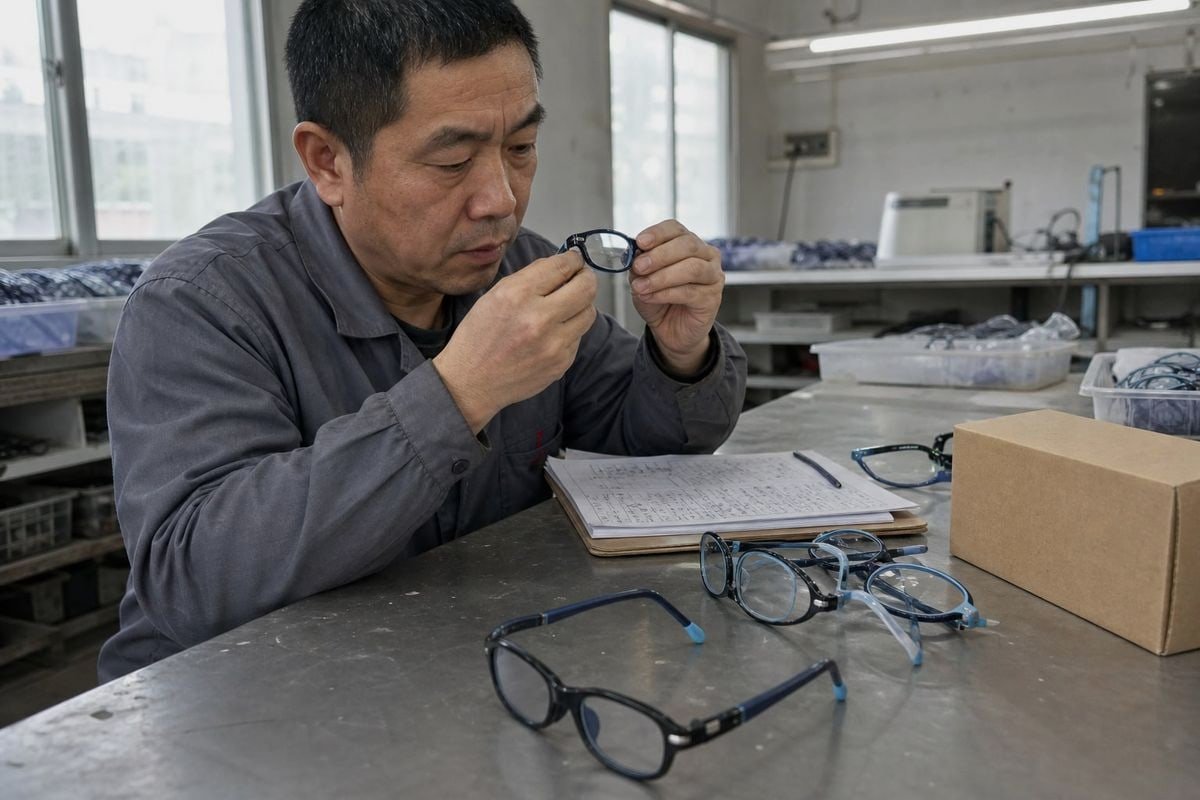
Lenses falling out of kids optical frames is the complaint I hear most from new buyers. It damages returns data, retail trust, and your brand — but on our production line, it is preventable.
Lenses fall out of kids optical frames when the frame no longer grips the lens edge securely. Common causes include loose hinge screws, warped or stretched frames, lens sizing errors, inadequate frame heating during insertion, heat exposure, and repeated twisting from one-handed removal by active children.
The good news is that each cause leaves a clear fingerprint. Once you know what to look for, you can tell a factory defect from normal wear. Let me walk you through it.
How do I know if my current lens-to-frame fit is actually a manufacturing defect?
A buyer from Australia once sent me photos of thirty returned frames, convinced the whole batch was defective. After inspection, only nine were. The other twenty-one told a different story — and knowing the difference saved his reorder.
A manufacturing defect shows up early and repeatedly: lenses pop out within weeks without impact, rotate or "chatter" in the eyewire, or fall from multiple units in the same batch. Wear-related fallout appears after months, usually alongside bent temples, stretched bridges, or visibly loose hinge screws.
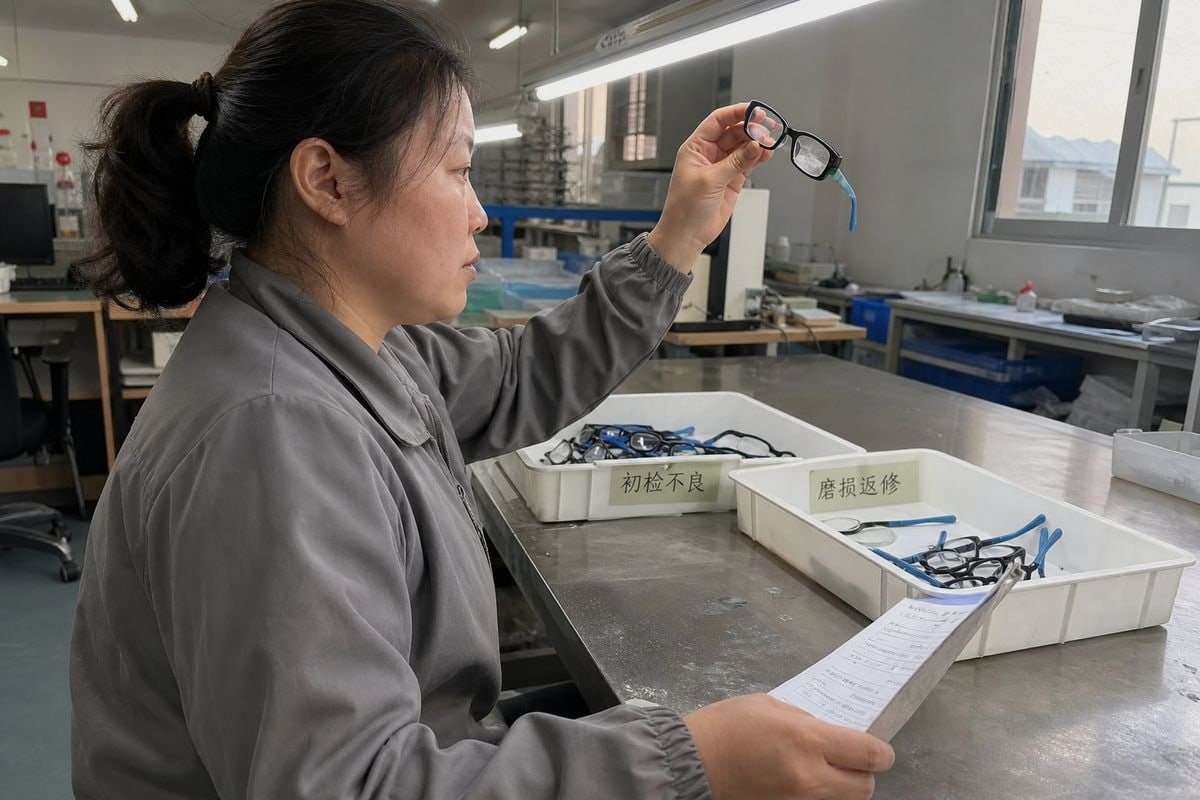
The core mechanical fact is simple. A lens stays in place because the frame's internal groove 1 hugs the lens bevel under tension. Anything that reduces that tension — a lens edged slightly too small, a groove cut too shallow, or a frame never properly heated during insertion — weakens the grip from day one. That is a factory problem. Anything that stretches or deforms the frame afterward — drops, sitting on the glasses, sleeping in them — is a use problem.
The three fingerprints of a factory defect
First, check lens sizing error. If you can rotate a lens gently with your thumb, or hear a faint click when you tap the frame near your ear, the lens was cut too small for the frame circumference. That internal "chatter" grinds away at the groove until the lens falls out.
Second, check lens groove alignment. Hold the frame up to light and look at the seam between lens and eyewire. Gaps, uneven seating, or a lens sitting proud on one side point to a bevel-profile mismatch — common in high-prescription lenses where the edge is too thin to lock mechanically.
Third, check the insertion process itself. Plastic frames must be heated so the material expands, accepts the lens, and then shrinks around it as it cools. Skip or rush that step, and the fit is loose from the start.
| Symptom | Likely Cause | Defect or Wear? |
|---|---|---|
| Lens pops out in first 2–4 weeks, no impact | Lens edged too small, poor insertion | に書き込むことをお勧めする実用的なチェックリストがあります。 |
| Lens rattles or rotates in frame | Lens sizing error, shallow groove | に書き込むことをお勧めする実用的なチェックリストがあります。 |
| Multiple units in one batch fail the same way | Process or tooling issue | に書き込むことをお勧めする実用的なチェックリストがあります。 |
| Fallout after a drop or rough play | Impact deformation of eyewire | Wear |
| Fallout with bent temples or stretched bridge | One-handed removal, torquing | Wear |
| Fallout after summer, left in hot car | Heat softening of frame material | Environment |
One more subtle cause worth checking: chemical softening. Pediatric sunscreens, hair products, and skin oils can migrate into the frame's internal groove over months and soften certain plastics. It mimics a defect but is really a materials-and-environment issue — which brings us to material choice.
Can choosing TR90 or TPEE materials help me avoid loose lenses in active kids' frames?
The trade-off we weigh most often when developing a new kids style is stiffness versus resilience. A rigid frame holds a lens tightly — until it cracks or permanently deforms. That trade-off is exactly why our factory standardized on TR90 and TPEE fifteen years into this business.
Yes. TR90 and TPEE have shape memory, so they flex under impact or twisting and return to their original geometry, preserving lens groove tension. Rigid acetate frames suffer structural fatigue and gradual shrinkage, losing their grip on the lens edge over time in active use.
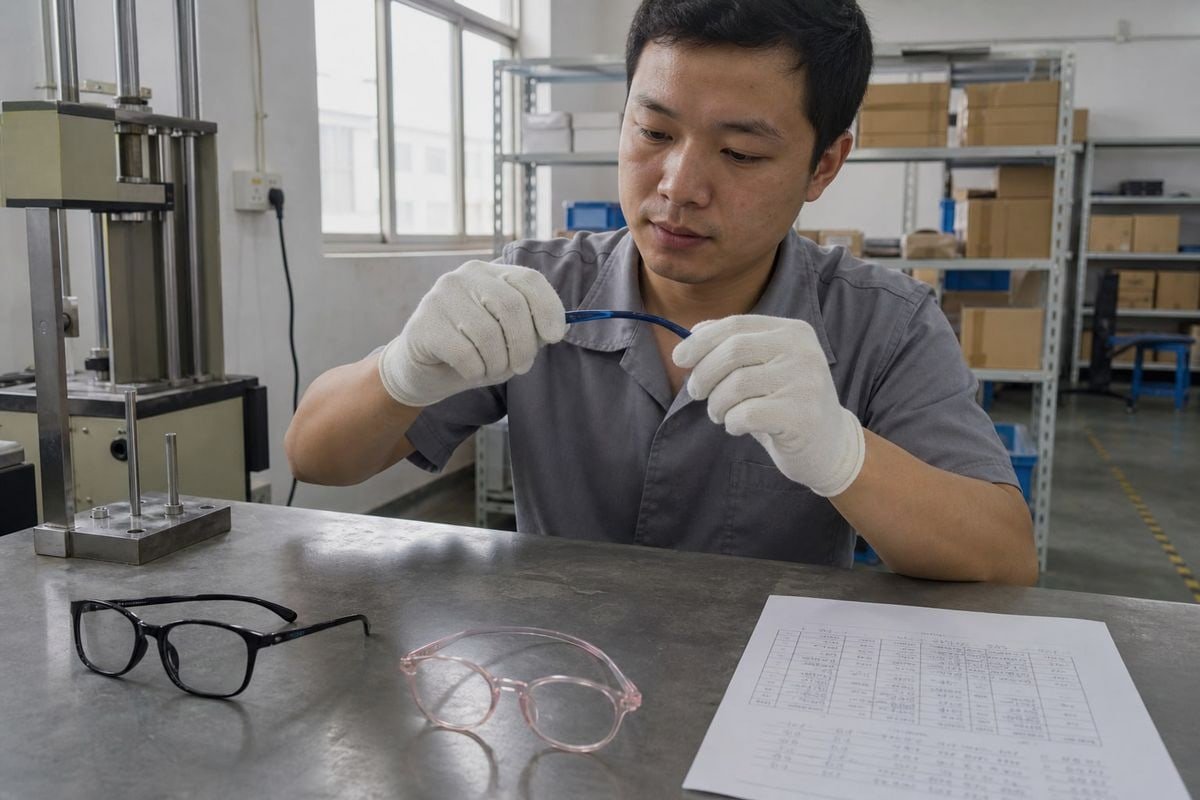
Frame material durability is not just about breaking. It is about how the eyewire behaves after hundreds of small stresses. Kids twist their glasses off one-handed, cram them into backpacks, and wear them through playground games. Each event deforms the frame slightly. A material with shape memory recovers. A material without it accumulates damage until the groove no longer holds the bevel.
Why shape memory protects lens retention
TR90 is a thermoplastic polyamide. When a child drops the glasses, the eyewire deforms momentarily — that momentary deformation 2 is what ejects lenses from rigid frames on impact. TR90 flexes through the impact and snaps back, so the lens usually stays seated. TPEE goes further: it is softer and even more elastic, which is why we use it for temples on many of our TR90 frames, and for full frames on our youngest sizes. A TR90 front with TPEE temples gives you a stable eyewire plus temples that survive constant pulling.
Acetate frame shrinkage is the hidden problem with traditional materials. Acetate loses plasticizers slowly, contracting over time. Ironically, mild shrinkage can tighten a lens — but it also makes the frame brittle, and brittle eyewires crack at the groove. There is also differential thermal contraction to consider: when a child moves from outdoor heat into air conditioning, frame and lens shrink at different rates. Flexible polymers absorb that mismatch; rigid materials transfer the stress to the lens seat.
| プロパティ | TR90 | TPEE | 標準アセテート |
|---|---|---|---|
| Shape memory | 素晴らしい | 素晴らしい | 悪い |
| Impact recovery | Returns to shape | Returns to shape | May crack or deform |
| 中程度から重い | 非常に軽い | 非常に軽い | より重い |
| Long-term dimensional stability | 高い | 高い | Shrinks over years |
| Suits active lifestyle eyewear | はい | Yes (best for toddlers) | 限定的 |
| Chemical resistance (skin oils, sunscreen) | 接触点に集中 | 接触点に集中 | 中程度 |
Pair these frames with polycarbonate lenses — lightweight and impact-resistant — and you reduce both the mass stressing the eyewire and the risk of lens damage on impact. Material choice will not fix a lens sizing error, but it dramatically reduces wear-driven fallout.
What quality control steps should I look for from a manufacturer to prevent this issue?
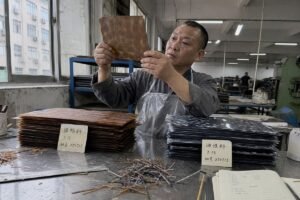
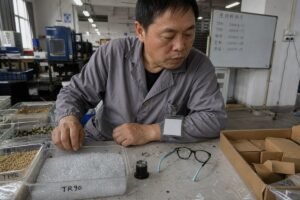
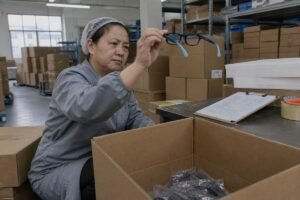
Our 5S-managed workshop in Taizhou runs a specific checkpoint just for lens retention, because we learned early that a lens which passes visual inspection can still fail in a backpack three weeks later. Good QC catches what the eye misses.
Look for documented lens-edging tolerance checks, controlled frame heating during lens insertion, a lens retention or push-out test on samples from every batch, hinge screw torque verification, and a final twist-and-flex inspection. Batch-level records and pre-shipment inspection reports confirm the process is real.
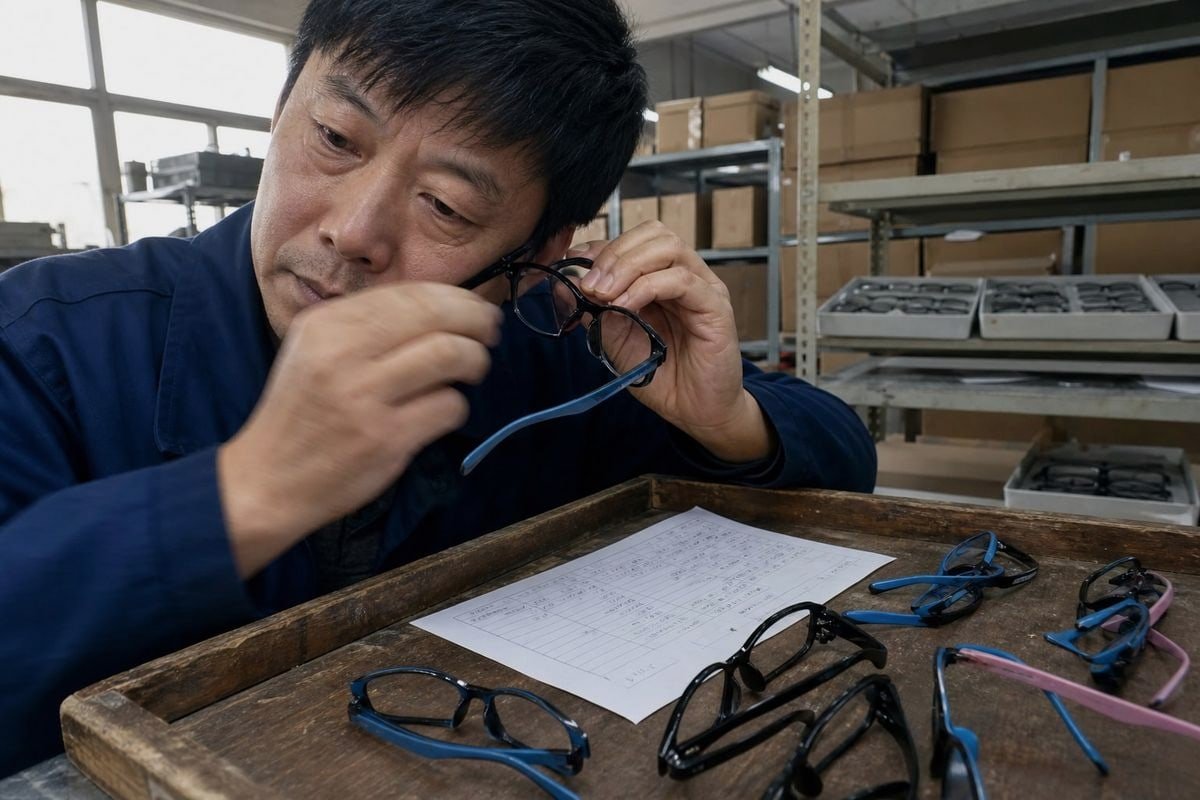
Quality control for lens retention is a chain, and it is only as strong as its weakest step. When we audit our own line — or when buyers audit us — these are the stages that matter, in order.
The five-step retention QC sequence
- Edging tolerance verification. The lens circumference must match the frame's groove circumference within a tight tolerance. Too small creates chatter; too large stresses and can crack the eyewire. Every edging machine needs regular calibration checks.
- Controlled frame heating at insertion. The frame front is warmed to a set temperature range so it expands, accepts the lens, and shrinks around it as it cools. Inadequate frame heating is one of the most common root cause 3s of early fallout — the material never "grips."
- Bevel and groove inspection. Operators check lens bevel depth against the groove, especially on thinner edges where the mechanical lock is weakest. Correct lens groove alignment should show a clean, gap-free seam all the way around.
- Hardware check. Loose hinge screws are the classic slow failure in metal-hinge kids frames, loosened by the vibration of daily play. We verify screw seating, and where a design uses spring hinges 4, we cycle-test them, since spring hinges also absorb the torque of one-handed removal.
- Final flex-and-twist test. A sample from each batch is twisted, flexed, and lightly impact-tested. The lens must stay seated with no rotation.
| QC Step | What It Catches | Question to Ask Your Supplier |
|---|---|---|
| Edging tolerance check | Lens sizing error | What tolerance do you edge to, and how often are machines calibrated? |
| Controlled heating | Weak initial grip | What is your insertion temperature process for TR90? |
| Bevel/groove inspection | Bevel-profile mismatch | How do you handle thin-edge or high-Rx demo lenses? |
| Screw torque check | Loose hinge screws | Do you verify hardware on every unit or by sampling? |
| Flex-and-twist sampling | Batch-level weakness | Can I see retention test records for my batch? |
A supplier who answers these questions with specifics — not slogans — is running real QC. One who hesitates is hoping you will not ask.
Should I switch OEM/ODM factories if my lenses keep falling out after delivery?
A procurement manager from Japan asked me this exact question last year, frustrated after two failed batches elsewhere. My honest answer surprised her: switch only after you have run one structured diagnosis, because switching blindly often reproduces the same failure with a new logo on the box.
Not immediately. First run a root-cause analysis: document failure timing, batch patterns, and symptoms, then give your factory one corrective-action cycle. Switch if failures are batch-wide, the factory denies the data, refuses process changes, or the same defect repeats after their promised fix.

The decision is really about whether your current partner has a process problem or a culture problem. Process problems are fixable in one production cycle. Culture problems — denial, blame-shifting, silence — never fix themselves.
Run the diagnosis before you decide
Collect data on every returned unit: when it failed, how it failed, and whether the failure clusters in one batch or spreads randomly. Random, late failures across batches usually mean a design issue — perhaps the frame needs deeper lens bevel depth, spring hinges, or a switch from rigid material to TR90. Clustered, early failures mean a process breakdown: skipped heating, an uncalibrated edger, or a rushed order. Share this data with your factory and ask for a written corrective action plan, not an apology.
Then judge the response. A serious partner will identify the root cause, show you the process change, and offer retention testing on the next batch. In our experience exporting to buyers in more than twenty countries, the factories that fail buyers are rarely the ones with a single bad batch — they are the ones that treat complaints as negotiations instead of engineering problems.
If you do switch, change the criteria too
Do not just change the name on the purchase order. Change what you demand. Ask for genuine flexible-material expertise in TPEE and TR90, not generic plastic. Ask whether the factory can support proper optical frame adjustment 5 guidance for your retail partners, since fit problems downstream get blamed on manufacturing. Ask to sample from existing tooling first — we keep roughly 800 existing styles precisely so brands can validate quality and lens retention on real products before committing to custom molds. Testing a proven style is the cheapest defect insurance you can buy.
And confirm the factory is actually a factory. Traders cannot fix a heating process they do not own.
結論
Lenses fall out when frames stop gripping them. Diagnose the failure pattern, choose TR90 or TPEE with real QC, and demand corrective action — then your kids optical frames will hold.
脚注
1. Authoritative NIH source defining the eyewire and its groove for lens retention in spectacle frames. ↩︎
2. Technical specifications of TR90 (Grilamid TR) regarding its elastic recovery and deformation properties. ↩︎
3. Methodology for identifying root causes of manufacturing defects and implementing corrective actions. ↩︎
4. Mechanical overview of hinge types, including spring-loaded mechanisms used to manage torque in eyewear. ↩︎
5. WHO guidelines on the quality, prescribing, and fitting of spectacles for pediatric populations. ↩︎
 English
  Español de México
  Deutsch
  Français
  日本語
日本語  العربية
  Português do Brasil