What Portability and Durability Trade-Offs Do Foldable Kids’ Sunglasses Have?
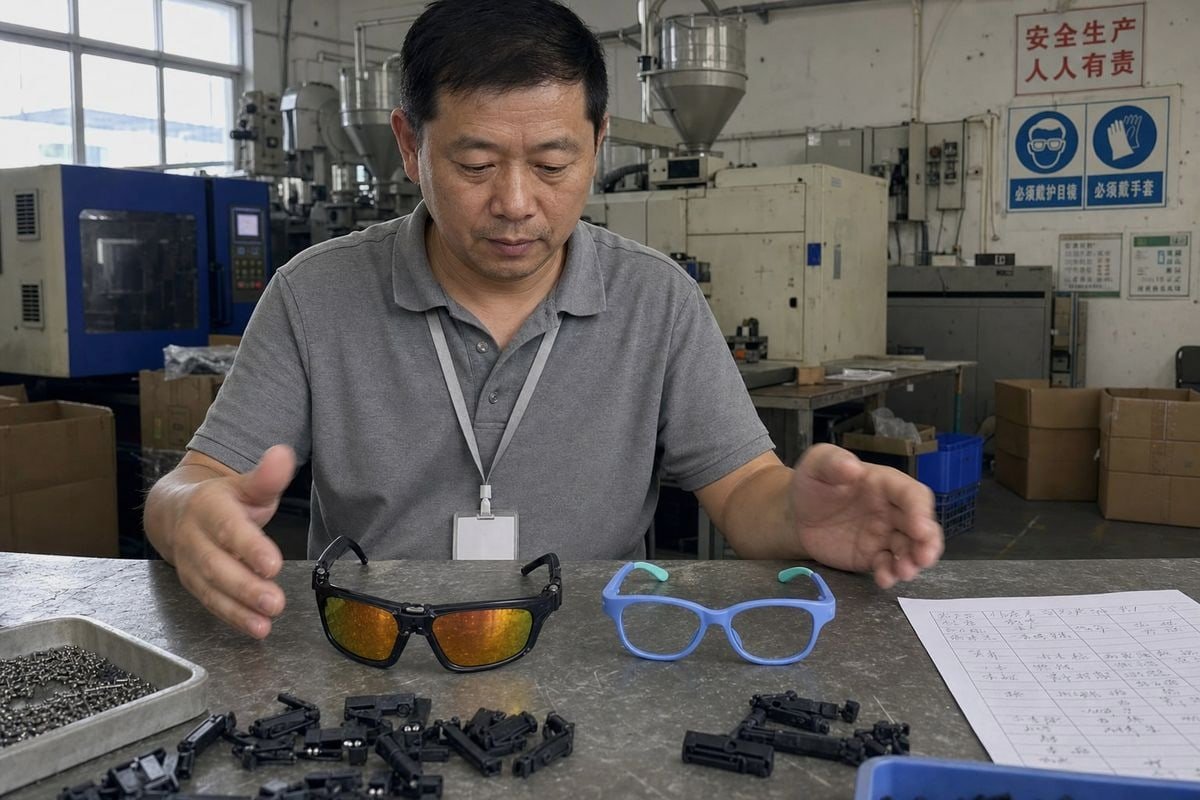
Foldable kids’ sunglasses look brilliant in a catalog. But on our production line in Taizhou, I’ve seen how one weak hinge can sink an entire retail launch. Buyers get returns. Parents get frustrated. Kids get broken glasses. The fix starts with understanding the trade-off before you place the order.
Foldable kids’ sunglasses trade added mechanical complexity for maximum portability. Extra hinges at the bridge and temples create the first failure points under repeated folding, so foldables suit travel-focused use, while one-piece flexible frames like TR90 or TPEE remain tougher for rough everyday play.
That is the short answer. The longer answer depends on hinge quality, frame material, your target age group, and how your customers actually use the product. Let me walk you through each factor.
How does folding stress affect the lifespan of TPEE and TR90 hinges over time?
A buyer from Australia once sent me a returned sample with a hinge that had drifted loose after one summer. Our engineers traced it to micro-fatigue in the hinge housing, not the screw itself. That taught me to look deeper than the obvious part.
Repeated folding cycles concentrate stress at the hinge housing, causing gradual wobble, screw loosening, and lens misalignment. TR90 and TPEE resist this fatigue better than standard plastics because their memory-flex properties absorb stress, but even flexible polymers degrade faster around metal hinge inserts under heavy cycling.
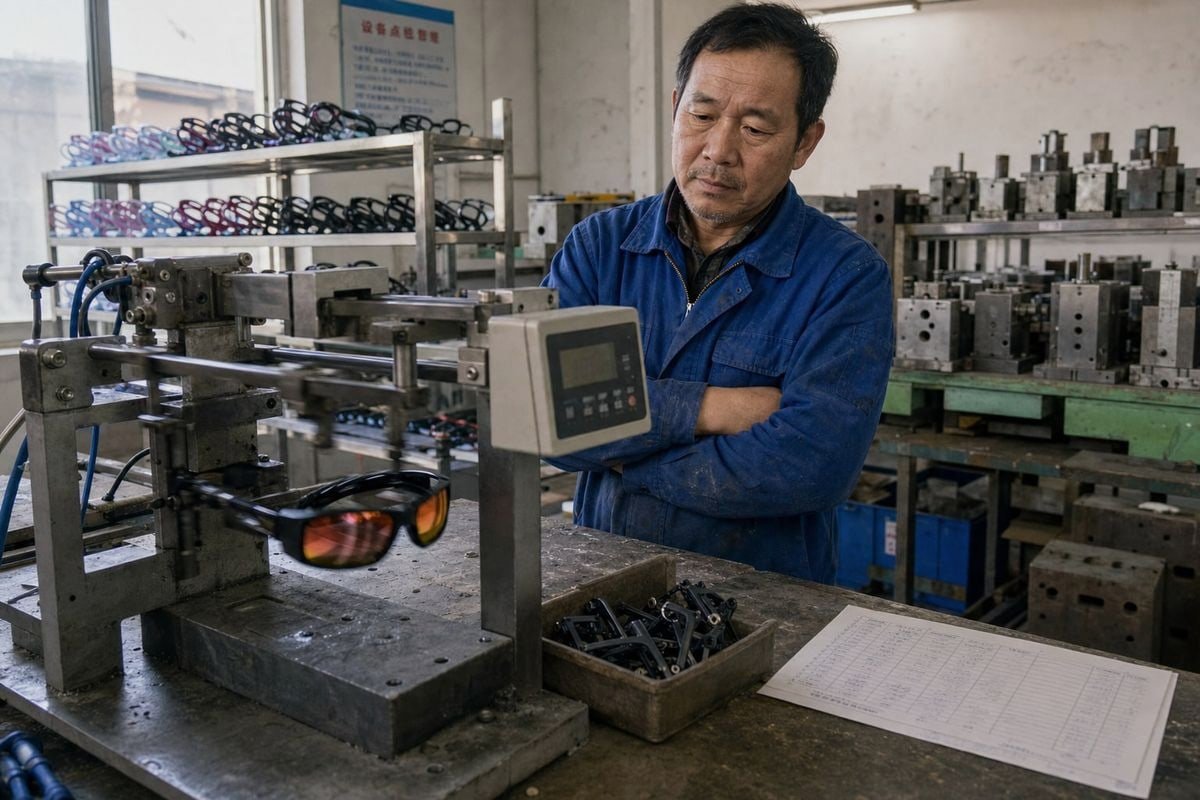
Folding stress is cumulative. Every open-and-close cycle flexes the material around the hinge pin. Over hundreds of cycles, that flex creates micro-fatigue in the frame housing. The result is not a sudden snap. It is a slow drift: a little wobble, then a loose fit, then subtle lens misalignment that can allow peripheral UV leakage past the lens edge.
Why material choice changes the fatigue curve
TR90 1 is a thermoplastic with genuine memory-flex behavior. It bends and bounces back. TPEE flexible frames go even further; they are soft, resilient, and very forgiving on a child's face. In our fifteen years of eyewear work, we have found that these materials distribute hinge mechanism stress across a wider area than rigid plastics do. Standard 射出成形プラスチック 2 concentrates stress right at the hinge bore, which is why cheap foldables fail early.
What the cycle numbers suggest
Treat published cycle counts as quality claims, not universal rules. Still, the pattern is consistent:
| Hinge quality tier | Typical reported lifespan | Common failure mode |
|---|---|---|
| Budget plastic hinge | Roughly 800–1,500 folds | Wobble, screw back-out, cracking |
| Mid-range reinforced hinge | Several thousand folds | Gradual loosening, alignment drift |
| Premium engineered hinge | 8,000–12,000+ folds | Cosmetic wear before mechanical failure |
Kids compound all of this. Children fold and unfold glasses far more often than adults, sometimes just for fun. The transforming action feels toy-like, which invites aggressive handling. So when we spec a foldable design, we assume the child will double or triple the normal cycle count. Frame longevity and wear must be engineered for that reality, not for adult behavior.
Can I get a compact, travel-friendly design without sacrificing frame strength for active kids?
One trade-off we weigh constantly in our workshop: every millimeter shaved off a folded profile usually costs you material thickness somewhere. The question is whether you cut it in a safe place or a structural one.
Yes, but only with deliberate engineering. Reinforced hinge hardware, thicker TR90 sections around joints, and shatterproof polycarbonate lenses preserve most frame strength. Expect a modest weight and temple-bulk penalty; a well-built foldable can serve active kids, though a one-piece flexible frame still wins on raw toughness.
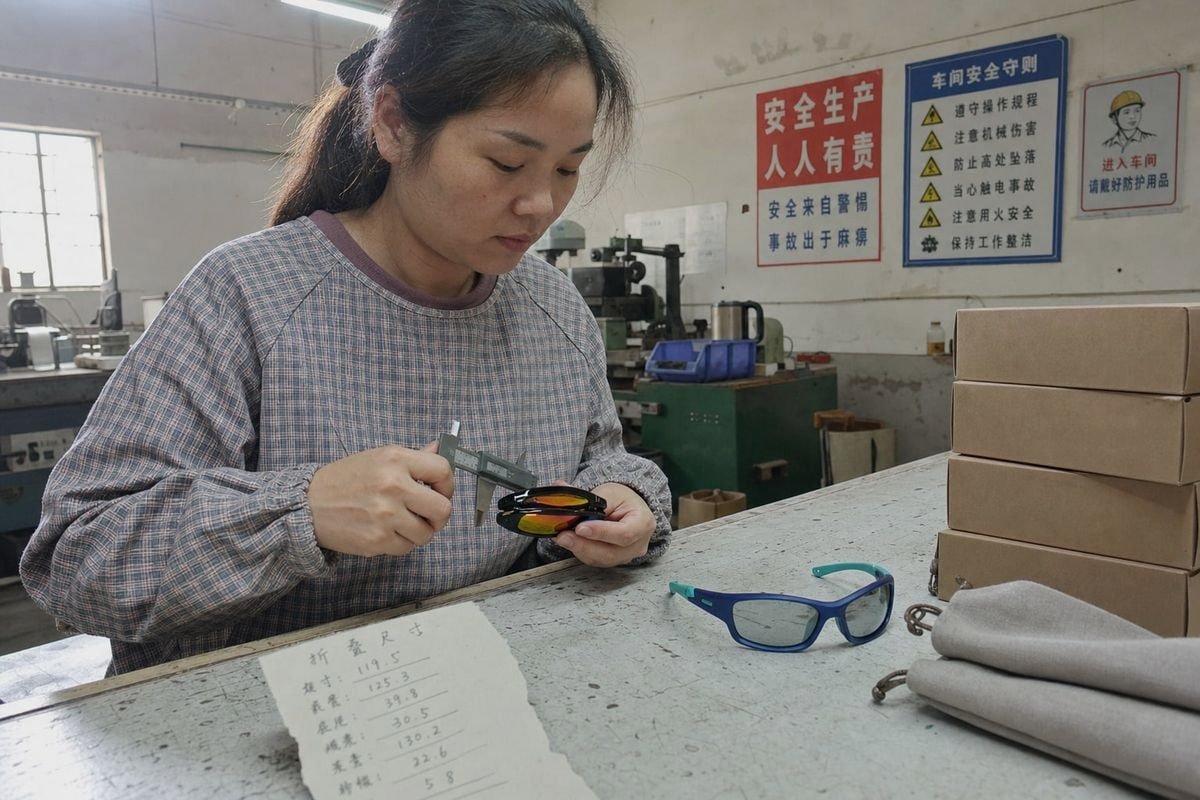
The portability payoff is real. A good foldable design can cut frame width by up to half, and packed volume by 75–80 percent compared with a rigid frame in a bulky case. Premium models fold down to around 15 mm thick. That means the glasses live in a lunchbox, a school bag pocket, or a parent's jacket. Compact folding also reduces the surface area exposed to scratches, so a foldable stored loose in a backpack can actually outlast a traditional frame stored the same careless way.
Where strength can be preserved
Structural integrity trade-offs are manageable if you focus on three zones:
- The bridge joint. This takes the most stress. It needs reinforced material or a metal insert, not a thin plastic living hinge.
- The temple hinges. Slightly thicker TR90 walls here add grams, not bulk the child will notice.
- The lens mount. Shatterproof ポリカーボネートレンズ 3 should be secured so folding torque never transfers into the lens groove.
Where compromises are acceptable
A foldable will always feel a touch bulkier at the temples because of the hinge hardware. It may also sit slightly less stable during sprinting or jumping if the hinge geometry is loose. For a travel-oriented product line, those are fair compromises. For a sports line built around wraparound shield styles — like the aerodynamic single-lens designs we produce with mirrored gradient lenses — we recommend skipping the folding feature entirely. Wraparound performance frames depend on continuous curvature, and cutting hinges into that curve weakens exactly what makes them protective. A compact storage case is the smarter portability answer for that category.
What quality control checks should I ask my manufacturer about for foldable frame durability?
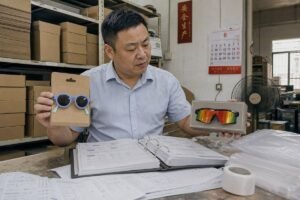
When a Japanese brand audited our 5S-managed workshop last year, their first question was not about price. It was about our hinge cycle testing protocol. That is exactly the right instinct, and it is the question I wish more first-time buyers asked.
Ask for hinge cycle testing data, torque retention checks on screws, drop and twist impact resistance testing, lens retention verification after folding, UV400 protection standards confirmation, and material safety certificates proving BPA-free non-toxic materials. A serious factory can show documented procedures for each.
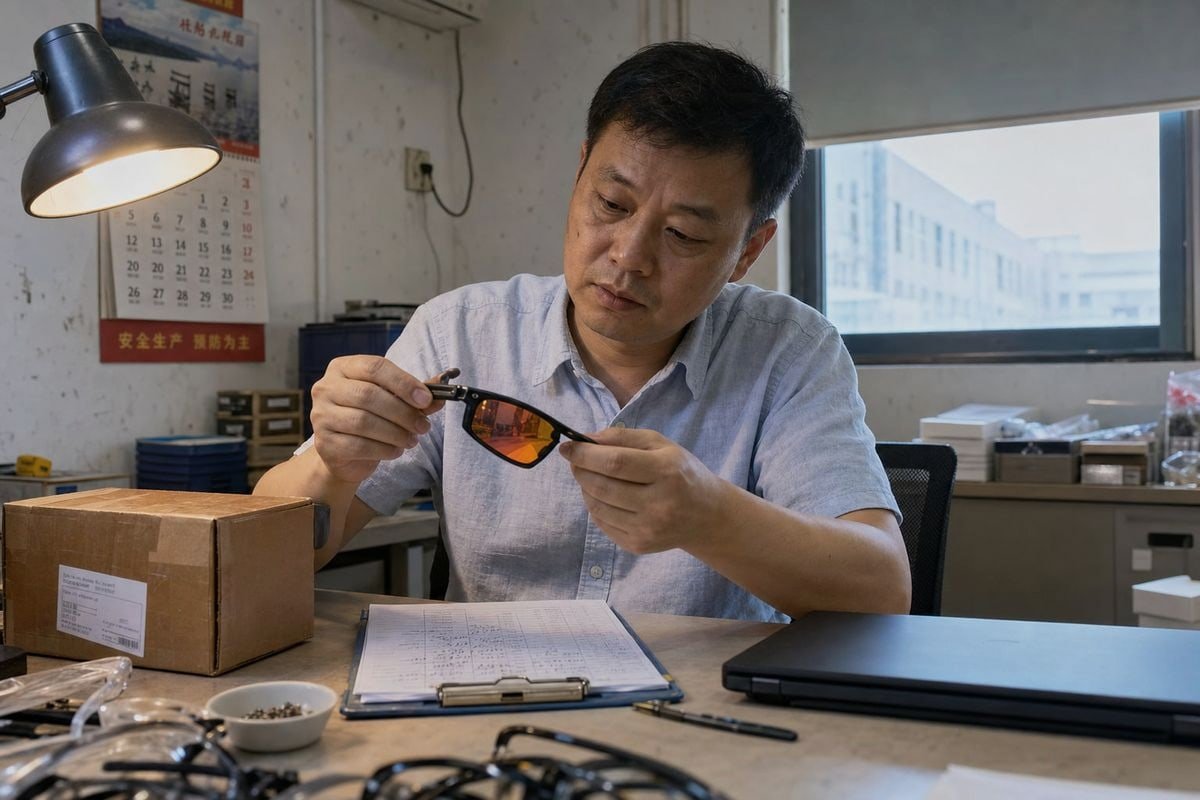
Quality control for foldables needs to go beyond the standard checks used for one-piece frames. The moving parts create new inspection points, and each one deserves a documented procedure. Here is the checklist we recommend our B2B customers use when qualifying any supplier, including us:
| QC check | What it verifies | What to ask for |
|---|---|---|
| Hinge cycle test | Folds survived before wobble | Cycle count and pass criteria |
| Torque retention | Screws stay tight over time | Torque specs and thread-lock method |
| Drop and twist test | Impact resistance testing at joints | Test height, surface, and sample size |
| Lens retention | Lenses stay seated after folding | Push-out force results |
| Alignment check | Frame geometry holds after cycling | Optical alignment tolerance |
| UV transmission | UV400保護基準 4 met | Lens test reports per batch |
| 材料安全性 | BPA-free non-toxic materials 5 | Third-party chemical test certificates |
| Hinge contamination | Resistance to sand and debris | Crevice design review |
Why the contamination check matters more than you think
Folding joints create deep crevices. Kids fill those crevices with sunscreen, sweat, and beach sand. That mixture causes two problems: mechanical grinding that accelerates hinge wear, and hygiene concerns from trapped residue. On our line, we review joint geometry at the design stage to minimize trap points, and we advise buyers to include cleaning guidance on packaging inserts.
Small parts and child safety
Foldable mechanisms often contain small pins and screws. For products aimed at toddlers, this is a real hazard: loosened parts can become choking or scratching risks 6. This is one reason we steer younger age groups toward our one-piece TPEE flexible frames and reserve folding designs for children roughly eight and up.
Are there trade-offs between lightweight folding mechanisms and impact resistance I should consider?
Early in my export career, I learned a hard lesson: a European distributor loved an ultra-light folding sample at the trade show, then reported cracked bridges after their first playground season. Light and tough are not the same thing, especially where hinges live.
Yes. Lighter folding mechanisms use thinner hinge walls and smaller fasteners, which reduces impact resistance at the joints. A dropped foldable concentrates shock at its hinges, while a one-piece flexible frame absorbs the same shock across its whole body. Balance weight savings against reinforcement needs.

Weight matters for children. A heavy frame slides down small noses, gets removed, and gets lost. So the temptation to shave grams is understandable. But every gram removed from a hinge zone is structural material you no longer have when the glasses hit concrete.
How impact behaves differently in each design
A one-piece TR90 or TPEE frame handles a drop as a single flexible body. It bends, absorbs, and springs back. A foldable frame handles the same drop as three or four rigid segments connected by pivots. The shock funnels into the pivots — the weakest, thinnest points. That is a fundamental physics disadvantage, not a manufacturing defect.
| 要因 | Lightweight foldable | One-piece flexible frame |
|---|---|---|
| Weight on the face | 素晴らしい | 非常に良い |
| Drop survival | Fair to good | 素晴らしい |
| Twist tolerance | Limited by hinges | Full-frame flex recovery |
| Packed size | 素晴らしい | 中程度 |
| Best user | Careful kids 8+, travel use | Toddlers and active play |
Practical ways to balance the trade-off
There are sensible middle paths. Polymer bushings inside metal hinges reduce weight while cushioning impact. Pairing shatterproof polycarbonate lenses with polarized lens technology 7 keeps optical performance high without adding frame mass. And emerging modular designs even turn the hinge weakness into a benefit: parents replace a single broken segment instead of the whole frame. For most kids' brands we work with, though, the honest recommendation is segmentation. Offer a foldable as the travel accessory in your range, and build your everyday hero product on a flexible one-piece platform. Two SKUs, two use cases, fewer returns.
結論
Foldable kids' sunglasses solve a real parent problem — glasses that never get carried get lost or forgotten. But hinges are the price of packability. Match the design to the use case: foldables for travel-focused, careful kids; flexible one-piece TR90 or TPEE frames for rough daily play. Demand documented hinge testing, verified UV400 lenses, and safe materials from your supplier, and the trade-off becomes a deliberate product decision instead of a costly surprise. If you want to explore both routes across our existing style library, my team and I are glad to help you build a range that balances portability and durability the right way.
脚注
1. Background on thermoplastic materials clarifies TR90’s memory-flex properties mentioned throughout. ↩︎
2. Background on injection molding clarifies manufacturing process referenced when comparing hinge materials. ↩︎
3. Wikipedia background explains polycarbonate’s shatter-resistance relevant to lens durability claims. ↩︎
4. Official FDA guide that explicitly defines UV400 ratings and sunglass safety requirements. ↩︎
5. EPA resource on safer chemical choices supports claims about non-toxic material certification. ↩︎
6. CDC child safety resource supports the hazard warning about small hinge parts for toddlers. ↩︎
7. Explains the optical principle behind polarized lenses referenced in the impact-resistance discussion. ↩︎

 English
  Español de México
  Deutsch
  Français
  日本語
日本語  العربية
  Português do Brasil