What Key Parameters Does EN ISO 12312-1 Specify for Kids’ Sunglasses?
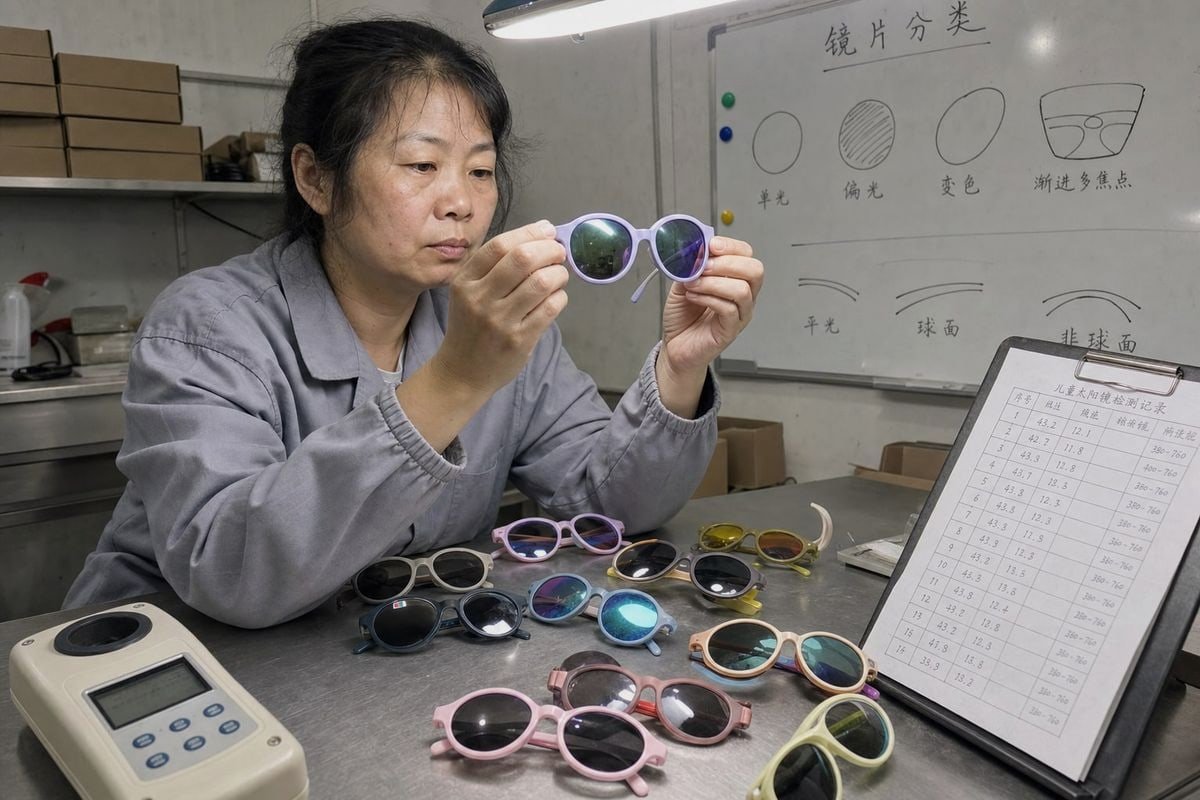
Buyers often ask me about EN ISO 12312-1 1 for kids’ sunglasses after a shipment gets flagged in Europe. One missed parameter can freeze inventory, and our production line sees this risk daily.
EN ISO 12312-1 specifies UV protection through spectral transmittance limits, luminous transmittance filter categories 0–4, optical quality tolerances for refractive and prismatic power, mechanical strength and impact resistance, child headform fit testing, side coverage for category 4 lenses, and mandatory labeling and user information.
That single sentence covers a lot of ground. Below, I break each parameter into practical checks you can use when sourcing or auditing children’s sunglasses.
What UV Protection and Lens Category Requirements Should I Verify Under EN ISO 12312-1?
During a lens audit last spring, our QC team rejected an entire batch that claimed UV400 protection but failed spectral transmittance 2 measurement. Claims mean nothing without lab data.
Under EN ISO 12312-1, lenses must block virtually all UV radiation up to 380 nm, with transmittance below 0.05% for true 100% UV protection. Lenses fall into five filter categories (0–4) based on luminous transmittance, and categories 3 and 4 must never overlap.
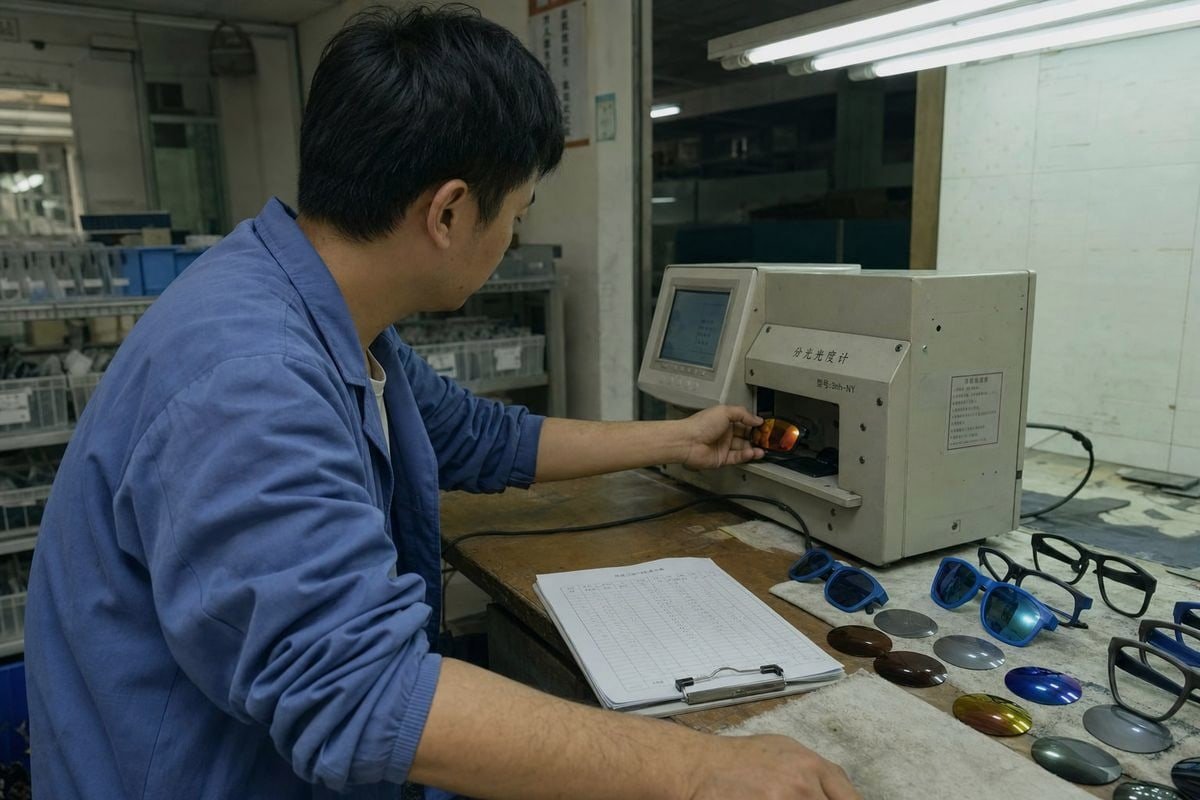
UV protection is the parameter parents notice first. But the standard treats it as a measurable spectral transmittance requirement, not a marketing phrase. When we source lens blanks for our TR90 and TPEE frames, we require spectrophotometer reports for every lens color, including mirrored gradients and polarized options. A dark gray lens can still leak UV if the raw material lacks proper absorbers. Darkness and protection are separate properties.
Filter Categories Explained
Luminous transmittance tells you how much visible light 3 passes through the lens. The standard assigns each lens to one of five filter categories. Adjacent categories may not overlap by more than ±2 percentage points, and there is zero overlap between categories 3 and 4.
| Filter Category | Luminous Transmittance | Typical Use for Kids |
|---|---|---|
| 0 | 80–100% | Fashion, indoor, no real glare use |
| 1 | 43–80% | Overcast days, light shade |
| 2 | 18–43% | Average sunlight, playground use |
| 3 | 8–18% | Bright sun, beach, most kids' sunglasses |
| 4 | 3–8% | Extreme glare: glaciers, high altitude — not for driving |
For children's collections, we recommend category 3 as the default. It gives strong glare reduction for outdoor play. Category 4 has special rules, including side protection for kids, which I cover later. One more optical check worth knowing: wide-angle scattering, or haze, must stay very low — one industry guide cites a 3% ceiling — because scattered light washes out contrast and strains young eyes.
How Do I Ensure My Sunglasses Frames Meet EN ISO 12312-1 Safety and Durability Standards?
Fifteen years of molding children's frames taught our engineers one thing: a frame that survives a drop test can still fail a child who chews the temple tips.
Frames must pass mechanical strength and robustness tests, resist impact without producing sharp fragments, withstand solar radiation aging and ignition testing, and show no surface defects. For kids, flexible materials like TR90 and TPEE reduce breakage risk while maintaining structural integrity under stress.
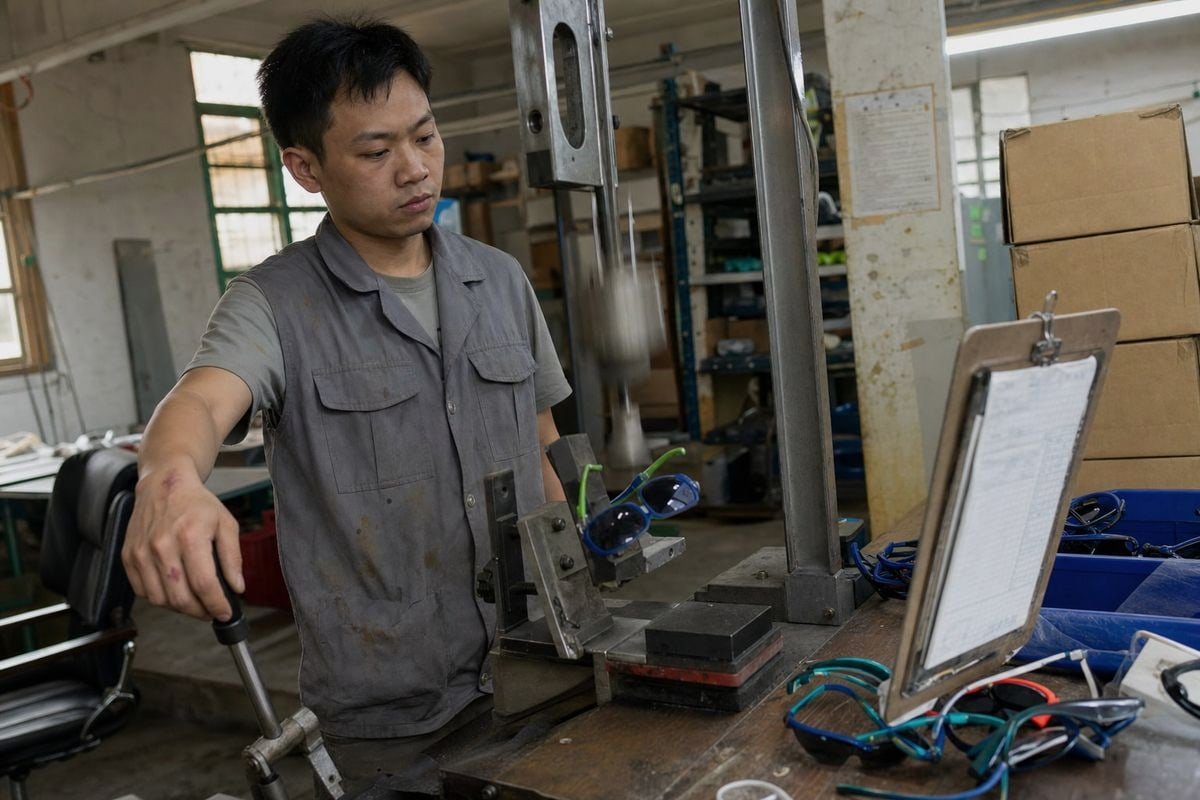
The standard checks the complete product, not just the lens. Mechanical strength testing applies static load and deformation checks to the frame and lens assembly. Impact resistance testing confirms that the eyewear will not shatter into dangerous shards under a defined strike. This matters far more for children than adults. Kids sit on their sunglasses, bend them backward, and drop them onto concrete. In our 5S-managed workshop, we simulate this abuse before any of our roughly 800 existing styles reaches a buyer's shelf.
Why Material Choice Drives Compliance
Rigid, brittle plastics pass initial tests but crack after UV aging. The standard includes resistance to solar radiation 4 and resistance to ignition for exactly this reason. A frame that becomes brittle in sunlight is a hidden hazard.
| Durability Parameter | What the Standard Checks | Practical Risk If Failed |
|---|---|---|
| Mechanical strength | Deformation under load | Frame snaps during normal wear |
| 耐衝撃性 | Behavior under defined strike | Sharp fragments near a child's eye |
| Solar radiation resistance | Properties after UV aging | Brittleness, color fading, warping |
| Ignition resistance | Reaction to a heated rod | Melting or burning material |
| Surface and material quality | Defects, burrs, rough edges | Skin irritation, scratched lenses |
There is also a chemical dimension. Metal parts such as hinge screws should meet nickel release limits, since prolonged skin contact with nickel can trigger allergies. Buyers in Europe increasingly ask us for this test alongside the optical reports, and some baby brands now request toy-grade migration testing on mouthable components too. We support both, because a two-year-old will absolutely put temple tips in their mouth.
Which Labeling and Marking Requirements Do I Need to Follow for EN ISO 12312-1 Compliance?
A distributor in Europe once returned a retail-ready order to us — not for optics, but because the hangtag lacked the filter category. Packaging is compliance, too.
Compliant kids' sunglasses need CE marking, the manufacturer or importer's identification, the filter category number, a reference to EN ISO 12312-1, and user information covering suitability for driving, category 4 restrictions, and care instructions, supplied on the product, packaging, or accompanying leaflet.
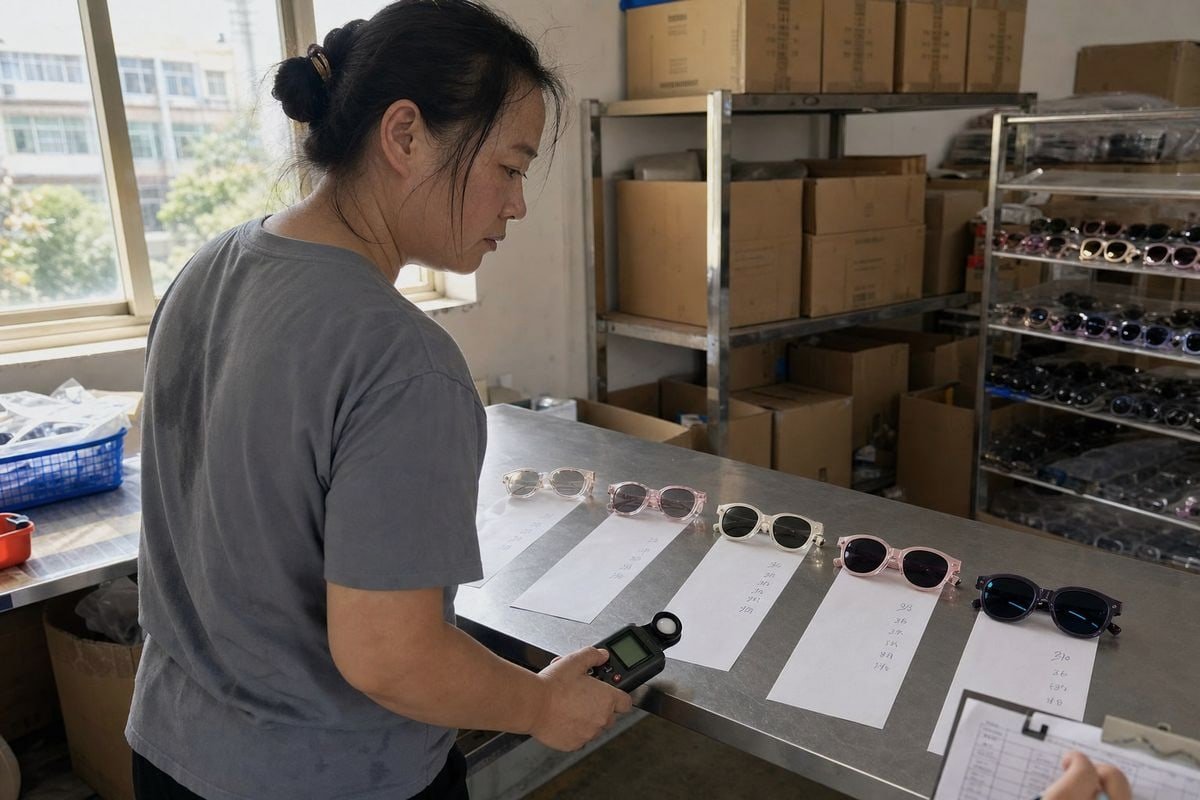
Labeling is where many otherwise excellent products stumble. Sunglasses sold in the EU are 個人用保護具 5 under Regulation (EU) 2016/425 6, and EN ISO 12312-1 is the harmonized standard that supports the CEマーキング. The marking itself is only the visible tip. Behind it sits a Declaration of Conformity and a technical file that customs authorities can request at any time.
What Must Appear and Where
Some information must be traceable to the product itself; other items can live on packaging or an insert. When we prepare OEM packaging for our buyers — custom boxes, pouches, and hangtags — we build a labeling checklist into the artwork approval stage so nothing gets missed at print.
| Labeling Element | Typical Location | なぜ重要なのか |
|---|---|---|
| CEマーキング | Frame or hangtag/packaging | Legal market access in the EU |
| Manufacturer/importer name and address | Packaging or insert | Traceability under PPE rules |
| Filter category (0–4) | Hangtag or sticker | Tells parents the intended light conditions |
| Standard reference (EN ISO 12312-1) | Packaging or insert | Shows the tested benchmark |
| "Not suitable for driving" (where applicable) | User information | Category 4 and some tints restrict road use |
| Special lens notes (polarized, photochromic, gradient) | User information | Prevents misuse and manages expectations |
Two extra points for children's lines. First, warnings should state that sunglasses are not eye protectors against mechanical hazards — they are sun filters, not safety goggles. Second, if your product overlaps with baby age groups, expect retailers to ask for additional consumer information about supervised use. Clear, honest labeling protects your brand as much as it protects the child.
What Testing and Certification Steps Should I Expect When Sourcing EN ISO 12312-1 Compliant Kids' Sunglasses?
When a new buyer from Australia asked us for "the certificate," we walked them through why one PDF is never the whole story. Verification is a process.
Expect accredited laboratory testing of spectral transmittance, refractive and prismatic power, mechanical robustness, and fit on pediatric headforms 1-C6 and 1-C12, followed by a Declaration of Conformity, a technical file, CE marking, and ongoing batch-level quality control on transmittance and construction.
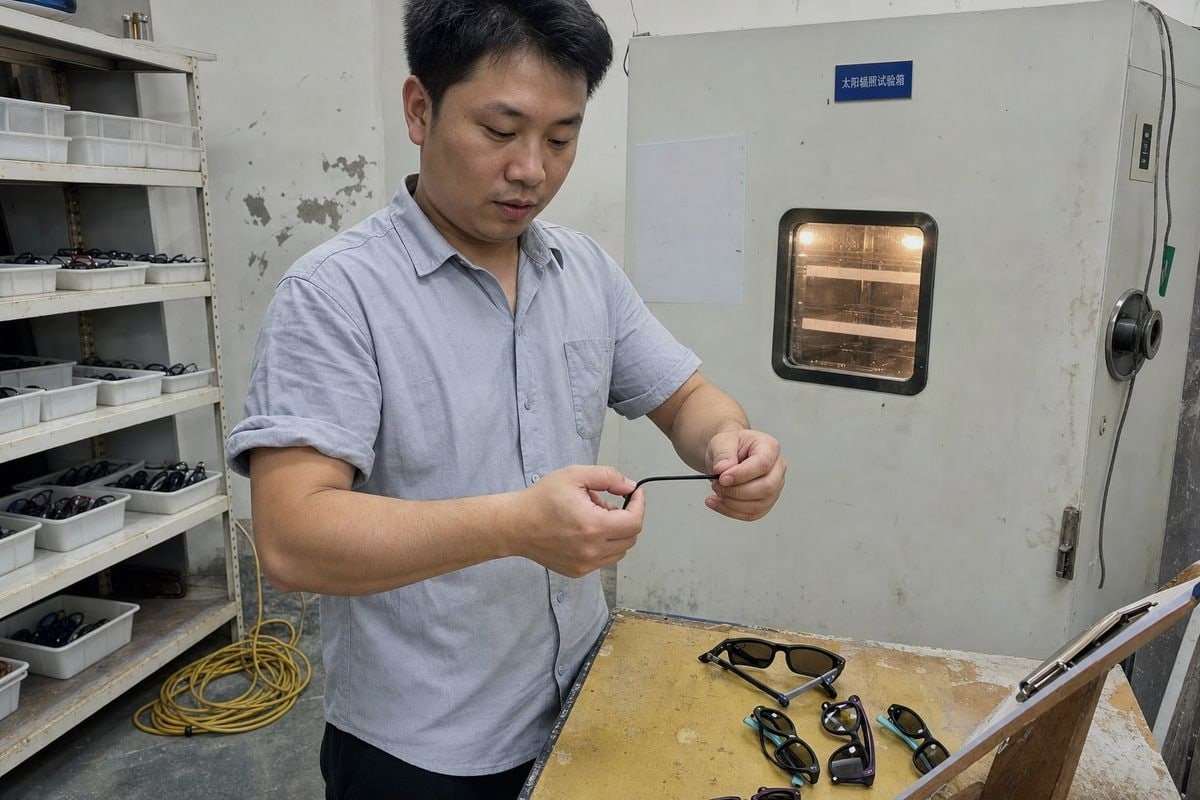
The 2022 edition modernized how children's products are tested, and this is where kids' sunglasses genuinely differ from adult ones. Fit and coverage tests now use dedicated children's headforms from ISO 18526-4 7, including the 1-C6 and 1-C12 variants that represent younger face geometries. A frame that covers an adult headform properly can leave large light gaps on a six-year-old's face. This is one reason we design our TR90 fronts and flexible TPEE temples around real children's head dimensions rather than scaling down adult styles.
The Sourcing Verification Sequence
Here is the sequence I recommend to procurement managers:
- Request current test reports from an accredited lab, referencing EN ISO 12312-1:2022, not the older 2013 edition. Older reports may miss the updated headforms, the revised local refractive power check using a grid image, and the tightened uniformity rule (30 mm measurement circle, 15% limit for most categories).
- Match the report to the actual product. Lens color, coating, and frame model must correspond. A report for a gray lens does not cover a mirrored orange gradient shield.
- Verify optical power tolerances. Spherical, cylindrical, and prismatic refractive power must sit within the standard's limits, because excess prismatic deviation displaces images and causes eye strain in developing vision.
- Confirm special-lens clauses. Polarized, photochromic, gradient, and category 4 lenses have their own requirements — including optional photochromic activation reporting at +5°C and +35°C, and mandatory side protection for kids' category 4 models.
- Review the Declaration of Conformity and technical file, then agree on batch QC: transmittance spot checks, hinge and screw inspection, and packaging label verification before shipment.
A factory that can explain each of these steps, rather than just email a certificate, is a factory you can build a brand on. That transparency is exactly how we have kept long-term partners across 20+ countries.
結論
EN ISO 12312-1 turns vague safety claims into measurable parameters: spectral transmittance, filter categories, optical power tolerances, impact resistance, child headform fit, and honest labeling. Verify each one, and your kids' sunglasses line stands on solid ground.
脚注
1. Official ISO page for the EN ISO 12312-1 standard specifying sunglasses requirements. ↩︎
2. Wikipedia entry explaining the physics of transmittance and spectral measurement. ↩︎
3. Wikipedia overview of the visible spectrum and light properties. ↩︎
4. Wikipedia article on polymer degradation caused by solar radiation and UV exposure. ↩︎
5. European Commission portal for personal protective equipment safety and compliance. ↩︎
6. Official EU legislative text for Regulation (EU) 2016/425 on personal protective equipment. ↩︎
7. ISO standard detailing headforms used for testing eye and face protection. ↩︎


 English
  Español de México
  Deutsch
  Français
  日本語
日本語  العربية
  Português do Brasil