TPEE製子供用サングラスは熱い車内で変形する?耐熱性の限界は?
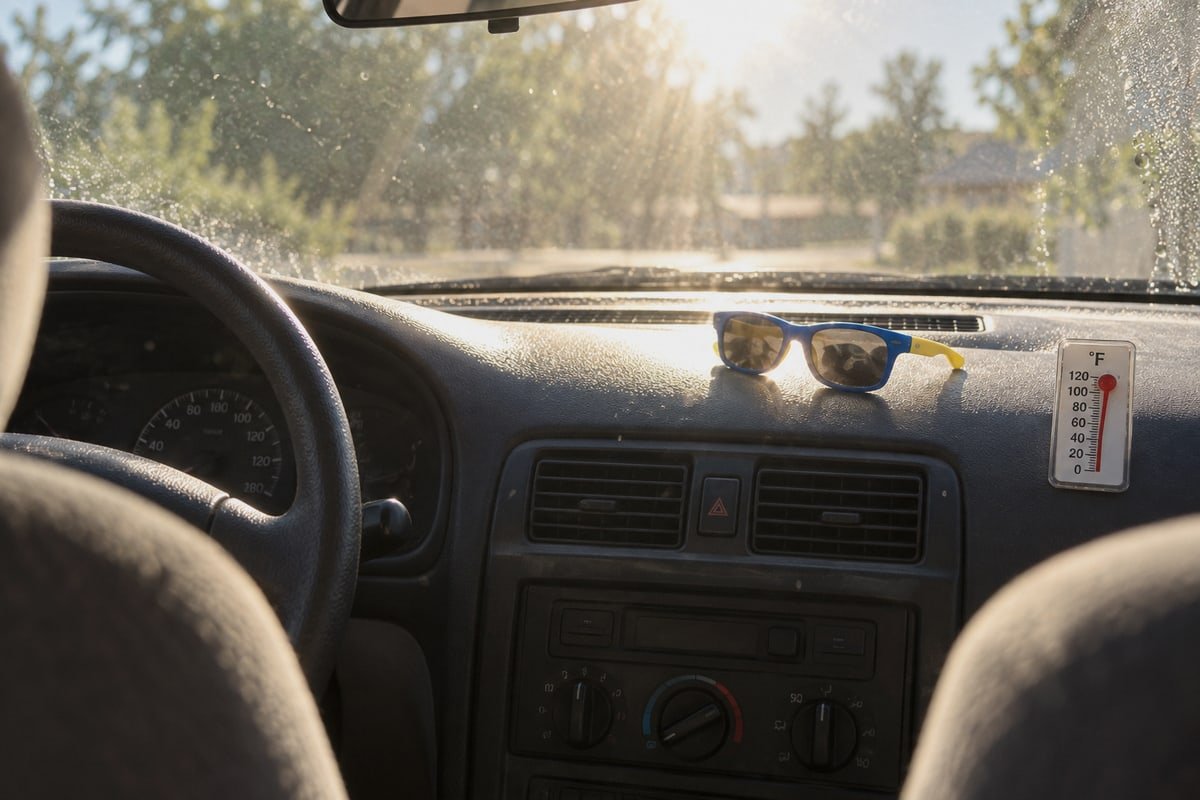
毎年夏になると、どこかの親がTPEE製子供用サングラスが熱いダッシュボードの上で曲がっているのを見つけます。その懸念は私たちの台州の生産ラインにもバイヤーからの質問として届くため、私たちは真剣に受け止めています。.
TPEE製の子供用サングラスは、TPEEの融点が180〜220℃であるのに対し、車内は最高で約90℃になるため、暑い車内でも溶けません。ただし、一部のTPEEグレードは70℃前後から軟化し始めるため、長時間の暴露は一時的な歪み、レンズの緩み、または圧力下での永久的な変形を引き起こす可能性があります。.
その短い答えには多くの詳細が隠されています。本当の質問はフレームが溶けるかどうかではありません。安全マージンがどこにあるのか、そして何千ものペアを注文する前にそれをどのように確認するかということです。以下では、テスト、温度限界、材料比較、そしてサプライヤーに尋ねるであろう質問について説明します。.
極端な夏の暑さでTPEEフレームが形状を維持できるかどうかをテストするにはどうすればよいですか?
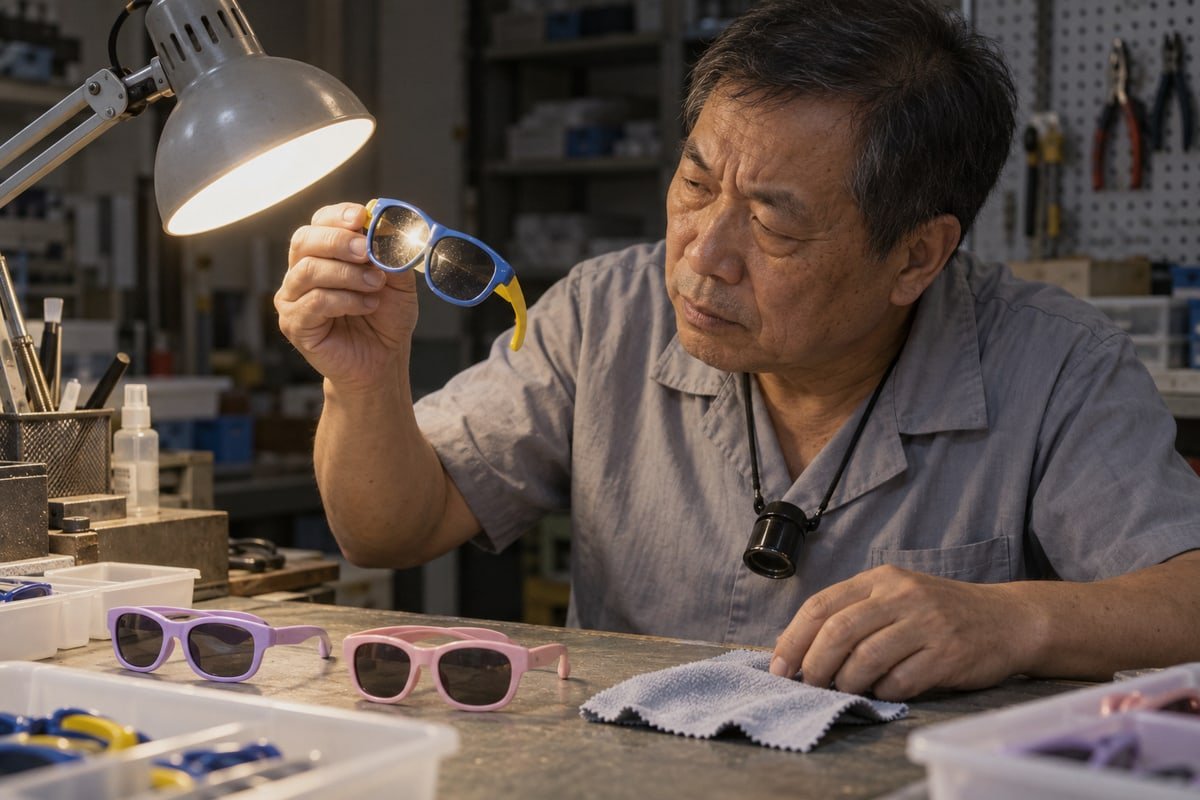
私たちのQC検査官の一人は、5Sワークショップのベンチの隣に小さなオーブンを置いています。新しいTPEEテンプルデザインが出荷される前に、そこで一日の午後を過ごします。.
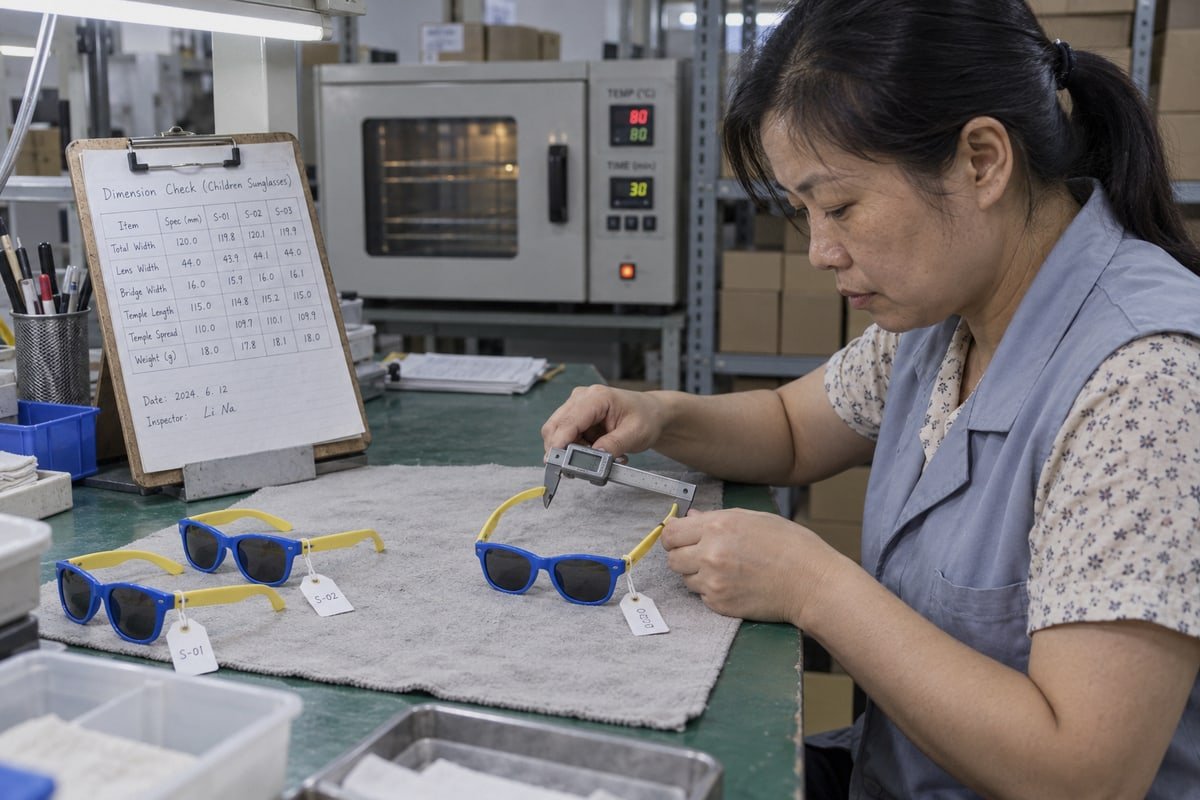
管理されたオーブンでTPEEフレームを70℃、80℃、90℃でそれぞれ2〜4時間加熱し、冷却後にテンプル幅、ブリッジ幅、レンズ保持力を測定してTPEEフレームをテストします。このサイクルを数回繰り返し、永久圧縮永久ひずみをチェックするために、サンプルに重りをかけて負荷をかけます。.
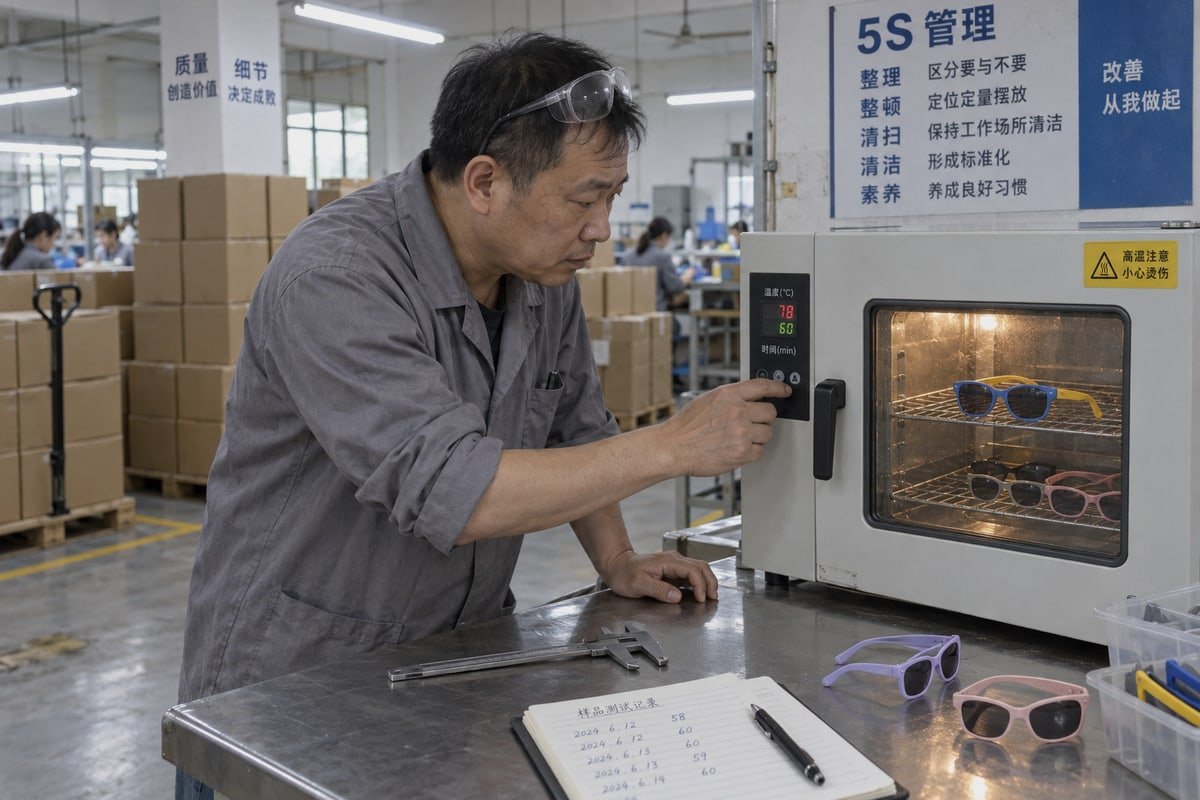
意味のあるチェックを実行するために材料ラボは必要ありません。信頼できるサーモスタットを備えた小さなオーブン、ノギス、明るいランプ、そしていくつか予備のある十分なサンプルが必要です。バルク注文の前に独自の証拠が欲しいバイヤーに私が推奨するプロセスは次のとおりです。.
サンプルで実行できる5段階のホットカーシミュレーション
- サンプルを室温で24時間コンディショニングします。ベースライン測定値を記録します:先端でのテンプルの広がり、ブリッジの幅、レンズの座面の深さ、ヒンジの張力。.
- 最初のセットを70°Cで2時間加熱します。これは少なくとも1つのTPEEグレードに記載されている熱変形温度に相当するため、より弱い配合の早期軟化が明らかになります。.
- 2番目のセットを90°Cで4時間加熱します。これは強い日差しの下の駐車中の車の現実的なピーク内部温度であり、アセテートや標準的なプラスチックが形状を失う60°C〜70°Cを大きく上回っています。.
- 各サンプルを1時間冷却してから、再度測定します。各数値をベースラインと比較します。.
- 3番目のセットを90°Cのオーブンと20°Cの部屋の間で5回サイクルします。これは、熱い車とエアコン完備の家との間でメガネを移動させる熱衝撃を模倣します。.
| 何を測定するか | それをチェックする方法 | 警告サイン |
|---|---|---|
| テンプルの広がり | フレームを開いた状態で置いたテンプルの先端のノギス | 冷却後に広がりが生じ、元に戻らない |
| 鼻梁の幅 | 最も狭い内側のポイントのノギス | ブリッジが開いたり閉じたりして、髪の毛の幅以上になる |
| 何も外れない(EN 71-1ロジック) | レンズの後ろからの穏やかな親指の圧力 | レンズがクリックしたり、回転したり、溝から外れたりする |
| ヒンジの感触 | 10回開閉する | 緩い、ぐらぐらする、またはざらざらした動き |
| 表面仕上げ | 低い角度からの明るいランプ | 鈍い斑点、ブルーム、または曇った残留物 |
圧縮セットを捉えるために荷重を追加する
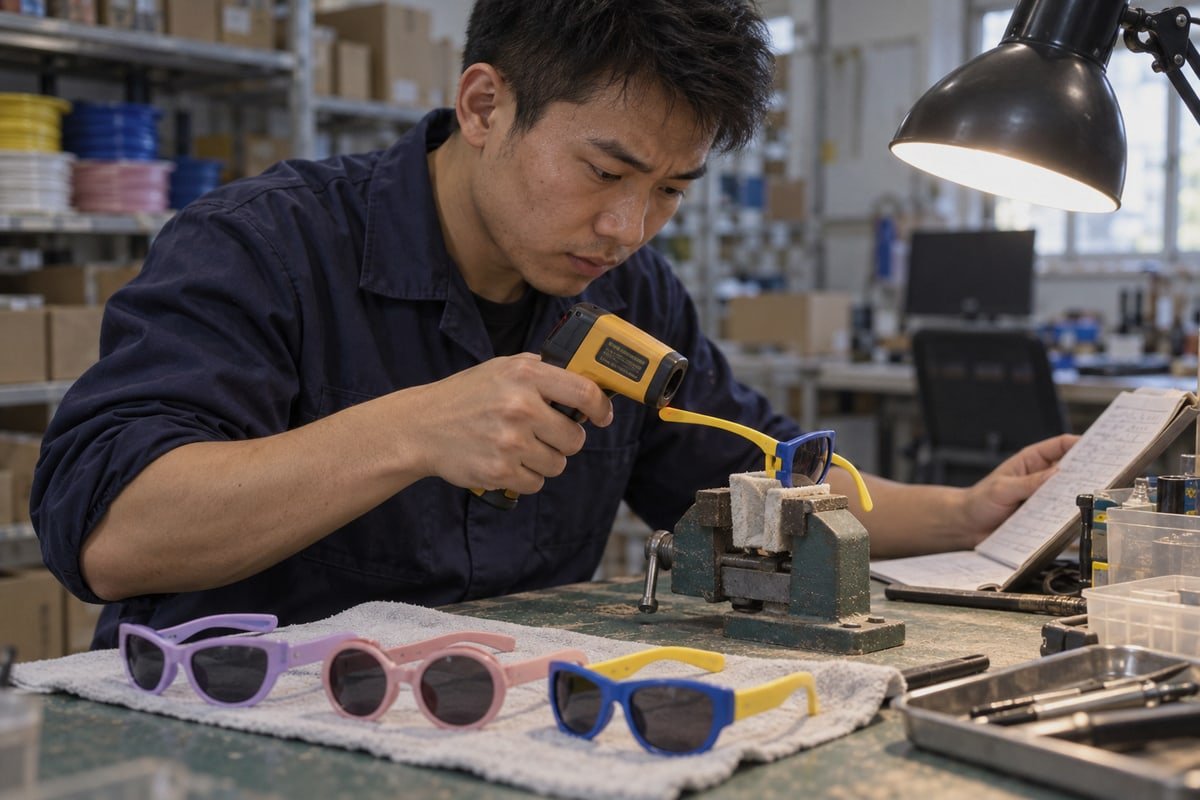
TPEEは記憶素材です。通常、冷却後に成形された形状に戻ります。例外は圧力です。軟化したフレームが重いバッグの下に挟まれた場合、 圧縮セット, を引き起こす可能性があり、その変形は永続的です。したがって、90°Cの実行中に1つのサンプルに中程度の重量をかけます。冷却後、テンプルがまだ平行に配置されているか確認します。.
レンズを忘れないでください
フレームは物語の半分にすぎません。基材とコーティングが異なる速度で膨張するときに、細かい網目状の亀裂として現れるクレイジングを探してください。偏光フィルターと接着剤はフレーム自体よりも熱に敏感であるため、 偏光レンズ 1 気泡やエッジの剥がれ.
TPEEサングラスは、品質が低下する前にどのくらいの温度範囲に安全に耐えられますか?
がないか確認してください。最後に、レンズを清潔な布で拭きます。低グレードのTPEEブレンドは熱の下でガスを放出し、通常のクリーニングに抵抗する曇ったフィルムを残す可能性があります。.
高品質TPEEサングラスは、約120℃まで機械的強度と柔軟性を完全に維持し、180℃から220℃の間でのみ融解します。長期的な使用範囲はグレードによって約-40℃から150℃までですが、耐熱たわみ値は43℃から193℃まであり、一部の配合では70℃近くで軟化します。.
より柔らかいTPEEは幼児のこめかみに優しく感じられますが、より柔らかいグレードは通常熱の下で早く柔らかくなります。私たちは、開発するすべての子供用フレームでそのトレードオフを考慮します。 バイヤーはしばしば私に2つの矛盾する文書を送ってきます。1つは-70°Cから180°Cのサービス範囲を約束するサプライヤーのパンフレットです。もう1つは、柔らかいTPEEフレームが駐車中の車で伸びたという消費者レビューです。どちらも真実である可能性があります。それらの間のギャップは、 熱可塑性ポリエステルエラストマーの特性.
が配合によって変化すること、およびいくつかの異なる熱効果の違いから生じます。
| 温度 | What happens to TPEE | TPEEに何が起こるか |
|---|---|---|
| 数字がどこから来るか | 氷点下 2 軟質セグメントのガラス転移温度は0°Cよりはるかに低いため、フレームは冬でも曲げられます | -40°Cから-70°Cの低エンドサービスを引用する材料参照 |
| 約43°C | 要求の厳しい負荷の下で一般的なデータシートで見られる最低の熱たわみ値 | 43°Cから193°Cのデータシート範囲 |
| 約70°C | 特定のグレードに記載されている熱変形温度;早期の軟化が始まる | 個々のグレード参照 |
| About 90°C | Typical peak temperature inside a closed car in strong sun | Hot-car measurements |
| Up to 120°C | Mechanical strength and flexibility 3 remain intact in good grades | Material property summaries |
| 150°C to 180°C | Upper end of long-term service depending on grade | Supplier claims, formulation-dependent |
| 180°C to 220°C | Melting point; the frame physically melts | Polymer data |
Notice where 90°C falls in that table. It is far below the melting point. It is also above the 70°C figure for the weaker grade. That overlap is the whole story. Whether your frames survive depends on which grade sits inside them.
Melting, softening, warping, and permanent set are four different things
Melting only happens near 200°C, so a car will never melt a TPEE frame. Softening starts near the heat-deflection temperature 4, and the frame becomes easier to bend. Warping is temporary shape loss while soft, and TPEE's memory usually reverses it on cooling. Permanent set happens when a soft frame is stressed, stretched, or crushed long enough that the polymer chains relax into a new position. Thin temples, slim nose bridges, and springy wraparound shapes reach that point sooner than chunky fronts.
Why "heat-resistant" is not "heatproof"
Some suppliers argue that TPEE survives automotive paint-bake ovens and retains performance better than TPU at high temperature, so a parked car cannot harm it. That is a fair point for a thick industrial part. It is not a guarantee for a two-millimeter temple tip on a child's frame. Thermal degradation, where the polymer actually breaks down, needs far more heat than a car provides. Dimensional stability under mild load is the real concern, and it depends on grade, wall thickness, and how long the heat lasts.
TPEEフレームはTR90または通常のプラスチックサングラスよりも耐熱性がありますか?
A procurement manager from Australia once asked me why her rubber-coated frames warped while our TR90 samples survived the same courier van. That question deserves a careful comparison.
TPEEフレームは、酢酸セルロースや一般的なプラスチックよりも耐熱性に優れており、これらは60℃~70℃で軟化しますが、TPUよりも形状記憶性に優れています。TR90は、車の最高温度下での剛性寸法安定性に若干優れており、そのためTR90のフロントとTPEEのテンプルを組み合わせることで、両者の長所を兼ね備えています。.
| 素材 | Behavior near 90°C | 暑い車でのフレーム歪みのリスク | Hot-car risk | Best role in kids' eyewear |
|---|---|---|---|---|
| TPEE | Softens in weaker grades, recovers shape on cooling, resists creep in good grades | Very high; bends flat without cracking | Low to moderate, grade-dependent | Temples, nose bridges, soft full frames for toddlers |
| TR90 | Stays rigid and stable; high heat tolerance for a nylon-based material | High; flexible but firmer than TPEE | 低 | Fronts and optical frames that must hold lens alignment |
| TPU | Softens earlier than TPEE at elevated heat and can feel tacky | 非常に高い | 中程度 | Budget soft frames and grips |
| ポリカーボネート(PC) | Rigid and stable; used for shatterproof lenses | High impact resistance, little bend | Low for the frame, but lens coatings can craze | Lenses and rigid sport frames |
| Acetate and standard plastics | Begin to soften and lose shape at 60°C–70°C | Low; can snap under bending | 高い | Fashion adult frames, not active kids |
| Rubberized coatings | Coating can go soft or peel | Depends on the core | 中程度から高程度 | Grip zones only |
Why flexible does not mean heatproof
Many buyers assume a frame that bends flat must shrug off heat. That is a common mistake. Flexibility comes from a low glass transition temperature in the soft segments. Heat resistance comes from the hard crystalline segments and their melting point. TPEE happens to score well on both, which is why we use it so much. TPU has similar flexibility but weaker heat retention, so it drifts sooner. Acetate has neither advantage in a car.
Why we pair TR90 fronts with TPEE temples
Our two-tone square style, with a royal blue front and yellow temples, shows the logic. The front holds the lenses and needs dimensional stability, so TR90 does that job. The temples take the twisting, chewing, and sitting-on that children deliver, so TPEE handles flexible frame durability there. In a hot car, the rigid front resists movement while the soft temple can recover its shape after cooling.
Where the lenses fit in
TPEE has a higher coefficient of 熱膨張係数 5 than polycarbonate. At peak heat, the frame can expand away from the lens and loosen the fit, which is one reason lenses pop out of cheap soft frames. A deep lens groove and a properly sized lens reduce that risk. Polarized filters and lens adhesives remain the most heat-sensitive parts of any pair, whichever frame material you choose.
大量注文の前に、製造業者に耐熱性について確認するために何を尋ねるべきですか?
Years ago, we learned that a datasheet without a grade name is worth very little. Now we share the exact TPEE grade and its heat-deflection data with every bulk buyer.
TPEEグレードの正確な名称、荷重下のたわみ温度、ガラス転移温度、および70℃~90℃でのホットストレージテストレポートを製造元に問い合わせてください。また、レンズ接着剤の耐熱性、偏光フィルムの制限、BPAフリー認証、およびフレームとレンズの膨張率が一致しているかどうかも確認してください。.
The goal of these questions is not to trap a supplier. It is to find out whether they understand their own material. A factory that has worked with TPEE for years will answer quickly and show documents. A trading company will often pause and forward your email. That pause tells you a lot.
Questions about the raw material
| 必須の質問リスト | 良い答えは次のようになります | A weak answer looks like |
|---|---|---|
| Which TPEE grade and supplier do you use? | A named grade with a datasheet attached | "Standard TPEE" or "high-quality TPEE" |
| What is the heat-deflection temperature under load? | A number with the test load and method stated | A single service range copied from marketing |
| Is the material BPA-free and does it meet food-grade safety standards? | Certificates from the resin supplier and third-party tests on the finished frame | A verbal yes with no paperwork |
| How does the grade handle thermal degradation during molding? | Controlled melt temperatures and dried resin, with scrap rate awareness | No clear process description |
The BPA-free material question matters more for toddlers than for older children, because young kids chew temple tips. Some buyers in Japan and Europe also ask whether the elastomer meets food-grade safety standards as an extra layer of reassurance. Good grades can, so ask.
Questions about the finished frame
Ask for a hot-storage test at 70°C and 90°C on your exact style, not on a random sample. Wall thickness changes results, so a chunky round frame like our blush-pink kids' model behaves differently from a slim lavender cat-eye. Ask how the lens groove was sized against the thermal expansion of the polycarbonate shatterproof lenses. Ask whether the polarized film supplier states a maximum storage temperature. And ask how many heat cycles the sample survived, because thermal shock across several seasons slowly reduces elastic recovery.
Questions about your program
If you are launching a new brand, ask whether you can start from existing tooling. Choosing from a large library of existing styles, in our case around 800, lets you test heat performance and market response without paying for molds first. Then confirm that custom colors, logos, lens options, and packaging can be added under full OEM/ODM support without changing the base material grade. Finally, request a care-label text about hot cars. Even the best frame benefits from a parent who knows to move it off the dashboard.
結論
TPEE kids sunglasses will not melt in a car, but heat can warp weak grades. Test the frames, pick a proven grade, and guide parents on storage.
この記事で言及されている製品の調達に興味がありますか?詳細を表示し、ここから見積もりをリクエストしてください。
脚注
1. International standard covering requirements for sunglasses and polarized filters. ↩︎
2. Scientific resource explaining glass transition temperature in polymer science. ↩︎
3. Authoritative scientific definition of mechanical strength and material flexibility. ↩︎
4. Official ISO standard for testing the heat deflection temperature of plastics. ↩︎
5. Comprehensive explanation of how materials expand and contract with temperature. ↩︎
 English
 Español de México
 Deutsch
 Français
 日本語
 العربية
 Português do Brasil