Kids’ Optical Frames: China vs Southeast Asia on Capacity, Lead Time, and Cost?
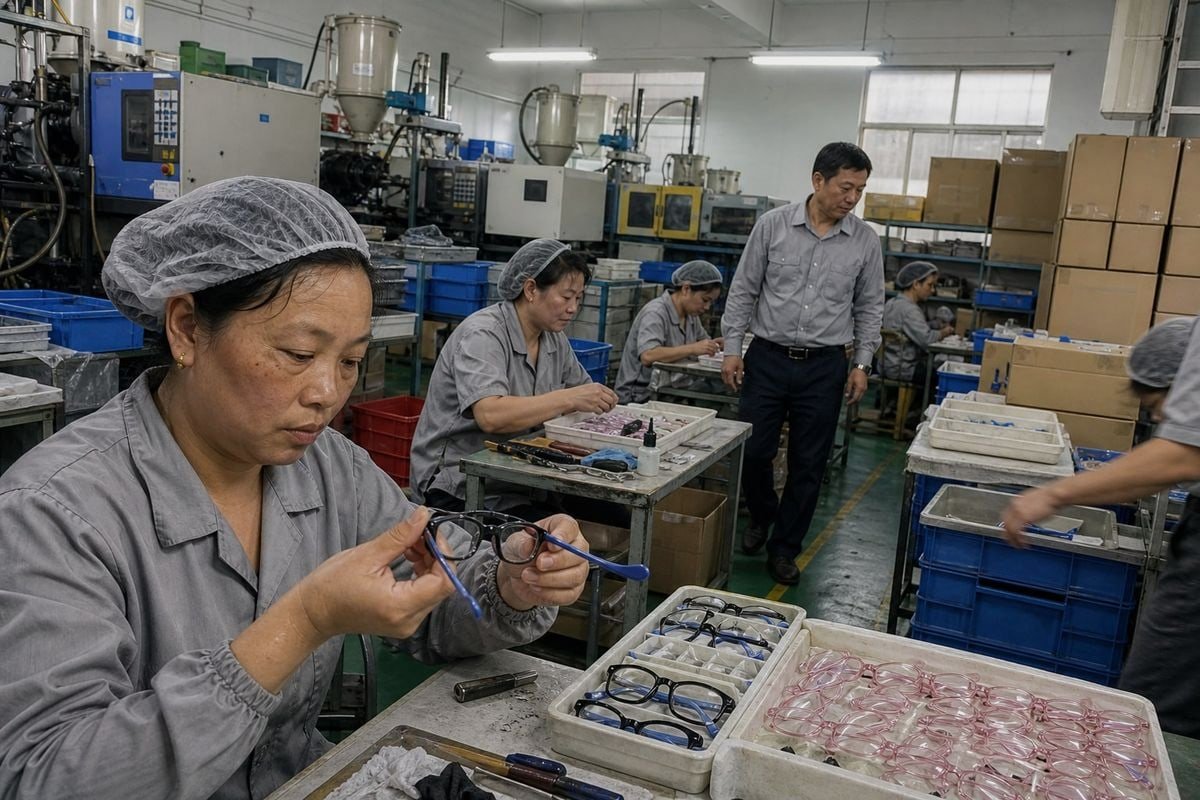
Choosing where to source kids’ optical frames can stall a launch for months spectacle frames 1. On our Taizhou production line, we meet buyers stuck between China’s scale and Southeast Asia’s promise.
China leads on capacity, lead time, and complex OEM work for kids’ optical frames, producing over half of the world’s frames with 15–30 day lead times. Southeast Asia offers lower tariffs and diversification, making it best for mature, high-volume reorders of proven styles.
That short answer hides real nuance. The right region depends on your production profile, not a simple better-or-worse verdict. Below, I break down capacity, lead times, landed cost, and quality control so you can decide with clear eyes.
How do I compare production capacity between Chinese and Southeast Asian factories for kids' optical frames?
A buyer from Australia once asked me why her Vietnamese quote took three weeks. The answer was capacity depth. Our workshop of 120 workers sits inside a cluster that hers did not have.
China dominates absolute capacity, producing 242 million spectacle frames — about 69% of Asia-Pacific output — with clusters like Danyang making over 100 million frames yearly. Southeast Asia is far smaller: Vietnam produced 3.7 million plastic frames and Thailand 3.5 million in 2024.
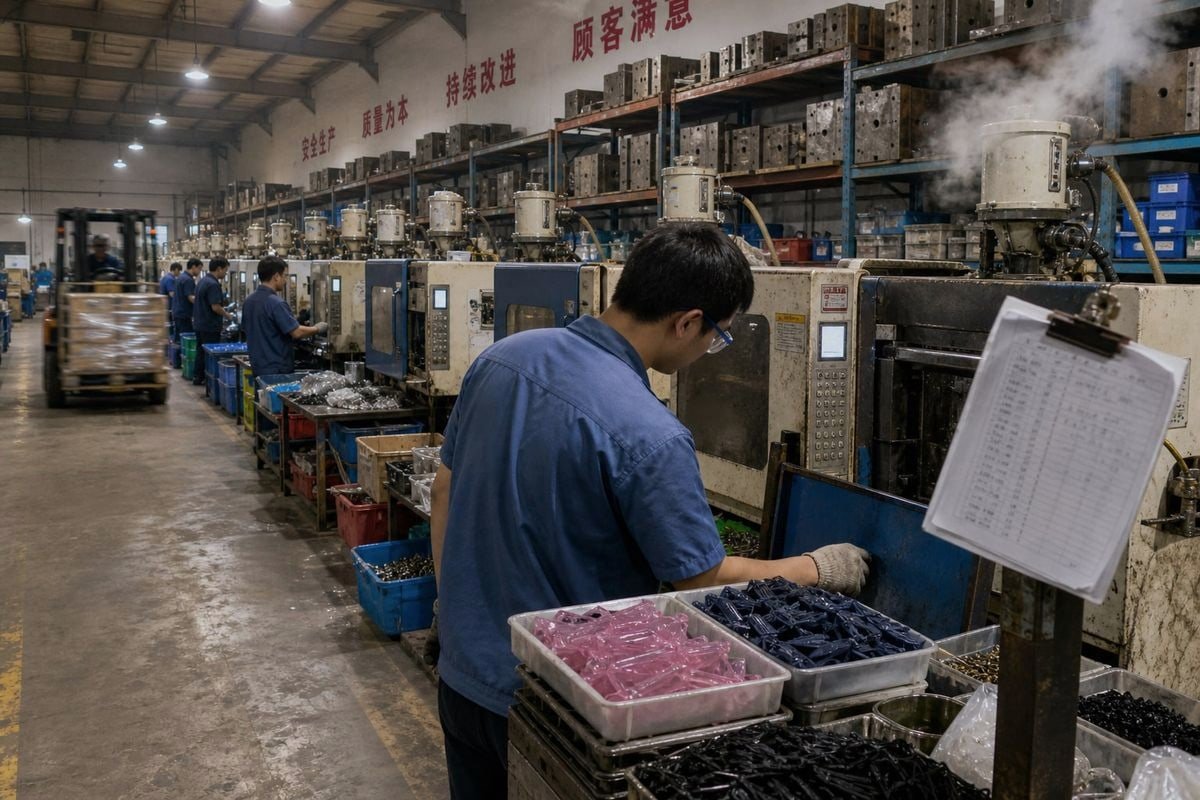
Capacity is not just a headline number. For kids' optical frames, you need to look at three layers: total regional output, single-factory throughput, and supplier variety. China wins on all three today, but the gap matters differently depending on your order profile.
The three layers of capacity
First, regional output. China remains the center of the Asia Pacific eyewear market, and the eyewear manufacturing hubs of Danyang, Wenzhou, and Taizhou hold most of the world's frame tooling. Danyang alone is reported to produce more than 100 million frame pairs and 400 million lenses annually. Vietnam, Thailand, and Myanmar together held 76% of Southeast Asia's plastic frame production in 2024 — but the whole region's output is a rounding error next to China's.
Second, single-factory throughput. Some Chinese suppliers report monthly capacities from hundreds of thousands to over 1.65 million pieces, and one kids' TR frame producer cites 5 million units per year. Southeast Asian plants are typically mid-sized and less specialized in children's frame materials.
Third, supplier variety. This is where kids' frames get demanding. Children's eyewear needs small sizing, flexible hinges, and skin-friendly materials like TR90 and TPEE 2. In our experience, that requires nearby mold shops, hinge suppliers, and silicone-tip vendors. China's clusters have them within an hour's drive.
| Capacity Factor | 中国 | Southeast Asia |
|---|---|---|
| Regional frame output | 242M units (~69% of Asia-Pacific) | Vietnam 3.7M, Thailand 3.5M (2024, plastic frames) |
| Large-factory throughput | Up to 1.65M pieces/month reported | Mostly mid-sized plants |
| Kids-specific material expertise | Deep (TR90, TPEE, silicone components) | Emerging, mostly standard plastics |
| Supplier variety for multi-SKU lines | 非常に高い | 限定的 |
What this means for a kids' eyewear line
If you plan a multi-SKU launch — say, ten frame shapes across six colorways with varying minimum order quantity needs — China lets you scale fast without rebuilding your supplier base. If you run one or two evergreen styles at steady volume, Southeast Asia's smaller capacity can still serve you well.
Which region offers more reliable lead times when I need consistent reorders for my kids' eyewear line?
Last spring, we turned around a repeat order of flexible kids glasses for a Japanese distributor in 18 working days. The temple silicone, hinges, and packaging all came from partners nearby.
China offers faster and more predictable production lead times — typically 15 to 30 working days — because tooling, components, and finishing sit inside dense clusters. Southeast Asia can match this for stable repeat styles, but first-pass development and variability risks are generally higher there.
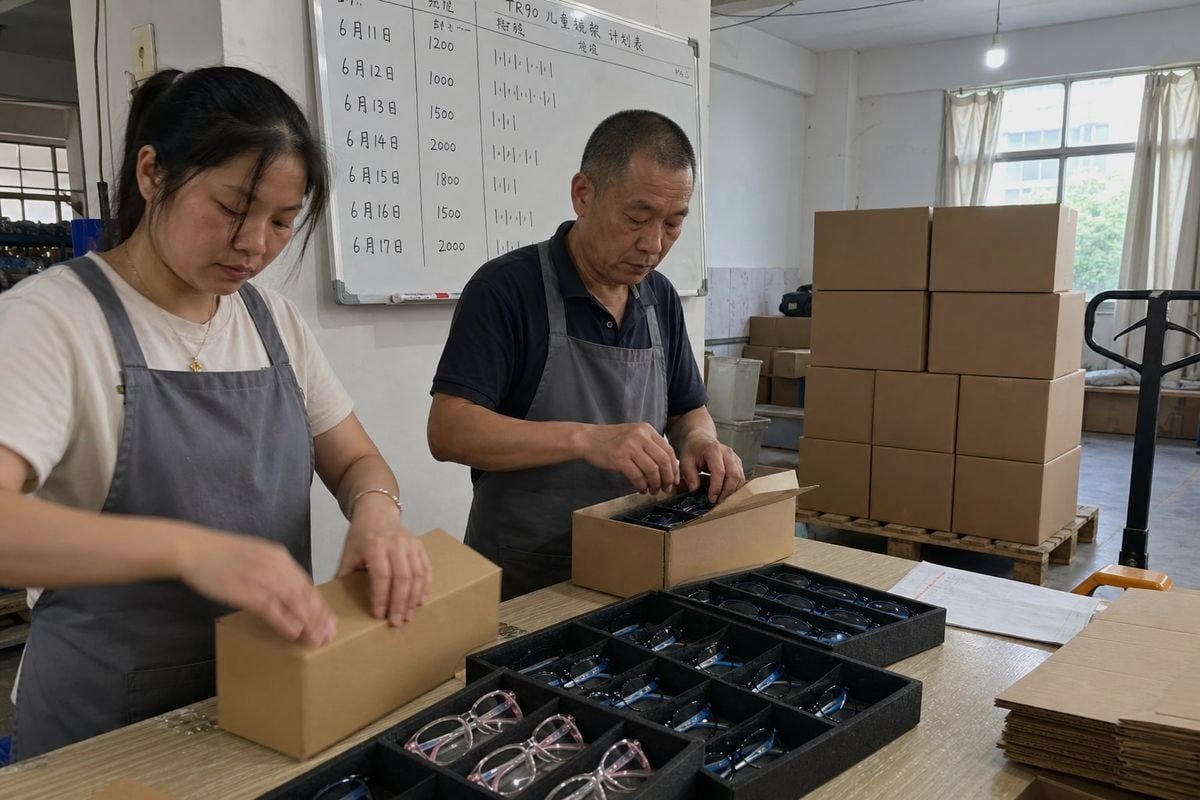
Lead time reliability matters more than raw speed for a kids' eyewear line. Children's frames sell in seasonal waves — back-to-school in particular — and a two-week slip can cost you the whole retail window. So let me unpack where delays actually come from.
Where lead time is really won or lost
Factory cycle time is only one piece. The full clock includes mold availability, component sourcing, color matching, lens cutting, assembly, QC, packaging, and freight booking. In China's clusters, every one of those steps happens locally. When a buyer asks us to adjust nose pad geometry or hinge tension mid-order, we can get revised parts in days, not weeks. Several Chinese suppliers list lead times as short as 15 working days for exactly this reason.
Southeast Asia tells a different story. For a proven, unchanged style on a steady reorder cycle, a Thai or Vietnamese plant can deliver competitive lead times. The sources are consistent on this: Southeast Asia's real edge is a balanced mix of lead time, cost, and de-risking on repeats — not faster first-pass development. Its component ecosystem is still maturing, so any design change may mean importing parts from China anyway, which adds transit time and supply chain disruptions risk 3.
A practical reorder framework
- New style, first production run: China, almost always. Iteration speed matters most here.
- Proven style, stable spec, high volume: Southeast Asia becomes viable, especially if import tariffs 4 favor it in your market.
- Seasonal multi-SKU program with mid-cycle tweaks: China, because cluster proximity absorbs changes without schedule slips.
- Dual-sourcing for resilience: run the primary in one region and qualify a backup in the other before you need it.
One more point from our own floor: reorder reliability also depends on how well the factory documents your spec. We keep full tooling, colorway, and packaging records per SKU, so a reorder six months later matches the first run. Ask any factory — in either region — how they archive specs before you commit.
How do I evaluate true landed cost differences between China and Southeast Asia for optical frame manufacturing?
The trade-off we discuss most with European buyers is unit price versus total landed cost. A frame that looks cheaper ex-factory can lose that edge once duties and freight land on the invoice.
Compare landed cost, not factory price. China usually wins on unit cost at scale due to automation and supplier density. Southeast Asia can win on total landed cost for high-volume reorders when lower labor costs and reduced import tariffs offset its higher input and logistics friction.
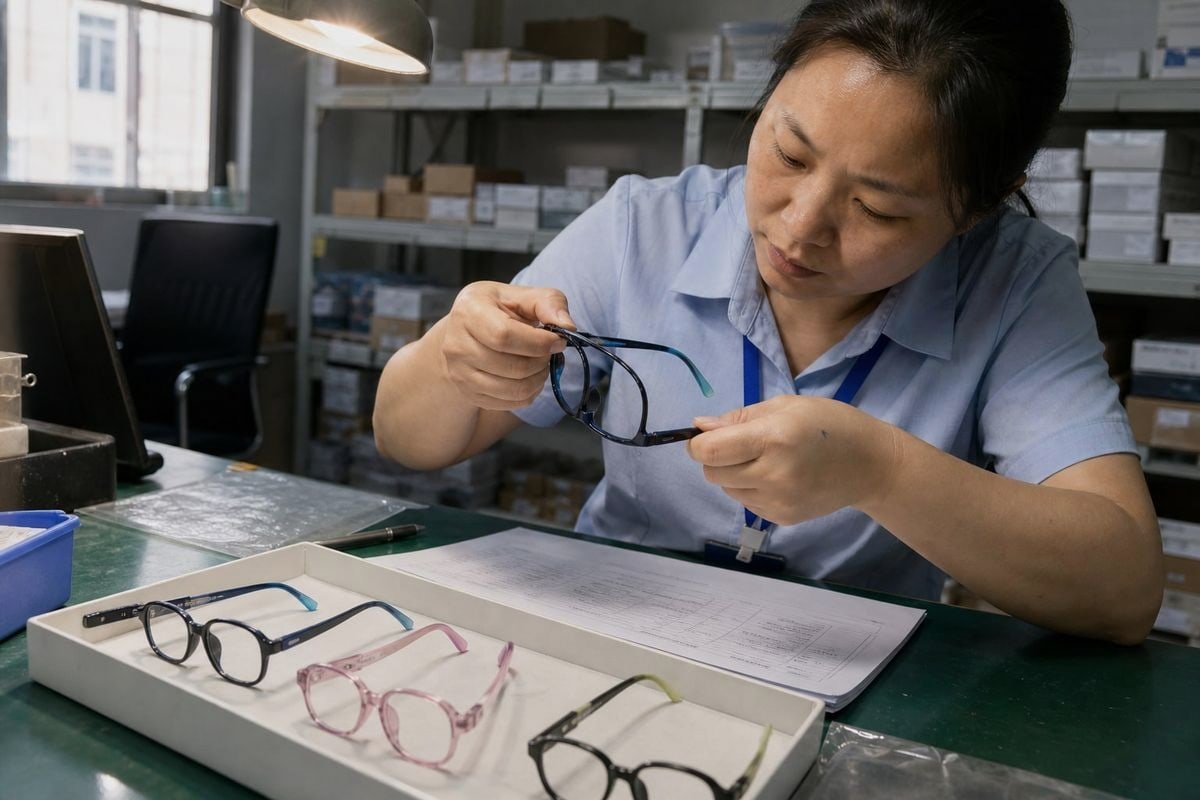
Cost is the hardest variable to generalize, so I recommend building a simple landed-cost model before you choose a region. Your cost of goods manufactured is only the starting line.
Building the landed-cost picture
Start with the ex-factory price, then layer on everything that happens between the factory gate and your warehouse. Here is how the components typically compare:
| Cost Component | 中国 | Southeast Asia |
|---|---|---|
| Unit manufacturing cost | Highly competitive at scale; automation and cluster density keep it low | Lower labor cost, but components often imported, raising input cost |
| Tooling and molds | Cheap and fast; ~800 existing styles at factories like ours avoid mold fees entirely | Fewer open molds; new tooling often costs more and takes longer |
| Import tariffs (US and some Western markets) | Higher exposure in tariff-affected markets | Often lower duties under favorable trade agreements |
| Freight and logistics | Mature, frequent sailings, low friction | Improving, but fewer direct routes from some ports |
| Transaction and rework costs | Low; deep OEM ODM eyewear experience reduces errors | Can be higher during supplier qualification |
The reorder-cycle argument
One comparison the research supports directly: once a style is proven and moves into a reorder cycle, shifting production to Thailand can improve margins and reduce tariff risk for certain destination markets. That is the honest pro-Southeast Asia case, and I will not argue against the math when it works. But the math only works after you have absorbed development, tooling, and qualification costs in China first. Buyers who skip that step often pay it back in sampling rounds and rejected shipments.
There is also a hidden cost lever many buyers miss: minimum order quantity strategy. Choosing from an existing style library — we hold around 800 open styles — lets a new brand test the market without mold investment. That single decision often moves the landed-cost needle more than the region choice does.
What quality control and material expertise should I expect when sourcing kids' optical frames from these regions?
A lesson from fifteen years of making children's frames: a kid will sit on their glasses within the first month. Quality control for this category starts with that assumption.
Expect deep flexible-material expertise — TR90, TPEE, silicone components — and mature, increasingly automated QC in China's specialized kids' frame factories. In Southeast Asia, Thailand offers the strongest certification and consistency for OEM projects, while Vietnam suits standard mid-range volume styles.
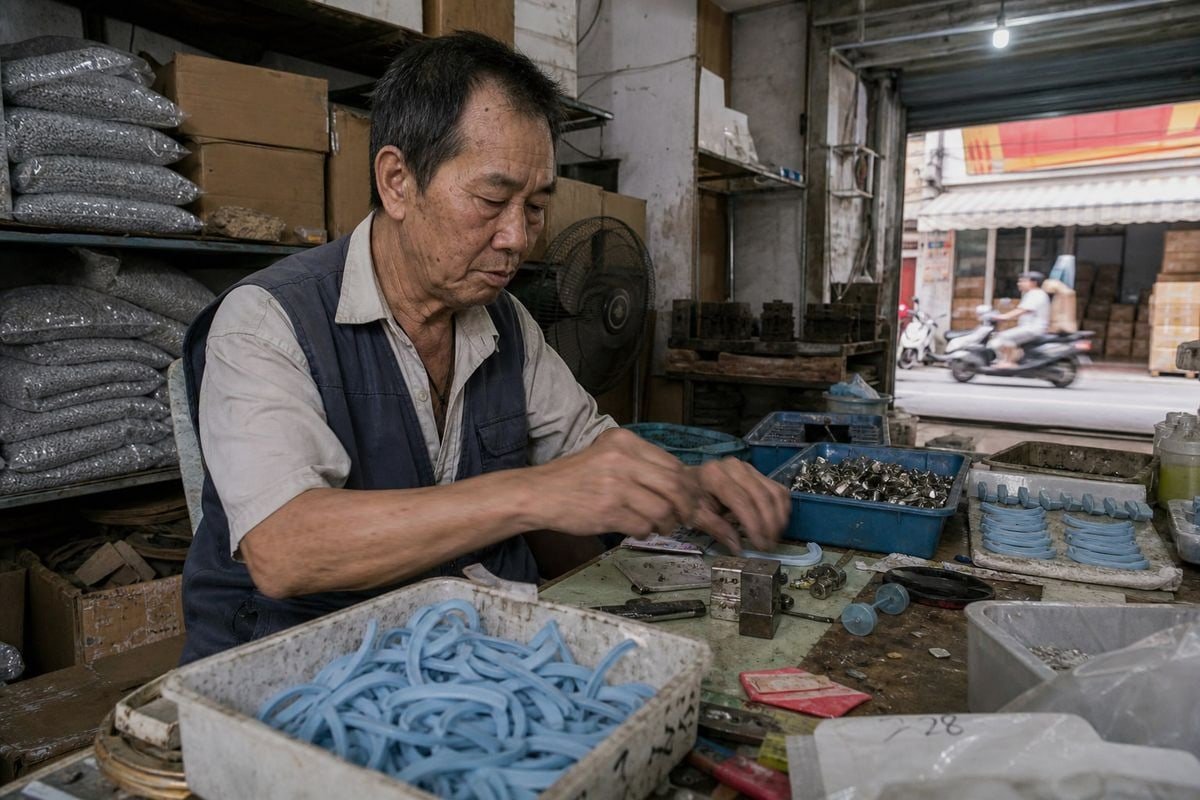
Kids' optical frames are not shrunken adult frames. They demand impact resistance, hypoallergenic surfaces, flexible hinges, secure temple tips, and repeatable small sizing across many SKUs. Any eyewear factory audit you run should test the region's depth on exactly these points.
Material expertise is the first filter
Children's frame materials are a specialty. TR90 gives lightweight impact resistance; TPEE adds the softness and flex that keeps a frame comfortable — and intact — on an active child. When we developed a two-tone kids' frame with rubberized silicone temple tips, we went through several iterations of hinge tension and tip hardness before the fit was right for small faces. That iteration loop needs material engineers on site. China's specialized kids' frame factories have them; most Southeast Asian plants are still building this depth, though Thai suppliers are closing the gap on certified OEM work, and some regional makers are now marketing sustainable, bio-based materials for eco-focused brands.
QC systems and standards by region
| QC Dimension | China (specialized factories) | Thailand | Vietnam |
|---|---|---|---|
| Optical quality standards compliance | Strong; many plants meet international safety norms 5 | Strong for certified OEM projects | Adequate for standard styles |
| Kids-specific testing (flex, impact, skin contact) | Deep, routine in dedicated kids' factories | 開発 | 限定的 |
| Automation and AI-driven inspection | Increasingly common, aiding complex kids' designs | Emerging | 稀 |
| Best fit | Complex, custom, multi-SKU kids' programs | Mid-to-high-end proven styles | Volume-driven mid-range styles |
Two more expectations to set. First, China's quality reputation has genuinely improved; the old "cheap and inconsistent" image no longer matches the specialized factories, and agile micro-factories using 3D printing now handle small-batch custom pediatric requirements. Second, do not treat Southeast Asia as one block. Thailand and Vietnam play different roles, and your audit checklist should differ for each. In our 5S-managed workshop, we invite buyers to audit hinge cycling, temple flex, and packaging inspection in person — expect the same openness from any factory you shortlist, in either region.
結論
Sourcing kids’ optical frames is not China versus Southeast Asia — it is scale and speed versus diversification. Match the region to your production profile, then audit the factory hard.
The evidence points to a clear playbook. Use China for launches, complex custom work, multi-SKU programs, and fast reorders, because its eyewear manufacturing hubs deliver unmatched capacity, 15–30 day lead times, and deep TR90/TPEE expertise for children’s frames. Consider Southeast Asia — Thailand for certified OEM quality, Vietnam for mid-range volume — once a style is proven and tariff exposure or supply chain resilience justifies a China-plus-one strategy. And whichever region you choose, evaluate landed cost rather than factory price, and verify kids-specific QC in person. If you want to test the market without mold investment, our team in Taizhou is glad to walk you through existing styles and a realistic sourcing plan for your brand.
脚注
1. Provides global market size and regional dominance for spectacles and frames. ↩︎
2. Compares TR90 and TPEE materials, highlighting their properties for kids’ eyewear. ↩︎
3. Explains the impact of supply chain disruptions on manufacturing and risk management. ↩︎
4. Replaced with an authoritative government source (.gov) providing an overview of import tariffs and fees. ↩︎
5. Replaced with an authoritative standards body (BSI) detailing the EN ISO 16321 suite of international standards for protective eyewear. ↩︎
 English
  Español de México
  Deutsch
  Français
  日本語
日本語  العربية
  Português do Brasil