Do Kids’ Optical Frames from China Need CE Class I Certification?

Buyers ask us about CE Class I certification for kids’ optical frames almost weekly at our Taizhou factory. Confusing answers online cause delayed shipments, customs holds, and wasted testing budgets.
Kids’ optical frames sold in the EU are Class I medical devices under MDR 2017/745. They must carry CE marking, but Class I allows self-certification — no notified body certificate is required. You need a Declaration of Conformity, technical documentation, and EN ISO 12870 test evidence instead.
That short answer hides a lot of practical detail. Let me walk you through what documents to request, what the tests actually cover, what customs will check, and how to spot fake certificates.
What documentation should I request from my China manufacturer to prove CE Class I compliance?
A procurement manager from a Dutch kids' brand once emailed me a single-page "CE certificate" from another supplier and asked if it was enough. It wasn't — and I told her exactly what was missing.
Request the EU Declaration of Conformity, the technical documentation file, EN ISO 12870 test reports from an accredited lab, REACH and nickel release test results, product labeling artwork, and the manufacturer's quality management system evidence. A standalone "CE certificate" alone proves very little.

When we prepare compliance packages for our European buyers, we treat the paperwork as seriously as the product itself. The Medical Device Regulation puts the legal burden on whoever places the frames on the EU market. If you are the importer, that is you. So your file needs to be complete before the goods ship, not after.
The core documents, in order of importance
| 文書 | 登録番号 | Who issues it |
|---|---|---|
| EU 適合宣言 1 | The product meets MDR requirements | Manufacturer (or EU rep) |
| Technical documentation | Design, materials, risk analysis, labeling | Manufacturer |
| EN ISO 12870 2 test report | Frames pass mechanical and dimensional tests | Accredited third-party lab |
| REACH / nickel release report | Chemical safety for skin contact | Accredited third-party lab |
| Labeling and packaging artwork | Correct CE mark, traceability, sizing | Manufacturer + importer |
| QMS evidence (e.g., ISO 13485 alignment) | Consistent production quality | Manufacturer |
Why the Declaration of Conformity matters most
The Declaration of Conformity is the legal anchor. It names the product, the applicable regulation, the harmonized standards used, and the responsible party. Without it, the CE mark on the frame is just ink. We issue a DoC for each optical frame model we export to the EU, and we keep the supporting technical documentation on file so buyers can respond to any authority request.
Ask for model-specific reports
One common trap: generic test reports. A report for an adult acetate frame does not cover a child's frame with TPEE temples. Materials differ, dimensions differ, and children's skin sensitivity raises the bar. Always match the report to the exact model, material, and color batch you are ordering.
Which safety tests and standards does CE Class I certification actually cover for kids' optical frames?
There is a trade-off we weigh in every kids' frame we design: make the temples flexible enough to survive a child's rough handling, yet stable enough to pass mechanical performance tests. Both sides of that balance come straight from the standards.
CE compliance for kids' optical frames centers on EN ISO 12870, covering mechanical stability, bridge deformation, temple endurance, dimensional accuracy, and marking. Chemical safety adds REACH restrictions, nickel release standards for metal parts, and physiological compatibility of materials in prolonged skin contact.
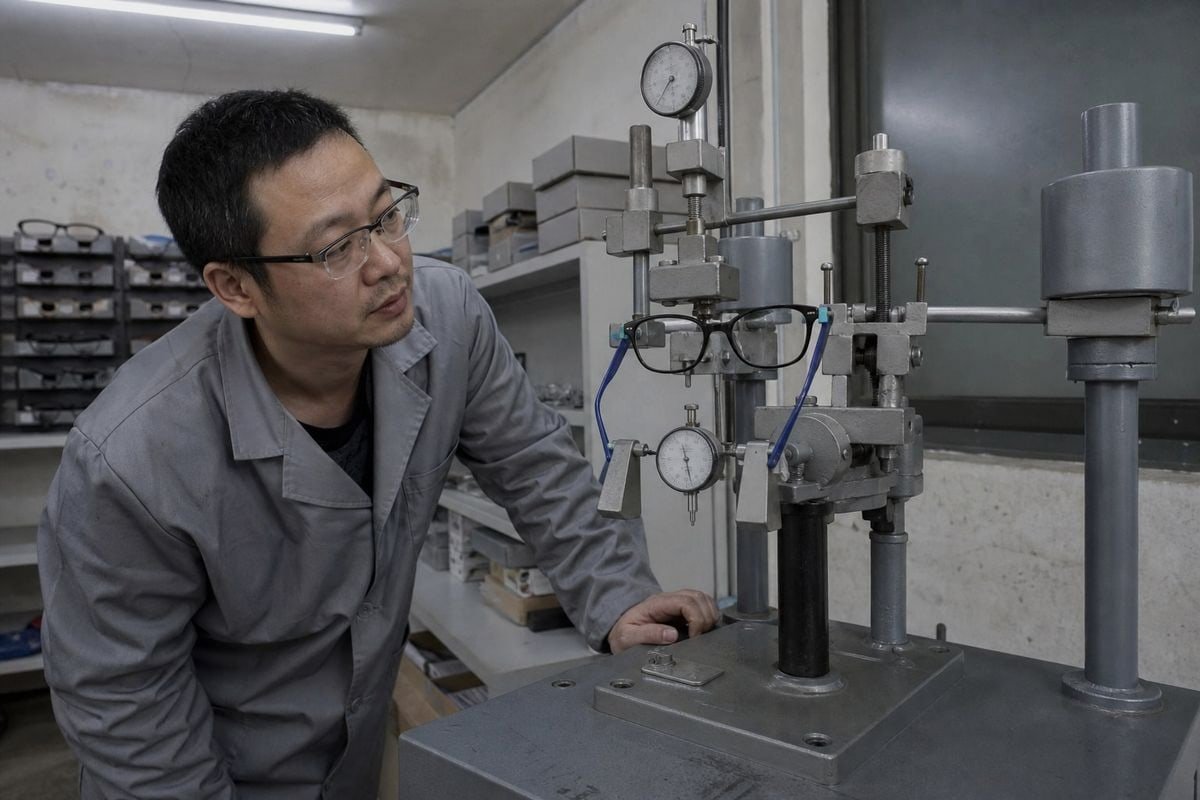
The phrase "CE Class I certification" makes people imagine one big test. In reality, compliance is a bundle of requirements, and EN ISO 12870 sits at the center of it for spectacle frames. When we send our TR90 kids' optical frames with TPEE temples to third-party labs, the test plan reads like an obstacle course for eyewear.
What EN ISO 12870 actually tests
| Test area | What happens to the frame | 子供にとってなぜ重要なのか |
|---|---|---|
| Bridge deformation | Sustained load applied across the bridge | Kids drop, sit on, and bend frames daily |
| Temple endurance | Temples opened and closed hundreds of times | Active children flex hinges constantly |
| Dimensional stability | Frame heated and checked for warping | Frames left in hot cars or sunlight |
| Resistance to perspiration | Exposure to artificial sweat | Children sweat more during play |
| Marking durability | Rubbing test on printed markings | Traceability info must stay legible |
| Screw and hinge integrity | Torque and retention checks | Loose small parts are a hazard for kids |
Chemical and skin-contact requirements
Frames sit on a child's face for hours. That is why physiological compatibility is not a marketing phrase — it is a regulatory expectation. REACH restricts heavy metals, phthalates, and certain azo dyes. REACH restrictions 4 Nickel release standards apply to any metal component touching skin, such as hinges or decorative pins. This is one reason we build most of our children's frames in TPEE and TR90. These materials are lightweight, hypoallergenic, and environmentally friendly, and they avoid many metal-related chemical risks from the start.
Children add scrutiny, not a new device class
Frames for kids stay in Class I. But in practice, buyers and authorities look harder at impact behavior, flexibility, and small-part security on children's products. Our own internal QC goes beyond the standard here, because a hinge screw that loosens on an adult frame is an annoyance; on a toddler frame, it is a safety issue.
Can I import children's optical frames into Europe without CE certification, or will customs reject my shipment?
Years of exporting kids' eyewear to European distributors have taught our team one hard lesson: customs officers do not debate regulatory nuance. They check paperwork, and missing paperwork stops containers.
You cannot legally place children's optical frames on the EU market without CE marking and supporting compliance documents. Customs can detain, reject, or destroy non-compliant shipments. However, you do not need a notified body certificate — self-certified Class I documentation is what border authorities expect.
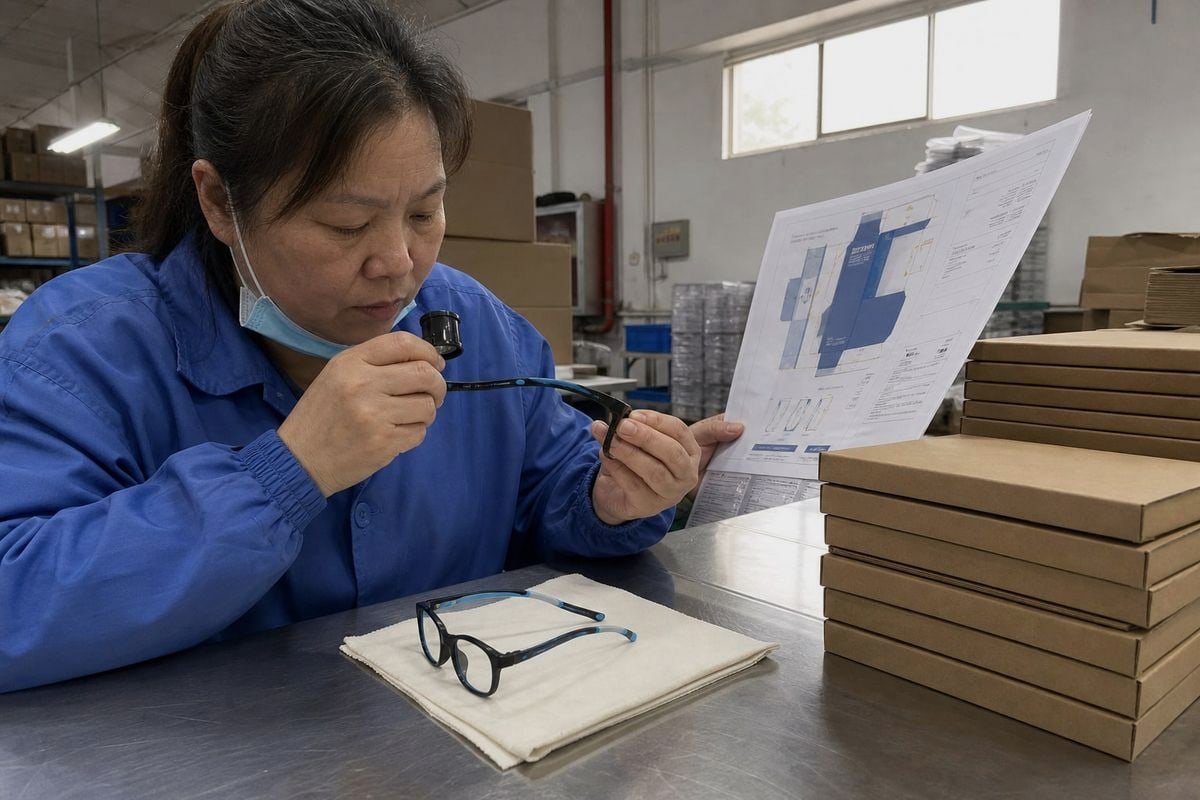
Here is the distinction that saves importers real money. "CE certification" in the sense of a third-party certificate is not mandatory for Class I devices. "CE compliance" — the marking, the Declaration of Conformity, the technical documentation, the correct labeling — absolutely is. Import regulations treat the two very differently, and mixing them up leads to one of two expensive mistakes: paying for unnecessary certification, or shipping with nothing at all.
What happens at the border
Customs and market surveillance authorities can pull any consignment for inspection. For kids' optical frames, they typically look at three things. First, is the CE mark physically present and correctly formatted on the product or packaging? Second, can the importer produce a Declaration of Conformity on request? Third, does labeling include traceability details — manufacturer identity, importer identity, and model reference?
If any element fails, the options are ugly:
- Detention. Goods sit in a bonded warehouse while you scramble for documents. Storage fees accumulate daily.
- Rejection. The shipment is refused entry and must be re-exported at your cost.
- Destruction. In serious cases, authorities order non-compliant goods destroyed.
- Recall. If non-compliant frames reach shelves, a forced recall damages your brand far more than any testing invoice.
The importer wears the legal hat
Under EU import regulations, the importer of goods from a non-EU manufacturer carries direct legal responsibility. You must verify that we, the factory, have done the conformity work, and you must keep the documentation available for ten years. This is why we hand over complete files before shipment. In our experience, buyers who receive the DoC and test reports alongside the pre-shipment inspection report clear customs without a single question. Buyers who plan to "sort the paperwork later" are the ones who call us in a panic from a bonded warehouse.
One nuance: destination decides everything
CE obligations apply only if the frames enter the EU/EEA market. Our buyers in Australia, Japan, and the US follow different frameworks — in the US, for example, spectacle frames are FDA-regulated medical devices exempt from 510(k) but still subject to other rules. Product safety standards are regional, so tell your supplier the destination market before production starts, not after.
How do I verify that a supplier's CE certificate is genuine and not fraudulent before placing a bulk order?
Early in my export career, a buyer forwarded me a competitor's glossy "CE certificate" and asked why ours looked different. Ten minutes of checking showed theirs was issued by a company that was not an accredited lab at all.
Verify the issuing lab's accreditation on its national accreditation body database, confirm the certificate number directly with the lab, check that the document names the exact product model and standard, and demand the Declaration of Conformity plus raw test reports. Genuine compliance is a paper trail, not a single page.

Fraudulent or misleading CE documents are common in low-cost sourcing channels. Some are outright forgeries. More often, they are technically real documents that prove nothing — a "certificate of compliance" self-printed by a trading company, or a test report for a completely different product. Here is the verification process we recommend to every new buyer, including our own customers who want to audit us.
A five-step verification process
- Check the issuer. Look up the testing lab or certification body on its national accreditation database (for example, CNAS in China, or the relevant EU member state body). If the issuer is not accredited for the cited standard, stop.
- Contact the lab directly. Email the lab with the certificate or report number. Reputable labs confirm authenticity quickly. Fraudsters count on nobody checking.
- Match the details. The document must name the exact model number, material, and standard — EN ISO 12870 for frames, plus REACH and nickel release standards 5 where relevant. A vague description like "plastic eyewear" is a red flag.
- Demand the full package. Ask for the Declaration of Conformity, the test reports behind it, and a summary of the technical documentation. A supplier who has done the work can send this within a day or two. A supplier who stalls probably has nothing.
- Test a labeled sample yourself. Before a bulk order, send one retail-ready sample to an independent lab for spot verification. The cost is small compared to a rejected container.
Red flags versus green flags
| 赤信号 | Green flag |
|---|---|
| One-page "CE certificate" with no test data | Full DoC plus multi-page accredited test reports |
| Issuer cannot be found in accreditation databases | Issuer verifiable, report number confirmable |
| Report covers a different model or adult frames | Report matches your exact kids' model and material |
| Supplier resists questions about standards | Supplier explains EN ISO 12870 scope openly |
| No QMS evidence | Documented quality system, factory audit welcome |
We actively encourage buyers to audit our Taizhou factory and our 5S-managed workshop, because transparency is the fastest trust-builder in this business. After fifteen years making children's eyewear, we have learned that serious brands do not buy certificates — they buy verifiable processes.
結論
Kids' optical frames from China need CE compliance for EU sales — not a notified body certificate. Class I self-certification works, but only with a genuine Declaration of Conformity, EN ISO 12870 testing, and complete technical documentation. Skipping this risks detained shipments and recalls. Choose a factory that hands you the full paper trail before production, and EU market access becomes routine rather than a gamble.
脚注
1. Essential legal document for CE compliance, issued by the manufacturer. ↩︎
2. Core international standard for testing the mechanical and dimensional performance of spectacle frames. ↩︎
3. Provides the official text of the EU Medical Device Regulation. ↩︎
4. EU regulation on chemicals and their safe use, including restrictions on hazardous substances. ↩︎
5. Specifies limits and test methods for nickel release from products in contact with skin. ↩︎


 English
  Español de México
  Deutsch
  Français
  日本語
日本語  العربية
  Português do Brasil