How Do I Get Chinese Factories to Add CPSIA Tracking Labels to Kids Optical Frames?
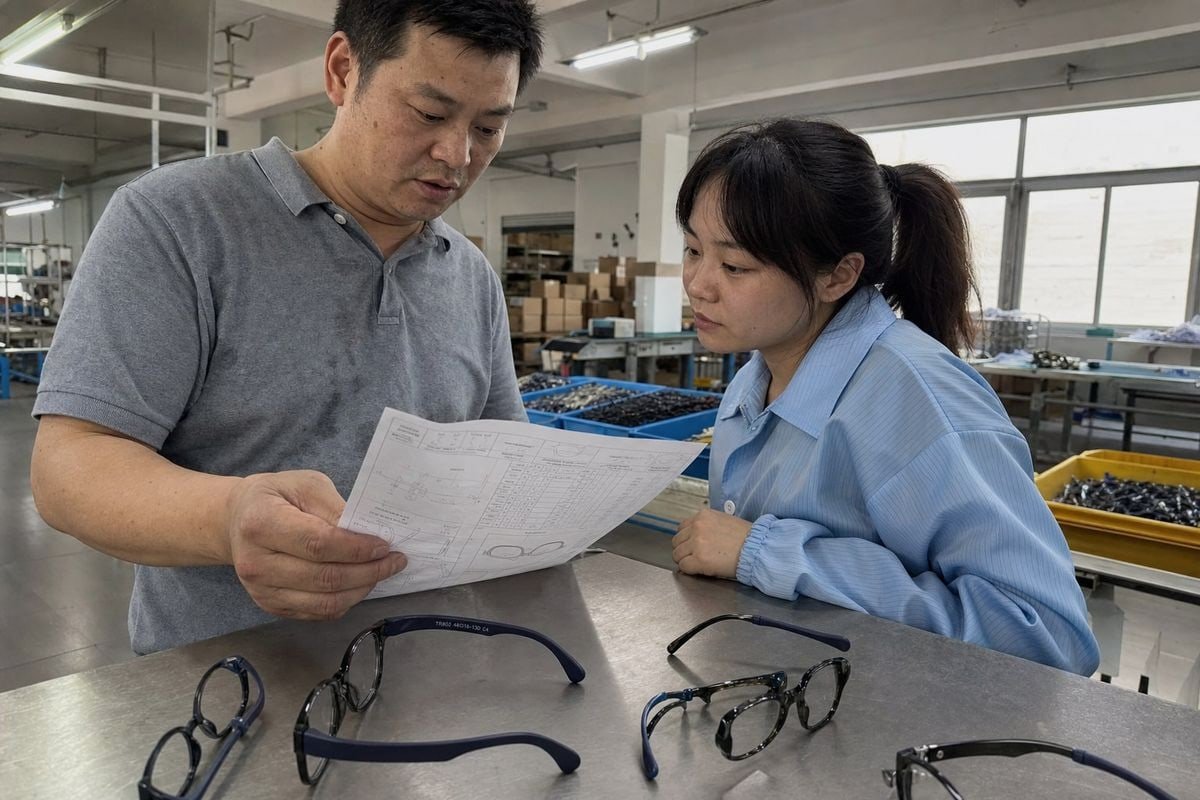
Getting CPSIA tracking labels on kids optical frames sounds simple until a shipment gets flagged at customs. On our production line in Taizhou, we see this problem stop orders cold.
To get Chinese factories to add CPSIA tracking labels to kids optical frames, supply a complete label specification before production: your importer name, production city and date, batch code logic, exact placement, and marking method. Then approve a physical sample and require photo proof before shipment.
The key idea is simple. Do not ask for a favor. Give the factory a spec they can execute. Below, I break down exactly what that spec needs to contain, step by step.
What Information Must Be Included in a CPSIA Tracking Label for Kids Optical Frames?
A buyer from Australia once sent us artwork with only a logo and "Made in China" on it. That label would have failed CPSIA Section 103 1 completely, and their whole order was at risk.
A CPSIA tracking label for kids optical frames must include the manufacturer, importer, or private labeler name; the production location (city and country); the production date; and batch, run, or lot traceability information. The label must be permanent, visible, and legible on the product and packaging where practicable.
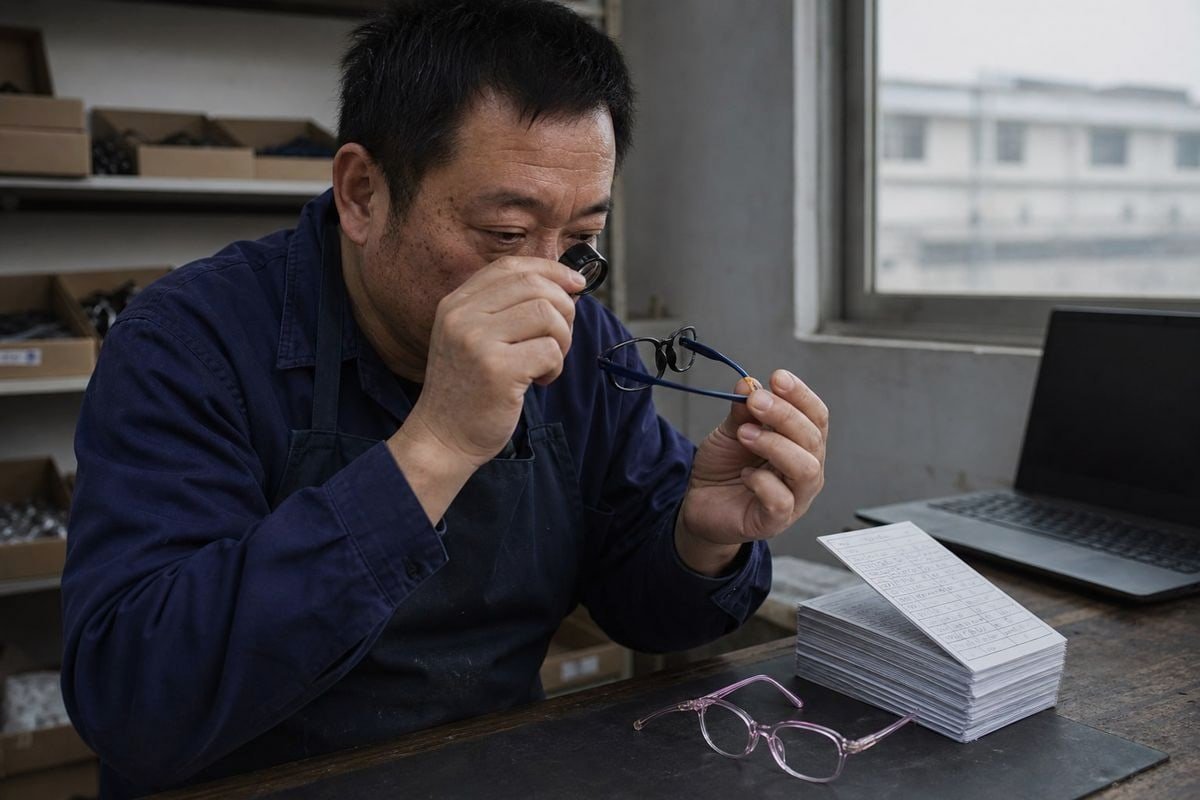
CPSIA Section 103 applies to children's products, meaning items designed or intended primarily for children 12 or younger. Kids optical frames marketed for children clearly fall into this category. So the tracking label is not optional. It exists so the CPSC and consumers can trace a specific product back to a specific production run during a recall or investigation. That is the whole purpose: recall traceability.
The Four Required Elements
Here is what the label must communicate, in plain terms:
| Required Element | What It Means for Optical Frames | 例 |
|---|---|---|
| Company identity | Your legal importer or private labeler name | ABC Kids Eyewear |
| Production location | City and country where frames were made | 中国、台州 |
| Production date | Month and year of manufacture | 2026-08 |
| Traceability detail | Batch, run, or lot number tied to your order | KOF-0826-A3 |
One helpful nuance: CPSC regulations allow this information to appear in code form, as long as the consumer knows who to contact to decode it. That matters for eyewear, because a temple arm has very little space. A short coded lot number on the frame, backed by full details on the packaging and your records, is a workable approach.
What Existing Frame Markings Do Not Cover
Many buyers assume the standard brand, model, and size markings already printed on optical frames satisfy the rule. They do not. Those markings identify the style, not the production run. Without a production date and batch reference, they fail CPSIA requirements. Also remember that country of origin marking under customs law is a separate obligation. "Made in China" alone does not make a tracking label. Your label spec needs to cover both, and it needs to tie back to your 、またはCPCは、中心となる文書です。米国法では、輸入者または国内製造者が発行する必要がありますが、CPSC認定検査機関からの合格テスト結果に基づいている必要があります。サプライヤーの自己申告に基づいて有効なCPCを発行することはできません。 2 and third-party lab testing records, including lead and phthalates testing where applicable.
How Do I Confirm My Chinese Manufacturer Can Print Permanent Tracking Labels on Frames?
In fifteen years of eyewear manufacturing in China, our engineers have learned that "can you print this?" is the wrong question. The right question is "can you print this permanently, on this material, at this size?"
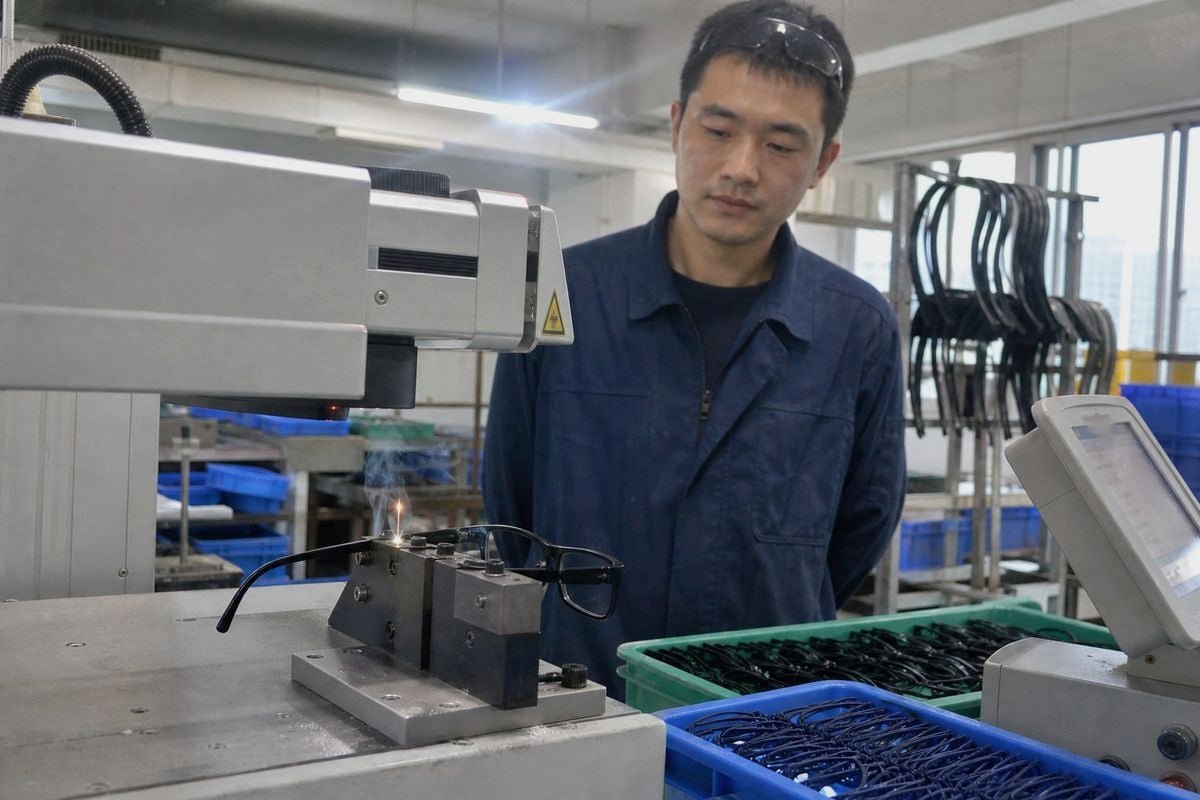
Confirm capability by requesting marked physical samples on your exact frame material, then rub-testing, wash-testing, and flex-testing the marking yourself. Ask the factory which methods they support — laser etching, pad printing, or molded-in marks — and verify permanence before approving bulk production.
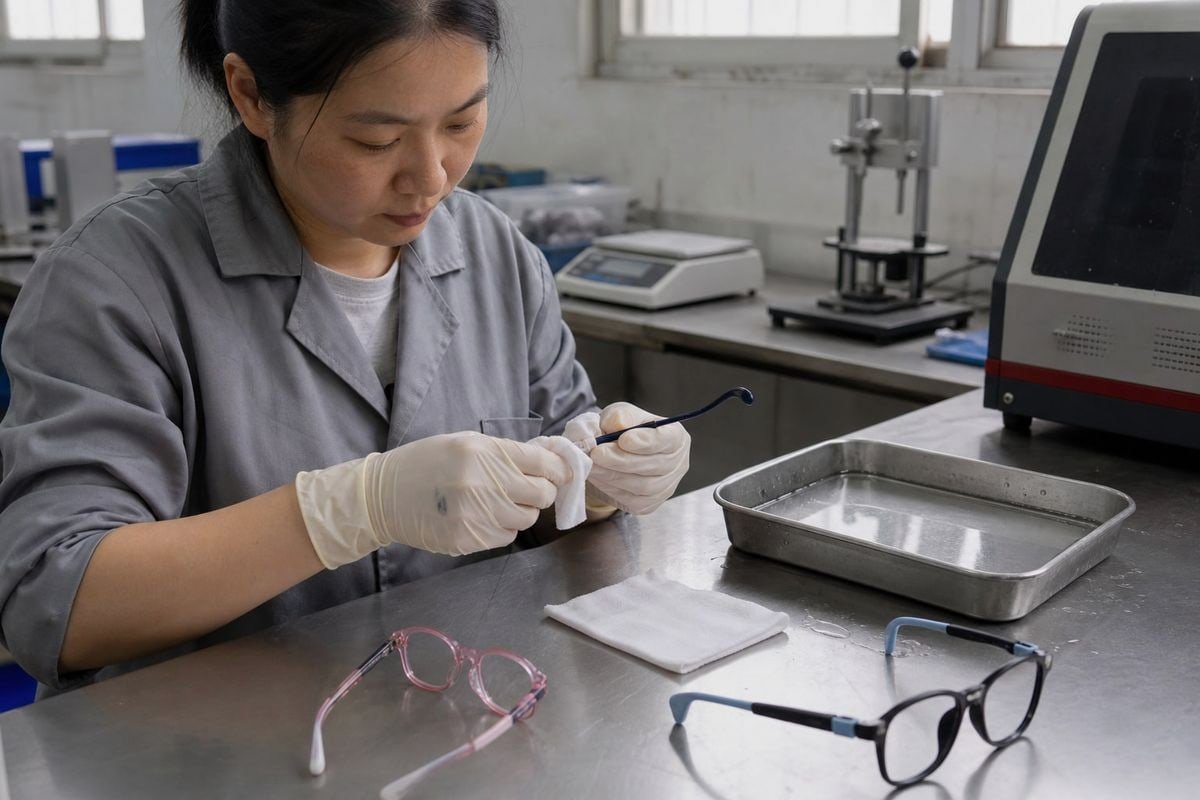
Permanent means the marking should not wear off, fade, or fall off under normal use. For children's frames, "normal use" is aggressive. Kids drop frames, chew temple tips, and wipe lenses with anything nearby. A cheap ink stamp will disappear in weeks. That is why marking method matters as much as label content.
Match the Marking Method to the Frame Material
Different frame materials behave differently. On our TR90 kids optical frames with TPEE temples, we weigh these options for every project:
| Marking Method | 最適 | Durability | コストへの影響 |
|---|---|---|---|
| Laser etching 3 | TR90, acetate, metal parts | 素晴らしい | Low per unit, small setup fee |
| Pad printing (durable ink) | Flat inner temple surfaces | 適切に硬化すれば良好 | Lowest cost |
| Molded-in marks | Injection-molded TR90 and TPEE | Permanent by nature | Requires mold change |
| Engraving | Metal hinges and cores | 素晴らしい | 中程度 |
| Durable label | Cases and packaging only | Acceptable for packaging | 低 |
Flexible TPEE temples are the tricky part. Soft rubbery material flexes constantly, so surface printing can crack. In our workshop, we usually recommend laser marking on the rigid TR90 front or inner temple, with full label details on the case and box.
A Simple Verification Process
- Ask the factory to name their marking methods for your material.
- Request a marked pre-production sample.
- Rub the mark 20 times with a damp cloth. Bend the temple repeatedly.
- Check legibility under normal light without magnification.
- Approve the sample in writing and reference it in your purchase order.
If a supplier resists sending a marked sample, treat that as a red flag. A real factory with quality control discipline will show you the marking on the actual part, not just on paper. That verification step also protects you as the importer of record, because U.S. import compliance responsibility sits with you, not the factory.
Can I Customize the Tracking Label Placement Without Affecting Frame Comfort or Durability?
The trade-off we weigh most often at the design stage is surface area versus skin contact. A child's frame has tiny flat zones, and every marking location touches either the face, the hair, or the flex zone of the temple.
Yes. Tracking label placement on kids optical frames can be customized to the inner temple arm, the frame front interior, or behind the nose bridge area — zones that avoid skin pressure points and flex stress. Plan placement during design, not after tooling, to protect comfort and durability.
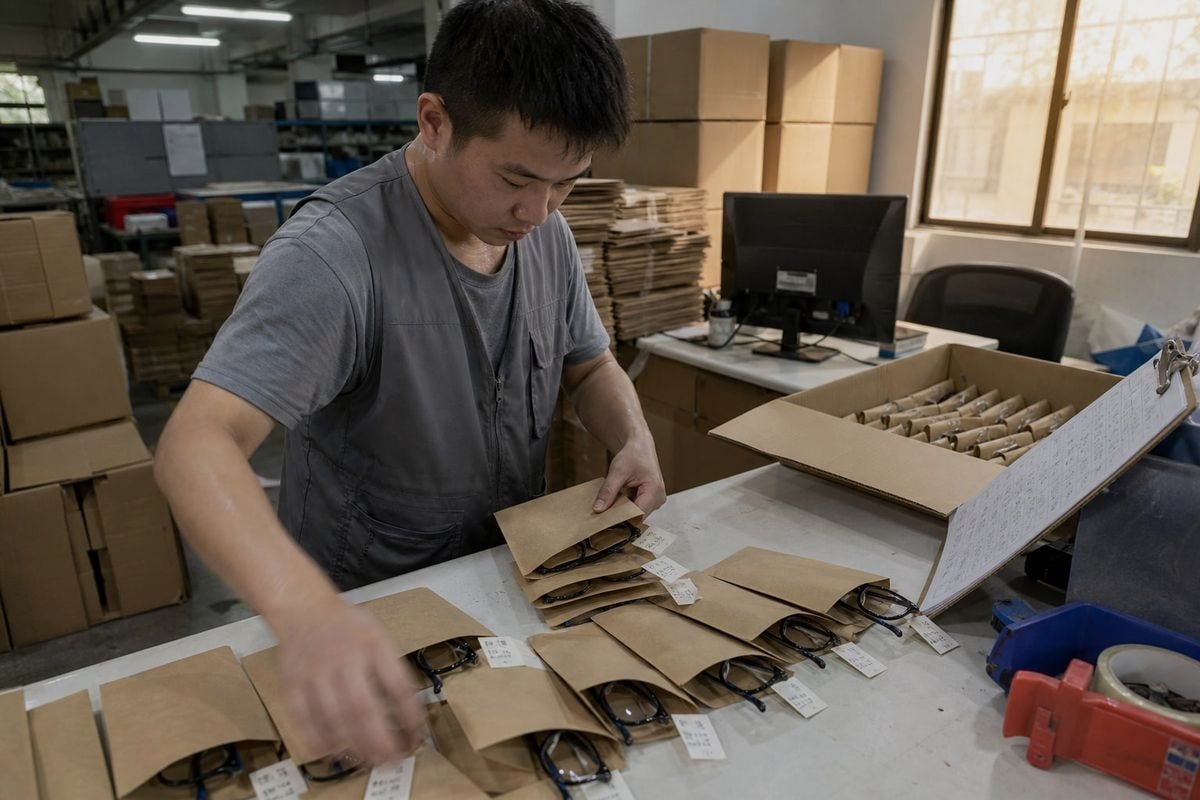
Small products get flexibility under the law. The statute says marking is required "to the extent practicable," and CPSC guidance confirms there is no single mandated format. The required information can even be spread across multiple permanent marks, as long as the totality satisfies the rule. For compact kids frames, that flexibility is your friend.
Placement Zones Ranked by Practicality
From hundreds of children's styles we have developed, these are the realistic placement options:
- Inner left temple arm. The industry-standard zone. Flat, hidden when worn, and away from the hinge flex point.
- Inner frame front, behind the lens rim. Good for laser etching on TR90. Invisible during wear.
- Temple tip interior. Works only if the tip is rigid. Soft silicone tips, like the cable-style ear hooks we use on sporty kids frames, are poor candidates because the material stretches.
- Packaging plus abbreviated frame code. A short lot code etched on the frame, with the full label on the case and retail box.
Protecting Comfort and Strength
Two rules keep placement safe. First, never mark a skin-contact surface with raised or engraved texture deep enough to feel. A child will notice a rough patch behind the ear immediately. Second, avoid the high-flex zone within roughly a centimeter of the hinge, where repeated bending stresses the material. Laser etching removes almost no material, so it does not weaken TR90 when placed on a flat, low-stress area. For molded-in marks, we position the cavity text where wall thickness is greatest, so structural integrity and impact resistance stay intact — important since children's eyewear must also meet broader product safety standards, and buyers often reference ASTM F963-style mechanical expectations 4 for children's goods. Agree on placement at the sampling stage. Changing it after mold approval means rework, delay, and sometimes new tooling cost.
What Documentation Should My Factory Provide to Prove CPSIA Label Compliance Before Shipping?
A hard lesson from an early export order taught us this: a perfect label with no paper trail is still a compliance gap. The buyer's customs broker asked for records we then scrambled to compile overnight.
Before shipping, your factory should provide pre-shipment photos of the marked frames and packaging, a label placement report, batch and production date records matching your code system, third-party lab test reports, and the data you need to issue the Children's Product Certificate as importer.
Remember the division of responsibility. The U.S. importer of record is legally responsible for CPSIA compliance, including issuing the Children’s Product Certificate. The factory's job is execution and evidence. Your job is to define what evidence you need and refuse shipment until you have it. Put this in your purchase order or manufacturing agreement, with clear consequences for non-compliance, so accountability is contractual rather than assumed.
The Pre-Shipment Documentation Package
| 文書 | それが証明するもの | Who Produces It |
|---|---|---|
| Marked-sample approval record | The label spec was agreed before production | Buyer and factory jointly |
| Pre-shipment photos of frames, cases, cartons | Labels are actually applied and legible | Factory QC |
| Batch and production date log | Codes match the physical goods | 工場 |
| Third-party lab testing 5 reports | Lead and phthalates testing and other required tests passed | CPSC-accepted lab |
| Children's Product Certificate data sheet | You can issue an accurate CPC | Buyer, using factory data |
| Packing list with lot codes | Cartons trace to production runs | 工場 |
Tie the Label to the Test Report
The tracking label and the CPC are separate requirements, but they must connect. The production date and batch on the frame should match the batch referenced in the lab test report and the CPC. If a recall ever happens, that chain is what limits the damage to one lot instead of your entire inventory. In our export workflow, QC photographs the marking on random units from each carton during final inspection, and those photos travel with the shipping documents. Some of our brand customers go further and add a QR code on the packaging that links to their traceability records — stricter than the legal minimum, but excellent for recall control. Ask for this package with every order, not just the first one. Each production run needs a fresh, unique label reflecting new dates and batch numbers.
結論
Do not ask your factory to "add a CPSIA label." Hand them a complete spec — content, method, placement, batch logic, and documentation — and verify samples before shipment. That is how our team keeps kids optical frames compliant, comfortable, and recall-ready for brands worldwide.
脚注
1. Provides a comprehensive overview of the Consumer Product Safety Improvement Act. ↩︎
2. Official CPSC guide on issuing a Children’s Product Certificate (CPC). ↩︎
3. Discusses the durability and process of laser engraving on various materials. ↩︎
4. Explains the mandatory toy safety standard ASTM F963 for products sold in the US. ↩︎
5. Lists CPSC-accepted laboratories for required product safety testing. ↩︎
 English
  Español de México
  Deutsch
  Français
  日本語
日本語  العربية
  Português do Brasil