How Is Elastic Rebound in Kids’ Optical Frames Measured, and What’s Acceptable?
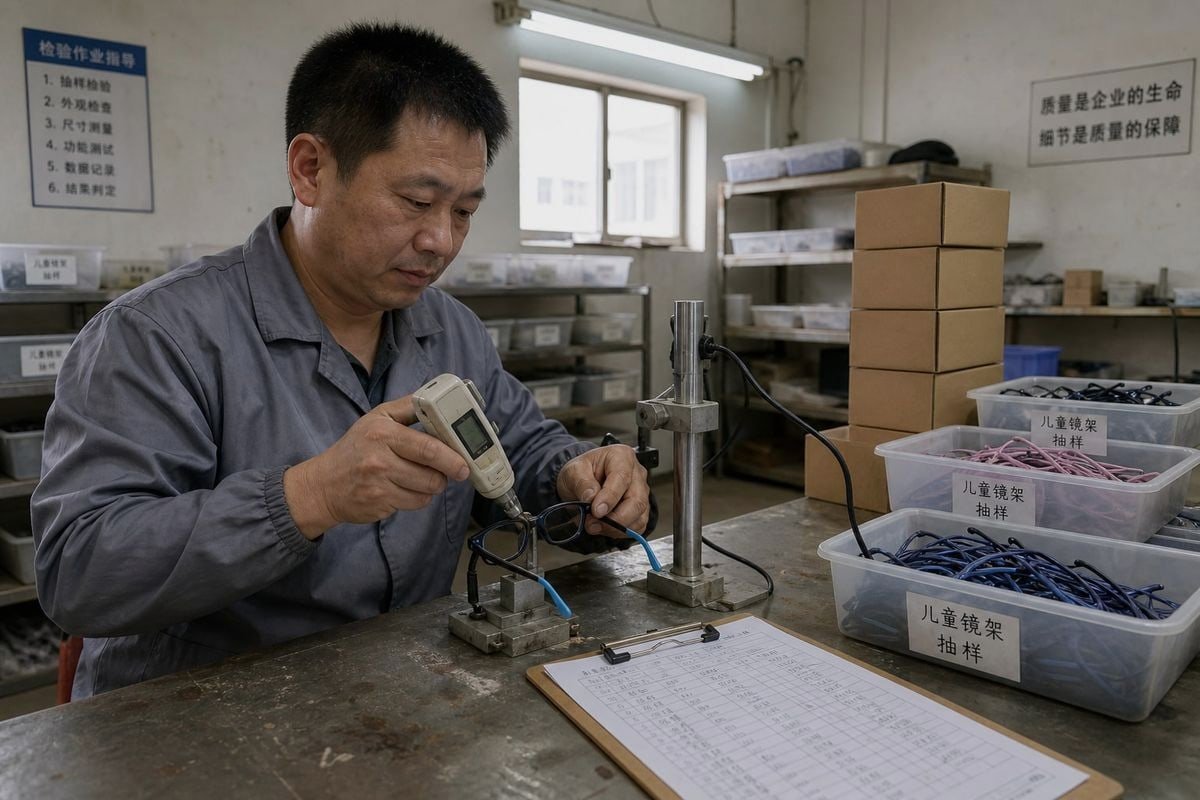
Elastic rebound in kids’ optical frames decides whether a brand survives its first year. On our production line in Taizhou, I have seen buyers order frames that felt flexible in the showroom, then watched their return rates climb when temples splayed and fronts warped after two months of playground wear. The frustrating part is that most importers never ask for rebound data before signing the purchase order. The fix is simpler than you think: request the right tests, know the acceptable numbers, and read factory reports critically before you commit.
Elastic rebound in kids’ optical frames is measured by applying a controlled force or displacement — such as the ISO 12870 bridge deformation test using 5N for five seconds — then measuring residual permanent deformation. Acceptable frames show over 98% recovery and no more than 5 mm permanent set after 500 temple flex cycles.
That short answer covers the core numbers. But if you are placing bulk orders for a children’s eyewear brand, you need more detail. Let me walk through the tests, the ranges, and how to compare factory reports.
What testing methods can I request to verify elastic rebound before placing a bulk order?
A procurement manager from Australia once asked me to bend a sample temple to 180 degrees during a video call. That informal check has real value — but formal testing tells you far more.
Before a bulk order, buyers should request the ISO 12870 bridge deformation test (5N force held for five seconds), a 500-cycle temple flex endurance test measuring permanent deformation, a 180-degree temple bend recovery check, and a frame recovery rate report showing at least 98% return to neutral alignment.
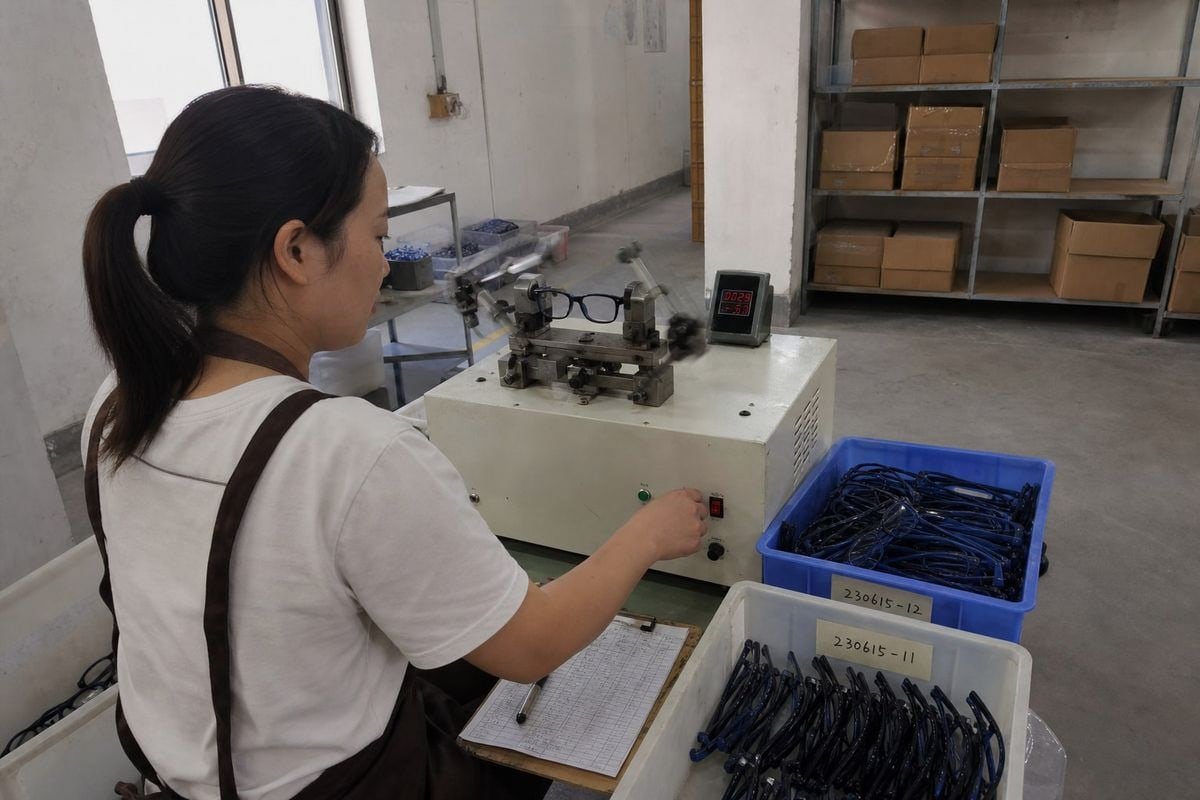
These four tests cover different failure modes, and each one matters for pediatric frame durability. In our QC room, we run them in sequence on samples pulled randomly from production batches, not from a special "golden sample" shelf. You should insist on the same random sampling when you audit any supplier.
The four core tests explained
子供製品証明書 ISO 12870 standards 1 define the baseline. The bridge stability test applies a 5N force (or a prescribed displacement) to the frame front for five seconds. When the load is released, the frame must return to its original state. Any residual twist or spread counts as permanent deformation and signals a failed batch.
Temple flex testing goes further. The temples are opened and closed through 500 alternating cycles. After the final cycle, permanent deformation must not exceed 5 mm. This simulates months of a child putting glasses on and taking them off.
| Test | 方法 | Pass Criterion |
|---|---|---|
| Bridge deformation (ISO 12870) | 5N force applied for 5 seconds | Full return to original state |
| Temple flex endurance | 500 alternating open/close cycles | ≤5 mm permanent deformation |
| 180-degree bend recovery | Temple bent flat against frame front | No cracking, >98% shape recovery |
| Micro-rebound fatigue | 5,000+ low-angle (30°) flexes | No visible bowing or hinge loosening |
The newer micro-rebound fatigue protocols deserve a mention. They run 5,000 or more low-angle 30-degree flexes to simulate the high-frequency on-off handling patterns unique to children. Not every lab offers this yet, but we added it to our internal protocol because kids handle glasses roughly and often. Ask your factory whether they can run it. If they have never heard of low-angle fatigue testing, that itself tells you something about their focus on children's products.
Finally, request test reports tied to your specific batch, not generic certificates. A certificate from two years ago proves nothing about the resin lot in your container.
What acceptable rebound range should I look for in TR90 and TPEE kids' frames?
When we were developing our TR90 frames with TPEE temples, we learned that the two materials behave differently under load — and that "acceptable" is not one number for both.
Acceptable elastic rebound for TR90 and TPEE kids' frames means a recovery rate above 98% after maximum deflection, permanent deformation of 5 mm or less after 500 temple flex cycles, and full 180-degree bending capability without cracking, whitening, or measurable loss of temple tension.
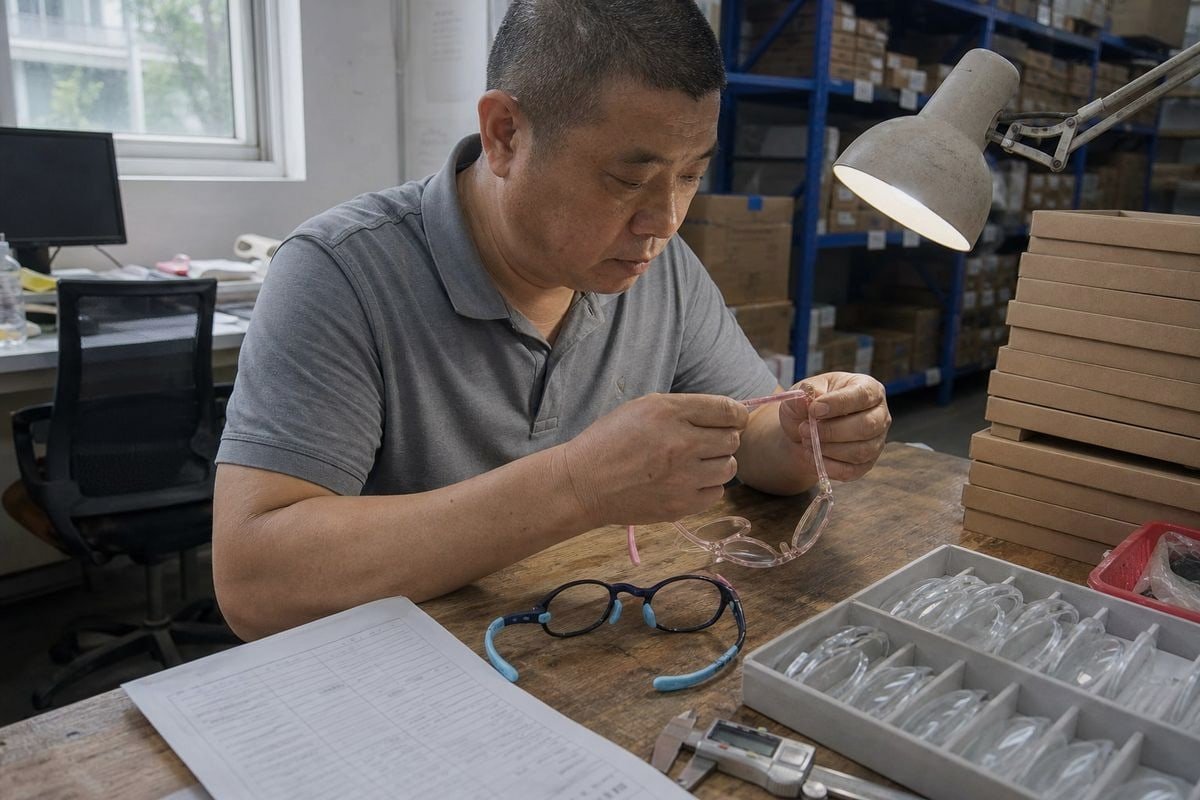
Both TR90 (Grilamid) and TPEE (thermoplastic polyester elastomer 2) are shape memory polymers. Their molecular structure lets them absorb deformation and release it, which is why they can bend 180 degrees without structural failure. But they sit at different points on the stiffness spectrum, and you should specify targets accordingly.
How the two materials compare
TR90 material properties favor structural stability. It has a higher flexural modulus 3, so it holds an adjustment well and keeps the frame front square. TPEE is softer and springier, which makes it ideal for temples and any part that contacts a child's skin. That is exactly why our most popular construction pairs a TR90 front with TPEE temples — you get a stable optical platform plus forgiving arms.
| プロパティ | TR90 | TPEE |
|---|---|---|
| Flexural modulus | Higher — holds adjustments | Lower — very springy |
| Recovery rate target | ≥98% | ≥98%, faster snap-back |
| Best use in kids' frames | Frame front, bridge | Temples, tips |
| 180° bend | Passes without failure | Passes with faster recovery |
| Feel on skin | Firm, lightweight | Soft, rubber-like |
Here is a buyer objection worth addressing directly: some buyers assume maximum springiness is always better. It is not. A frame that rebounds too aggressively resists staying adjusted, so the optician cannot fine-tune pantoscopic tilt 4 or vertex distance for a specific child. What you want is controlled resilience — a frame that recovers predictably but accepts a deliberate adjustment. This is why we tune temple wall thickness rather than simply choosing the softest resin available.
One more range to watch: temple bowing. If temples curve outward permanently after wear, the elastic limit has been exceeded — often because the frame is undersized for the child's temporal width. Correct sizing across your size run matters as much as material choice.
How do I compare elastic rebound test reports between different eyewear factories?
Over fifteen years of exporting, I have reviewed competitor test reports that buyers forwarded to us for a second opinion. The differences between honest and inflated reports follow predictable patterns.
Compare test reports by checking that each factory used the same standard (ISO 12870), the same sample source (random production units, not hand-picked samples), matching cycle counts and forces, batch-specific dates, and clearly stated pass criteria like ≤5 mm permanent deformation and ≥98% frame recovery rate.
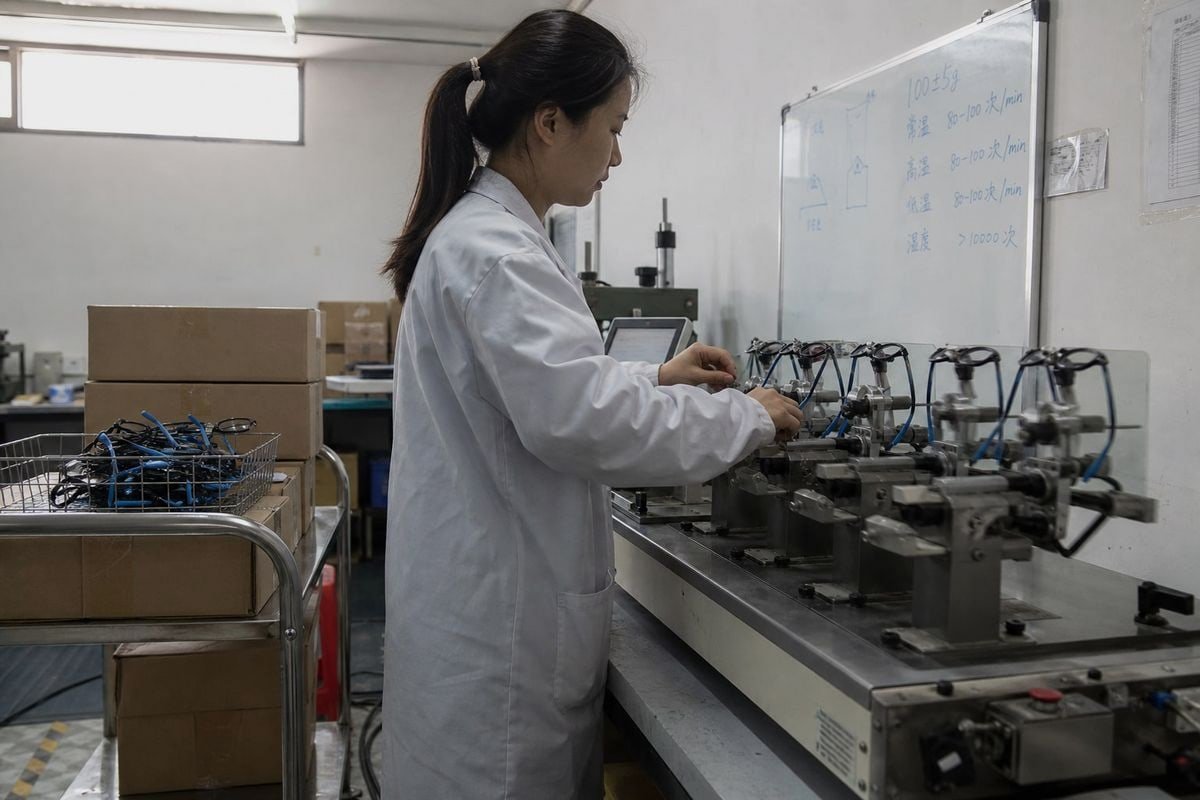
A test report is only as trustworthy as its methodology section. Two factories can both claim "passed flex testing" while running completely different protocols. Your job is to normalize the comparison before you compare the results.
A step-by-step comparison process
- Confirm the standard. Both reports should reference ISO 12870 standards explicitly. A report citing only an internal company standard cannot be benchmarked.
- Check the sample origin. Reports based on pre-production samples are weaker evidence than reports on randomly pulled bulk units. Ask each factory in writing how samples were selected.
- Match the test parameters. One factory may run 500 temple flex cycles; another may run 100 and still call it a pass. Compare cycle counts, applied force, and hold times line by line.
- Verify the metrics reported. Look for numbers, not adjectives. "Good rebound" means nothing. "0.8 mm permanent deformation after 500 cycles" means something.
- Check the date and batch linkage. A report should name the production batch, resin lot, and test date. Generic certificates recycled across orders are a red flag.
- Ask about failure handling. A confident factory will tell you what happens when a batch fails — rework, scrap, or resin supplier claims. Vague answers suggest failures are quietly shipped.
In our experience serving buyers across 20+ countries, the factories that resist third-party verification are the same ones whose frames develop temple bowing in the field. We welcome buyers sending our samples to independent labs, because our internal data and the external data should match. If a supplier discourages that, walk away. Also compare how each factory documents UV exposure effects — prolonged sunlight can cause memory decay in some bio-based polymers, reducing rebound speed and increasing brittleness over time, so a serious report will note material aging behavior, not just fresh-off-the-line performance.
Why does consistent elastic rebound matter for my brand's safety claims and returns rate?
A European baby-brand buyer once told me her previous supplier's frames passed every initial test — yet her returns spiked in month three. The cause was batch-to-batch inconsistency, not bad design.
Consistent elastic rebound protects your brand because every safety and durability claim you print applies to every unit sold. Inconsistent rebound causes warped fronts, loose temples, and lens decentration in random batches, which drives returns, undermines advertised claims, and exposes the brand to compliance disputes.
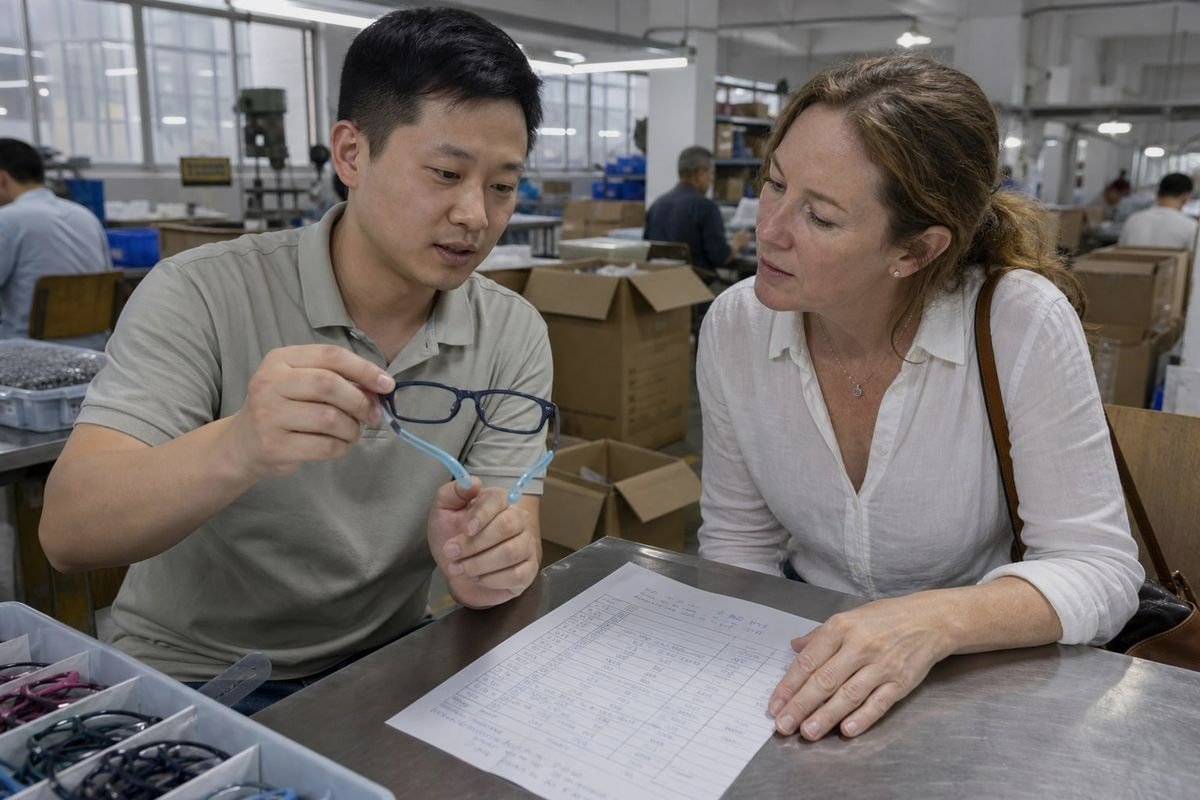
Rebound consistency is where manufacturing discipline shows. A frame's recovery depends on resin quality, injection parameters, cooling time, and mold condition. If any of these drift between batches, some units will hold 99% recovery while others drop below the threshold — and you will not know which units went to which retailer.
The link between rebound and optical fit
Poor rebound is not just a durability issue. When a frame fails to recover its shape, it changes the fit variables that determine whether a child actually sees well through the lenses: frame level, pantoscopic tilt, vertex distance, bridge alignment, and temple pressure. Pediatric dispensing practice is precise here — for distance-only glasses, fitting height may shift by 0.5 mm for every 1° of pantoscopic tilt, and one common rule places the optical center 5 1 mm below pupil center for every 2° of tilt. A frame that comes back from a bend twisted by even a few degrees moves the lens out of its intended position relative to the pupil.
| Rebound failure | Fit consequence | Business consequence |
|---|---|---|
| Front warps after bending | Unequal vertex distance, tilted lenses | Vision complaints, optician rejections |
| Temples bow outward | Glasses slide down, unstable fit | Returns, negative reviews |
| Bridge deforms permanently | Pressure points, red marks on nose | Comfort complaints, safety concerns |
| Hinge tension loss | Temples splay, frame falls off | Breakage claims, lost repeat orders |
For a brand making safety and comfort claims on packaging, this is the exposure point. Your claims are only defensible if the frame recovery rate is stable across every carton. At our 5S-managed workshop, we control this through fixed injection parameters per style, documented resin lot tracking, and rebound spot checks within each production run — because a buyer building a brand cannot afford one bad batch out of ten. Consistency is also why brands testing the market benefit from choosing among proven existing styles first: the tooling and process parameters are already validated across many production runs before your logo ever goes on the temple.
結論
Elastic rebound in kids' optical frames is measurable, comparable, and negotiable before you order. Demand ISO 12870 data, ≥98% recovery, ≤5 mm deformation — and batch-level consistency. Choose partners who prove it, and your returns rate will thank you.
脚注
1. Official international standard for testing and requirements for spectacle frames used in the eyewear industry. ↩︎
2. Authoritative technical overview of TPE-E materials, detailing the flexibility and durability properties mentioned in the article. ↩︎
3. Official technical data on the mechanical properties and stiffness of high-performance frame polymers like TR90. ↩︎
4. Professional guidance on optical fitting parameters that affect vision correction and frame adjustment for children. ↩︎
5. Regulatory oversight information for eyewear classified as medical devices to ensure user safety and performance. ↩︎


 English
  Español de México
  Deutsch
  Français
  日本語
日本語  العربية
  Português do Brasil