Quels tests d'inspection de qualité sont effectués sur les lunettes de soleil pour enfants avant l'expédition ?
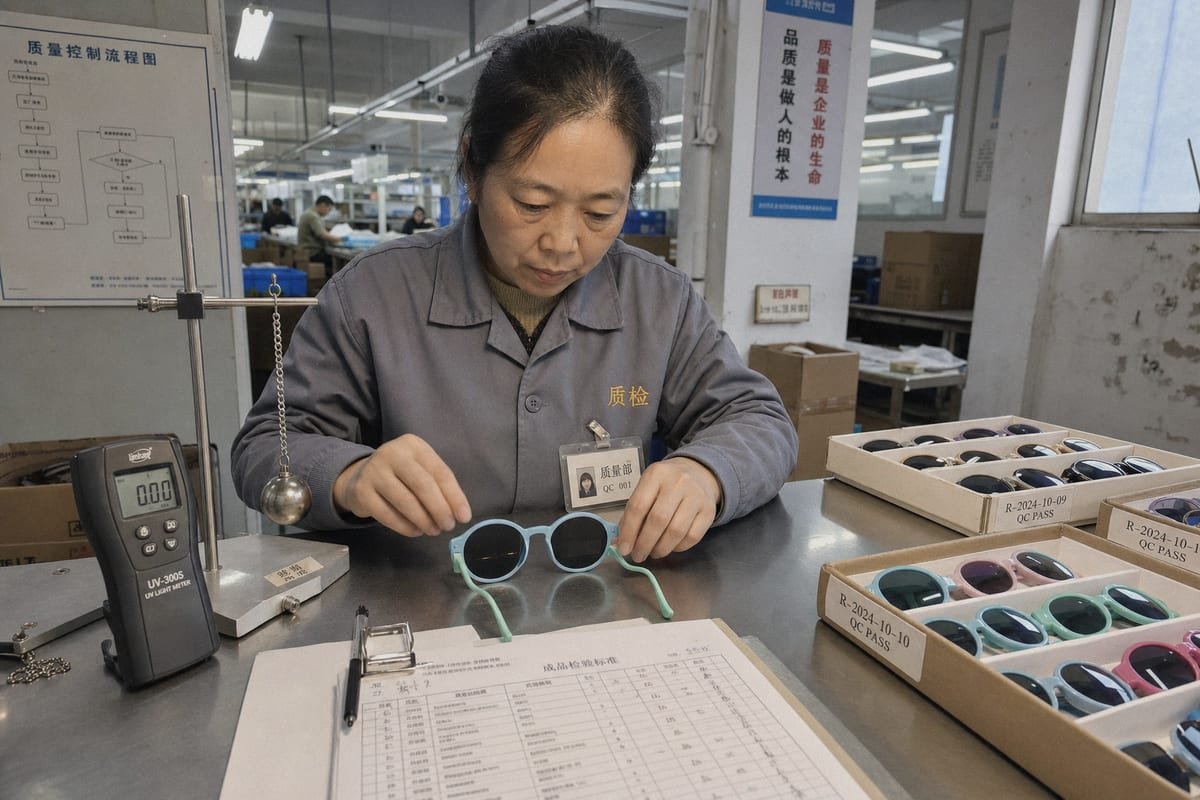
Les tests d'inspection de qualité sur les lunettes de soleil pour enfants décident si une expédition protège les enfants ou les met en danger test de fatigue de la charnière 1. J'ai vu des acheteurs apprendre cette leçon à leurs dépens sur notre chaîne de production.
Avant l'expédition, les lunettes de soleil pour enfants subissent une vérification de la protection UV400, des tests de résistance aux chocs par chute de bille, des tests de durabilité du cadre et de fatigue de la charnière, des tests de sécurité chimique pour le plomb et les phtalates, des vérifications des petites pièces et des bords tranchants, une inspection de la clarté optique et un échantillonnage avant expédition basé sur l'AQL avec une documentation complète.
C'est une longue liste de contrôle. Laissez-moi la décomposer section par section, afin que vous sachiez exactement ce qu'il faut exiger de tout fournisseur avant que vos marchandises ne quittent l'usine.
Quelles normes de sécurité dois-je attendre de mon fournisseur pour les tests ?
Il y a quelques années, un acheteur européen nous a demandé un document que nous ne pouvions pas fournir assez rapidement — et je n'ai jamais oublié cette leçon. Depuis, notre équipe prépare les dossiers de conformité avant même le début de la production.
Les fournisseurs doivent tester les lunettes de soleil pour enfants par rapport à la norme ISO 12312-1 pour les propriétés optiques et de transmission, à la norme FDA 21 CFR 801.410 pour la résistance aux chocs, à la conformité CPSIA pour le plomb et les phtalates, aux règles EN 71 sur les petites pièces et aux limites de libération de nickel pour tous les composants métalliques en contact avec la peau.
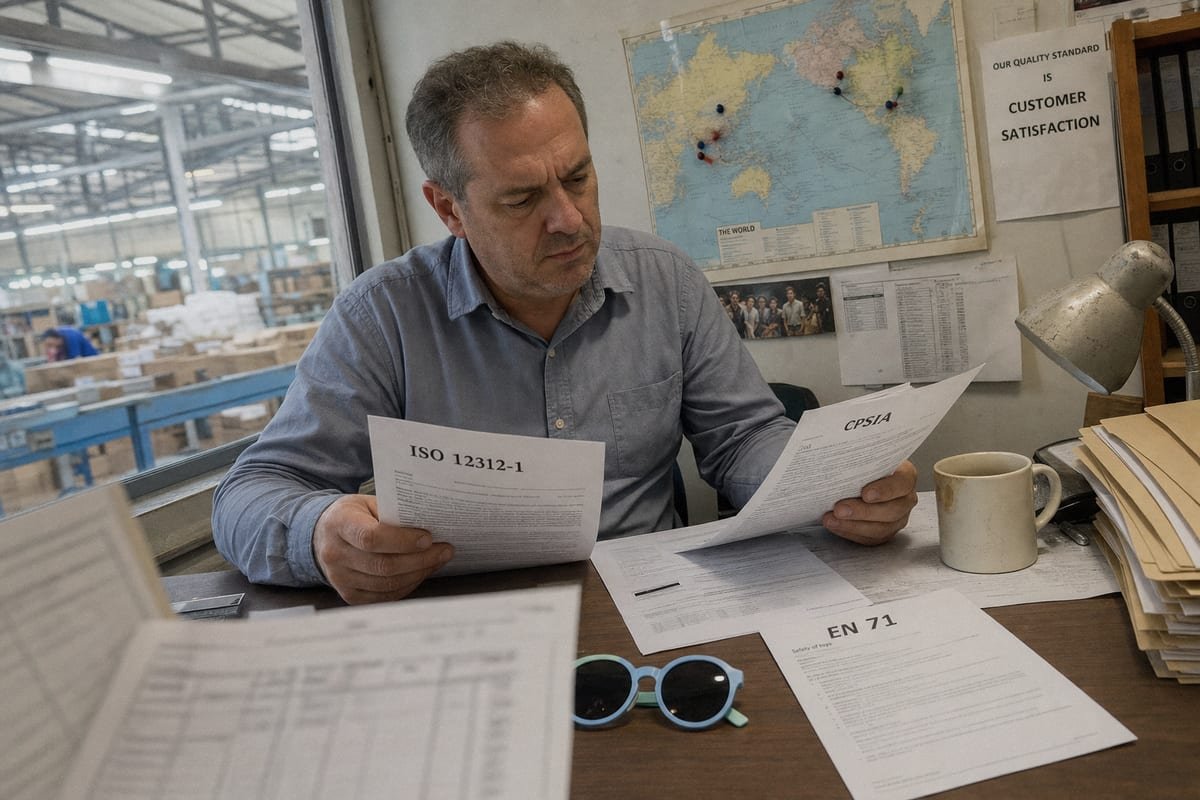
Les normes ne sont pas interchangeables. Chaque marché a ses propres règles, et les produits pour enfants sont soumis à un examen plus strict que les lunettes pour adultes. Au cours de nos quinze années d'exportation vers plus de vingt pays, nous avons appris à cartographier chaque commande vers son marché de destination en premier. Ce n'est qu'alors que nous verrouillons le plan de test.
Les deux couches de tests
Pensez aux tests en deux couches. La première couche est la conformité réglementaire. Ce sont des tests en laboratoire qui rendent le produit légal à vendre. La deuxième couche est le contrôle qualité en usine. Ces vérifications détectent les défauts tels que les charnières desserrées, les verres rayés ou les mauvais emballages avant l'expédition. Un fournisseur qui ne fait qu'une seule couche fait la moitié du travail.
Normes clés par marché
| Marché | Norme | Ce qu'elle couvre |
|---|---|---|
| États-Unis | FDA 21 CFR 801.410 | Test de résistance aux chocs (test de chute de bille) |
| États-Unis | conformité CPSIA 2 | Plomb inférieur à 90 ppm, phtalates inférieurs à 0,1% |
| UE | Norme ISO 12312-1 3 | Exigences de filtrage UV, de transmission, de puissance optique |
| UE | EN 71 (petites pièces) | Risques d'étouffement pour les jeunes enfants |
| UE | Test de libération de nickel 4 | Pièces métalliques en contact prolongé avec la peau |
| Australie | AS/NZS 1067.1 | Catégories de verres de lunettes de soleil et performances UV |
Voici une nuance que de nombreux nouveaux acheteurs manquent. Un produit qui réussit la liste de contrôle américaine peut toujours échouer exigences européennes, parce que le Norme ISO 12312-1 mesure les catégories de verres et propriétés de transmission 5 différemment. Lorsqu'un client vend dans les deux régions, nous construisons une matrice de test combinée. Cela coûte un peu plus cher au départ. Cela coûte beaucoup moins cher qu'une expédition rejetée ou un rappel.
Posez une simple question à votre fournisseur : quelle norme, quel laboratoire et quel lot ? S'ils ne peuvent pas répondre aux trois, continuez à chercher.
Comment tester la durabilité et la flexibilité des montures en TPEE et TR90 ?
Il y a un compromis que nous évaluons sur chaque nouveau moule : rendre le cadre plus rigide pour un look net, ou plus souple pour la sécurité lorsqu'un tout-petit le plie en arrière. Pour les lunettes pour enfants, nous choisissons presque toujours la flexibilité.
Les montures en TPEE et TR90 sont testées par des tests de fatigue des charnières d'environ 500 cycles d'ouverture-fermeture, des vérifications de torsion et de retour des branches, des tests de chute à hauteur de table, des essais de résistance au froid et à la chaleur, et des tests de force de traction confirmant que les pièces restent serrées après des contraintes répétées.
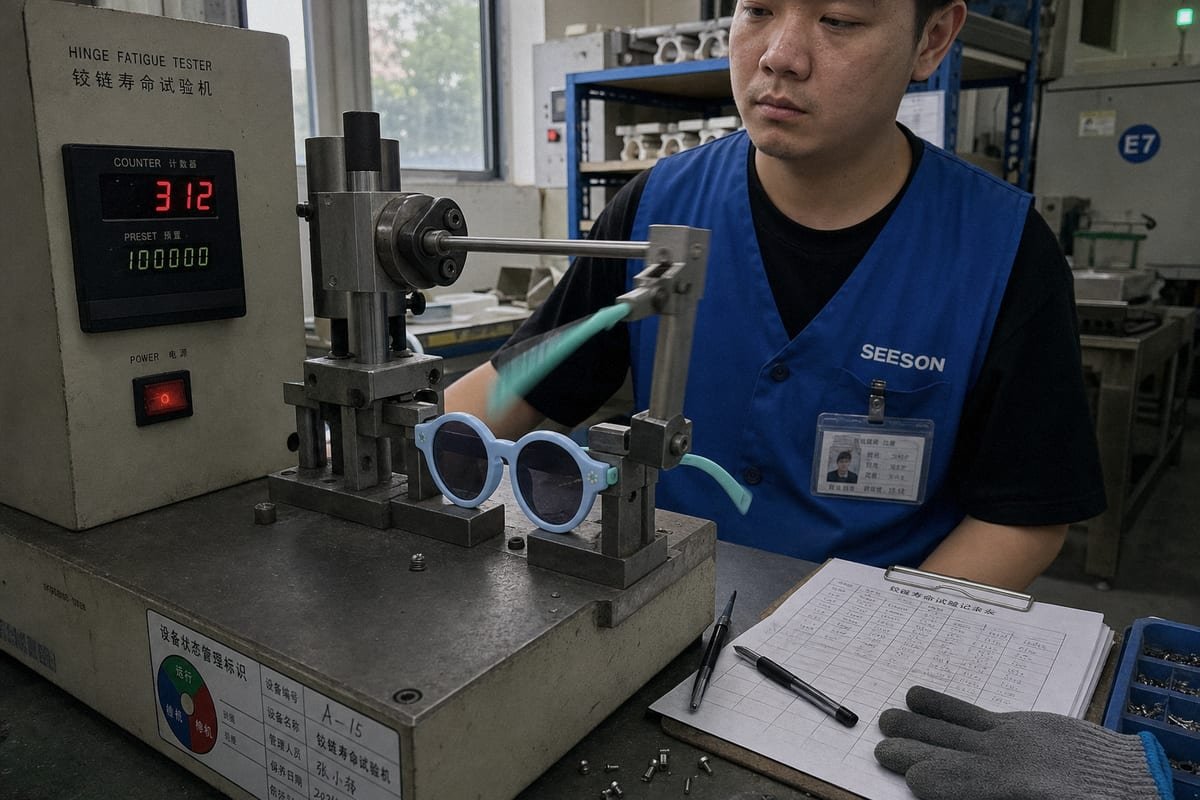
Les enfants ne traitent pas les lunettes de soleil avec douceur. Ils s'assoient dessus, mâchent les branches et les arrachent d'une seule main. C'est précisément pourquoi nous fabriquons la plupart de nos quelque 800 modèles en TPEE et TR90 — des matériaux choisis pour leur mémoire, leur flexibilité et leur légèreté. Mais le choix du matériau seul ne suffit pas. Les tests de durabilité du cadre doivent prouver que la conception résiste aux abus réels.
Les contrôles de durabilité de base que nous effectuons
- Test de fatigue de la charnière. Nous ouvrons et fermons les branches à plusieurs reprises, généralement jusqu'à 500 cycles. Après le cyclage, les charnières ne doivent pas se desserrer, se fissurer ou grincer. Les vis doivent maintenir le couple.
- Flexion et retour des branches. Nous plions les branches en TPEE bien au-delà de leur angle d'ouverture normal. Un bon cadre reprend sa forme sans blanchiment ni marques de contrainte à l'articulation.
- Test de torsion. Nous tordons le devant du cadre comme si nous essorions une serviette. Le TR90 doit fléchir et récupérer ; les substituts cassants se brisent.
- Test de chute. Nous laissons tomber des lunettes de soleil assemblées sur un sol dur à hauteur de table, sous plusieurs angles. Les verres doivent rester en place. Rien ne doit se détacher.
- Résistance à la température. Les enfants laissent des lunettes dans des voitures chaudes et des sacs à dos froids. Nous vérifions la déformation, le changement de couleur et la fragilité après exposition à la température.
Pourquoi la vérification des matériaux est importante
Tous les cadres vendus sous le nom de "TR90" ne sont pas authentiques. Les mélanges bon marché semblent identiques le premier jour mais se fissurent en quelques semaines. Sur notre chaîne, nous vérifions les lots de matières premières avant l'injection, car un test de durabilité sur un cadre fini ne peut pas compenser entièrement une résine compromise. C'est une raison pour laquelle nous nous positionnons comme un partenaire à long terme plutôt qu'un fournisseur à bas prix : l'approvisionnement constant en matériaux est la source de la durabilité constante.
Vérifiez également l'espace entre le cadre et le verre après tous les tests mécaniques. Une tolérance courante est de 0,5 mm ou moins. Un espace plus grand signifie que le verre peut sortir pendant le jeu.
Quels contrôles de qualité des verres garantissent la protection UV et la clarté optique ?
Un acheteur d'Australie nous a un jour envoyé un échantillon d'un concurrent avec des verres très foncés et nous a demandé pourquoi les enfants se plaignaient de maux de tête. Notre laboratoire a trouvé la réponse en quelques minutes : teinte forte, faible protection UV et distorsion optique visible.
Les contrôles de qualité des verres comprennent la vérification par spectromètre du niveau de protection UV400, la mesure de la transmittance pour confirmer la catégorie de verre correcte, l'inspection au frontofocomètre pour la distorsion et la puissance optique, le test d'efficacité de la polarisation lorsque revendiqué, et les contrôles d'adhérence et de rayure du revêtement sur toute la surface du verre.
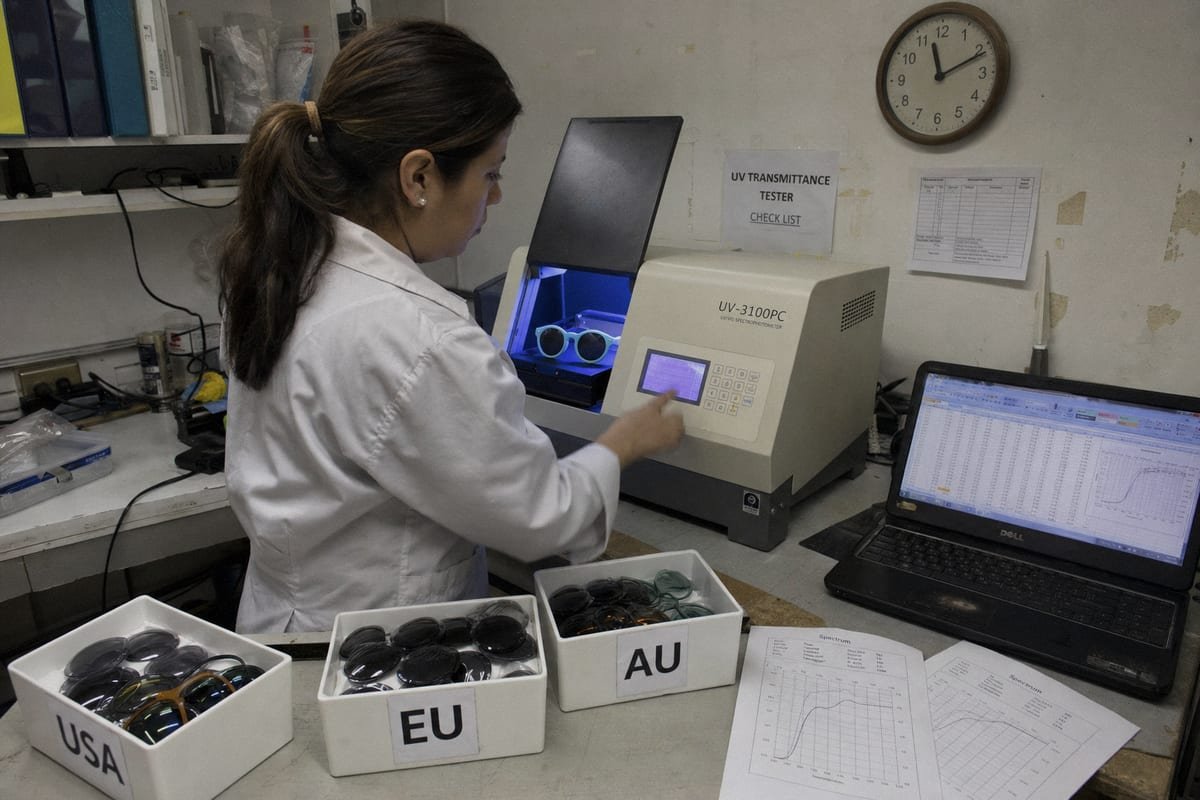
Voici le fait le plus important pour toute marque pour enfants : la profondeur de la teinte n'est pas une protection UV. Un verre sombre sans filtration UV adéquate est pire que pas de lunettes de soleil du tout. La teinte sombre dilate la pupille d'un enfant, qui admet alors plus de rayons UV non filtrés dans l'œil en développement. Seuls des tests instrumentaux peuvent confirmer une protection réelle.
La séquence de test des verres
| Test | Instrument | Critères de réussite |
|---|---|---|
| Blocage UV | Spectromètre UV | 100% des UVA/UVB bloqués jusqu'à 400 nm |
| Transmission visible | Télémètre de transmission | Correspond à la catégorie de verre déclarée (par exemple, Cat. 3) |
| Distorsion optique | Lensomètre | Pas d'ondulations, de prisme ou de puissance optique involontaire |
| Efficacité de la polarisation | Testeur de polarisation | Atteint l'efficacité déclarée pour les SKUs polarisés |
| Qualité du revêtement | Vérification visuelle + adhérence | Pas de décollement, de bulles ou de revêtement miroir inégal |
| Finition de surface | Boîte d'inspection lumineuse | Pas de rayures, de piqûres ou de voile |
Distorsion et confort
Les exigences de puissance optique sont importantes même pour les verres non correcteurs. Un verre de lunettes de soleil doit avoir une puissance corrective pratiquement nulle. Si un produit bon marché le moulage par injection 6 laisse des ondulations dans le verre, un enfant peut ressentir une fatigue oculaire, des maux de tête ou des vertiges. Nous vérifions la puissance plane sur un lensomètre pour chaque lot de production, car les enfants expriment rarement le problème — ils arrêtent simplement de porter les lunettes, et le parent blâme votre marque.
Revêtements miroir et dégradés
Nos styles de lunettes de sport avec des verres miroir orange-or nécessitent une vérification supplémentaire : uniformité du revêtement. Les revêtements miroir appliqués de manière inégale peuvent créer des "points chauds" de transmission où la filtration diminue. Nous scannons la surface du verre, pas seulement le centre, pour confirmer des propriétés de transmission constantes d'un bord à l'autre. Pour les options polarisées, nous vérifions également l'efficacité de la polarisation et le bon alignement de l'axe de polarisation, car un filtre mal aligné déforme la perception des écrans et des reflets par les enfants.
Comment puis-je vérifier le contrôle qualité avant l'expédition des lunettes de soleil de mes enfants ?
Lorsque de nouveaux acheteurs visitent notre atelier géré selon la méthode 5S à Taizhou, la question qu'ils posent le plus souvent n'est pas sur le prix. C'est celle-ci : comment savoir si chaque expédition future correspond à l'échantillon d'or que j'ai approuvé ?
Vérifier le contrôle qualité en exigeant des rapports de laboratoire spécifiques au lot pour les tests de sécurité UV, d'impact et chimiques, une inspection préalable à l'expédition par une tierce partie basée sur l'AQL, un échantillon de référence signé, des enregistrements de vérification des charnières et de l'assemblage, des photos d'inspection, et la vérification de l'emballage et de l'étiquetage avant de libérer le paiement.
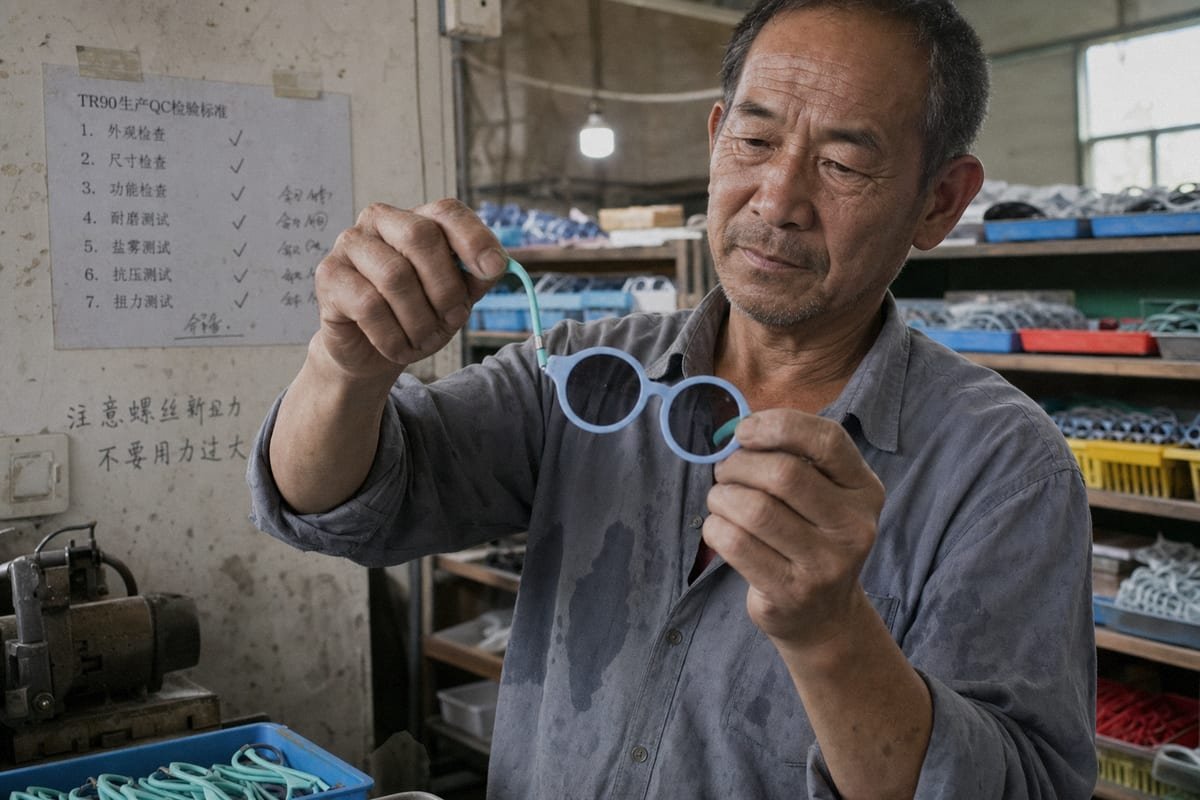
Vous n'avez pas besoin de prendre l'avion pour la Chine pour chaque commande. Vous avez besoin d'un système de vérification. Voici le flux de travail que nous recommandons à chaque marque avec laquelle nous travaillons, et celui que nous exécutons en interne sur notre propre ligne.
Le flux de travail de vérification avant expédition
- Approbation de l'échantillon d'or. Les deux parties signent un échantillon de référence couvrant la couleur, la teinte, la position du logo et l'emballage. Tout litige ultérieur sera résolu par rapport à cet échantillon.
- Contrôles des matériaux entrants. Les lots de résine, les ébauches de verres et les vis sont vérifiés avant la production. Les défauts détectés ici coûtent quelques centimes ; les défauts détectés en mer coûtent toute la commande.
- Inspection en cours de processus. Les opérateurs vérifient l'assemblage, le siège des verres et la tension des charnières pendant la production, pas seulement à la fin.
- Tests en laboratoire par lot. la vérification UV400 7, le test de chute de bille d'acier de 5/8 pouce à 50 pouces, le dépistage de conformité CPSIA et les résultats des tests de libération de nickel là où des pièces métalliques existent. Pour le marché américain, la certification de résistance aux chocs doit exister pour chaque lot, pas seulement pour la première commande.
- Inspection finale AQL. Un échantillon aléatoire statistiquement valide est prélevé sur les cartons finis et classé selon des limites de défauts convenues.
- Dossier de documentation. Les rapports, les photos et les numéros de lot sont conservés pour la traçabilité.
Ce que signifient les niveaux AQL pour vous
| Type de défaut | AQL typique | Exemples |
|---|---|---|
| Critique | 0 (aucun accepté) | Bords tranchants, petites pièces détachables, test UV ou d'impact échoué |
| Majeur | 2.5 | Charnière lâche, mauvais alignement de la lentille, écaillage du revêtement |
| Mineur | 4.0 | Marque cosmétique légère, léger décalage d'impression sur l'emballage |
Une note honnête : aucun laboratoire d'usine ne teste chaque paire. La conformité repose sur un échantillonnage statistiquement significatif, c'est pourquoi la documentation au niveau du lot est plus importante que tout certificat individuel. Un fournisseur proposant des "certificats" sans numéros de lot, sans nom de laboratoire et sans dates propose du papier, pas une preuve. Demandez le dossier complet, et toute usine sérieuse — y compris la nôtre — le fournira sans hésitation.
Conclusion
Les lunettes de soleil pour enfants sont confrontées à de réels dangers : fuites d'UV, verres qui se brisent, matériaux toxiques, pièces qui étouffent. Exigez des tests d'inspection de qualité vérifiés — cartographie des normes, essais de durabilité, vérification des verres et inspection AQL documentée — avant que toute expédition ne quitte l'usine.
Notes de bas de page
ASTM International développe des normes d'essais de matériaux et de mécanique pertinentes pour la méthodologie de fatigue des charnières. ↩︎
La page de la CPSC explique la loi fédérale fixant les limites de plomb et de phtalates pour les produits pour enfants. ↩︎
Norme ISO officielle régissant la transmission des verres de lunettes de soleil et les exigences optiques référencées dans l'article. ↩︎
Contexte sur l'allergie au nickel expliquant pourquoi les tests de libération de nickel sont importants pour les pièces métalliques des lunettes. ↩︎
Explique le concept optique de transmission utilisé pour vérifier le filtrage UV constant sur les verres. ↩︎
Contexte sur le processus de fabrication qui peut introduire une distorsion des verres si mal contrôlé. ↩︎
La fiche d'information de l'OMS sur les rayons UV soutient pourquoi la vérification UV400 protège les yeux en développement des enfants. ↩︎
Plus d'articles que vous pourriez aimer


Vous recherchez un partenaire fiable en lunetterie pour enfants ?
Explorez plus de 800 styles prêts et un support OEM/ODM complet adapté à votre marque.
Contactez-nous English
  Español de México
  Deutsch
  Français
  日本語
日本語  العربية
  Português do Brasil