What Packaging Info Do Parents Notice First on Kids Optical Frames?
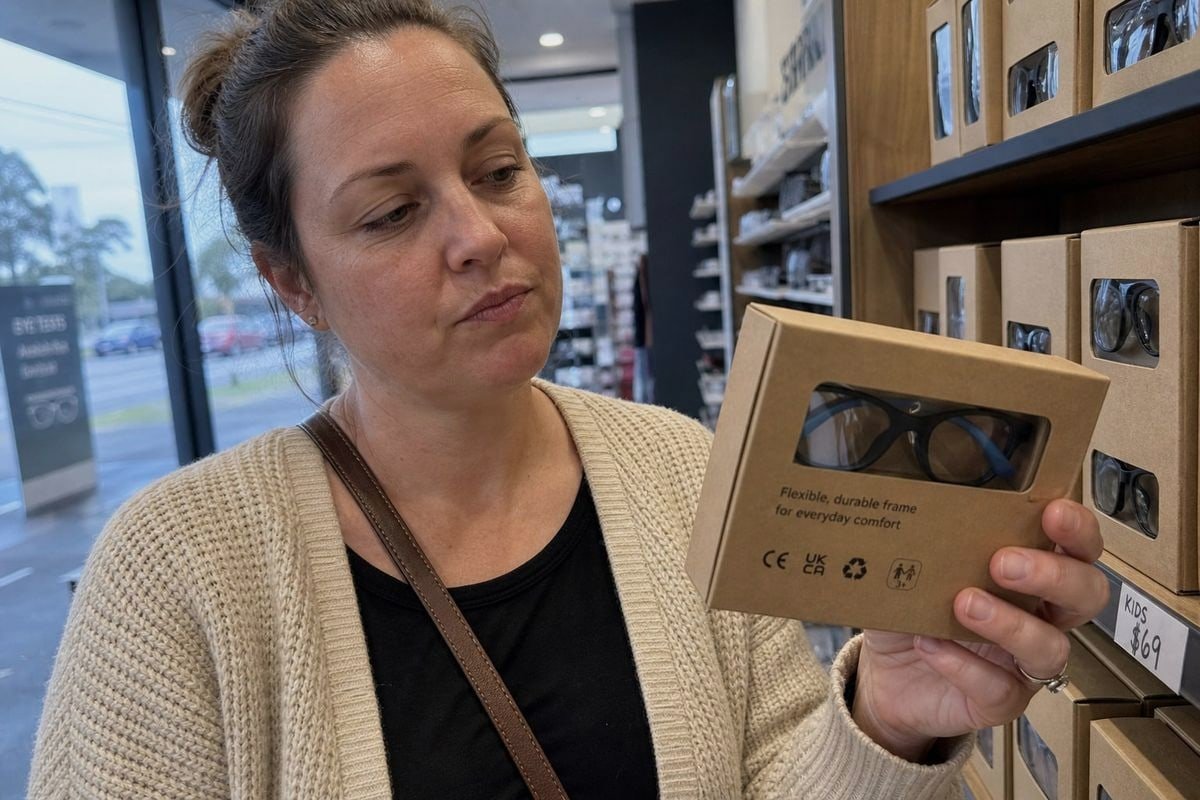
Buyers often ask me what packaging info parents notice first on kids optical frames. Our Taizhou factory has seen great frames fail at retail simply because the box said nothing that calmed a worried parent.
Parents notice safety certifications first on kids optical frames packaging — CE, FDA, and UV400 marks — followed by material safety claims, durability cues like flexible TR90 construction, and clear sizing guidance. Packaging that signals value, trust, and child-safe materials wins the purchase decision fastest.
That short answer covers the essentials. But each of those signals deserves a closer look. Below, I break down the four packaging areas that matter most, based on what our brand customers actually sell through.
What safety certifications and material information should I display on my kids' frame packaging?
A procurement manager from Australia once returned our first packaging draft with one comment: "Where does it say the frame is safe?" That single question reshaped how we design retail-ready boxes.
Display CE marking, FDA medical device compliance where relevant, UV400 protection labels, and clear material declarations such as BPA-free plastic certification and hypoallergenic frame materials. Parents scan for third-party validation first, so certification marks should sit on the front panel, not hidden on the base.
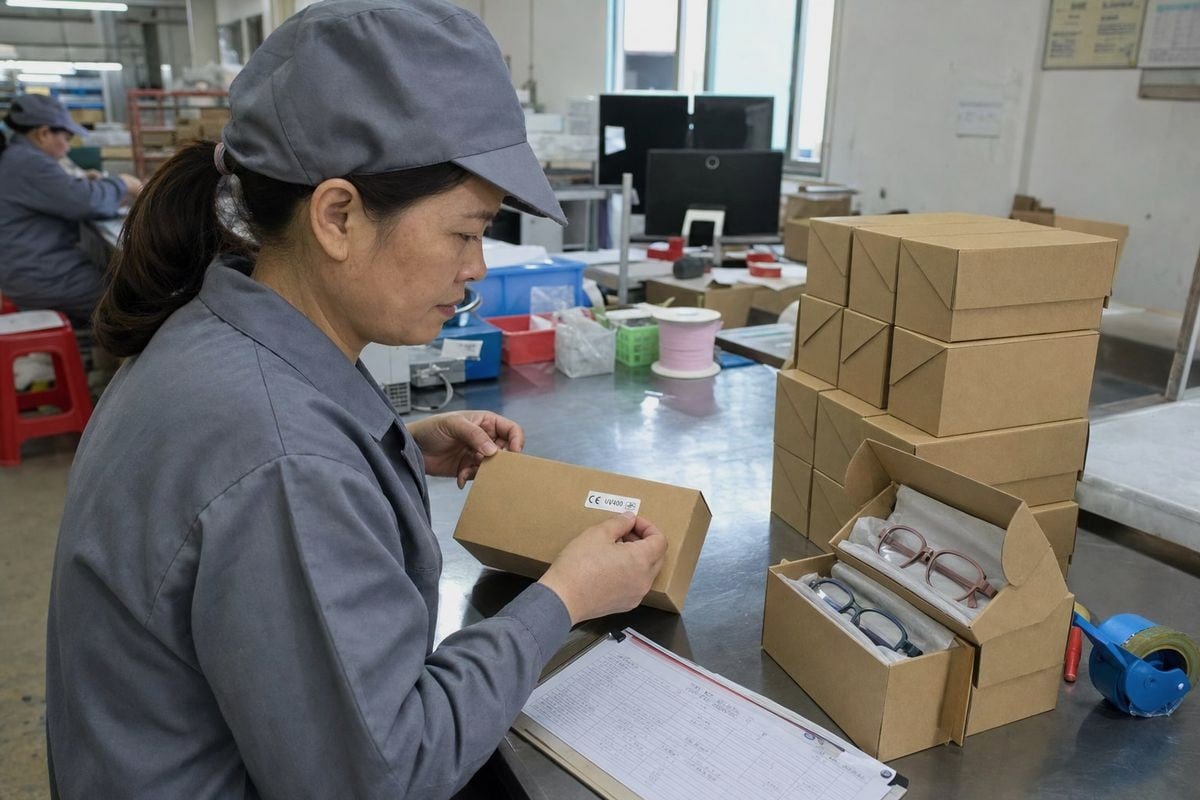
Safety information is the fastest trust signal on any children's product. Parents do not read paragraphs at the shelf. They scan for symbols they recognize. Our export experience across 20+ countries confirms this: the packaging that converts is the packaging that answers "is this safe?" in under three seconds.
Which marks carry the most weight?
Pediatric eyewear safety standards differ by market, so the marks you lead with should match your destination country. Here is how we advise our B2B customers to prioritize:
| Market | Priority mark | What parents read into it |
|---|---|---|
| EU / UK | Marquage CE | Legal compliance, tested product |
| USA | FDA medical device compliance | Regulated, drop-ball tested lenses |
| Global | UV400 protection label | Real eye protection, not a toy |
| All markets | BPA-free / hypoallergenic claims | Safe against a child's skin |
Material declarations parents actually understand
Avoid jargon. "TR90" means nothing to most parents until you translate it. On the packaging we develop for brands, we pair the technical name with a plain-English benefit: "TR90 — lightweight, flexible, safe for active kids." The same applies to hypoallergenic frame materials. Say what it prevents: skin irritation, redness, discomfort behind the ears.
One more lesson from our production line: keep claims verifiable. If your packaging says BPA-free, your supplier should hold the test reports. We keep material certificates 1 on file for every resin batch precisely because our brand customers get audited by retailers. A claim you cannot back up is a recall risk, not a selling point.
Should I highlight UV protection and polarized lens options on my children's eyewear labels?
When we were developing our UV400 and polarized lens range for a Japanese kids' brand, their buyer insisted the UV claim appear in three places on the box. Sales data later proved her right.
Yes. Highlight UV400 protection prominently on children's eyewear labels, because parents treat UV protection as a health feature, not an upgrade. Mention polarized lens options as a secondary benefit for sunglasses and clip-ons, framed around glare reduction for outdoor play.
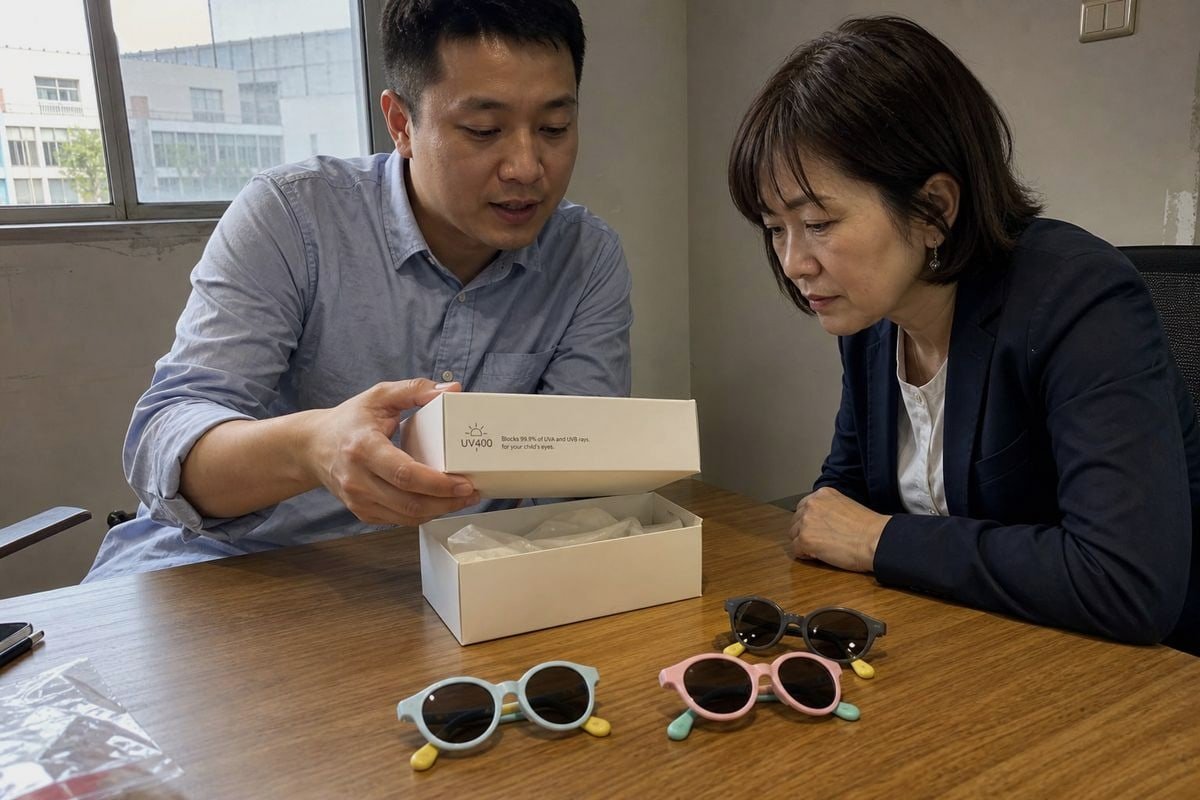
UV protection 2 is one of the few technical claims that parents already understand. They apply sunscreen daily. They know UV damages skin, and increasingly they know it damages young eyes too. So a clear UV400 protection label does double duty: it reassures, and it justifies price. Packaging that communicates real value — not just decoration — is what parents respond to first, and UV protection is measurable value.
How to present the claim without confusing parents
There is a difference between "UV protection" and "UV400." The first is vague. The second is a specific threshold — blocking wavelengths up to 400 nanometers. We recommend our brand customers print "UV400" plus one short line: "Blocks 100% of UVA and UVB rays." That converts a technical spec into a parental benefit.
Polarized lenses need a different framing. Polarization does not add UV protection; it cuts glare. On our polarized kids’ sunglasses lines, the packaging language that works is activity-based: "Clearer vision at the beach, on water, and in snow." Parents connect it to real scenarios rather than physics.
Where optical frames fit in
Even for clear optical frames 3, lens-related claims matter. Note prescription lens compatibility on the packaging so parents know their optician can fit lenses easily. If the demo lenses carry any UV filtering, say so — but never overstate it. Honest, specific claims build the long-term trust that keeps a children's brand alive. That is also why we run incoming lens inspections at our 5S-managed workshop: the label is a promise, and the product inside must keep it.
How should I present sizing and fit guidance on my kids' optical frames?
Fit complaints are the number one reason children reject glasses, and we learned this the hard way. Early in our OEM work, a European distributor reported returns not for defects, but because parents guessed the wrong size.
Present sizing with an age-appropriate sizing chart, printed frame measurements in millimeters (lens width, bridge width, temple length), and a simple visual fit guide. Add notes on adjustable features like an adjustable bridge fit so parents feel confident the frame will stay in place.
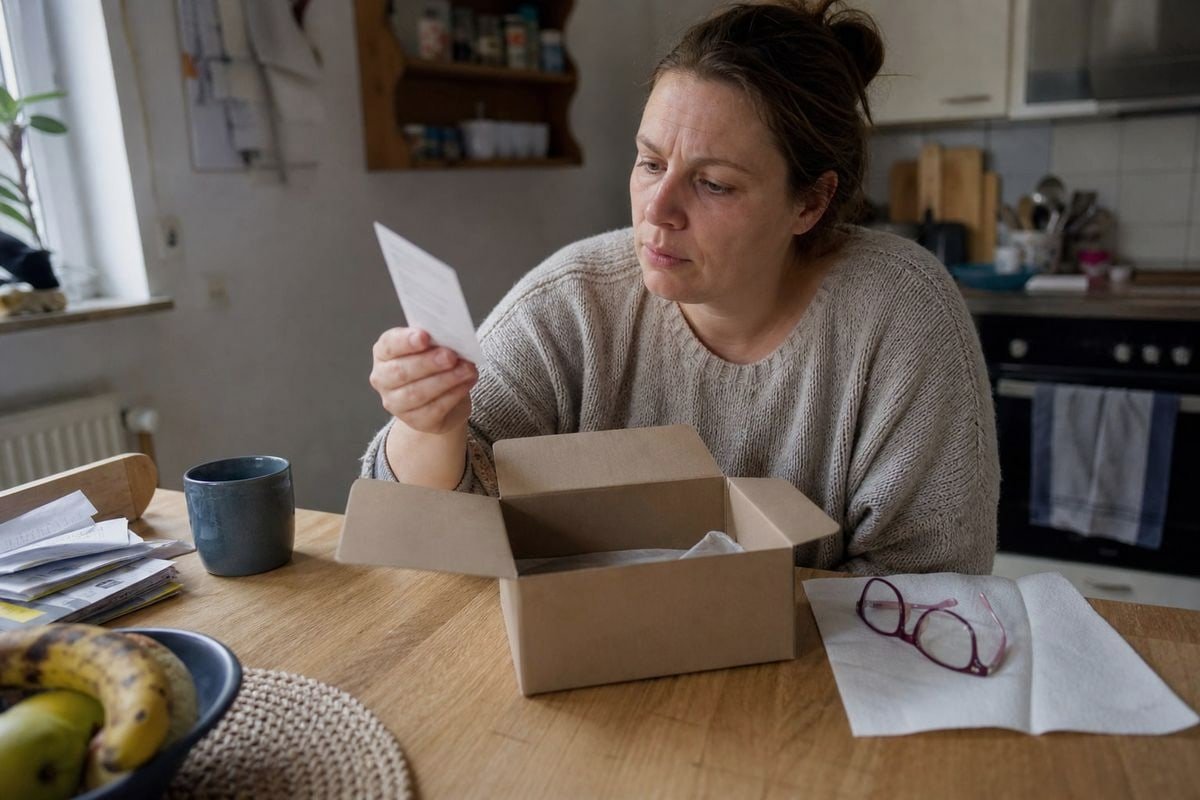
Sizing information is where packaging can genuinely reduce returns. Parents cannot always bring the child to the shelf, and online buyers cannot try anything on. So the box has to do the fitting room's job.
Make the numbers meaningful
Raw measurements alone do not help most parents. A bridge width of 16mm is abstract. Pair every measurement with an age band and a face-shape note. Here is the structure we print for our brand customers:
| Measurement | Where to show it | Parent-friendly translation |
|---|---|---|
| Lens width | Side panel + temple print | "Fits narrow / average / wide faces" |
| Bridge width | Sizing chart | "Suits low or developing nose bridges" |
| Temple length | Sizing chart | "Reaches comfortably behind the ear" |
| Age grading | Front panel | "Ages 3–6" or "Ages 6–10" |
Show, don't just tell
A small diagram of a child's face with the three measurements labeled outperforms text every time. Some of our customers also add a printed try-on guide inside the lid: three checkpoints — no pinching at the temples, no sliding down the nose, no pressure behind the ears. Parents follow it in thirty seconds.
Two more elements are worth the print space. First, mention curved, ergonomic ear hooks or an adjustable bridge fit if the frame has them, because staying in place is the fit worry parents voice most. Second, a QR code linking to a digital fitting or adjustment guide extends the packaging without cluttering it. We have added these codes for several customers, and opticians appreciate them as much as parents do.
What flexibility and durability benefits should I emphasize on my children's frame packaging?
Every trade show, I do the same demonstration: I twist one of our TR90 frames with TPEE temples into a loop and let it spring back. Buyers film it. That ten-second proof is exactly what packaging must replicate on the shelf.
Emphasize flexible, bend-resistant frame materials like TR90 and TPEE, flexible hinge technology, impact resistant lenses, and lightweight comfort. Support these claims with manufacturer warranty details, because durability promises paired with a warranty are the strongest value signal for parents facing frequent breakage.
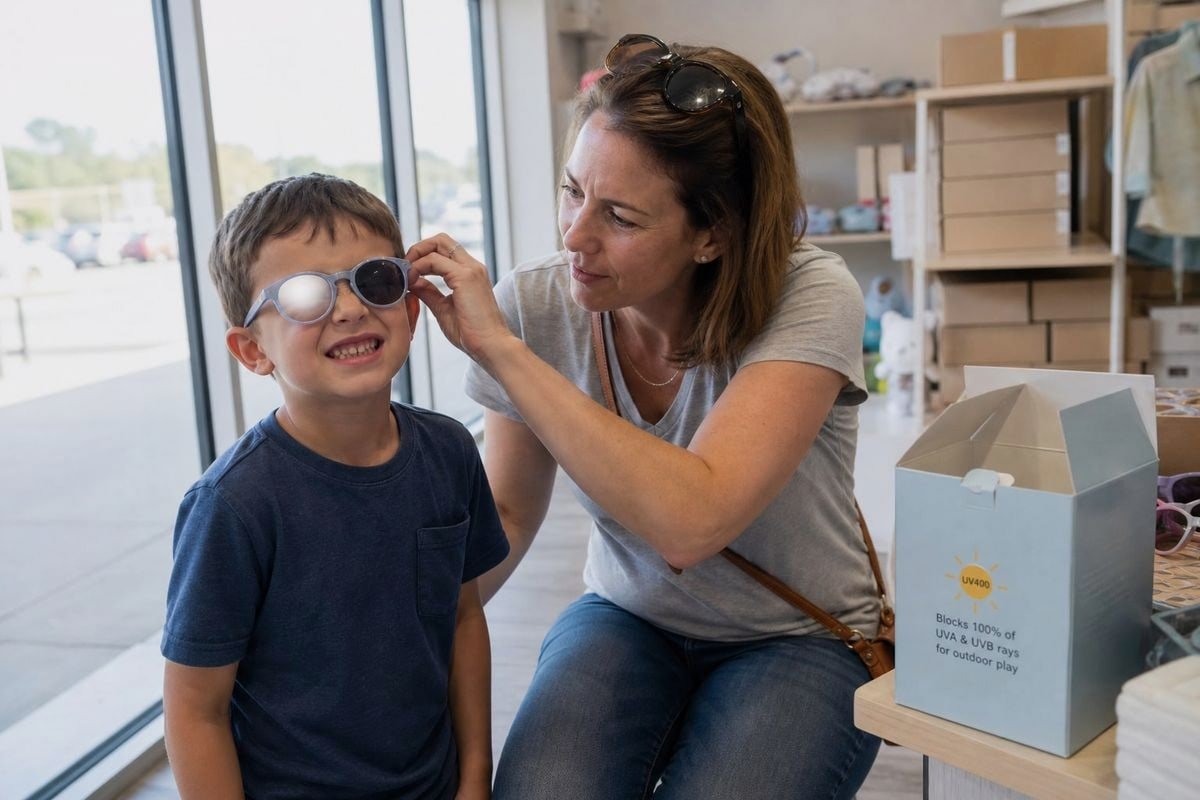
Parents budget for kids' glasses knowing they will be sat on, dropped, and yanked off one-handed. So durability cues are not a bonus feature on packaging — they are the core purchase justification. The research on parental decision-making is consistent: breakage resistance, warranty coverage, and daily-wear survival sit at the top of the mental checklist, right beside price and value.
Translate engineering into shelf language
Our engineers can talk about TPEE elasticity modulus all day. Parents need three words: "bends, doesn't break." Here is how we map material properties to packaging claims:
| Engineering feature | Packaging claim that works |
|---|---|
| TR90 frame construction | "Flexible frame that survives twists and drops" |
| TPEE soft temples | "Soft, skin-friendly temples for all-day comfort" |
| Flexible hinge technology | "Hinges flex outward without snapping" |
| Impact resistant lenses | "Shatter-resistant lenses for active play" |
Back the claim with a promise
Durability claims gain real weight when manufacturer warranty details sit next to them. Even a simple line — "12-month breakage warranty" — changes how parents read the price tag. It converts a durability claim from marketing into a guarantee. We encourage our brand customers to define warranty terms early in development, because the packaging, the insert card, and the retailer's return policy all need to say the same thing.
One caution from our OEM/ODM work: never print "unbreakable." Everything breaks under enough force, and that word invites disputes. "Bend-resistant" and "flexible" are honest, testable, and just as persuasive. If your line uses sustainable packaging design or recyclable materials, note it briefly too — it reinforces the responsible, trustworthy tone that durability claims depend on, without crowding the main message.
Conclusion
Parents notice safety marks 4, material claims, sizing guidance, and durability promises first. Get those four right on your kids optical frames packaging, and the parent's trust follows fast.
Weak packaging quietly kills strong frames. Every unanswered safety question at the shelf is a lost sale. After 15 years building children's eyewear for brands in 20+ countries, our team has seen that retail-ready packaging — clear certifications, honest UV400 labels, an age-appropriate sizing chart, and warranty-backed durability claims — is what turns browsers into repeat buyers. If you are developing a kids' line, choose from our ~800 existing TR90 and TPEE styles, and let us build the branded, parent-convincing packaging alongside the frames.
Notes de bas de page
1. Authoritative .gov source explaining safety certification requirements specifically for children’s products, replacing the broken ISO link. ↩︎
2. WHO fact sheet explaining the health necessity of UV protection for eyes. ↩︎
3. The FDA regulates clear optical frames and lenses as Class I medical devices. ↩︎
4. Official EU portal for CE marking, one of the key safety marks for children’s eyewear. ↩︎
Plus d'articles que vous pourriez aimer

août 5, 2026
Bio-Based vs Regular Cellulose Acetate: What's the Difference for Kids' Frames?

août 5, 2026
How Recyclable Are Kids' Optical Frame Materials, and What Eco-Friendly Alternatives Exist?

août 5, 2026
Do Kids Optical Frames Whiten or Age in Storage, and How to Control Warehouse Conditions?
Vous recherchez un partenaire fiable en lunetterie pour enfants ?
Explorez plus de 800 styles prêts et un support OEM/ODM complet adapté à votre marque.
Contactez-nous English
  Español de México
  Deutsch
  Français
  日本語
日本語  العربية
  Português do Brasil