What Do Lens Category Numbers (0–4) Mean for Kids’ Sunglasses?
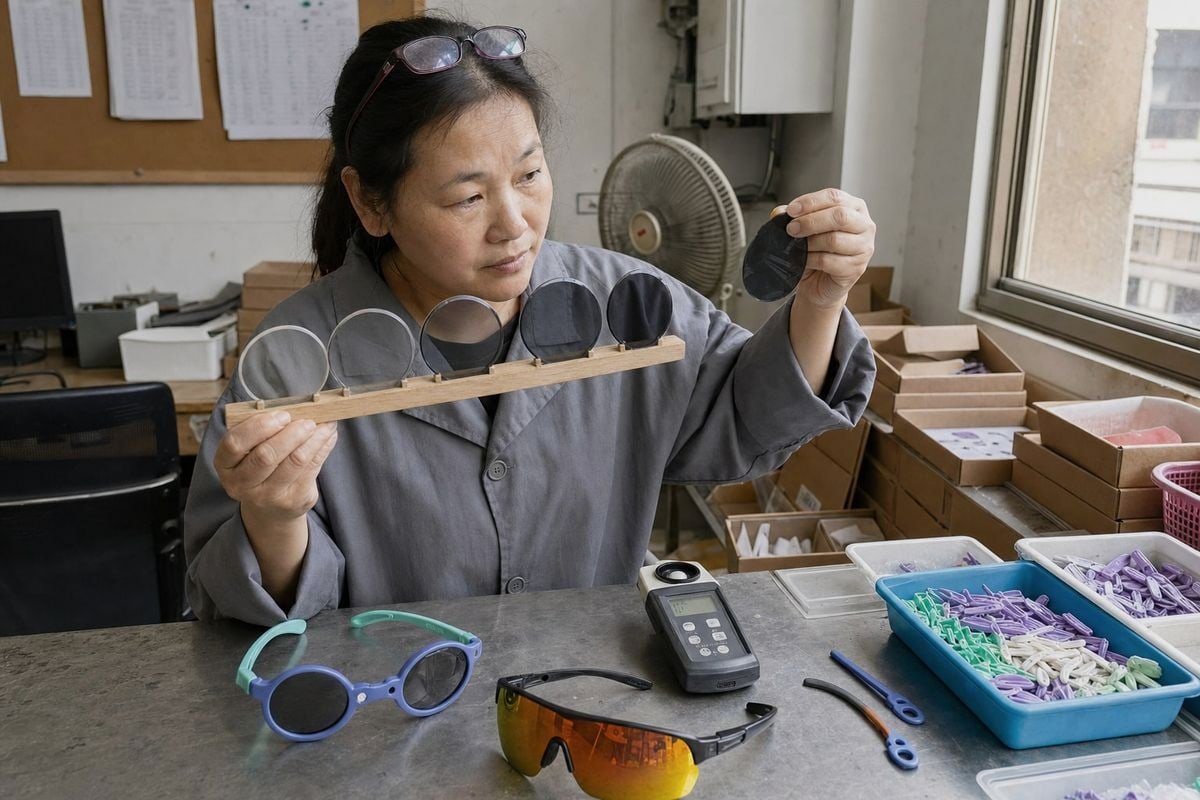
Lens category numbers confuse many buyers who visit our Taizhou factory ANSI Z80.3 1. Choose wrong, and your kids’ sunglasses fail retail audits, frustrate parents, and stall reorders. Let me clear this up.
Lens category numbers 0–4 on kids’ sunglasses indicate Visible Light Transmission — how much light passes through the lens. Category 0 is nearly clear (80–100% VLT); Category 4 is very dark (3–8% VLT). The number describes tint darkness, not UV protection, which must be verified separately as UV400.
That short answer covers the basics. But if you are building a kids’ eyewear line, you need more detail. Let me walk you through how we handle this question with buyers every week.
What lens category should I choose for my kids' sunglasses brand's climate and use case?
A buyer from Brisbane once asked me why her Category 1 samples felt "too bright" during beach testing. Our team explained the answer in one word: climate. Tint must match the sun.
Choose Category 3 (8–18% VLT) for bright, sunny markets like Australia, Southern Europe, or beach destinations. Choose Category 2 (18–43% VLT) for temperate climates and everyday play. Reserve Category 4 for snow or high altitude only, and avoid Categories 0–1 as primary sunwear.
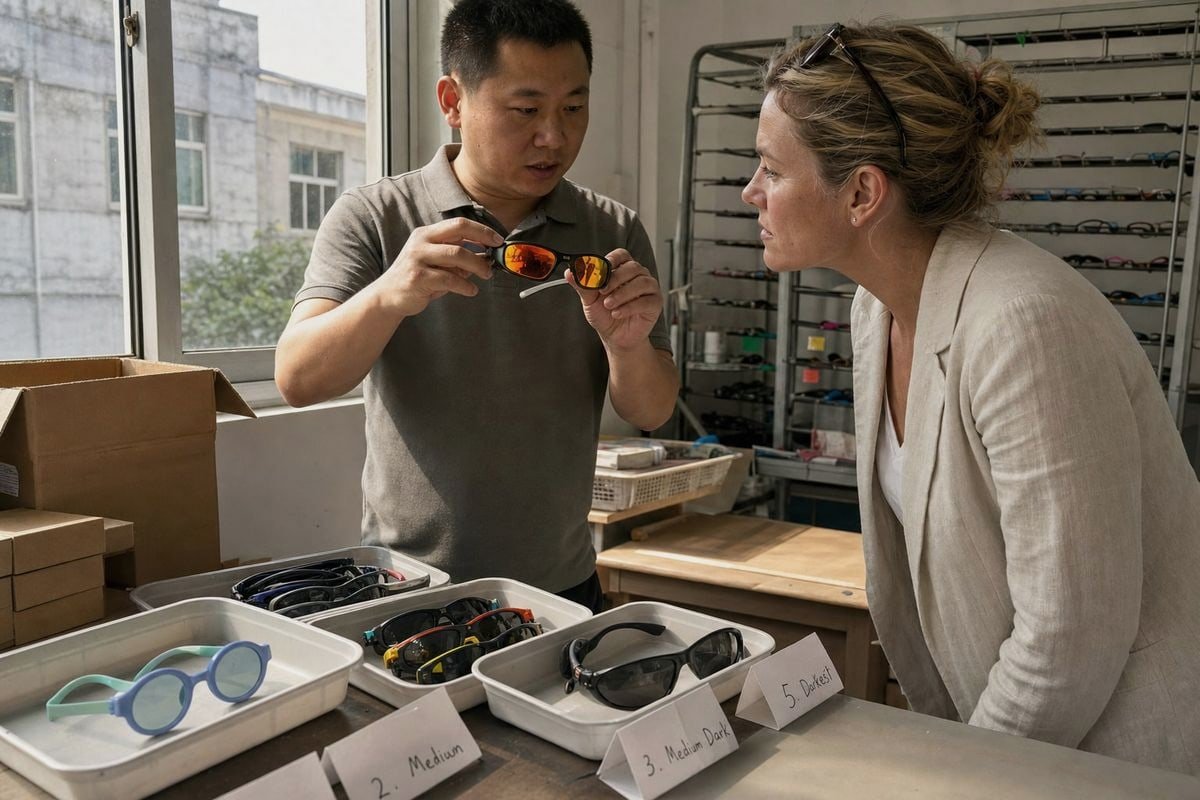
The category system comes from the Norme ISO 12312-1 2 and similar European norms. It classifies lenses by Transmission de la lumière visible 3, which is the percentage of visible light that reaches the eye. A lower percentage means a darker lens and stronger glare reduction. Here is the full scale as we apply it in production:
| Catégorie | Plage de TLV | Best Use for Kids | Not Recommended For |
|---|---|---|---|
| 0 | 80–100% | Indoor, fashion, sensory comfort | Any real sun exposure |
| 1 | 43–80% | Overcast days, low light | Bright outdoor play |
| 2 | 18–43% | Everyday wear, mixed weather | Intense beach or snow glare |
| 3 | 8–18% | Soleil éclatant, plage, aire de jeux | Dusk, indoor transitions |
| 4 | 3–8% | Snowfields, glaciers, high altitude protection | Driving, everyday use, cycling |
Match the Category to the Market, Not the Trend
In our fifteen years of making children's eyewear, we have seen a clear pattern. Brands selling into Australia, the Middle East, or Mediterranean Europe nearly always land on Category 3. Brands in Northern Europe, Japan, or Canada often split their lines between Category 2 and Category 3.
Why does this matter so much for children? Eye health for children is more fragile than for adults. Kids also refuse to wear things that feel wrong. A lens that is too dark for a cloudy schoolyard gets pulled off and stuffed in a backpack. A lens that is too light on a bright beach makes a child squint. Either way, the parent blames your brand.
Think About Activity, Too
Climate is half the equation. Activity is the other half. Water and sand reflect light upward, so beach styles benefit from darker tint intensity and sometimes polarized lenses. Stroller use and casual town wear sit comfortably in Category 2. Ski goggles and alpine sunglasses justify Category 4, but that is a niche, not a core kids' range.
How do I match lens categories to UV400 protection when sourcing from a manufacturer?
During a QC audit last year, our inspection team rejected a batch of externally sourced sample lenses. The tint looked perfect. The UV filtration did not meet spec. That distinction is everything.
Lens category and UV400 protection are independent specifications. Category measures visible tint darkness; UV400 measures blockage of ultraviolet rays up to 400 nanometers. When sourcing, require written confirmation of UV400 on every lens, at every category level, and verify it with spectrophotometer test reports.

This is the single most misunderstood point in kids' eyewear sourcing. Many first-time buyers assume a darker lens automatically blocks more UV. It does not. Tint comes from dye or coating. UV filtration comes from the lens material and its UV-absorbing additives. The two are made in separate steps.
Here is the danger. A dark lens without proper UV filtering is worse than no sunglasses at all. The dark tint causes a child's pupils to dilate. Dilated pupils then let more unfiltered UV radiation reach the retina. Children are especially at risk because their young, clear crystalline lenses transmit more UV to the back of the eye than adult lenses do. This is why sun safety standards treat UV filtration as non-negotiable.
What to Ask Your Supplier
When we onboard a new buyer, we encourage them to request three things. First, ask for the lens material specification. We use verres en polycarbonate 4 and similar impact-resistant options for children because they combine inherent UV absorption with shatter resistance. Second, ask for UV transmission test data, not just a "UV400" sticker. Third, confirm which standard the product is tested against, such as the ISO 12312-1 standard, AS/NZS 1067 5 for Australia, or ANSI Z80.3 for the US.
A Simple Sourcing Matrix
| Spécification | Ce qu'il contrôle | Comment vérifier |
|---|---|---|
| Catégorie de lentille (0–4) | Visible tint darkness | VLT measurement report |
| UV400 | UVA/UVB blockage to 400nm | Spectrophotometer test |
| Polarisation | Reflected glare filtering | Polarization test card |
| Sécurité en cas d'impact | Shatter resistance | Material spec + drop-ball test |
One more nuance from our production line: coatings matter. On darker lenses, an inner-surface anti-reflective coating helps stop stray UV from bouncing off the back of the lens into the eye. It is a small detail, but premium kids' brands increasingly specify it.
Can I offer multiple lens category options within the same frame style for my product line?
One trade-off we weigh constantly in development: variety versus complexity. The good news is that lens categories are one of the easiest variables to multiply without adding tooling cost.
Yes. The same frame mold can carry different lens categories, tints, and coatings. A single style can ship as Category 2 for everyday lines, Category 3 for beach lines, and polarized or mirrored variants for premium tiers — all without new mold investment, since only the lens changes.

This is where an existing style library becomes powerful. With around 800 styles already tooled at our factory, a buyer can take one proven TR90 frame with flexible TPEE temples and build a small family of SKUs around it. The frame stays identical. The lens does the segmentation work.
Consider how this plays out across a real range. A soft, rounded frame in periwinkle blue with mint temples works beautifully with solid dark gray Category 3 lenses for daily sun protection. A sporty wraparound shield style in glossy black or white pairs naturally with a mirrored gradient lens — orange-to-gold or a multicolor iridescent finish — which parents read as "performance" and kids read as "cool." Mirror coatings typically sit on Category 3 bases, since the reflective layer adds glare reduction on top of the tint.
A Practical Tiering Strategy
- Entry tier: Category 2 or 3 solid tint, UV400, standard packaging.
- Core tier: Category 3 with polarized lenses for water and beach use.
- Premium tier: Category 3 mirrored or gradient lenses with anti-reflective inner coating.
- Specialty tier: Category 4 for snow-destination retailers, clearly labeled as not for driving or everyday wear.
Where Photochromic Fits
Émergent photochromic technology 7 deserves a mention. These lenses shift dynamically, often between Category 0–1 indoors and Category 2–3 in bright sun. They solve the "wearability gap" — the moment a child removes dark glasses in mixed light and loses all protection. We position photochromic as a premium option because the lens cost is higher, but for travel-focused or outdoor-lifestyle brands, it is a genuine differentiator.
One caution from experience: do not over-segment. Three lens options per frame is usually the ceiling before inventory management becomes painful for a young brand.
What lens category information should I include on packaging and labeling to meet buyer expectations?
A lesson we learned early in our export journey: beautiful packaging that omits compliance information gets stopped by a distributor's compliance officer, not by a customs official. Labeling is a sales tool and a legal requirement at once.
Packaging for kids' sunglasses should state the lens category number (0–4), UV400 or "100% UVA/UVB" protection, the applicable standard such as ISO 12312-1 or EN ISO 12312-1, a CE mark for Europe, and a clear warning if Category 4 lenses are unsuitable for driving.
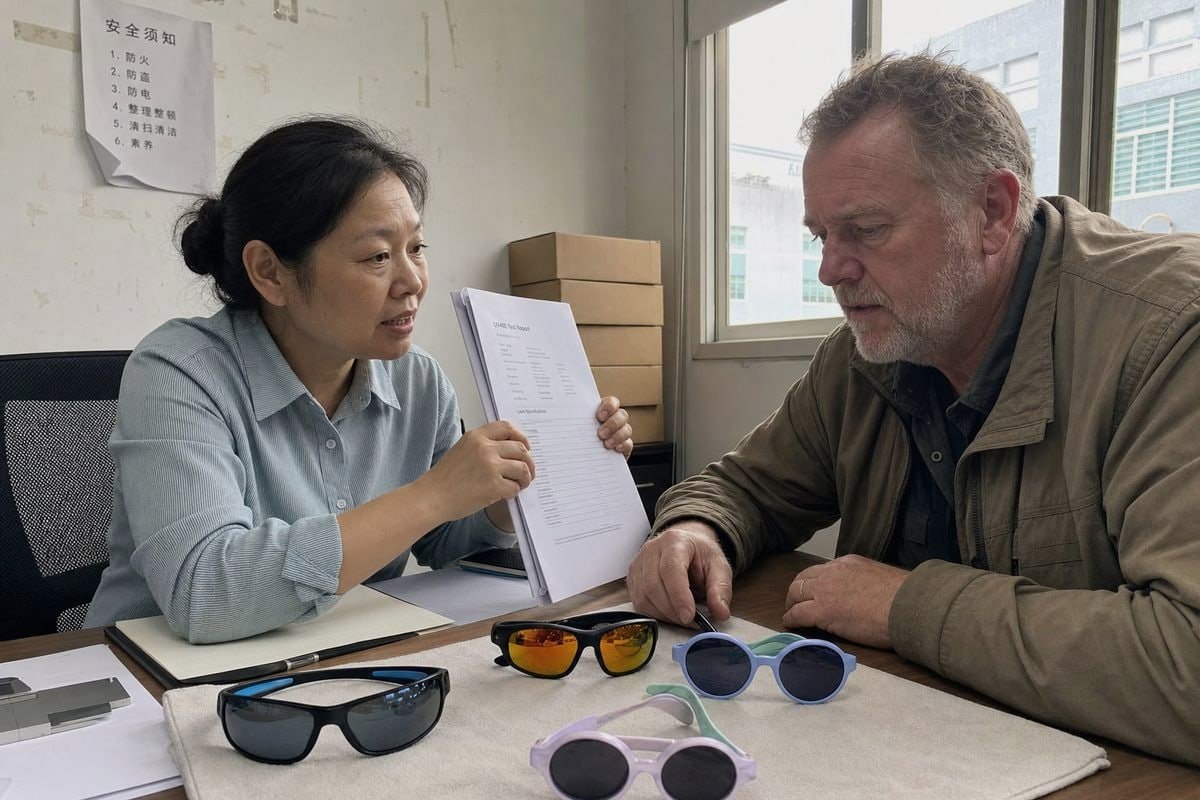
Different markets phrase their requirements differently, but the core information set is consistent. Here is the checklist we build into artwork approvals for OEM packaging projects:
| Label Element | Required or Recommended | Notes for Kids' Lines |
|---|---|---|
| Numéro de catégorie de lentille | Required (EU/AU) | State it plainly, e.g., "Filter Category 3" |
| UV400 / 100% UV claim | Required by retailers | Must be backed by test reports |
| Référence de la norme | Requis | ISO 12312-1, EN ISO 12312-1, or AS/NZS 1067 |
| Marquage CE | Required (EU) | Sunglasses are Category I PPE in the EU |
| "Not suitable for driving" warning | Required for Category 4 | Also wise for heavily mirrored lenses |
| "Not for direct sun viewing" note | Recommandé | Protects against eclipse-viewing misuse |
| Age suitability and material info | Recommandé | Parents value TR90/TPEE flexibility claims |
Turn Compliance into Marketing
Here is the part many buyers miss. Category and UV information should not hide in small print. Parents actively search for it. A hang tag that says "Category 3 lens — filters 82–92% of visible light, blocks 100% of UV rays" educates the shopper and justifies a premium price. We often design a simple icon system for our OEM clients: a sun icon for category, a shield icon for UV400 protection, and a wave icon for polarized options.
Keep Documentation Behind the Label
Every claim on the box needs a paper trail. When we run private-label projects, we keep test reports, Declarations of Conformity, and material certificates filed by production lot. If a retailer in Germany or Australia audits your product two years later, that file protects your brand. Ask any supplier you work with to commit to the same discipline before you approve artwork.
Conclusion
Lens categories tell you darkness; UV400 tells you safety. Get both right, label them clearly, and your kids' sunglasses line earns parents' trust — and repeat orders.
Notes de bas de page
1. Wikipedia entry detailing the American national standard for nonprescription sunglasses. ↩︎
2. Wikipedia provides a stable, accessible overview of international eyewear standards including the ISO 12312-1:2022 update. ↩︎
3. Technical explanation of how light passes through materials like sunglass lenses. ↩︎
4. Material properties of polycarbonate used for impact-resistant children’s eyewear. ↩︎
5. Official Australian government safety standard for sunglasses and fashion spectacles. ↩︎
6. The American Academy of Ophthalmology is a premier medical authority for verifying UV400 and eye safety requirements. ↩︎
7. Medical overview of lenses that adjust tint based on UV exposure. ↩︎
Plus d'articles que vous pourriez aimer


Vous recherchez un partenaire fiable en lunetterie pour enfants ?
Explorez plus de 800 styles prêts et un support OEM/ODM complet adapté à votre marque.
Contactez-nous English
  Español de México
  Deutsch
  Français
  日本語
日本語  العربية
  Português do Brasil