Can TPEE Kids Sunglasses Nose Pads, Temple Arms, and Straps Be Replaced Separately?
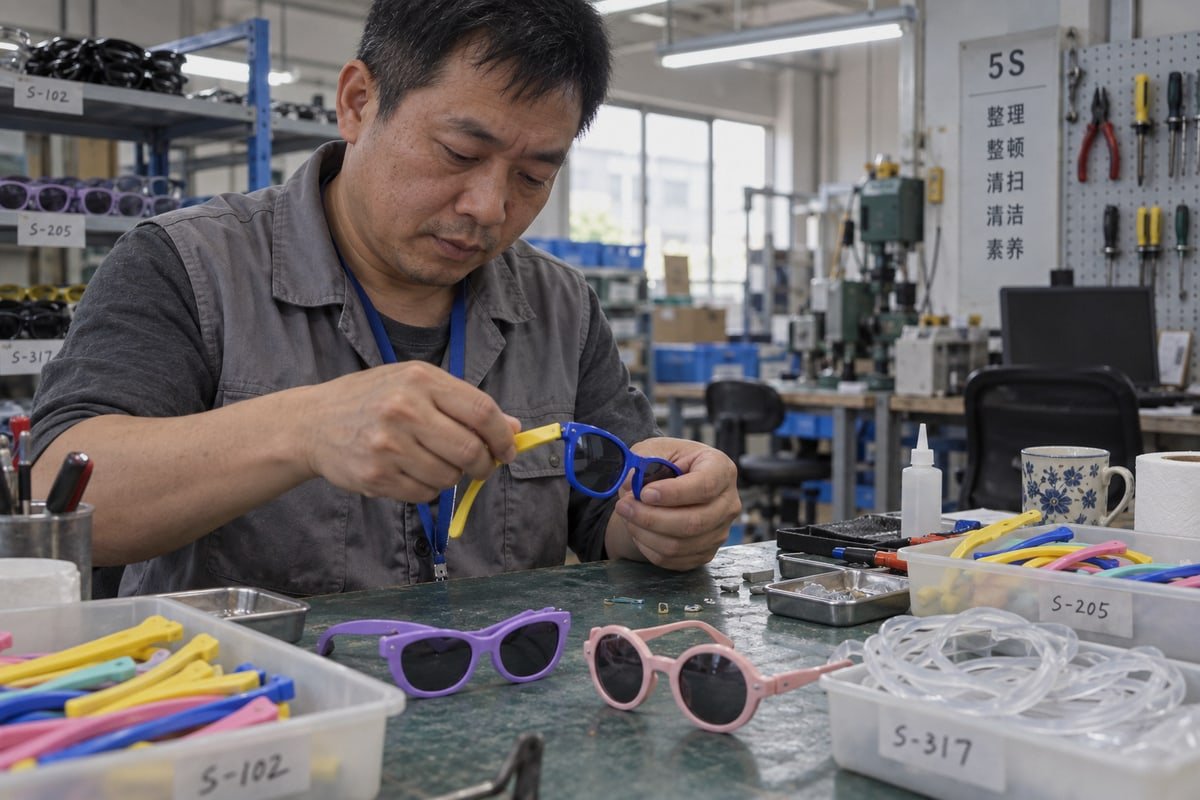
A parent emails your support team about TPEE kids sunglasses: one temple arm snapped. Do you replace the part or the pair? On our Taizhou line, that question shapes design.
TPEE kids sunglasses nose pads, temple arms, and straps can be replaced separately only when the frame uses a modular design. Snap-fit or screw-hinge temple arms and loop-on straps swap easily. Nose pads molded into a one-piece TPEE front cannot be replaced without changing the whole front.
That short answer hides a lot of detail. Each part behaves differently. The hinge type matters. The brand’s spare-parts policy matters. So I will walk through each part, then show you how to judge a supplier, then cover safety, and finally give you a list of questions to ask before you commit.
Which parts of TPEE kids sunglasses can I actually order as replacement components?
Last month our QC team pulled a batch of yellow TPEE temples off the line because the snap-fit hinges felt loose. That check exists because temples get swapped.
Temple arms and straps are the parts you can most reliably order separately for TPEE kids sunglasses. Temples usually ship in pairs, and straps are universal accessories. Nose pads are normally molded into the frame front for child safety, so they are replaced as a full front, not alone.
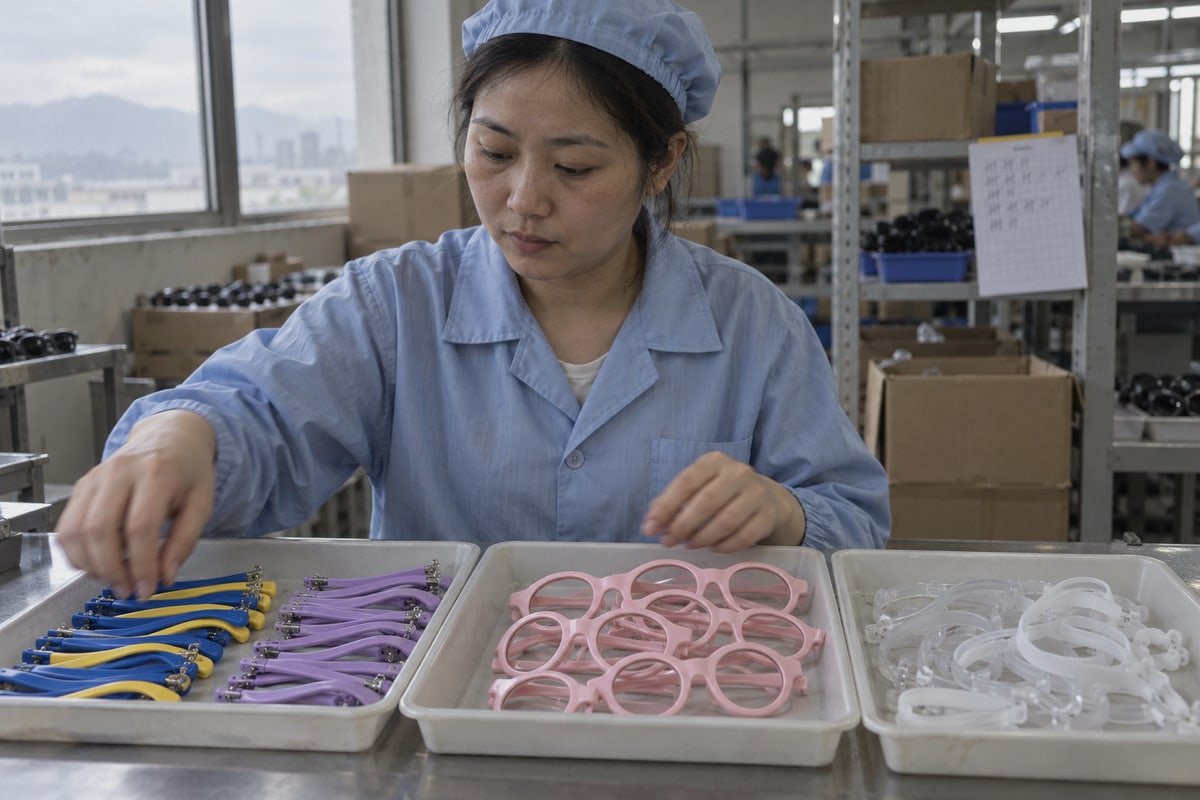
Let me start with the material, because it explains the rest. TPEE is a thermoplastic polyester elastomer. It bends, springs back, and resists impact. That is why we use it for children's frames and for the temples on our TR90 frames with TPEE temples. It is also a hypoallergenic frame material 1 and part of our BPA-free eyewear range. But flexibility changes how parts attach. You cannot always screw into soft material the way you can with hard acetate.
The three parts, one by one
Here is how each component works on most of the ~800 styles in our catalog.
| Pièce | Typical attachment on TPEE frames | Sold separately? | Pourquoi |
|---|---|---|---|
| Plaquettes de nez | Molded into the bridge as one piece | Rarement | Small loose pads are a choking hazard on non-toxic kids glasses; safety standards push brands toward integrated nose areas |
| Branches | Snap-fit pinless hinge, or small metal screw hinge | Yes, usually in pairs | Tool-free swap on snap-fit; screw swap on metal hinges |
| Straps | Loop or clip over the temple tips | Yes, as a universal accessory | Not a structural frame part, so fit is broad |
Plaquettes de nez
On our monoblock TPEE fronts, the nose area is part of the same shot of material as the rim. There is no pad to unscrew. If the bridge fails, the whole front gets replaced. That is a deliberate choice. A toddler chewing on a detachable pad is a risk we will not design in.
Branches
Temples are the real replacement story. Take our two-tone square frame with the royal blue front and yellow arms. It uses a small silver metal hinge. Those arms come off with a tiny screwdriver. Our softer round and cat-eye styles use a pinless snap-fit joint. A parent can pull one off and push a new one on. Either way, we ship spare temples in matched pairs, because left and right are mirrored.
Straps
An adjustable silicone head strap or an elastic retainer loops over the temple tips. It does not need a proprietary fitting. Most kids' sports and swim styles accept a strap this way. So straps are the easiest part to replace, and often the first thing a brand adds to its accessory list.
How do I know if a supplier can support spare parts for long-term customer service?
A procurement manager from Australia once asked me before signing: “If we sell a few thousand pairs, how many spare temples can you hold for us?”
A supplier can support spare parts long term if it owns the molds, keeps color-matched TPEE compound records, holds surplus temples and straps per order, and documents model numbers on each temple. Ask for these four things in writing before you launch a replaceable-parts program.
That buyer asked the right question. Spare parts are easy to promise and hard to deliver two years later. I have seen brands get stuck because their trading company changed factories, and the new factory had no mold for the old temple. The color no longer matched. The hinge spacing was off by a fraction. So the "spare part" was useless.
Four signals that a supplier can really do it
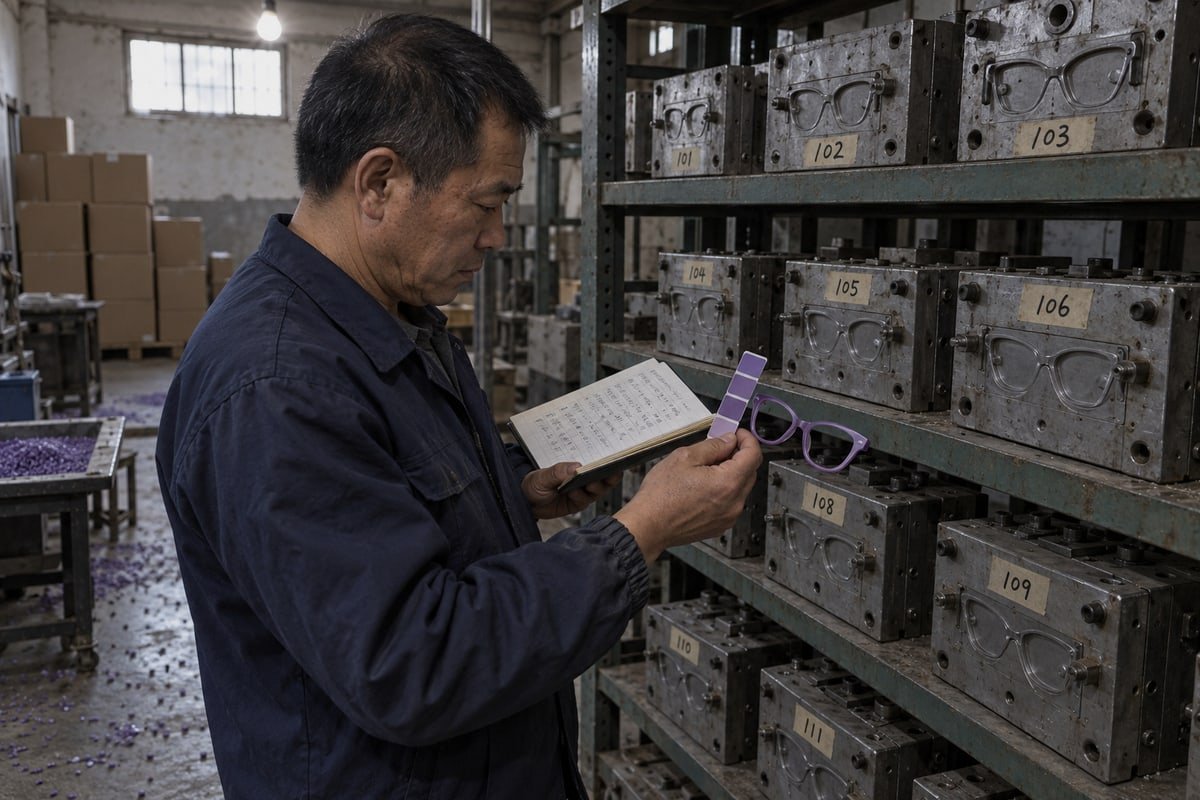
- Mold ownership. The supplier must physically own or control the temple and front molds. Ask to see them. In our 5S-managed workshop, molds are labeled and shelved by style number.
- Color records. TPEE is compounded in color. If the supplier does not log the exact formula per order, a spare temple made later will be a slightly different yellow or lavender. We keep the formula against the order number.
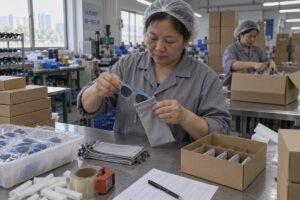
- Surplus per order. A good practice is to run extra temples and straps with the main order and ship them in the same carton. This solves the objection I hear most: shipping single components later is not worth the freight. Shipping them together is.
- Part identification. Look at the inner left temple on our lavender cat-eye style. It carries a Marquage CE 2 and engraved text. That engraving is what lets a customer service agent match a spare part to the right model without guessing.
Factory versus trading company
| La liste essentielle des questions | Trading company | Real factory |
|---|---|---|
| Who holds the mold? | Often the subcontracted factory | The factory itself |
| Can a spare temple be re-run in 18 months? | Only if the same factory is still used | Yes, from the same mold and formula |
| Who answers a technical fit question? | Relayed by email | The engineer who designed the hinge |
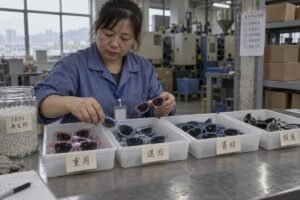
We are a real factory with about 120 workers and 15 years in eyewear. That matters less as a boast and more as a practical point. When a brand asks for a spare run of temples, the people who answer are the ones who made the first run. Long-term customer service for children's frames depends on that continuity, not on price.
Will mixing replacement parts affect the safety or durability of the original design?
Every time we design a snap-fit hinge, we weigh two things: easy tool-free replacement versus a joint that survives a toddler twisting it sideways.
Mixing replacement parts is safe only when the parts come from the same mold set and the same TPEE compound. Generic optical temples, mismatched hinge spacing, or a strap on a frame without proper temple tips can loosen the fit, create pinch points, and shorten flexible frame durability.

This is where I push back on the idea that any part is better than no part. Kids' frames are designed as a system. The front, the hinge, the temple, and the lens are tuned together. Change one piece with something from a generic marketplace and the system drifts.
Where mixed parts cause problems
| Mixed part | What goes wrong | Safety or durability effect |
|---|---|---|
| Generic optical temple on a TPEE front | Hinge spacing or pin size does not match | Loose joint, frame slips down the nose, lens sits off-axis |
| Harder TR90 temple on a soft snap-fit socket | Stiffer arm stresses the elastomer socket | Socket cracks after repeated flexing |
| Strap on a frame with no temple tips | Strap slides off or bunches | Poor retention during sport, hair pulling |
| Wrong length temple | Arm too short or too long for the head | Pressure behind the ear or constant slipping |
Why brand-specific eyewear repair kits exist
Because TPEE is a specialized elastomer 3, the industry has moved toward model-specific repair kits rather than universal parts. That is not a sales trick. A temple molded for a 125mm child head profile will not behave the same on a 135mm frame. When we build a kit for a buyer, it contains temples from the same cavity, the same compound batch, and the same anti-slip ear hooks as the original run.
Sometimes you do not need a new part at all
Two points soften the picture. First, TPEE has shape memory. A bent temple can often be reshaped with gentle, controlled warmth and will hold the new curve. Second, worn grip can be fixed with a silicone sleeve slipped over the existing temple. Neither option touches the hinge, so neither risks the original safety design.
The over-molding trade-off
Some of our newer fronts use multi-density over-molding. A firmer core and a softer skin are fused in one shot. That makes the part functionally inseparable, but the joint is stronger than a mechanical hinge. For a brand, this is a real choice: fewer replaceable parts, but far fewer breakages to begin with. Paired with impact-resistant lenses in UV400 or polarized options, the full-frame warranty route can beat a parts program on total cost.
What should I ask my manufacturer before committing to a replaceable-parts program?
One lesson stuck with me after fifteen years in eyewear: the spare-parts questions nobody asked at sampling stage always come back at the warranty stage.
Before committing, ask your manufacturer which parts are modular, whether temples use snap-fit or screw hinges, how spare parts are packed and labeled, what minimum spare quantity ships with each order, whether growth-kit temples exist, and how long the mold and color formula will be kept.
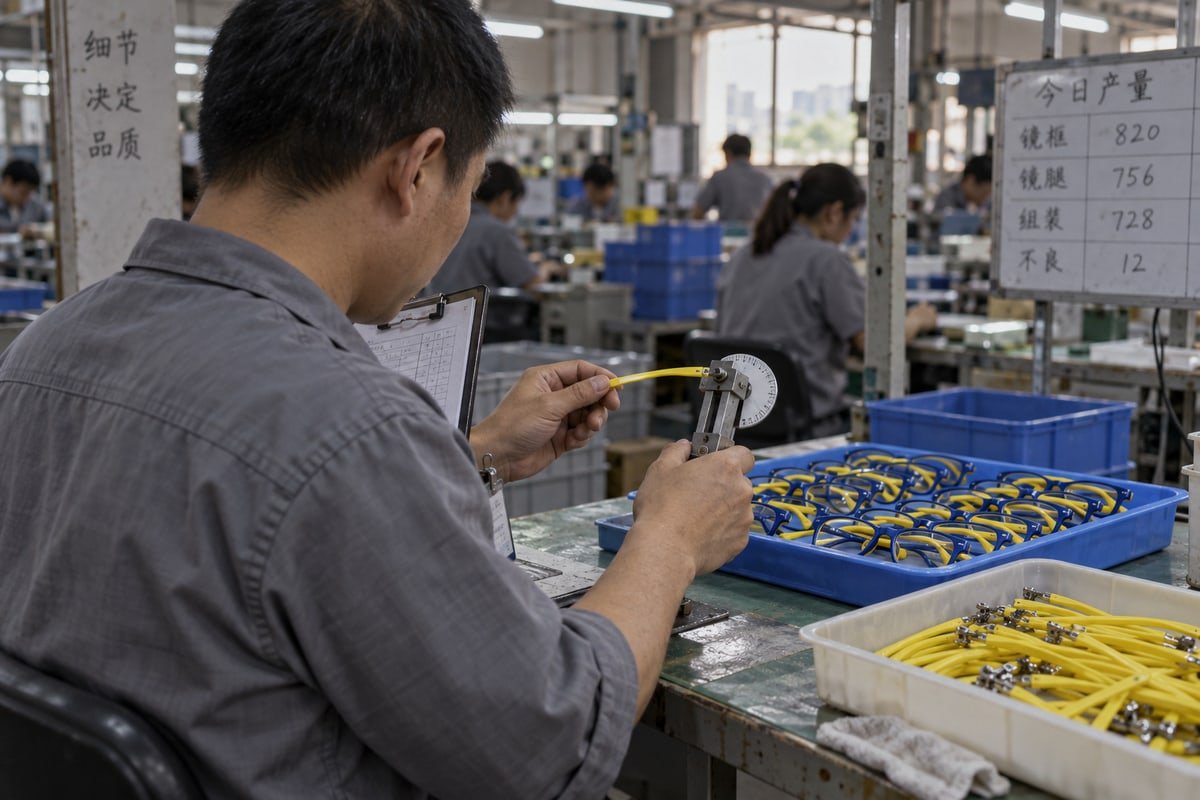
Here is the checklist I wish every buyer brought to the first call. I have added what a good answer sounds like, based on how we handle these requests for brands in Europe, Japan, and Australia.
| La liste essentielle des questions | Pourquoi c'est important | What a solid answer looks like |
|---|---|---|
| Which parts on this style are truly modular? | Sets customer expectations from day one | A parts diagram marking temples and straps as replaceable, nose area as integrated |
| Snap-fit or screw hinge? | Decides if parents need a tool | Snap-fit for toddler styles, screw hinge for the sturdier square frames |
| How are spares packed? | Loose parts get lost in warehouses | Pairs in labeled poly bags with style number and color code |
| What spare ratio ships with each order? | Avoids costly single-part freight later | A small percentage of temples and straps added to the main shipment |
| Do you offer growth-kit temples? | Kids grow; the front still fits | Longer temple lengths molded for the same front |
| How long do you keep mold and color data? | Protects reorders years later | Molds stored by style number, color formula filed with the order |
Raise the "just buy a new pair" objection early
Some buyers tell me a parts program is pointless because low-cost kids sunglasses are semi-disposable. For a bargain-bin product, they are right. But that is not what we build. If your brand sells a comfortable, BPA-free, non-toxic kids' frame at a mid or premium price, a lost temple should not cost the parent a full pair. A spare pair of temples is cheap to make with the main run. It becomes expensive only when it is an afterthought.
Growth kits and accessories change the math
Modular sunglasses design is moving beyond repair. Our TR90 front with TPEE temples can accept longer arms as a child grows. That turns a spare part into a selling point. The same is true of an adjustable silicone head strap sold alongside the frame. Both use the same hinge and temple tip as the original, so nothing about the safety design changes.
Sampling is the moment to test it
When we send samples, we ask buyers to actually pull a temple off and push it back on. Do it ten times. Loop a strap over the tips. Check the CE mark and style number on the inner temple. If a part program is going to fail, it fails in your hand at sampling, not in a warehouse two years later.
Conclusion
Broken temples cost brands trust. Ignored, they become one-star reviews. Design TPEE kids sunglasses with modular temples, universal straps, and a stocked spares plan, and the problem disappears.
Interested in sourcing the products mentioned in this article? See details and request a quote here:
Notes de bas de page
1. Explains the concept of hypoallergenic materials for products in contact with sensitive skin. ↩︎
2. Official European Commission page explaining the regulatory marking required for sunglasses sold in the EU. ↩︎
3. Scientific definition and engineering properties of the TPEE material used in the frames. ↩︎
Plus d'articles que vous pourriez aimer

Vous recherchez un partenaire fiable en lunetterie pour enfants ?
Explorez plus de 800 styles prêts et un support OEM/ODM complet adapté à votre marque.
Contactez-nous English
  Español de México
  Deutsch
  Français
  日本語
日本語  العربية
  Português do Brasil