Are TPEE Kids Sunglasses Frames Recyclable and Eco-Friendlier Than Plastic?
Every season, brand buyers ask us whether TPEE kids sunglasses frames are truly recyclable contenu biosourcé 1. Vague eco-claims worry them. On our Taizhou production line, we learned the honest answer has conditions.
TPEE kids sunglasses frames are technically recyclable because Thermoplastic Polyester Elastomer can be melted and remolded, and they are often eco-friendlier than brittle conventional plastics thanks to longer life and BPA-free chemistry. However, real recyclability depends on single-material design and access to specialty or take-back recycling, not curbside bins.
That short answer hides a lot of detail. The rest of this article walks through what makes TPEE different, how to check a supplier’s claims, what happens to comfort and durability, and what it does to your cost sheet. Let’s start with the material itself.
What Makes TPEE Different from Standard Plastic in Terms of Recyclability?
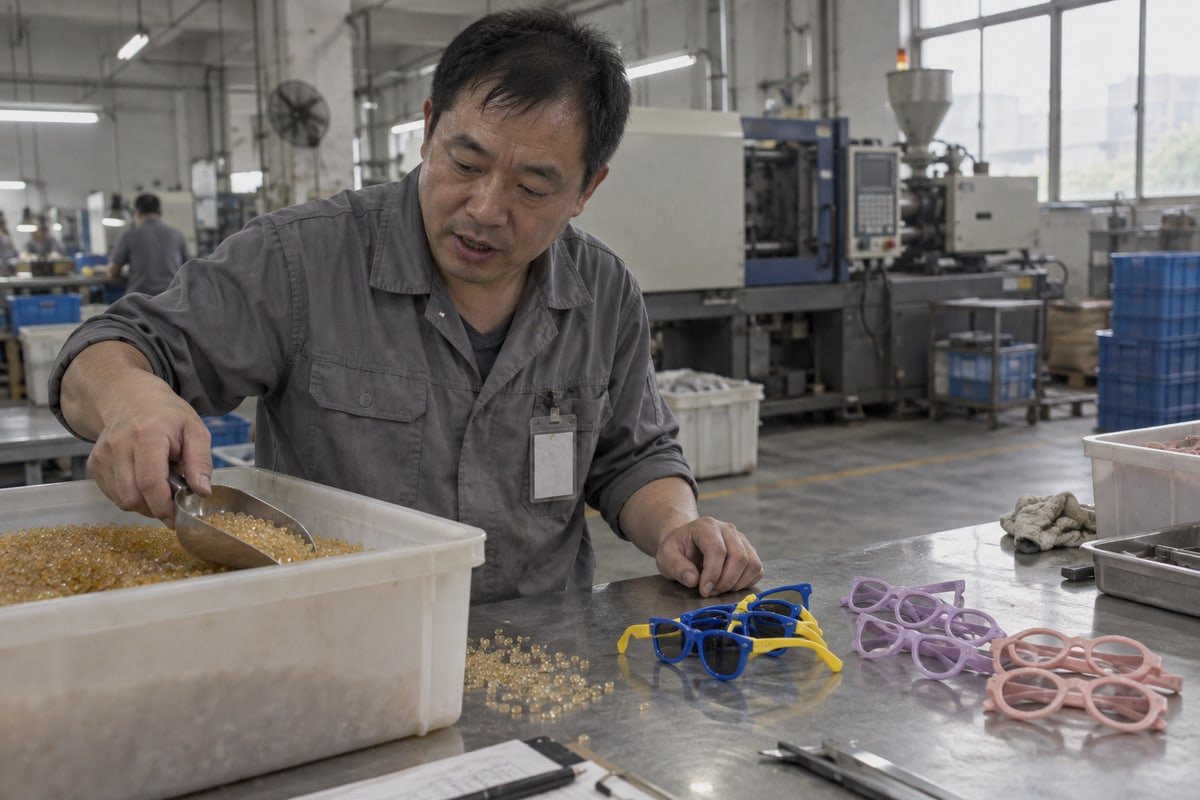
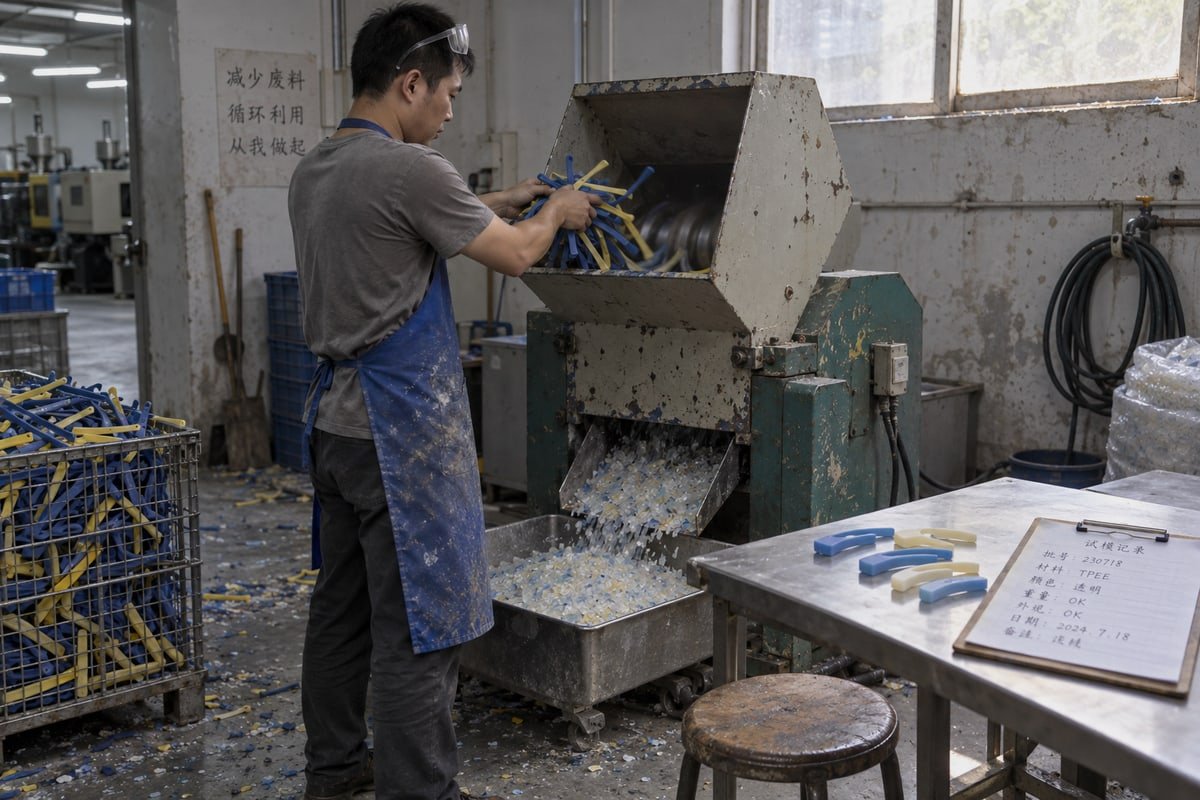
Last year our QC team reground a batch of rejected TPEE temples and molded them into test pieces. The regrind flowed cleanly. That small experiment shaped how we explain recyclability.
TPEE differs from standard plastic because it is a thermoplastic elastomer that can be reground and remolded repeatedly with little structural loss. Material suppliers state TPEE grades like Hytrel TPC-ET are 100% recyclable, with regrind blended back into virgin polymer at up to 50% under recommended processing conditions.
"Plastic" is a very broad word. It covers brittle polycarbonate, acetate, low-grade PVC, and premium engineering resins. So the fair comparison is not TPEE versus all plastic. It is TPEE versus the specific materials that usually end up in cheap children's sunglasses. Here is how the three most common frame options line up.
TR90 vs TPEE vs Conventional Plastic at a Glance
| Le rétrécissement des montures en acétate est le problème caché des matériaux traditionnels. L'acétate perd lentement ses plastifiants, se contractant avec le temps. Ironiquement, un léger rétrécissement peut resserrer un verre — mais il rend également la monture cassante, et les fils de lunette cassants se fissurent au niveau de la gorge. Il faut également tenir compte de la contraction thermique différentielle : lorsqu'un enfant passe de la chaleur extérieure à la climatisation, la monture et le verre se contractent à des vitesses différentes. Les polymères flexibles absorbent cette inadéquation ; les matériaux rigides transfèrent le stress au siège du verre. | TPEE | TR90 | Conventional PC / low-grade plastic |
|---|---|---|---|
| Material family | Thermoplastic Polyester Elastomer | Nylon-based thermoplastic | Rigid thermoplastic |
| Flexibility and shape memory | Très élevé | Élevé | Low; cracks when twisted |
| Conformité au test de chute de bille de la FDA | Très élevé | Élevé | Moderate to low |
| BPA-free / phthalate-free | Oui | Oui | Depends on grade; PVC often contains plasticizers |
| Technically recyclable | Yes, reground and remolded | Yes, but harder to reprocess | Varie considérablement |
| Typical recycling code | Code 7 (other) | Code 7 (other) | Code 7 or none |
| Curbside acceptance | Rarement | Rarement | Rarement |
What Recycling Code 7 Really Tells You
Recycling code 7 simply means "other." It is a catch-all group. It does not mean a frame is unrecyclable, and it does not mean a bin will take it. In practice, TPEE frames need an industrial recycler or a brand take-back route. That is the gap between "technically recyclable" and "recycled." We tell every buyer this up front, because a product page that says "recyclable" usually means the resin can be reprocessed, not that a parent can drop it in a household bin.
Why TPEE Holds Up Through Multiple Cycles
TPEE has good thermal stability 2 and strong mechanical memory. In our injection molding process, it also runs at lower processing temperatures 3 than several rigid engineering plastics. That lowers energy use and helps the carbon footprint of plastics used in the frame. Because the polymer degrades less per cycle, regrind can go back into new temples without heavy additive packages. That is exactly what a circular economy in eyewear needs. It also matters for kids. High abrasion resistance means less surface shedding and fewer microplastics during rough outdoor play.
Why Mixed Materials Break the Chain
The biggest barrier is not the resin. It is the product. Metal hinges, screws, painted coatings, and glued nose pads all contaminate a regrind batch. A mono-material, screwless TPEE frame can go straight back into the grinder. A frame with a metal hinge, like the silver hinge on a color-blocked square style, needs disassembly first. Design decides recyclability more than the pellet does.
How Can I Verify a Supplier's Eco-Friendly Claims Before Placing an Order?
A procurement manager from Australia once sent us a competitor's catalog and asked one question: prove it. She wanted evidence, not adjectives. Her request became our standard verification checklist.
Verify eco-friendly claims by requesting the resin grade and supplier datasheet, asking whether frames are mono-material, checking BPA-free and non-toxic test reports, confirming whether recycled or bio-based content is actually in the frame, and asking the factory to describe a real take-back or industrial recycling pathway.
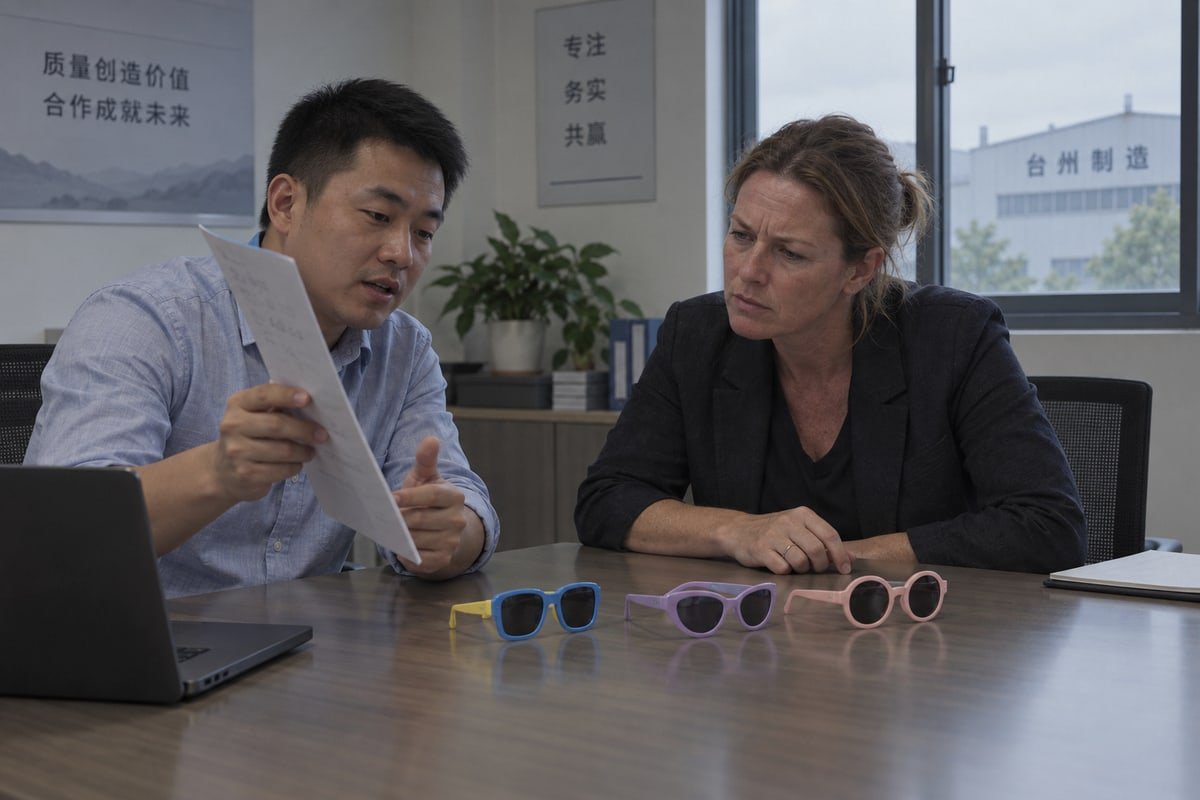
Green language is cheap. Evidence is not. Most of the sustainability claims you see online come from brands or resin suppliers, not from independent lifecycle studies. That does not make them false. It means you need to ask for the paperwork behind each claim. Below is the process we walk buyers through when they visit our workshop or join a video audit.
Un processus de vérification en cinq étapes
- Ask for the resin grade by name. "TPEE" alone is not enough. A serious factory can tell you the exact grade and hand over the supplier’s technical datasheet.
- Ask whether the frame is mono-material and screwless. If the answer is "the temples are TPEE but the hinge is metal," you know the recycling story is more complex.
- Request chemical safety reports. BPA-free eyewear should come with third-party test results 4, not a sentence on a product page. The same applies to phthalates and heavy metals, since non-toxic materials 5 for kids are the baseline, not a bonus.
- Separate frame content from packaging content. A compostable box is good. It says nothing about the frame.
- Ask what happens at end of life. If the factory or brand has no take-back or regrind route, "recyclable" is theoretical.
Claims Versus Proof
| Claim you will see | What to ask for | What a weak answer sounds like |
|---|---|---|
| "Eco-friendly TPEE" | Resin grade, datasheet, processing temperature | "It's imported material." |
| "BPA-free and non-toxic" | Third-party test report with the batch reference | "All our materials are safe." |
| "Made from recycled TPEE" | Percentage of regrind and where it comes from | "We use some recycled." |
| "Bio-based TPEE" | Feedstock source, such as castor-oil-derived grades | "It's plant-based." |
| "100% recyclable" | Description of the actual recycling channel | "Just recycle it." |
Check the Factory, Not Just the Frame
Traders resell whatever the resin supplier tells them. A real factory can show you the pellets, the dryer, the molding machines, and the regrind station. Our workshop in Taizhou runs about 120 workers under 5S management, and we have spent 15 years on children's eyewear. Ask for a live walk-through. Look at the inner temple, too. A CE marking and clear batch engraving, like you see on our lavender cat-eye style, show that someone took traceability seriously.
Will Choosing TPEE Frames Affect the Durability or Comfort My Brand Is Known For?
Softer always feels better on a child's nose, yet softer temples can lose lens tension. We weigh that balance in every mold we cut for flexible kids' frames.
Choosing TPEE frames usually improves durability and comfort rather than reducing them. TPEE bends, twists, and returns to shape, resists impacts, and shrugs off saltwater, chlorine, and UV exposure. Combined with TR90 fronts and TPEE temples, brands get lightweight, flexible frame durability without sacrificing a secure, comfortable fit.
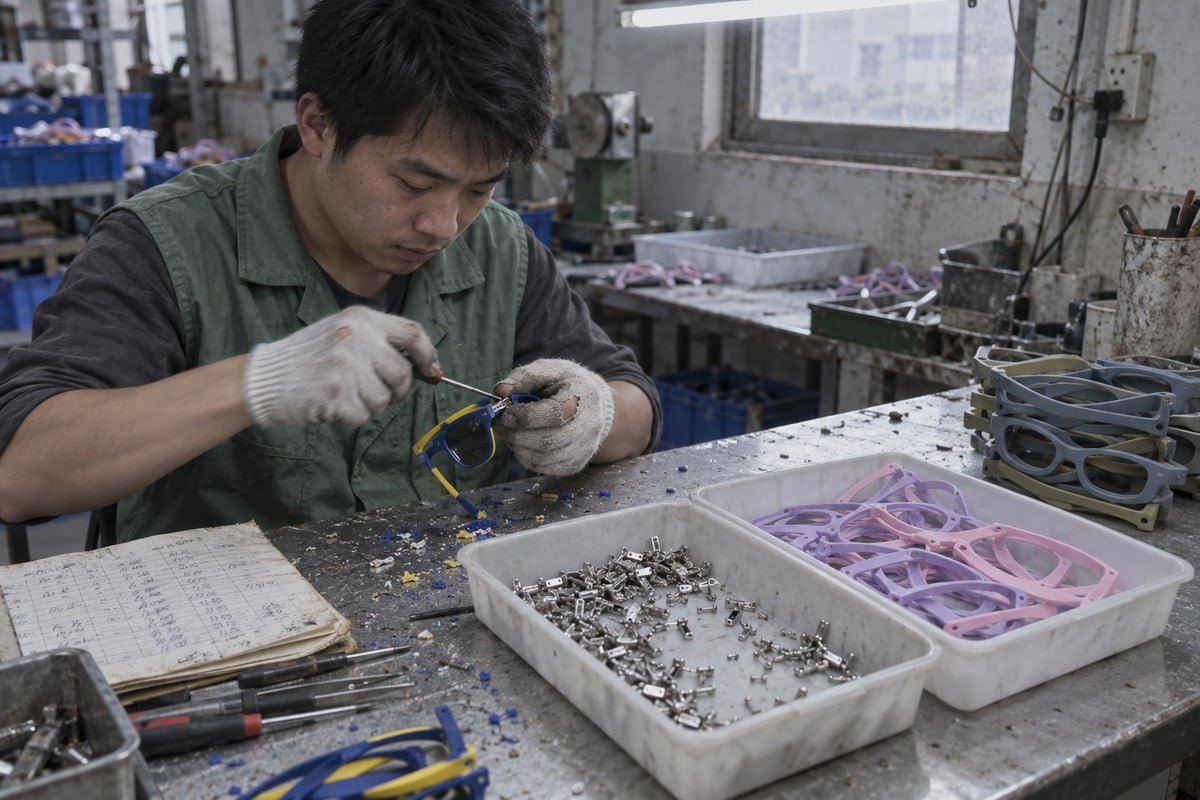
Buyers sometimes fear that "eco" means "compromise." In children's eyewear, the opposite is usually true. Durability is the sustainability feature. A frame that survives three summers replaces three cheap frames that cracked in one. Kids sit on sunglasses, chew the temple tips, and twist the arms backward. Rigid plastic fails at that first twist. TPEE flexes and recovers.
Impact Resistance Versus Frame Memory
Impact resistance and shape memory are two different things. A polycarbonate front resists a drop reasonably well, but it will not survive being folded in a backpack. TPEE handles both. Its elastomer structure absorbs the shock and springs back. This is why so many TPEE frames are sold as "unbreakable." We avoid that word ourselves, because nothing is unbreakable with a determined toddler. But breakage returns on TPEE and TR90 programs are clearly lower than on rigid plastic in our experience.
Which Configuration Fits Your Brand?
| Configuration | Idéal pour | Comfort notes | Recyclability notes |
|---|---|---|---|
| Full TPEE, screwless | Babies and toddlers | Softest, safest on the face | Easiest to regrind, mono-material |
| Façade en TR90 + branches en TPEE | Ages 3–12, active kids | Stable lens retention, soft behind the ears | Two resins; separate before regrind |
| Full TR90 | Older kids, optical frames | Light and rigid enough for prescription lenses | Recyclable but harder to reprocess |
The TR90 vs TPEE debate is not either-or for us. A TR90 front holds UV400 or polarized lenses firmly. TPEE temples give the softness parents want. Our blush-pink round kids' frame and our royal blue and yellow color-block square are good examples of shapes that work in both configurations.
Comfort Details Buyers Notice
Comfort is not only about hardness. Temple length, nose bridge width, and weight matter more. Because we hold around 800 existing styles, a new brand can pick a proven fit rather than gamble on a fresh mold. Every style has been worn on real children's faces before it goes into a catalog.
Does Using Eco-Friendlier Materials Add Extra Cost to My Bulk Order?
Years ago we assumed greener resin meant a bigger invoice for every client. Then we compared full landed costs against replacement rates and warranty returns. The math surprised us.
Eco-friendlier TPEE frames can add a modest premium at the raw-material stage, but existing-style programs, mono-material screwless designs, and lower breakage rates often offset it. Total cost per wearable season is usually equal or lower than cheap brittle plastic frames once replacements, returns, and brand reputation are counted.
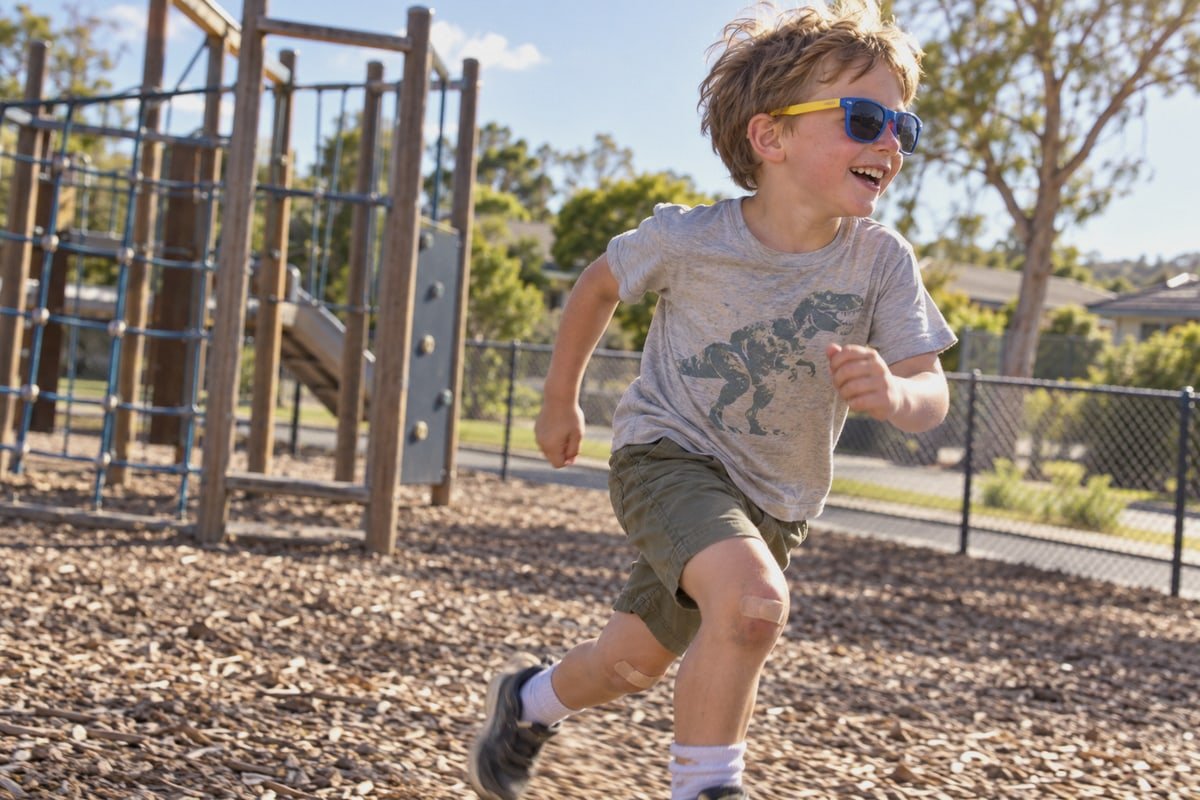
Price questions deserve a straight answer, so here is one. TPEE resin costs more per kilogram than commodity plastic. That is a fact. But resin is only one line on a cost sheet. The bigger levers are tooling, assembly, rejects, and returns. When you look at all of them, the picture changes.
Where the Cost Goes Up, and Where It Comes Down
| Cost driver | TPEE frames | Conventional plastic | Direction |
|---|---|---|---|
| Resin per kg | Plus élevé | Plus bas | Up |
| Processing energy | Lower processing temperatures | Plus élevé | Down |
| Hinge and screw assembly | Often eliminated in screwless designs | Requis | Down |
| Reject rate from cracking | Bas | Plus élevé | Down |
| Warranty and replacement returns | Bas | Plus élevé | Down |
| Regrind of factory scrap | Reusable in-house | Often wasted | Down |
Notice how many rows point down. A screwless, mono-material TPEE design skips a whole assembly step. Factory scrap goes back into the hopper instead of the bin. And a frame that does not crack does not come back to you as a chargeback.
Mold Investment: The Biggest Lever
For a new brand, the largest cost is rarely the resin. It is the mold. Cutting a new frame tool is a serious investment, and it locks you into one shape before you know what sells. This is why we push buyers toward our library of roughly 800 existing styles first. You choose a proven shape, add your colors, your logo, your lens spec, and your packaging, and you launch without tooling risk. Once a style proves itself in Australia, Japan, or Europe, then a custom mold makes sense.
What We Recommend for a First Order
Start with one or two existing TPEE or TR90-with-TPEE-temple styles. Specify UV400 or polarized lenses. Ask for mono-material where the design allows it. Add retail-ready packaging that is itself recyclable, so the whole product tells one consistent story. This approach keeps your first order affordable while giving you a credible sustainability claim. It also positions you as a brand with a long-term partner, not a one-off supplier hunt.
Conclusion
Vague eco-claims cost brands trust. Parents notice. TPEE kids sunglasses frames earn the label only when durable, mono-material, and backed by a real recycling pathway. We build them that way.
Interested in sourcing the products mentioned in this article? See details and request a quote here:
Notes de bas de page
1. Official USDA program site for certifying and identifying products with bio-based content. ↩︎
2. Authoritative scientific definition of thermal stability in polymer engineering and manufacturing. ↩︎
3. NIST resource covering manufacturing standards and technical processes like injection molding. ↩︎
4. ISO standard for laboratories providing the third-party testing results mentioned in the article. ↩︎
5. CPSC regulatory guidance on safety standards and non-toxic requirements for children’s products. ↩︎
Plus d'articles que vous pourriez aimer
Vous recherchez un partenaire fiable en lunetterie pour enfants ?
Explorez plus de 800 styles prêts et un support OEM/ODM complet adapté à votre marque.
Contactez-nous English
  Español de México
  Deutsch
  Français
  日本語
日本語  العربية
  Português do Brasil