Le matériau des verres de lunettes pour enfants peut-il provoquer des réactions allergiques cutanées ?
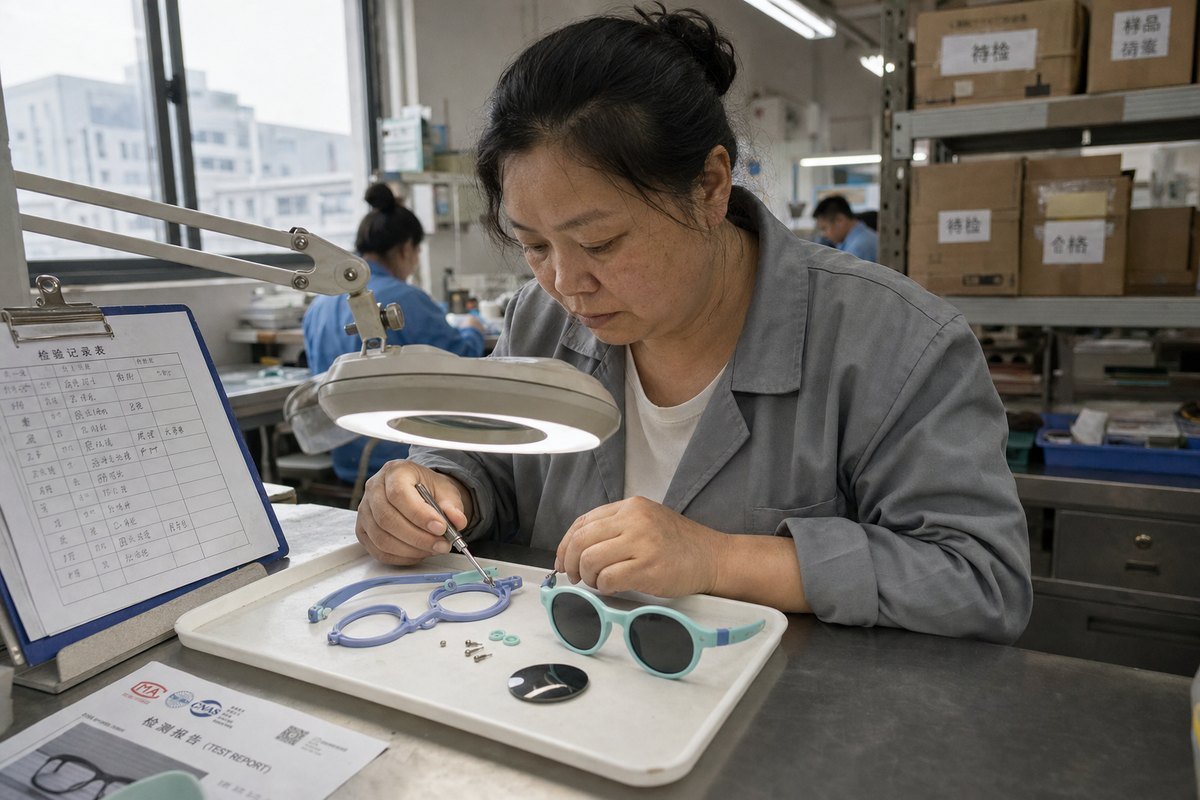
Au printemps dernier, un acheteur a contacté notre usine de Taizhou en panique : un enfant a développé une éruption cutanée, et le parent a blâmé le matériau des verres des lunettes pour enfants phtalates et libération de nickel 1. Le verre était-il vraiment coupable ? Cette seule plainte aurait pu couler sa jeune marque. Nous avons examiné chaque composant avant de répondre.
Le matériau des verres de lunettes pour enfants provoque rarement des réactions allergiques cutanées en soi. Les verres en polycarbonate et en Trivex sont largement inertes. La plupart des réactions sont des dermatites de contact déclenchées par les montures, les charnières en nickel, les plaquettes nasales, les plastifiants, les stabilisants UV, les colorants ou les revêtements de verres — pas par le matériau de base du verre.
Cette réponse courte cache beaucoup de détails. Ci-dessous, j'explique quels matériaux posent réellement problème, comment évaluer les fournisseurs et quelles certifications protègent votre marque.
Quels matériaux de verres et de montures sont les plus susceptibles de déclencher des réactions allergiques chez les enfants ?
En quinze ans de fabrication de lunettes pour enfants, notre équipe de contrôle qualité a attribué presque toutes les plaintes d'éruptions cutanées à une partie de la monture ou à un revêtement — presque jamais au cœur du verre lui-même.
Le nickel dans les charnières et les vis est l'allergène le plus courant pour les lunettes, suivi des plastifiants, des stabilisants UV, des colorants azoïques et du PVC de mauvaise qualité dans les montures. Les revêtements de lentilles et les monomères résiduels sur les lentilles bon marché peuvent également irriter la peau, tandis que les noyaux en polycarbonate et en Trivex provoquent rarement de véritables allergies.
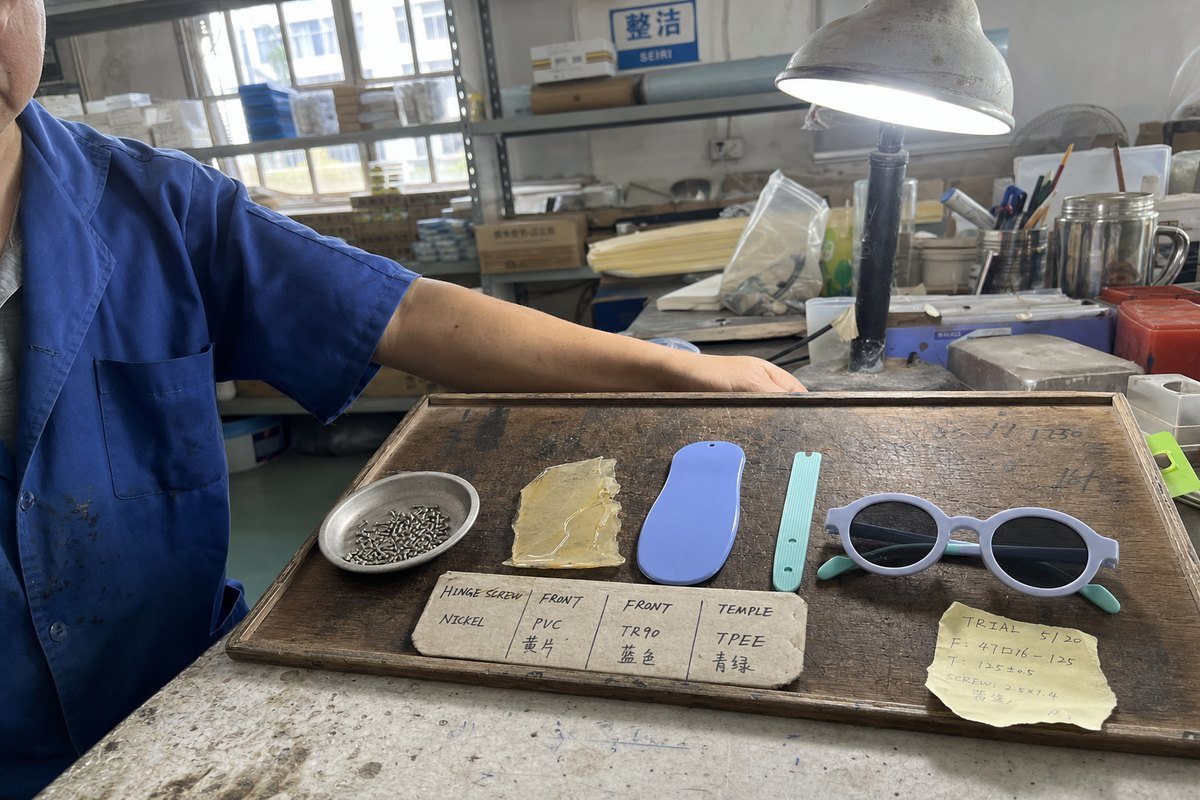
Laissez-moi décomposer cela composant par composant, car une paire de lunettes de soleil est en réalité un petit assemblage de chimies très différentes.
Le verre : généralement innocent, mais pas toujours
Les verres en polycarbonate 2 et le Trivex sont les normes de l'industrie pour les enfants car ils sont résistants aux chocs et légers. Les polymères eux-mêmes sont stables et se trouvent devant les yeux, touchant à peine la peau. Ainsi, la sécurité des verres Trivex et la sécurité du polycarbonate sont rarement le problème. Le risque provient de ce qui se trouve sur le verre : revêtements anti-rayures, revêtements miroir, colorants de teinte et — sur des verres très bon marché — "monomères libres" résiduels laissés par un durcissement incomplet. La sueur et la crème solaire peuvent activer ces résidus là où le bord du verre rencontre la joue de l'enfant.
La monture : où la plupart des problèmes commencent
Les enfants ont un couche cornée 3 plus fin que les adultes. Leur peau absorbe plus facilement les produits chimiques lixiviés, et la sueur ainsi que la friction au niveau de l'arête du nez et derrière les oreilles accélèrent la lixiviation. Voici comment les matériaux courants se classent selon notre expérience :
| Composant | Matériau typique | Risque d'allergie | Pourquoi |
|---|---|---|---|
| Charnières, vis | Alliage de nickel | Élevé | Allergie au nickel 4 est le déclencheur classique des lunettes |
| Montures bon marché | PVC avec phtalates | Élevé | Les plastifiants migrent dans la peau moite |
| Couleurs de monture | Colorants azoïques, peintures | Modéré | Les colorants et les solvants peuvent sensibiliser |
| Plaquettes de nez | Silicone ou caoutchouc de faible qualité | Modéré | Les accélérateurs de caoutchouc peuvent irriter |
| Montures de qualité | TR90, TPEE, acétate de cellulose | Bas | Polymères stables, moins d'additifs |
| Cœur du verre | Polycarbonate, Trivex | Très faible | Inerte ; les revêtements sont la vraie variable |
Notez que même les lunettes de soleil en "plastique" cachent souvent une minuscule vis de charnière métallique — comme celle visible sur nos montures rondes pastel. Si cette vis contient du nickel et touche la peau de la tempe, elle peut provoquer des symptômes d'irritation cutanée 5 malgré une monture par ailleurs sûre.
Comment puis-je identifier si mon fournisseur utilise des matériaux hypoallergéniques et sûrs pour les lunettes ?
Une responsable des achats d'Australie m'a un jour demandé de prouver — pas de promettre — que nos montures étaient sûres. Cette conversation a changé la façon dont nous documentons les matériaux sur notre chaîne de production.
Demandez aux fournisseurs des déclarations de matériaux indiquant le polymère exact, des rapports de test tiers pour la libération de nickel, les phtalates et les métaux lourds, ainsi que des preuves d'audit d'usine. Les partenaires authentiques fournissent une documentation par lot ; les réponses vagues comme "plastique écologique" ou les affirmations non vérifiées "hypoallergénique" sont des signaux d'alarme.
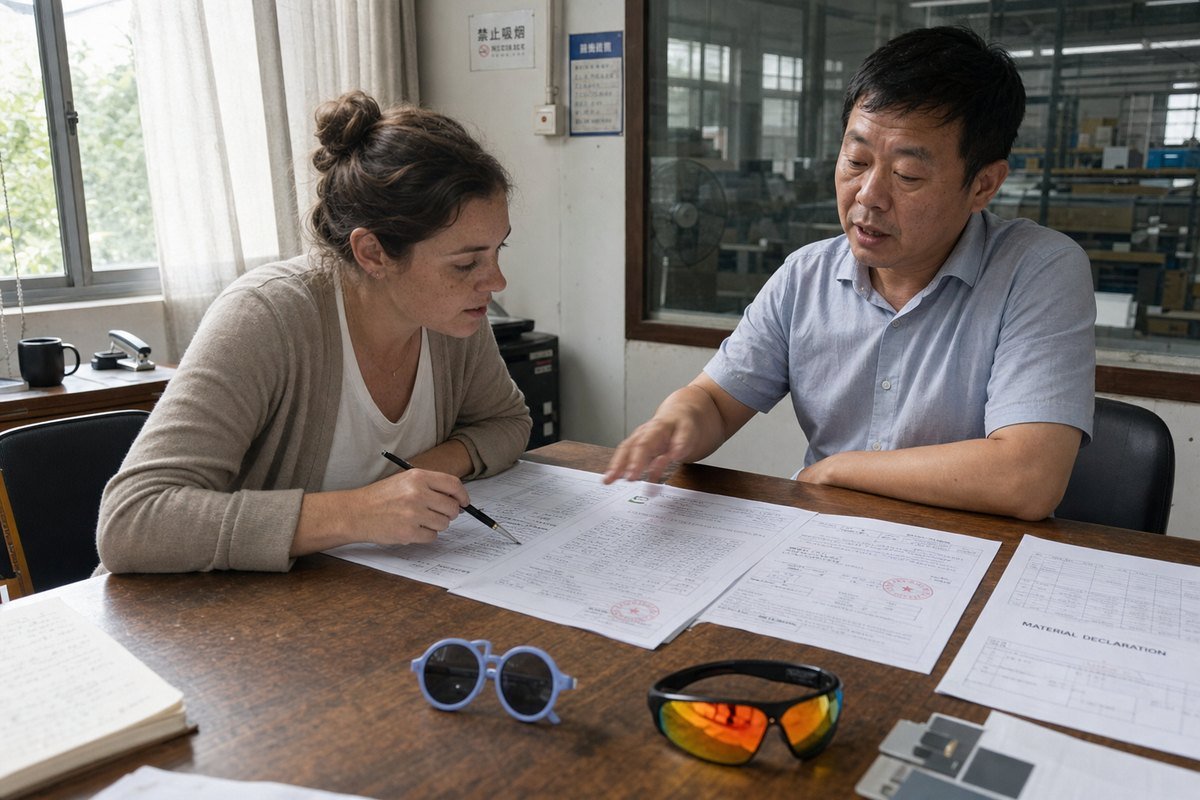
"Hypoallergénique" est un mot marketing, pas une norme réglementée. N'importe qui peut l'imprimer sur une étiquette volante. Votre processus de vérification doit donc aller plus loin que l'étiquette. Voici la séquence que je recommande aux acheteurs, car elle reflète ce que les usines sérieuses peuvent réellement répondre.
Un processus de sélection de fournisseurs en cinq étapes
- Demandez le nom exact du matériau. Pas du "plastique souple", mais du TR90 (polyamide), du TPEE ou de l'acétate de cellulose, avec la fiche technique du fournisseur de résine. Les matériaux sans BPA et les plastiques sans phtalates doivent être indiqués par écrit.
- Demandez chaque partie en contact avec la peau séparément. La monture, les branches, les plaquettes nasales en silicone, le métal des charnières, la peinture et le revêtement des verres ont chacun leur propre chimie. Une monture sûre avec une vis en nickel présente toujours un risque.
- Exigez des rapports de test par lot. Les rapports doivent provenir de laboratoires reconnus et être récents — un certificat vieux de trois ans ne vous dit rien sur la production actuelle.
- Vérifiez le contrôle des processus. Demandez comment ils préviennent les résidus de démoulage et confirmez le durcissement complet des verres. La polymérisation incomplète sur des verres à faible coût laisse des résidus réactifs sur la surface.
- Auditez ou visitez l'usine en vidéo. Un atelier géré selon la méthode 5S avec des lots de matériaux traçables se comporte très différemment d'un atelier qui achète de la résine broyée mélangée.
Une mise en garde de notre part : les plastiques recyclés ou "capturés dans l'océan" sont à la mode, mais leurs contaminants traces varient d'un lot à l'autre. Si vous voulez une histoire écologique, insistez sur des tests équivalents à ceux des matériaux vierges pour chaque lot, ou utilisez plutôt des polymères vierges certifiés respectueux de l'environnement.
Le TPEE et le TR90 sont-ils des alternatives plus sûres pour les enfants à la peau sensible ?
Il y a un compromis que nous évaluons sur chaque nouveau projet : quelle doit être la flexibilité d'une monture pour enfant par rapport à la structure dont elle a besoin. C'est précisément pour cette raison que nous avons standardisé le TPEE et le TR90.
Oui. Le TR90 et le TPEE font partie des choix de montures les plus sûrs pour les enfants sensibles. Les deux sont des polymères stables qui ne nécessitent pas de plastifiants phtalates, ne contiennent pas de nickel, résistent à la transpiration et restent flexibles sans additifs cassants — réduisant considérablement les déclencheurs de dermatite de contact présents dans les montures en PVC ou en métal.
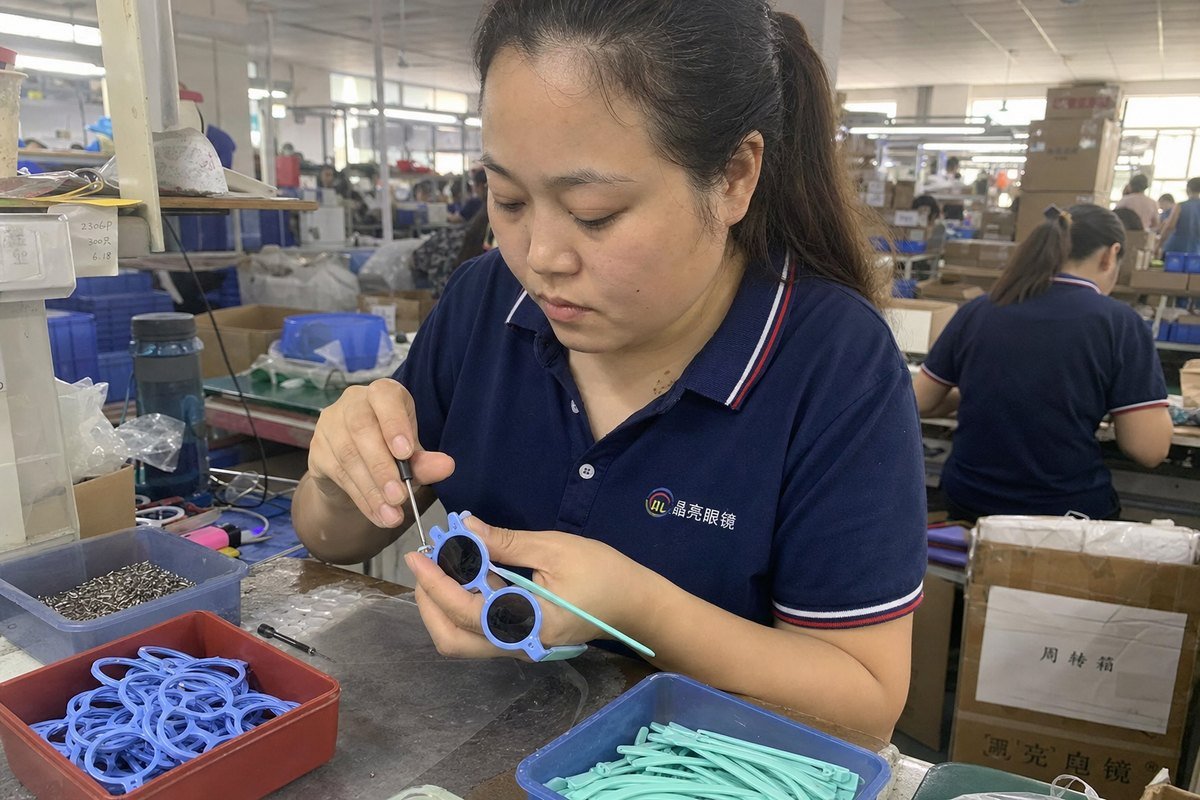
Pourquoi ces deux matériaux sont-ils si importants pour le risque d'allergie ? La réponse réside dans leur chimie. De nombreuses réactions cutanées proviennent d'additifs qui migrent hors d'un polymère — plastifiants, stabilisants et adoucissants. Le TR90, un polyamide thermoplastique 6, est intrinsèquement flexible et résistant aux chocs, il n'a donc pas besoin d'une forte charge de plastifiant. Le TPEE, un élastomère de polyester thermoplastique, est naturellement caoutchouteux. Il procure une sensation douce et adhérente sur les branches sans les accélérateurs de caoutchouc qui rendent certains élastomères sensibilisants.
Comparaison des principaux matériaux sans danger pour les enfants
| Le rétrécissement des montures en acétate est le problème caché des matériaux traditionnels. L'acétate perd lentement ses plastifiants, se contractant avec le temps. Ironiquement, un léger rétrécissement peut resserrer un verre — mais il rend également la monture cassante, et les fils de lunette cassants se fissurent au niveau de la gorge. Il faut également tenir compte de la contraction thermique différentielle : lorsqu'un enfant passe de la chaleur extérieure à la climatisation, la monture et le verre se contractent à des vitesses différentes. Les polymères flexibles absorbent cette inadéquation ; les matériaux rigides transfèrent le stress au siège du verre. | TR90 | TPEE | Titane | PVC (montures bon marché) |
|---|---|---|---|---|
| Flexibilité | Élevé | Très élevé | Faible à modéré | Variable |
| Nécessite des plastifiants | Non | Non | Certains | Oui, fortement |
| Construction sans nickel possible | Oui | Oui | Oui | Oui, mais souvent ignoré |
| Résistance à la transpiration | Excellent | Excellent | Bon | Faible avec le temps |
| Sécurité en cas de choc pour les enfants | Excellent | Excellent | Modéré | Mémoire de forme |
| Risque d'allergie relatif | Bas | Bas | Bas | Élevé |
Notre construction pour enfants la plus vendue associe un avant en TR90 à des branches en TPEE. L'avant en TR90 maintient solidement les verres en polycarbonate, tandis que les branches en TPEE se plient derrière les petites oreilles sans points de pression. Moins de pression signifie moins de friction, moins de rétention de sueur et moins de réactions irritantes que les parents pourraient confondre avec une allergie. Sur les styles avec charnières, nous spécifions du matériel sans nickel ou protégé, et nous maintenons les revêtements décoratifs au minimum sur les finitions mates pastel. L'acétate de cellulose reste également une option respectée, en particulier pour les montures optiques, mais pour les tout-petits actifs, le TR90 et le TPEE flexibles résistent simplement mieux aux abus.
Quelles certifications devrais-je demander pour confirmer que les lunettes de soleil de mes enfants sont testées contre les allergies ?
La préparation de la documentation d'exportation pour plus de vingt pays nous a enseigné une dure leçon : le certificat que l'acheteur oublie de demander est toujours celui que les douanes ou un client finit par demander.
Demander la norme EN ISO 12312-1 ou ANSI Z80.3 pour les performances des lunettes de soleil, la norme EN 71-3 ou CPSIA pour les métaux lourds et le plomb, la conformité REACH couvrant les phtalates et le dégagement de nickel, ainsi que des rapports de laboratoire pour le BPA et le cadmium. Ensemble, ceux-ci confirment la sécurité au contact de la peau et la protection UV400.
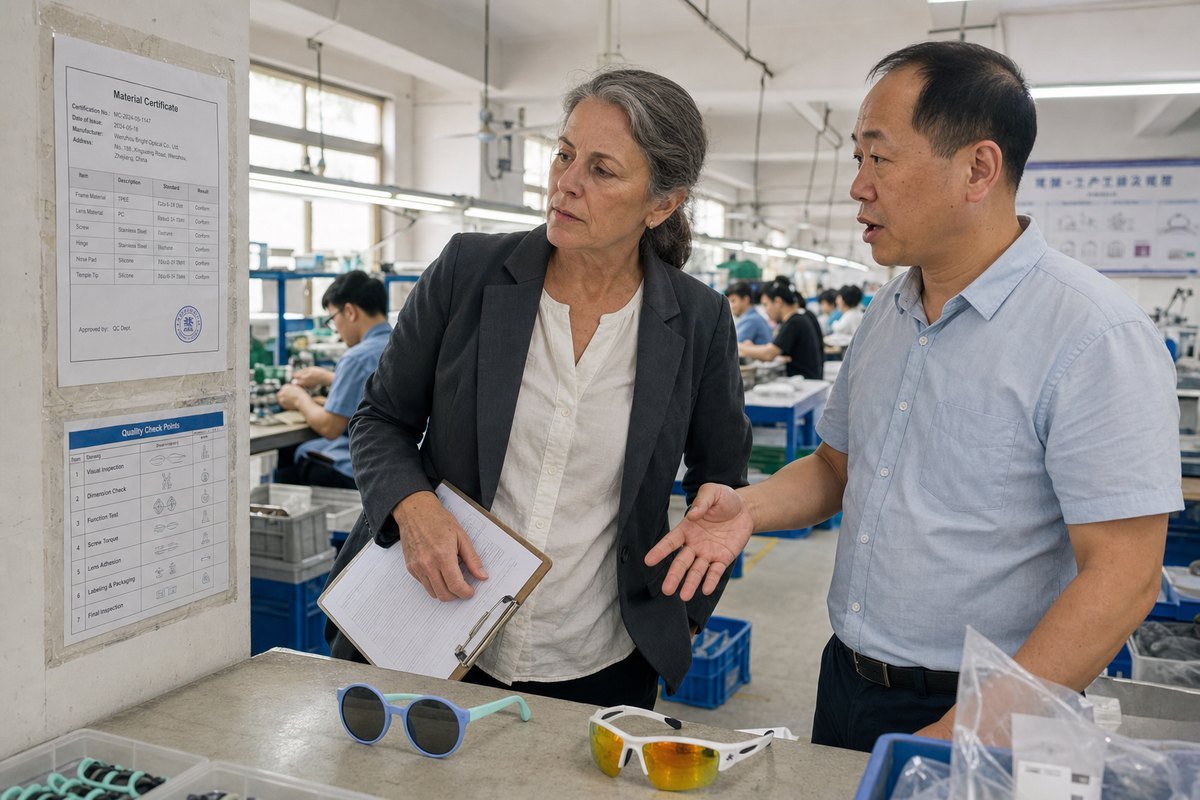
Aucun certificat unique ne dit "testé contre les allergies", car le risque d'allergie couvre plusieurs réglementations. Vous devez assembler une petite pile de documents qui couvrent ensemble les métaux, les produits chimiques et les performances optiques. Voici la liste de contrôle que nous préparons pour les clients de marque, organisée par ce que chaque document prouve réellement.
La pile de certifications expliquée
| Certification / Test | Région | Ce qu'elle couvre pour le risque d'allergie |
|---|---|---|
| EN ISO 12312-1 | UE | Sécurité des lunettes de soleil et performance de filtrage UV400 |
| ANSI Z80.3 7 | États-Unis | Exigences pour les lunettes de soleil non correctrices |
| EN 71-3 (proche des jouets) | UE | Migration des métaux lourds des matériaux que les enfants touchent |
| exigences CPSIA | États-Unis | Limites de plomb et de phtalates dans les produits pour enfants |
| REACH (y compris la libération de nickel, les SVHC) | UE | Produits chimiques restreints, plastifiants, migration de nickel |
| AS/NZS 1067 | Australie/Nouvelle-Zélande | Norme obligatoire pour les lunettes de soleil pour ce marché |
| Rapports de laboratoire : BPA, cadmium, colorants azoïques | Mondial | Confirme les matériaux sans BPA et les colorants sûrs |
Quelques notes pratiques. Premièrement, adaptez la pile à votre marché — une marque australienne a besoin de l'AS/NZS 1067, tandis qu'un acheteur européen s'appuie sur l'EN ISO 12312-1 et le REACH. Deuxièmement, demandez que les rapports mentionnent le SKU exact et le lot de production, pas seulement un échantillon de matériau générique. Troisièmement, rappelez-vous que les certifications ne remplacent pas le jugement médical. Si un enfant développe des symptômes d'irritation cutanée persistante, les parents doivent cesser l'utilisation, laver la zone et consulter un dermatologue ou un spécialiste en ophtalmologie pédiatrique. Les tests cutanés sont le seul moyen de confirmer une véritable allergie au nickel ou une sensibilité aux additifs. Lorsque votre produit est recommandé par les dermatologues dans l'esprit — matériaux propres, documents propres — ces conversations se terminent bien pour votre marque.
Conclusion
Les noyaux de verres provoquent rarement des réactions ; les montures, les pièces en nickel et les revêtements le font. Choisissez TR90 et TPEE, vérifiez les documents par lot et associez-vous à une usine qui prouve, et non qui promet, la sécurité.
Notes de bas de page
Aperçu de la réglementation REACH couvrant les substances restreintes telles que les phtalates et le nickel. ↩︎
Aperçu complet des propriétés du polycarbonate, y compris sa haute résistance aux chocs et ses utilisations optiques. ↩︎
Description scientifique de la couche la plus externe
Plus d'articles que vous pourriez aimer

Vous recherchez un partenaire fiable en lunetterie pour enfants ?
Explorez plus de 800 styles prêts et un support OEM/ODM complet adapté à votre marque.
Contactez-nous English
  Español de México
  Deutsch
  Français
  日本語
日本語  العربية
  Português do Brasil