How to Source Kids’ Sunglasses Without Cannibalizing Optical Frame Sales?
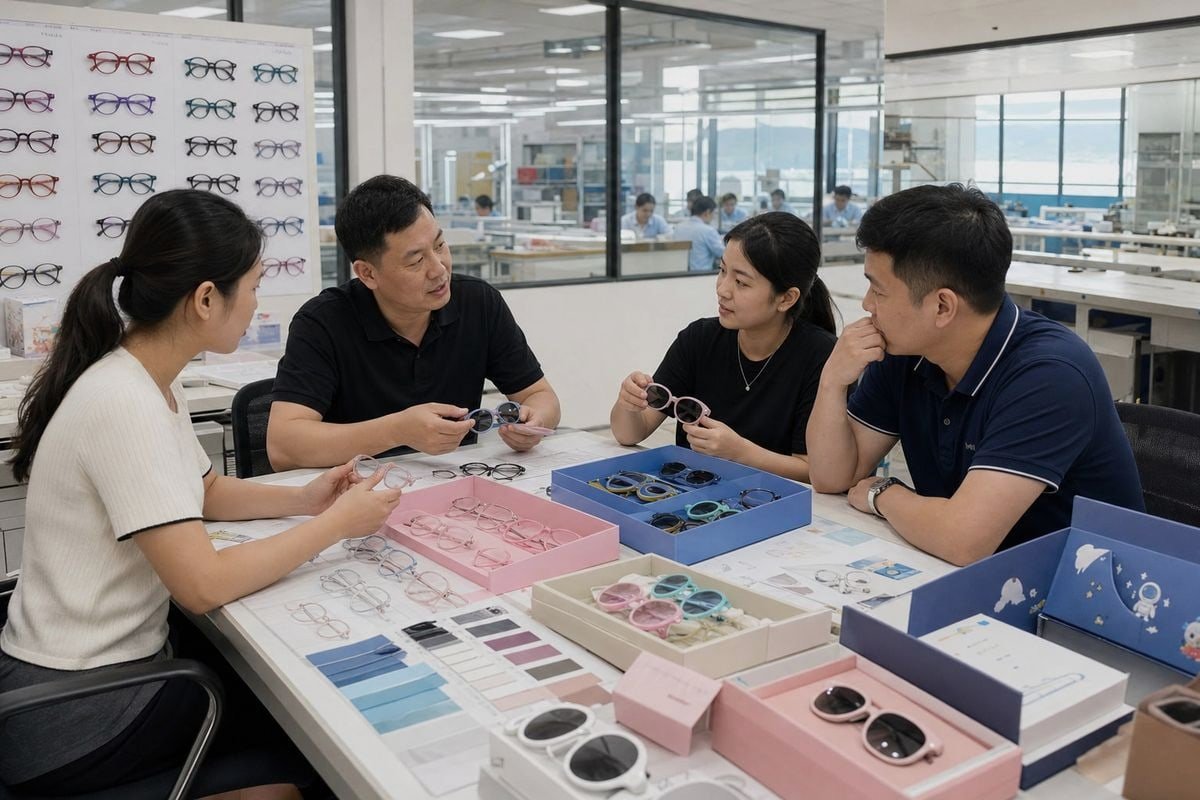
Sourcing kids’ sunglasses worries many optical buyers I meet at our Taizhou factory REACH 1. They fear sunwear will steal frame sales. Left unplanned, it often does — and margins suffer.
To source kids’ sunglasses without cannibalizing optical frame sales, treat sunwear as a separate add-on category: use distinct designs, age-based sizing, different price anchors, dedicated displays, and its own packaging. Position sunglasses as UV-protection accessories that increase basket size, not frame replacements.
That answer sounds simple. In practice, it comes down to four decisions: positioning, sourcing strategy, manufacturer selection, and branding La vérification de la conformité doit être effectuée tôt, pas tard. Confirmez les exigences de conformité et de certification CPSIA avant le début de la production. Si des tests en laboratoire sont nécessaires pour votre marché, les échantillons doivent être envoyés au laboratoire des semaines à l'avance. Les audits de contrôle qualité d'usine par des tiers nécessitent également une réservation à l'avance — les agences d'inspection sont également occupées pendant la haute saison. 2. Let me walk through each one, based on what actually works.
How can I position kids' sunglasses as a separate product line from my optical frames?
A buyer from Australia once told me her sunglass rack was killing her frame sales. When we reviewed her assortment, the problem was clear: her sunglasses looked like her optical frames, just cheaper.
Position kids' sunglasses as a health-driven, seasonal accessory line with its own purpose: outdoor UV protection for children. Give the line different shapes, colors, price points, and display space than optical frames, so parents see two complementary purchases instead of one substitutable product.
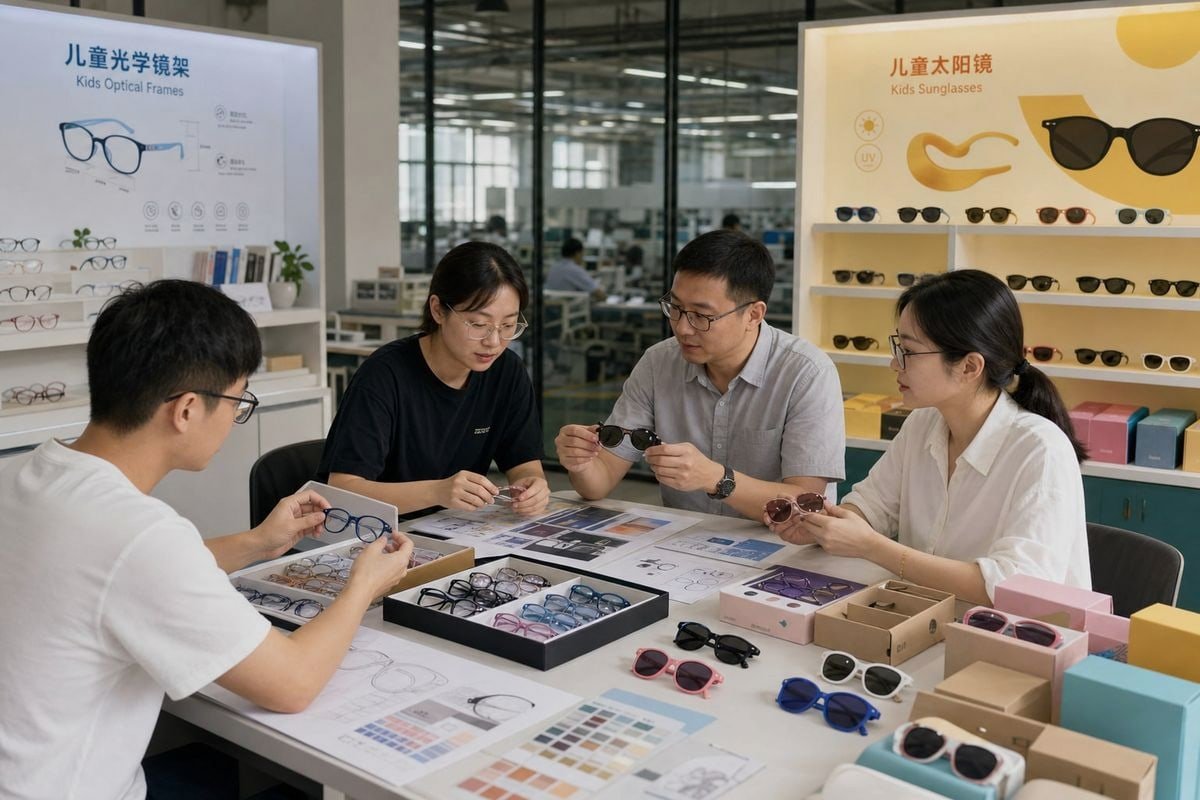
Positioning starts before you write a single purchase order. The core idea is job separation. Optical frames solve a vision problem. Kids' sunglasses solve a sun-safety problem. When parents understand that difference, they buy both. When they do not, they pick the cheaper item.
Anchor the line to UV protection, not fashion
In our experience exporting to 20+ countries, the strongest kids' sunwear programs lead with UV protection for children 3, not style. Cumulative UV exposure in childhood is a real concern, and parents respond to it. Frame the category as a required health tool. This also aligns with broader pediatric eyewear trends, where safety claims drive purchase decisions more than design alone.
Separate the roles clearly
Here is a simple positioning map I share with new buyers:
| Dimension | Kids' Optical Frames | Kids' Sunglasses |
|---|---|---|
| Job to be done | Vision correction | Outdoor UV protection |
| Purchase trigger | Prescription need | Season, sport, vacation |
| Price anchor | Premium, medical | Accessible, add-on |
| Design language | Everyday, subtle | Playful or sporty |
| Display location | Frame boards | Separate sun zone |
When the two lines occupy different mental categories, cannibalization drops sharply. Sunglasses become an add-on sales strategy that lifts average transaction value. A wraparound shield style with a mirrored orange-to-gold lens, for example, reads as sports equipment. No parent confuses it with a prescription frame. That visual distance is your first line of defense.
What sourcing strategies help me avoid overlapping styles between sunglasses and optical collections?
Style overlap is the trade-off I weigh most often when helping buyers pick from our roughly 800 existing styles. Choose too close to optical shapes, and you invite comparison shopping inside your own store.
Avoid overlap by sourcing sunglasses in distinct silhouettes, materials, and colorways: wraparound and shield shapes, bold two-tone or mirrored finishes, and sport-specific features. Segment by age band, cap the assortment to a few hero styles, and keep sunwear pricing clearly separated from frames.
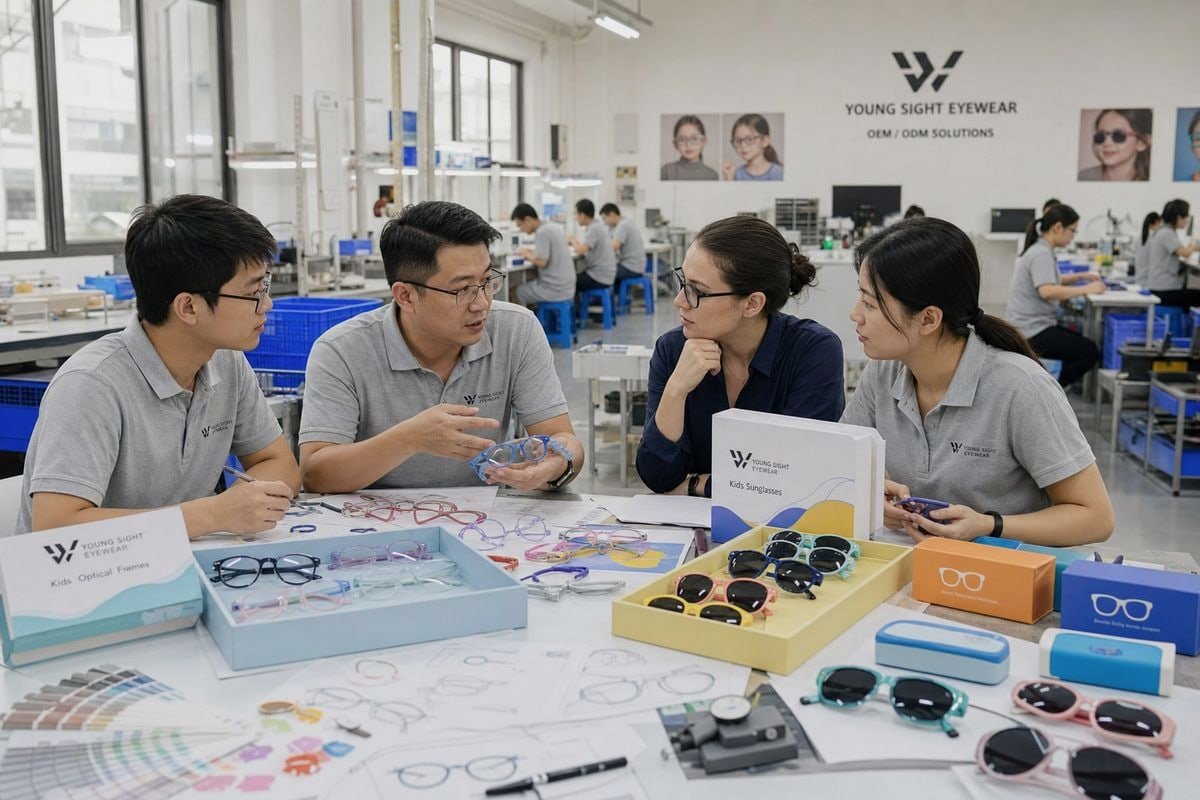
The fastest way to prevent overlap is a written design brief that bans it. Before requesting quotes, define what your sun line must not look like: no shapes, colors, or finishes that mirror your optical boards.
Source by silhouette and finish, not just price
Sunglass-only design cues create automatic separation:
- Shield and wraparound forms. A single-lens sport shield in glossy white or black with an iridescent mirrored gradient looks nothing like an everyday frame.
- Playful color-blocking. A matte powder-blue front fading to mint-teal temples signals a fun, casual accessory, not a clinical product.
- Mirrored and polarized lenses. UV400 mirrored tints are visual shorthand for sunwear. Optical frames never carry them.
- Sport hardware. Rubberized grips, curved ergonomic temples, and retention features read as athletic equipment.
Segment by age band
One line does not fit all children. Frame width, bridge height, and temple length change fast between ages two and twelve. We build our flexible TPEE and TR90 4 styles around these bands:
| Age Band | Fit Priority | Style Direction | Assortment Depth |
|---|---|---|---|
| 1–3 (toddler) | Flat bridge, soft flexible frame | Rounded, bright, simple | 2–3 SKUs |
| 4–7 (child) | Lightweight, flexible temples | Color-block, playful | 3–4 SKUs |
| 8–12 (tween) | Near-adult sizing, secure fit | Sporty, mirrored, wraparound | 3–4 SKUs |
A curated test program beats a broad stock commitment. Demand is seasonal and style-sensitive, so smart eyewear inventory management means limited hero styles per band, reordered when they prove themselves. This keeps stock lean and keeps your sun assortment from visually competing with your frame boards.
How do I choose a manufacturer who can develop distinct designs for both categories without conflict?
Fifteen years of running eyewear production lines has taught me one thing: category conflict usually starts at the factory, not the store. If your supplier only re-skins one mold family, your sunglasses and frames will inevitably blur together.
Choose a verified factory with separate design capability for sunwear and optical: a deep existing style library, genuine material expertise, dedicated tooling for each category, documented QC, and full OEM/ODM support. Confirm certifications, sample quality, reference-sample retention, and workable MOQs before committing.
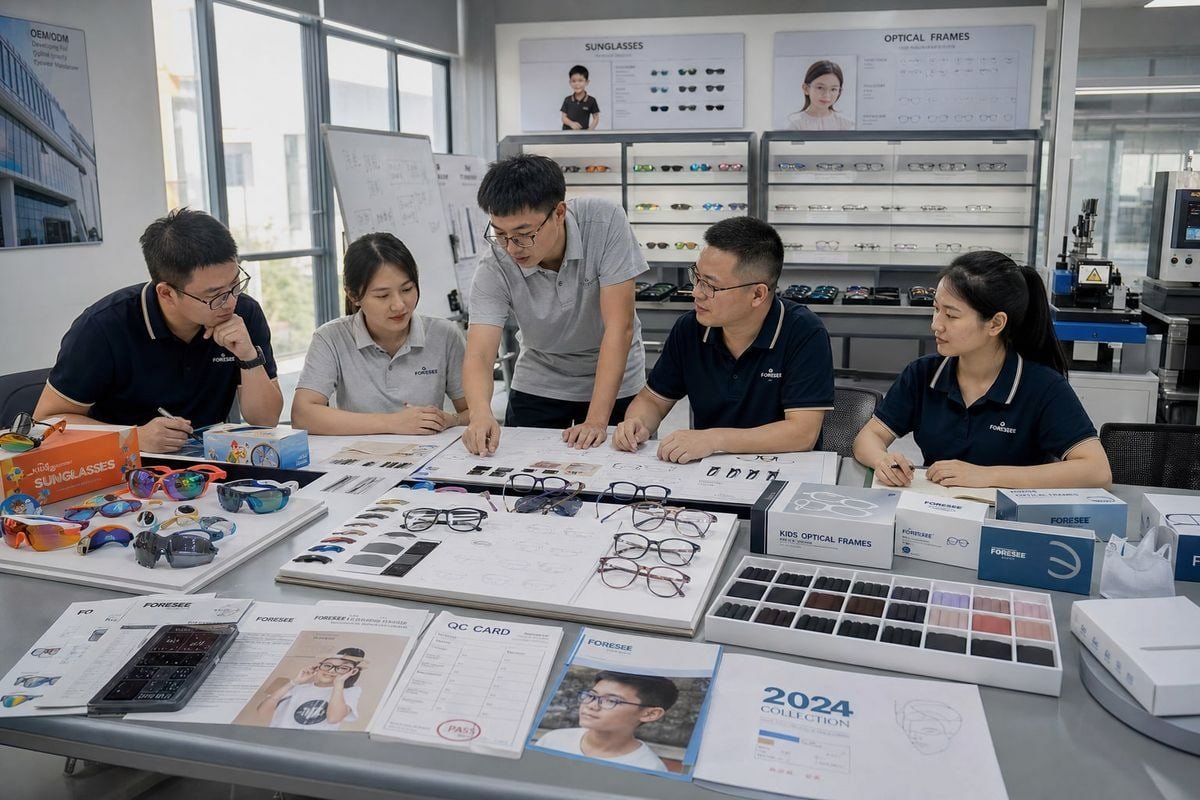
The right partner keeps your two categories structurally distinct. Here is how I would vet one, based on how serious buyers vet us.
A practical vetting checklist
- Verify factory status. Work with an actual manufacturer, not a trading company. Ask for workshop photos, worker count, and process documentation. Our 5S-managed workshop with around 120 workers is open to buyer audits for exactly this reason.
- Check the style library depth. A supplier with hundreds of existing styles — we maintain roughly 800 — lets you build distinct sun and optical assortments without heavy mold investment. New brands can test the market at lower risk.
- Confirm material expertise. Kids' eyewear demands flexible, safe materials. TPEE temples and TR90 fronts bend without snapping and sit comfortably on small faces. Cheap rigid plastic is a red flag for children's products.
- Demand safety compliance. BPA-free plastics, nickel-free hardware, rounded edges, impact-resistant UV400 lenses, and market-specific documentation such as CE, exigences CPSIA 5, and REACH.
- Review samples against a fit spec. Check frame size per age band, nose bridge comfort, temple curve, edge finishing, and wearing stability. We keep reference samples and production specs on file so reorders match the approved standard.
- Test communication. Send a detailed brief — target age group, color plan, logo needs, lens spec, packaging, quantity, target market — and judge the response speed and clarity.
- Arrange third-party inspection. Inspecting 10%–20% of a lot for lens quality, hinge feel, labeling, and packaging is standard practice and worth the cost.
A manufacturer who can execute distinct lens programs — polarized sun lenses, mirrored coatings, even photochromic lenses 6 that darken outdoors — gives you upsell options like prescription sun lenses conversations without stocking overlapping frames.
What packaging and branding tactics keep my sunglasses and optical frames from competing for the same customer?
Packaging changed my thinking years ago, when two buyers ordered the same sunglass style from us. One boxed it like a curated accessory and sold through at full price. The other used plain poly bags, and the product read as a cheap frame substitute.
Use category-specific packaging and branding: give sunglasses their own sub-brand look, sun-safety hang tags, bundle-friendly cases, and a separate display zone. Price sunwear as a second-pair add-on tied to frame purchases, so it reinforces rather than replaces the optical sale.
Branding is where positioning becomes visible at the point of sale. Poor packaging makes kids' sunglasses look like low-value substitutes. Strong packaging makes them look like curated pediatric accessories.
Build a separate visual identity
Give the sun line its own sub-brand cues: brighter palettes, outdoor imagery, and UV400 protection messaging on every hang tag. Our OEM/ODM team routinely develops custom boxes, pouches, hang tags, barcodes, and carton marks so buyers receive retail-ready goods that match their brand. That retail readiness is not decoration — it directly controls how customers categorize the product.
Merchandise for separation, not competition
Smart optical retail merchandising keeps the two lines physically apart:
| Tactic | How It Works | Anti-Cannibalization Effect |
|---|---|---|
| Dedicated Kids' Sun Zone | Lifestyle fixture away from frame boards | Removes side-by-side price comparison |
| Second-pair pricing | Sunwear discount only with frame purchase | Ties sun revenue to the optical sale |
| Family bundles | Frame + sunglasses + case + strap | Raises average transaction value |
| Restrained frame board management | Only a few hero sun styles displayed | Keeps the dispensary focused on frames |
| Staff scripting | UV-safety talk after the frame decision | Sunwear pitched as protection, not alternative |
Sequence the conversation
Train staff to introduce sunglasses after the optical frame is chosen, framed as sun protection for the same child. This sequencing turns sunwear into incremental revenue. Seasonal refreshes, trade-in credits for outgrown pairs, and sport-club tie-ins all deepen loyalty without ever discounting the core frame purchase.
Conclusion
Kids' sunglasses only cannibalize frames when sourced carelessly. Separate the positioning, styles, manufacturer capability, and packaging, and sunwear becomes a loyalty-building, basket-growing category that strengthens your optical business.
Notes de bas de page
1. Official EU chemical regulation source for REACH compliance referenced in vetting checklist ↩︎
2. Current FDA consumer update explaining the function of polarized lenses in sun safety. ↩︎
3. Official WHO fact sheet covering UV health risks and protection for children. ↩︎
4. Background reference on TR90 nylon-based material used in flexible children’s eyewear frames ↩︎
5. Official regulatory reference for children’s product safety compliance mentioned in article ↩︎
6. Wikipedia background on photochromic lens technology mentioned as an upsell option ↩︎
Plus d'articles que vous pourriez aimer

1 août 2026
L'usine doit-elle gérer l'emballage et l'étiquetage des lunettes pour enfants, ou utiliser un fournisseur désigné ?

1 août 2026
Entrepôt propre vs. exécution directe par le fournisseur : lequel réduit les coûts de retour pour les marques de lunettes pour enfants ?

1 août 2026
Entrepôt direct au port ou staging outre-mer : lequel permet d'économiser le plus sur l'expédition des lunettes pour enfants ?
Vous recherchez un partenaire fiable en lunetterie pour enfants ?
Explorez plus de 800 styles prêts et un support OEM/ODM complet adapté à votre marque.
Contactez-nous English
  Español de México
  Deutsch
  Français
  日本語
日本語  العربية
  Português do Brasil