How Can I Share Sales Data With Kids Optical Frames Suppliers For Next Season?

Sharing sales data with kids optical frames suppliers 1 sounds simple, yet at our Taizhou factory, we see buyers get it wrong every season — and pay for it in dead stock. A vague report leads to guesswork. Guesswork leads to wrong colors, wrong sizes, and missed back-to-school windows. The fix is a structured, supplier-ready data package, and I will show you exactly how we help our brand partners build one.
Share a structured sell-through report with your kids optical frames supplier: unit sales by SKU, color and size performance, top sellers, slow movers, returns, and inventory on hand. Send it in CSV or XLSX format 4–6 months before peak season so your supplier can plan production, MOQs, and assortments.
Let me break this down section by section. We will cover what data to share, how it improves your MOQs 2, which formats work best, and how past data unlocks better style recommendations.
Last spring, a distributor from Australia sent us their full-year sales export before placing their back-to-school order. That single file changed everything — we adjusted their color splits, cut two slow SKUs, and their sell-through jumped noticeably the next season.
Share unit sales by SKU, monthly sell-through rate, color and size performance, price bands, returns and breakage notes, stockouts, and current inventory on hand. For kids' frames, add age-band data, bridge and temple size fit feedback, and reason-for-purchase categories like back-to-school or sports.
The biggest mistake I see is buyers sending total revenue numbers. Revenue tells us almost nothing. What we need is SKU performance analysis 3 — the granular detail behind each style. When our team reviews a buyer's season, we look at what moved, what stalled, and why. That is what shapes the next production plan.
The core dataset every supplier needs
Here is the baseline package we recommend to every partner brand:
| Data Point | Why Your Supplier Needs It |
|---|---|
| Unit sales by SKU/style | Shows real demand per model, not just category totals |
| Monthly sell-through rate | Reveals seasonality and reorder timing |
| Color performance | Prevents overproducing slow aesthetic variants |
| Size performance (bridge/temple) | Guides fit adjustments for children's face sizes |
| Returns and breakage reasons | Flags hinge failures or lens scratches to re-engineer |
| Stockouts and reorder frequency | Identifies lost sales and safety stock levels needed |
| Inventory on hand | Separates true demand from leftover stock |
Kids-specific data that adults' frames don't need
Children's eyewear has its own dynamics. We always ask buyers to add these where possible:
- Age band or fitting group. A frame that sells for ages 4–6 behaves differently than one for ages 8–12.
- Outgrowth versus breakage lifecycle. Did the child outgrow the frame, or did it break? This tells us whether to focus on modular sizing or material durability.
- Reason for purchase. Back-to-school season, sports-specific use, or a backup pair — each drives different production priorities and timing.
- Parent price sensitivity. Which price bands converted, and where did parents hesitate?
- Emerging style requests. Optician notes about gaming aesthetics or character-inspired looks often show up months before hard sales numbers do.
One more point on qualitative feedback. When a buyer told us their returns clustered around temple-tip wear on active kids, our engineers reviewed the TPEE formulation on those temples for the next run. That kind of durability feedback loop only happens when the data — and the notes behind it — actually reach the factory.
How can sharing sell-through data help me get better MOQs from my optical frames manufacturer?
There is a trade-off I weigh with every new buyer: production efficiency versus their inventory risk. When a partner shows us reliable sell-through data, that trade-off shifts — and MOQ flexibility follows naturally.
Sell-through data reduces your supplier's forecasting risk, which lets them lower MOQs, split production runs, or stagger deliveries. Predictable demand data allows factories to reserve capacity, pre-buy materials like TR90 and TPEE, and treat you as a planning partner rather than a one-off order.
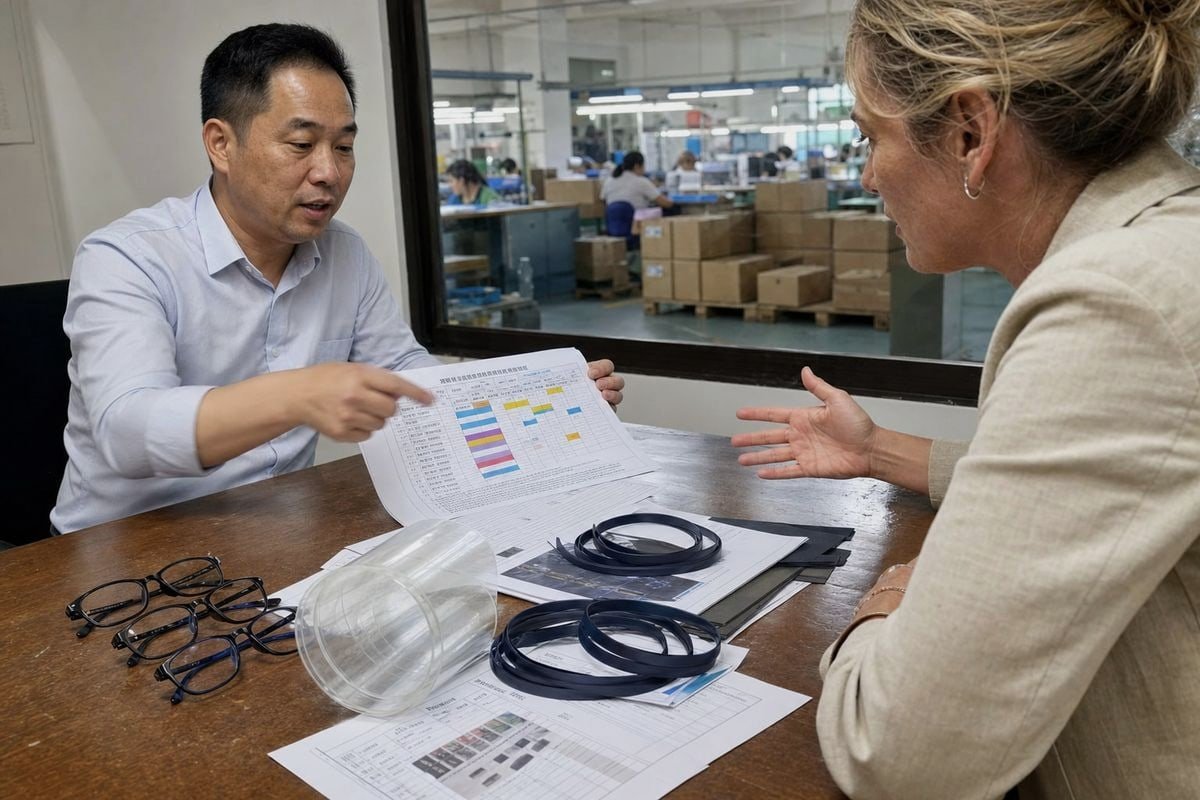
MOQs exist because factories carry risk. Every production run needs material purchasing, machine setup, color matching, and QC staffing 4. When we do not know whether a buyer will reorder, we protect ourselves with higher minimums. But data changes that equation completely.
Why data lowers your supplier's risk
Think about it from the factory floor. If you show us that a specific TR90 frame with TPEE temples 5 sold through at 85% last back-to-school season, we can forecast your reorder with confidence. That means we can:
- Reserve production capacity early. Sharing SKU-level forecasts 4–6 months before your peak season lets us lock in line time before the pre-season rush.
- Pre-purchase materials. TPEE and TR90 have their own lead times. Confirmed demand data lets us buy raw material in efficient batches and pass stability on to you.
- Split runs across colors. Instead of forcing one large run of a single color, we can plan data-driven pack ratios — for example, weighting core colors heavier than experimental brights.
- Offer staggered delivery. Predictable demand supports a vendor-managed inventory 6 style arrangement, where we produce ahead and ship against your replenishment schedule.
The negotiation math
| What You Share | What It Enables | Typical MOQ Impact |
|---|---|---|
| No data, first order | Full risk on supplier | Standard or higher MOQ |
| One season of sell-through | Basic demand forecasting | Standard MOQ, better color splits |
| Two+ seasons plus reorder history | Confident capacity planning | Lower MOQ or split shipments |
| Rolling forecast updates | Continuous replenishment planning | Flexible MOQs, priority lead time management |
Some buyers worry that sharing detailed numbers weakens their negotiating position. I understand that objection, but in practice the opposite happens. Withholding data forces us to price in uncertainty. You do not need to disclose customer-level details or exact margins — aggregated sell-through by style, color, and size is enough. In our fifteen years serving brands across 20+ countries, the partners who share data consistently get the best terms, because they make our seasonal stock planning easier and our production risk smaller.
Which formats or reports make it easiest for suppliers to understand my sales trends?
A buyer once emailed us fourteen separate PDF screenshots from their optical practice management software. Our team spent two days rebuilding the data by hand before we could even discuss the next season. A single clean spreadsheet would have taken twenty minutes.
Use a CSV or XLSX file with one row per SKU, including supplier reference, color, size, units sold, units returned, and inventory on hand. Add a one-page PDF summary for context. For recurring exchanges, POS data integration or API and EDI feeds automate the process.

Format matters more than most buyers realize. The goal is not just readability — it is making sure your data maps directly to our product catalog so nothing gets lost in translation.
Comparing the main format options
| Format | Idéal pour | Strengths | Weaknesses |
|---|---|---|---|
| CSV/XLSX | Most buyers, seasonal reviews | Easy to sort, filter, and match to catalogs | Needs manual sending each cycle |
| PDF summary | Executive context alongside the spreadsheet | Readable narrative, charts, notes | Data cannot be re-processed |
| API/EDI feed | Large retailers, recurring replenishment | Automated, near real-time, low error rate | Setup effort, needs IT support |
| Supplier portal upload | Smaller retailers, one-off reviews | Simple, structured, no integration needed | Depends on supplier's system |
The template we ask our partners to use
Keep one row per SKU with these columns: supplier name, brand, model reference, color, size, retail price, units sold, units returned, units on hand, and a reorder suggestion. That last column matters — it turns a report into a conversation starter.
The single most important detail is using the same product identifiers we use. If your POS renames our model "OK-2043 Blue" as "Kids Sport Blu," matching your sales to our catalog becomes guesswork. Before your first report, ask your supplier which SKU or catalog references they want. Many optical systems now support supplier catalog imports and even Frames Data style databases, which keep identifiers aligned automatically and streamline your inventory replenishment cycle.
For ongoing relationships, we encourage moving beyond static spreadsheets toward a shared, regularly updated file or integrated feed — a single source of truth. Spreadsheets are flexible, and they are a fine starting point. But integrated exchanges reduce manual errors, keep data current, and make each season's review faster than the last.
Can sharing past season data help my supplier recommend new styles from their existing collection?
Here is a lesson I learned early in our export business: buyers who pick styles from a catalog alone choose with their eyes. Buyers who pick styles guided by their own sales data choose with evidence — and their frame boards perform better for it.
Yes. Past season data lets your supplier match proven attributes — shapes, colors, sizes, materials, price points — against their existing collection. A factory with a large ready-made range can recommend styles that fit your demand profile without any new mold investment, cutting both cost and risk.

This is where a large existing collection becomes a genuine advantage. Our factory maintains roughly 800 ready styles across kids' optical frames and sunglasses. When a buyer shares their season data, we do not start from a blank page. We start from what already worked for them — and map it against what we already have on the shelf.
How the matching process works
- Extract your winning attributes. Suppose your data shows rounded rectangular shapes outsold angular ones, translucent pastel acetates like soft pink moved fastest with girls, and two-tone rubber temples with slip-resistant silicone ear hooks dominated the active-kids segment.
- Filter the collection. We screen our range for styles carrying those exact attributes — same shape family, similar color stories, matching size ranges for the age bands you serve.
- Fill the gaps. Your data also shows what you lacked. Missing a durable sporty style for ages 6–9? We shortlist flexible montures TR90 7 with TPEE temples built for exactly that use case.
- Test with low risk. Because these styles already exist, you can trial small quantities, then customize colors, logos, and packaging through OEM/ODM 8 once a style proves itself.
From sales data to frame board optimization
Good recommendations also improve how your frame board is organized. If your data shows 60% of kids' sales come from two shape families, your board should reflect that weighting instead of an even spread across every style. We often help buyers translate their sell-through data into pack ratios — heavier on proven core colors, lighter on experimental shades — so slow variants never pile up again.
There is a fair concern here: will supplier recommendations just push whatever the factory wants to sell? A trustworthy partner recommends against their own convenience when the data says so. We have advised buyers to drop styles that were easy for us to produce because their numbers showed parents in their market simply did not buy them. That honesty is what turns a supplier into a long-term planning partner.
Conclusion
Do not just send your kids optical frames supplier a sales report — send a buying story. Structured sell-through data earns better MOQs, smarter recommendations, and a stronger next season.
Notes de bas de page
1. Alibaba is a leading B2B marketplace for sourcing eyewear suppliers like those discussed. ↩︎
2. Explains the minimum order quantity concept central to supplier production planning discussed here. ↩︎
Plus d'articles que vous pourriez aimer
août 5, 2026
Bio-Based vs Regular Cellulose Acetate: What's the Difference for Kids' Frames?

août 5, 2026
How Recyclable Are Kids' Optical Frame Materials, and What Eco-Friendly Alternatives Exist?
août 5, 2026
Do Kids Optical Frames Whiten or Age in Storage, and How to Control Warehouse Conditions?
Vous recherchez un partenaire fiable en lunetterie pour enfants ?
Explorez plus de 800 styles prêts et un support OEM/ODM complet adapté à votre marque.
Contactez-nous English
  Español de México
  Deutsch
  Français
  日本語
日本語  العربية
  Português do Brasil