How to Request AS/NZS ISO 12870 Test Reports for Kids Optical Frames from China?

Requesting AS/NZS ISO 12870 1 test reports sounds simple until a supplier sends you a blurry PDF for a different frame. On our production line in Taizhou, we see why buyers get burned.
To request AS/NZS ISO 12870 test reports from China, ask your supplier for the full third-party lab report for your exact frame model, confirming the standard edition, accredited laboratory name, report number, test scope, sample photos, and pass results before you place the order.
That one sentence hides a lot of detail. In this guide, I will walk you through exactly what to ask for, how to verify it, and what to do when the paperwork falls short.
What documents should I ask my Chinese manufacturer to prove AS/NZS ISO 12870 compliance?
A buyer from Melbourne once asked me for "the certificate" for one of our TR90 kids optical frames children's eyewear safety claims 2. I sent her something better — the full test report — and explained why the difference matters.
Ask your Chinese manufacturer for the complete AS/NZS ISO 12870 test report, not just a certificate. It should include the standard edition, accredited lab details, report number, sample identification with photos, material declarations, full test scope, dated pass/fail results, and signatures on every page.
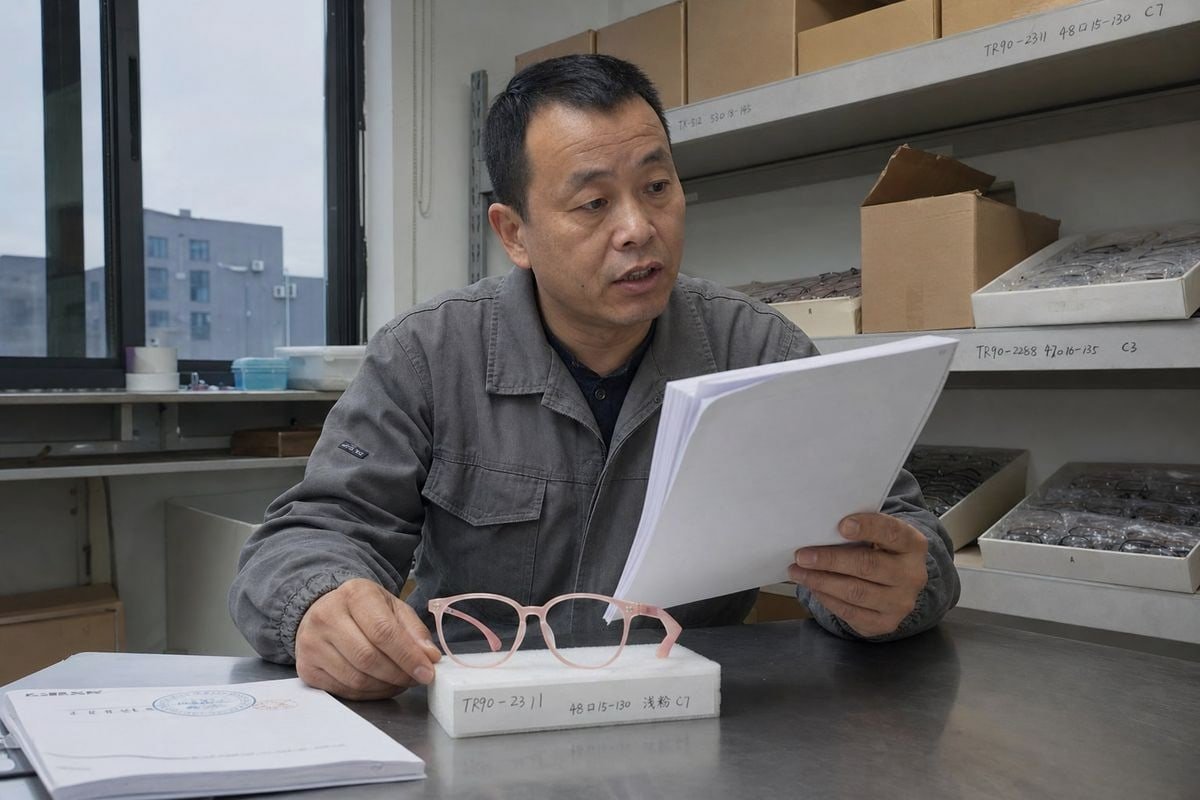
A certificate is a one-page summary. A test report is the evidence behind it. For optical frame compliance, you need the evidence. When our factory prepares documentation for buyers in Australia or Europe, we always bundle the report with supporting files, because import regulations Australia buyers face are strict, and retailers often audit paperwork before listing a product.
The document package you should request
Here is what a serious supplier should be able to hand over:
| Document | What it proves | Red flag if missing |
|---|---|---|
| Full test report | Actual test results against AS/NZS ISO 12870 | Supplier only offers a "certificate" |
| Standard edition reference | Whether AS/NZS ISO 12870:2012 or ISO 12870:2024 was used | Report just says "ISO 12870" with no year |
| Lab accreditation info | The lab is ISO 17025 accredited and independent | Self-issued factory "test report" |
| Sample photos and model code | The tested frame matches your SKU | Generic frame description only |
| Material declaration | Frame and temple materials match the tested sample | Vague terms like "plastic frame" |
| Nickel release testing results | Metal parts are safe for children's skin | No mention of metal components at all |
Why the standard edition matters
AS/NZS ISO 12870:2012 is the Australian and New Zealand adoption of the international standard, while ISO 12870:2024 is the current international edition. A supplier citing "ISO 12870" generically may be holding a report tested against an outdated version. Ask which edition was tested and confirm it satisfies your retailer or tender requirement. In our experience exporting to 20+ countries, buyers who lock down the edition upfront avoid painful re-testing later.
Ask about hazardous substance documentation too
AS/NZS ISO 12870 covers physiological compatibility 3, but many buyers pair it with hazardous substance testing and material traceability records. If a frame is marketed as hypoallergenic or metal-free, the paperwork should prove it. We supply material declarations for our TPEE and montures TR90 4 as standard practice, because children's eyewear safety claims must be backed by documents, not marketing copy.
Which lab tests does AS/NZS ISO 12870 require for kids optical frames, and how do I verify them?
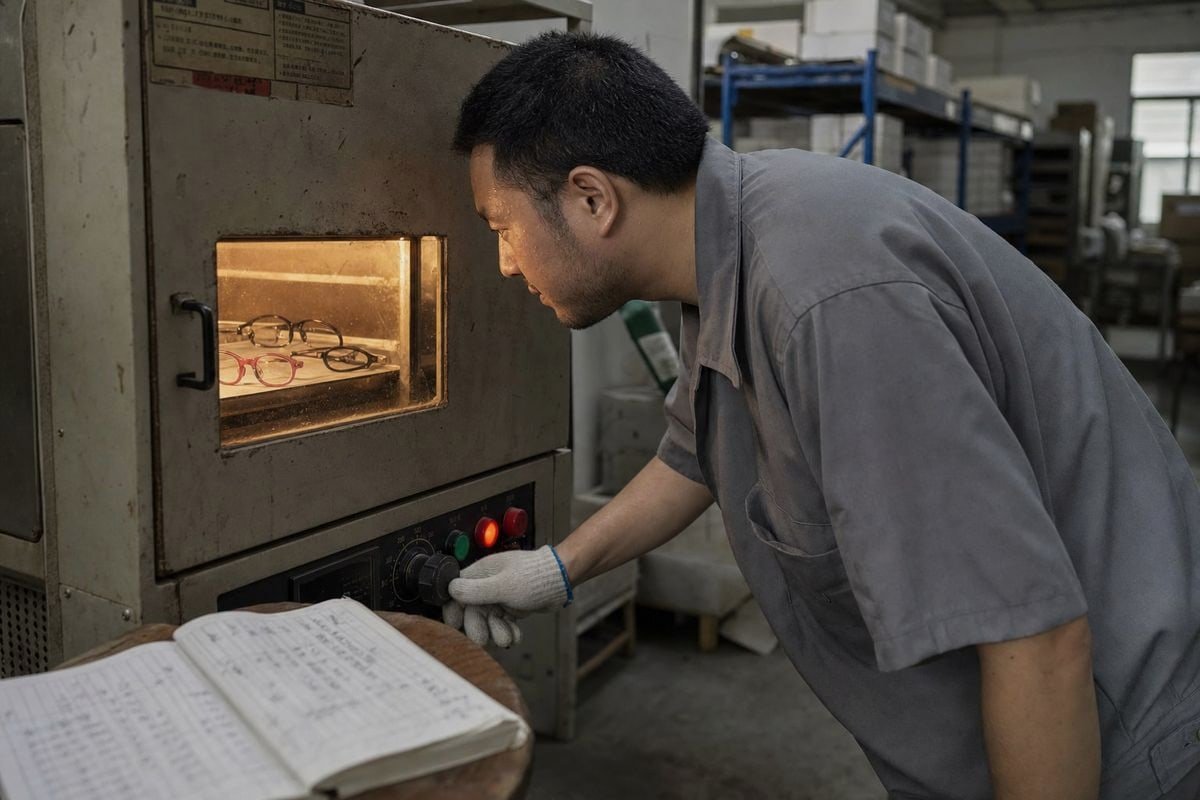
Small frames fail in specific ways. Our engineers learned this years ago when a tiny bridge design deformed under heat cycling during pre-production checks — a problem an adult-sized version never showed.
AS/NZS ISO 12870 requires tests for physiological compatibility, dimensional tolerances, screw threads, dimensional stability at elevated temperature, resistance to perspiration, mechanical stability including bridge deformation and endurance, resistance to ignition, and optical radiation. Verify them by checking each result appears in the report with measured values.
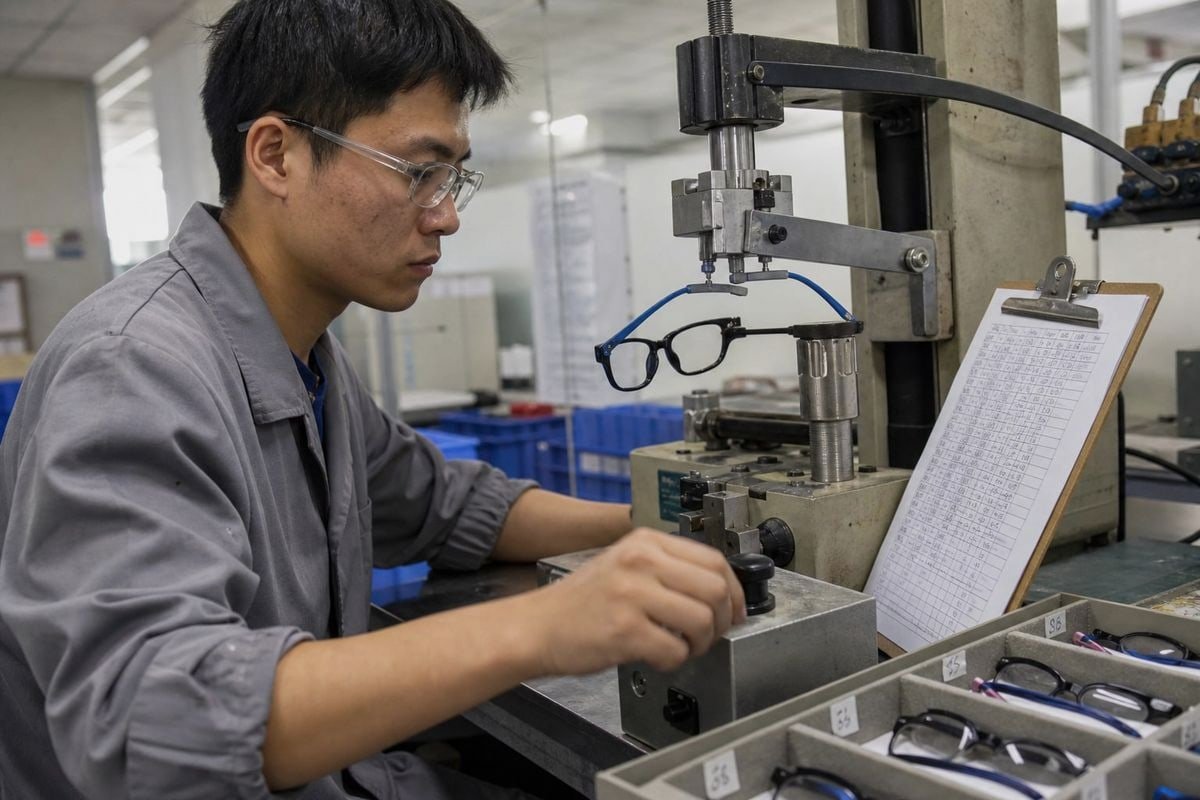
The standard applies to unglazed spectacle frames at the point of sale from the manufacturer or supplier to the retailer. That means the frame itself — before lenses are glazed — must pass. For kids' frames, this matters even more, because small parts, thin temples, and flexible hinges face harder daily abuse from children.
The core test areas explained
| Test area | What it checks | Why it matters for kids |
|---|---|---|
| Physiological compatibility | Materials touching the skin, including nickel release testing on metal parts | Children's skin is more sensitive to allergens |
| Dimensional stability at elevated temperature | Frame keeps its shape when warm | Kids leave glasses in hot cars and sunny spots |
| Resistance to perspiration | No corrosion or coating failure from sweat | Active kids sweat far more during play |
| Mechanical stability | Bridge deformation, lens retention, temple endurance cycling | Frames get bent, dropped, and sat on |
| Resistance to ignition | Frame does not sustain a flame | A basic safety floor for any children's product |
| Screw threads and tolerances | Hardware meets dimensional specs | Loose screws become small-part hazards |
How to verify each test was actually run
Do not just check the front page. Open the report and confirm every applicable clause has a recorded result. A credible third-party lab testing report lists each requirement, the method used, the measured value, and the verdict. If the report only tested three clauses out of the full scope, ask why. Some labs offer partial testing packages, and suppliers sometimes buy the cheapest one.
Also ask whether additional child-focused abuse tests were done. Many of our brand customers layer on small-parts checks, sharp-edge inspection, and drop testing referencing toy-safety thinking 5, even though AS/NZS ISO 12870 itself does not demand them. For frames combining rigid fronts with flexible silicone temple tips — like our TR90 frames with TPEE temples — mechanical stability frames testing on the actual material combination is the part I would never skip.
How can I confirm a test report is genuine and matches the exact frame style I'm ordering?
Trust, then verify. When we send test reports to new buyers, I actually encourage them to contact the lab directly — because a confident factory has nothing to hide, and I want that habit to protect them from less honest suppliers.
Confirm authenticity by contacting the issuing lab with the report number, checking the lab's accreditation status online, and matching the report's sample photos, model code, materials, and colorway against your ordered SKU. Any mismatch in construction or variant means the report does not cover your product.

A convincing-looking PDF proves nothing on its own. Report fraud in eyewear manufacturing China sourcing is not rare, and the most common trick is not forgery — it is borrowing. A supplier shows you a genuine report that belongs to a different frame, a different variant, or even a different factory.
A step-by-step verification process
- Check the lab. Look up the laboratory's name and confirm it holds ISO 17025 accreditation 6 for spectacle frame testing. Recognized commercial labs openly advertise ISO 12870 and AS/NZS ISO 12870 testing services.
- Verify the report number. Email or call the lab and ask them to confirm the report number, issue date, and applicant name. Legitimate labs answer these requests routinely.
- Match the sample identification. Compare the report's photos and model code to your order. Check frame shape, hinge type, temple material, and nose pad construction — not just the model number.
- Check variant coverage. If your frame comes in multiple colors or hinge options, ask which variant was tested. A translucent pink acetate frame and a black TR90 frame with rubber temples are different products, even under one style family.
- Inspect page continuity. Genuine reports have consistent page numbering, signatures, and formatting. Cut-and-paste edits often break these details.
- Check the date. An old report may reference a superseded edition. For current-market optical frame compliance, freshness matters.
The golden sample habit
One practice we push with every OEM customer: keep a golden sample. When a frame passes testing, both the buyer and our factory retain a sealed reference sample. Every future production run gets compared against it. This closes the gap between "the tested frame" and "the shipped frame" — which is where most supplier quality assurance failures actually happen. Combine that with material traceability records, and you have a defensible compliance file, not just a PDF in a folder.
What should I do if my supplier can't provide a valid AS/NZS ISO 12870 test report?
There is a trade-off I discuss with buyers every month: pay for fresh third-party testing now, or gamble on undocumented frames and risk a blocked shipment or retailer rejection later. The math almost always favors testing.
If your supplier cannot provide a valid report, require new third-party lab testing on your exact model before production, at agreed cost-sharing terms. If they refuse, resist, or stall, treat it as a serious risk signal and switch to a manufacturer with proven AS/NZS standards experience.
A missing report is not automatically a dealbreaker. Many perfectly capable factories simply have not tested a specific style yet, because testing is done per model and costs money. What matters is how the supplier responds when you ask.
Reading the supplier's response
| Supplier response | What it usually means | Your move |
|---|---|---|
| "We'll arrange testing at an accredited lab" | Capable factory, normal situation | Agree on cost split, timeline, and lab choice |
| "Here's a report for a similar frame" | They hope you won't check details | Politely decline; insist on model-specific testing |
| "Testing isn't necessary for kids' frames" | They don't understand children's eyewear safety requirements | Walk away — this gap won't close |
| "We have a certificate, no report exists" | Documentation is thin or borrowed | Verify with the lab; assume the worst until confirmed |
| Silence or repeated delays | They cannot pass, or won't invest | Move to a supplier with a compliance track record |
Structuring the testing arrangement
If you commission new testing, put it in writing. Specify the exact model, colorway, and material combination to be tested. Name the standard edition. Agree who pays — a common arrangement is that the buyer covers testing for a small first order, and the factory absorbs it once volumes commit. Add a failure analysis clause: if the frame fails any test, the manufacturer must provide root cause analysis and corrective action, then re-test at their cost.
We follow this playbook ourselves. With around 800 existing styles, we can often propose a frame that already has recent test history, which lets a new brand launch without heavy mold investment or long testing queues. When a buyer needs a custom OEM design instead, we build product certification into the development timeline from day one, so the report is ready before mass production — not scrambled together after the goods are packed.
Conclusion
Weak paperwork sinks good products. Demand model-specific AS/NZS ISO 12870 test reports, verify them with the lab, and partner with factories that treat compliance as standard practice — not an afterthought.
Notes de bas de page
1. Official source for the international standard for spectacle frames, including requirements and test methods. ↩︎
2. Provides guidance on children’s eyewear care and safety, emphasizing protection and proper use. ↩︎
3. Explains physiological compatibility as a key requirement within the ISO 12870 standard for spectacle frames. ↩︎
4. Explains TR90 material properties, benefits, and its suitability for eyewear frames. ↩︎
5. Provides comprehensive business guidance on toy safety from the Consumer Product Safety Commission. ↩︎
6. Provides official information on ISO/IEC 17025 standard for testing and calibration laboratories. ↩︎
Plus d'articles que vous pourriez aimer
août 5, 2026
Bio-Based vs Regular Cellulose Acetate: What's the Difference for Kids' Frames?
août 5, 2026
How Recyclable Are Kids' Optical Frame Materials, and What Eco-Friendly Alternatives Exist?
août 5, 2026
Do Kids Optical Frames Whiten or Age in Storage, and How to Control Warehouse Conditions?
Vous recherchez un partenaire fiable en lunetterie pour enfants ?
Explorez plus de 800 styles prêts et un support OEM/ODM complet adapté à votre marque.
Contactez-nous English
  Español de México
  Deutsch
  Français
  日本語
日本語  العربية
  Português do Brasil