How Can Packaging Design Prevent Transport Damage to TR90 Kids’ Sunglasses?
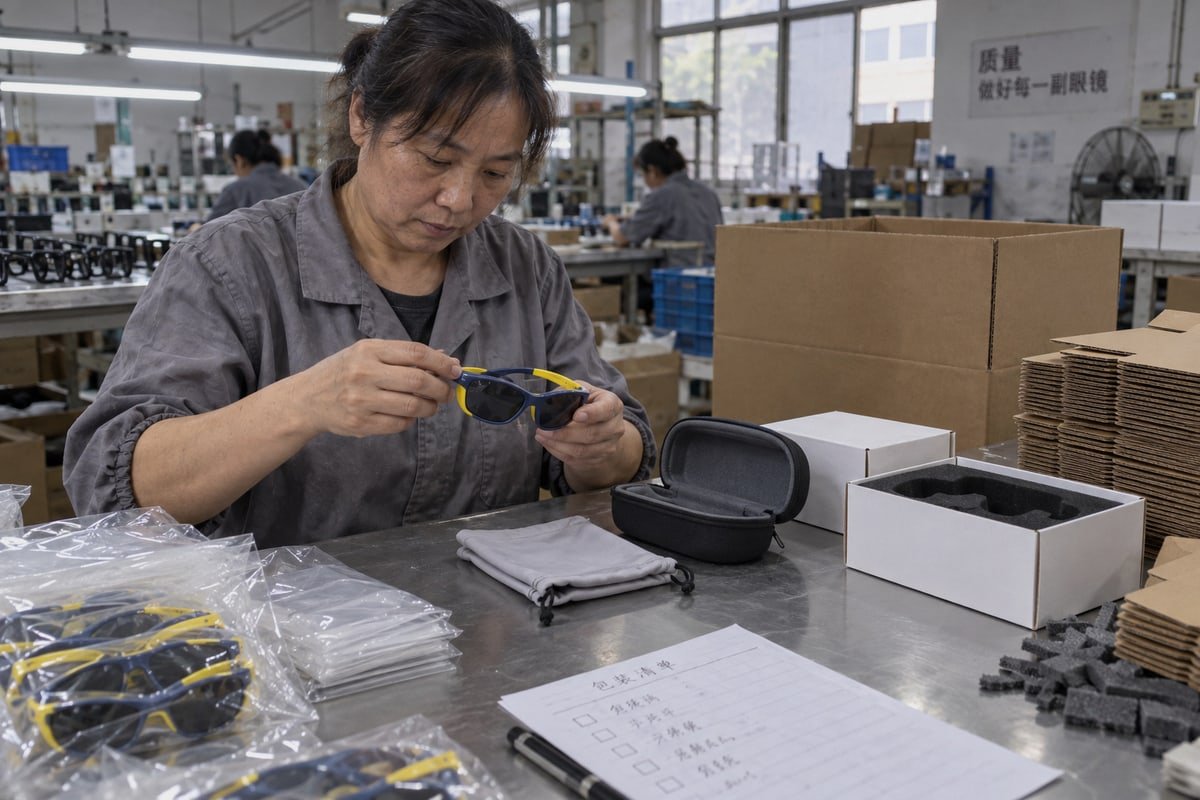
Scratched lenses, bent temples, one ruined batch ISTA-style drop tests 1. On our production line in Taizhou, we learned early that packaging design prevents transport damage to TR90 kids’ sunglasses.
Packaging design prevents transport damage to TR90 kids’ sunglasses by immobilizing each frame, shielding lenses from contact, supporting the front curve and nose bridge, and using layered protection: polybag, microfiber pouch, rigid case, retail box with insert, and a strong corrugated master carton.
TR90 is a tough material. It bends and returns to shape. But the frame is only one part of the shipment. The box, the insert, and the carton do the rest of the work. Below, I walk through each layer, from the lens groove to the pallet. I also share the tests we run before a single carton leaves our factory.
What packaging materials protect my TR90 sunglasses best during long-distance shipping?
During a routine carton check, our QC team found a lens popped out of a frame packed in only a polybag. That one unit changed our packing spec.
The best protection for TR90 sunglasses during long-distance shipping combines layers: an OPP polybag against dust, a microfiber pouch against scratches, a rigid EVA case against crushing, a retail box with insert to stop movement, and a high-BST corrugated master carton.
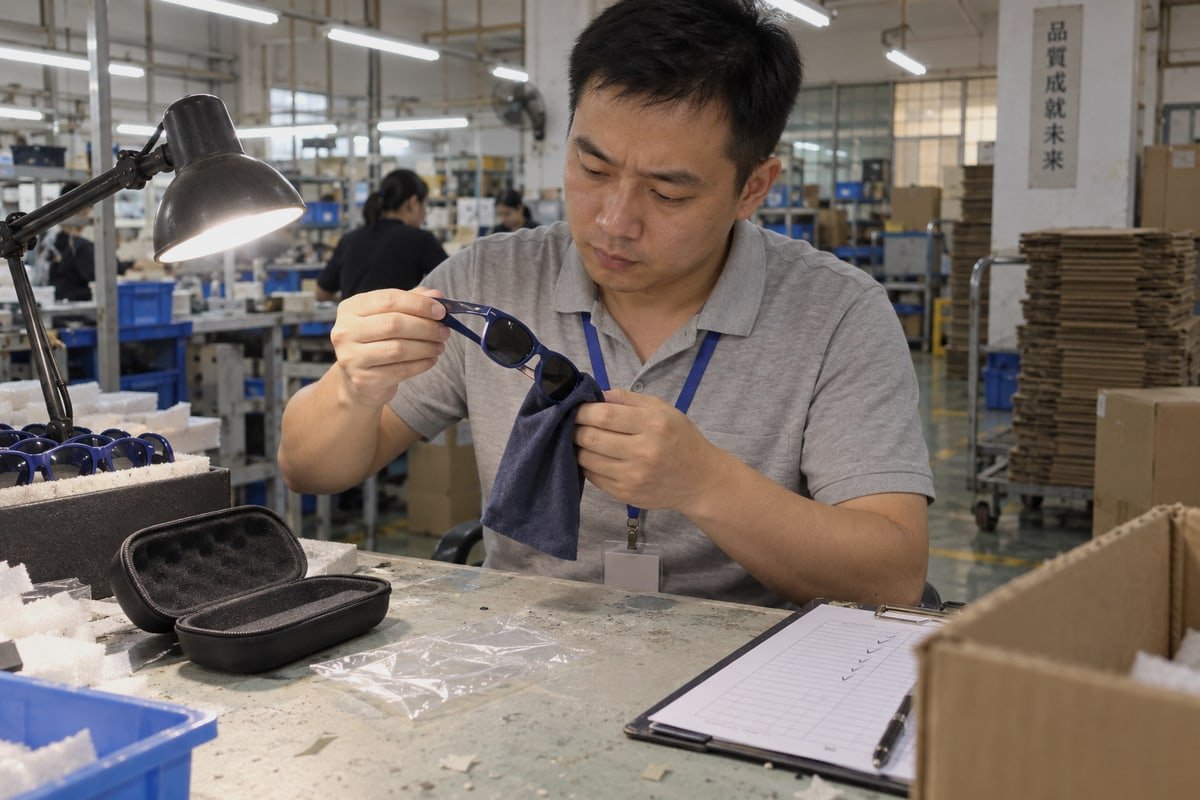
No single material solves shipping damage. Each layer handles one failure mode. So I think of packaging as a stack, not a wrapper.
Why TR90 still needs more than padding
TR90 is a thermoplastic. Its thermoplastic material properties 2 give it impact resistance and shape memory. The frame flexes, then springs back. That is why we chose it for active children.
But flexibility creates a hidden risk in transit. A flexible frame can twist inside a loose bag. When the front curve twists, the lens groove opens slightly. If the groove is shallow or the lens cut is a little off, the lens pops out. So lens fit and packaging are one protection system, not two separate jobs. Our engineers check groove depth and front curve stability during sampling for exactly this reason.
Kids' frames add another layer of risk. They are smaller and lighter. Suppliers often pack them densely, such as 1 piece per OPP bag, 12 pieces per inner box, and 300 pieces per carton. Dense packing means one crushed corner can affect many units at once.
The packaging layers compared
| Couche | Main job | Strength | Weakness |
|---|---|---|---|
| OPP polybag | Dust and scuff barrier | Cheap, light | Almost no impact protection |
| Microfiber storage pouches | Surface scratch protection | Soft contact, reusable by the child | Weak against compression |
| Rigid eyewear cases (EVA or hard shell) | Crush and impact protection | Best against lateral pressure | Adds bulk and cost |
| Retail box with insert | Immobilization plus branding | Stops rattling if the insert fits | Depends entirely on insert quality |
| Corrugated shipping boxes (master carton) | Stack and handling protection | Protects the whole batch | Only as good as the inner packing |
Pour long-distance export 3, I recommend at least polybag, pouch or case, and a boxed inner layer. Protective lens film on darker lenses, such as the flat gray-black lens on our navy wayfarer style, adds one more barrier against micro-scratches.
What about cold cargo holds?
Some buyers worry that TR90 turns brittle in unheated cargo. In practice, TR90 is known for passing impact testing at low temperatures with "No Break" results. I would not add thermal liners for the frame itself. I would focus that budget on a stronger carton and a better insert.
How do I design inner packaging to stop frames from shifting inside the box?
Every insert design forces a choice. We can grip the frame tightly for zero movement, or leave clearance so temples are never forced open. Kids' frames need both.
To stop frames shifting inside the box, use custom die-cut foam or molded pulp inserts that cradle the front curve, support the nose bridge, hold temples at their natural folded position, separate lenses from any surface, and leave zero gaps.
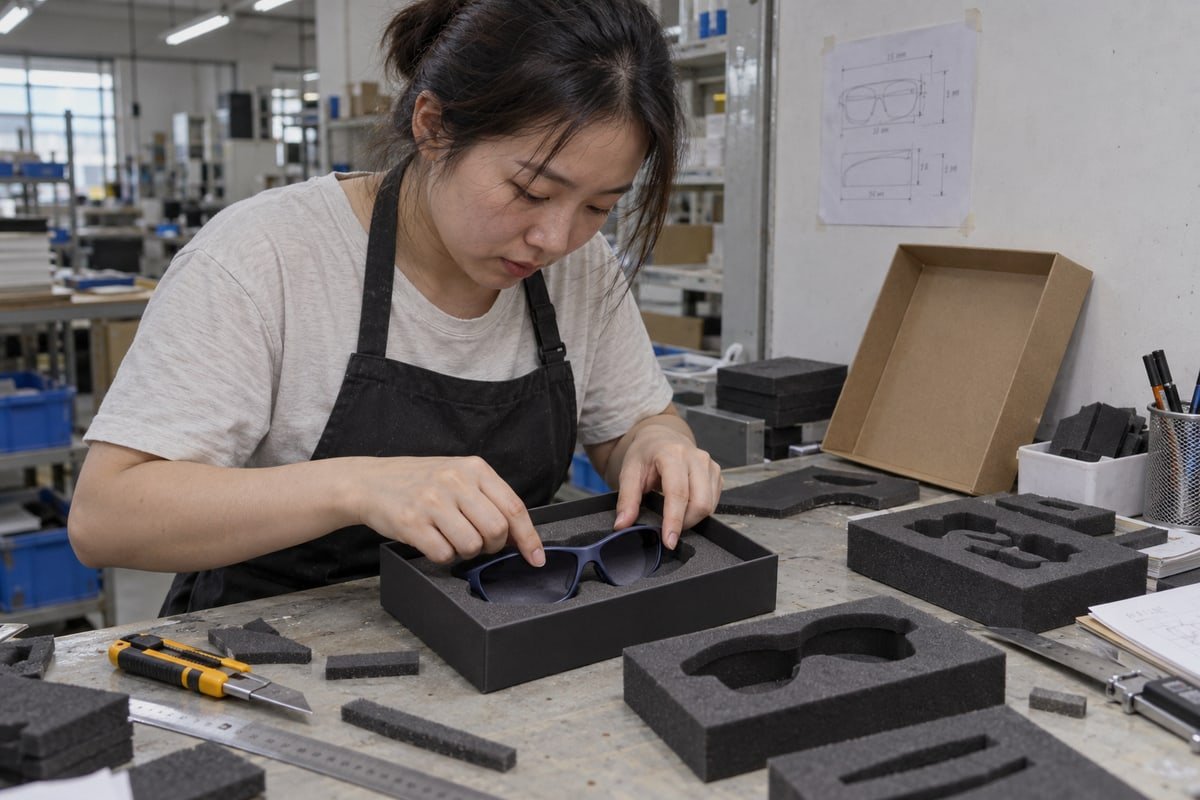
The insert is where most transport damage is either prevented or created. I have seen beautiful boxes fail because the cavity was cut for a generic frame shape. Here is the process we follow when we develop an insert for a client's chosen style.
A five-step insert design process
- Measure the actual frame, not a spec sheet. Our wraparound sport style has a deeper front curve than the flat oval retro style. The cavity depth must match the real curve, or the frame rocks.
- Support the nose bridge. The bridge is the most common fatigue point under stacking load. We add a small raised pad under the bridge so pressure from above does not flatten the front.
- Set the temple rest position. Temples should sit folded, at their natural closed angle. If the cavity forces them open even a few degrees, the hinge carries stress for the whole voyage. On children's frames, that can cause whitening at the hinge area.
- Isolate the lenses. Lens surfaces must not touch the insert wall, the box, or another frame. A thin protective lens film or a microfiber pouch handles this.
- Fill every void. Any remaining gap gets void fill packaging, such as kraft paper. Air inside the box means motion. Motion means abrasion.
Insert materials compared
| Insert type | Idéal pour | Note for kids' TR90 frames |
|---|---|---|
| Custom foam inserts (die-cut) | Premium retail boxes, lighter frames | Excellent grip; check the foam does not press on the two-tone temple finish |
| Molded pulp trays | Eco-focused brands | Can include crumple zones tuned to the low mass of children's eyewear |
| Die-cut cardboard | Cost-sensitive wholesale | Cheaper, but cavity edges can rub glossy black frames |
| Loose void fill only | Emergency repacking | Not recommended as the only restraint |
One more practical point. Separate SKUs clearly inside the inner box. When a warehouse has to open and re-sort mixed frames, repacking damage rises fast. A printed SKU label on each retail box saves the frames and saves the buyer's time.
Should I test my packaging against drop and pressure damage before mass production?
A procurement manager from Australia once asked me why we drop a sample carton before every new order. My answer: the carton is cheaper to break than her launch.
Yes. Test packaging before mass production with ISTA-style drop tests, stack and compression tests, vibration checks, and a post-test inspection for lens pop-out, scratches, bent temples, and crushed cases. Fixing an insert costs far less than reworking a shipped batch.
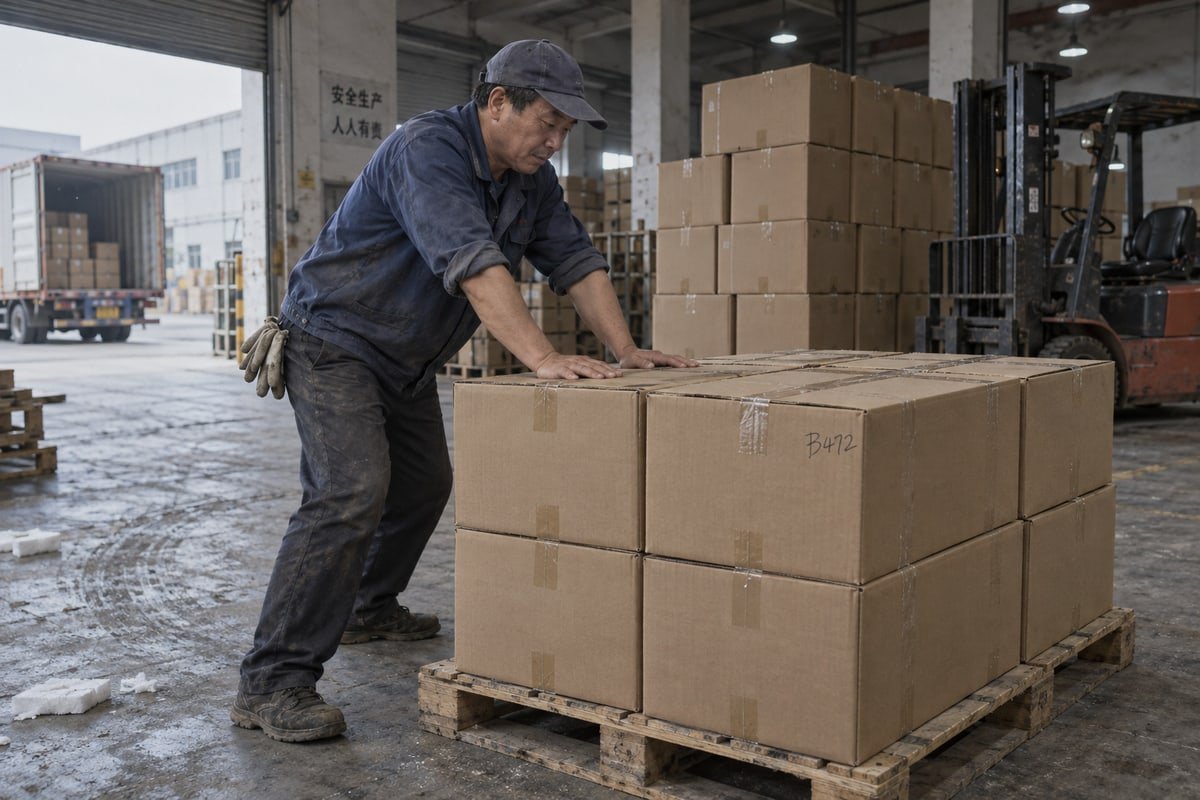
Testing sounds like a big-company step. It is not. A single filled sample carton, a measuring tape, and a stack of weights get you most of the way. Our 5S-managed workshop keeps a simple test corner for exactly this purpose.
The tests that matter for kids' eyewear
| Test | Ce que cela simule | What to check afterward |
|---|---|---|
| ISTA drop testing (corners, edges, faces) | Handling drops at ports and warehouses | Lens retention, temple angle, insert position |
| Stack or compression test | Pallet stacking in containers | Carton bulge, crushed inner boxes, flattened cases |
| Vibration or transit shake test | Truck and ship movement over weeks | Lens micro-scratches, frame rubbing marks |
| Bursting Test check on carton board | Carton wall strength | The BST rating printed by the board supplier matches the order |
Drop testing tells you most about the insert. If the frame shifts after a corner drop, the cavity is wrong. Compression testing tells you about the carton. If the top layer of inner boxes deforms, either the board grade is too low or the carton is overpacked.
What a pre-shipment QC checklist should include
Our QC team runs a checklist that covers packaging integrity 4, dimensional checks on frames, impact testing on samples, surface inspection under light, and carton-level verification against the packing list. We inspect to an agreed AQL level with the buyer. Structural integrity of the carton is a pass-or-fail item, not a judgment call.
I also recommend one more test that many buyers skip. Open a carton at the destination and repeat the surface inspection. Arrival checks close the loop. They show whether the packaging design that passed in Taizhou still held up after weeks at sea.
Avoid overpacking. A carton rated for 300 pieces should carry 300 pieces, not 340 because the freight forwarder had space. Overpacking crushes cases and defeats every good decision made upstream.
Can I balance protective packaging with a retail-ready, branded unboxing experience?
Our biggest packaging lesson came from a retail box that looked beautiful but let the frame slide. Pretty is not protective. Now we design the insert first, print second.
Yes. A retail-ready branded box can protect if the insert immobilizes the frame, the box carries a barcode label, warning insert, and hangtag, and it sits in a rigid inner box inside a strong master carton. Branding and protection share the same structure.
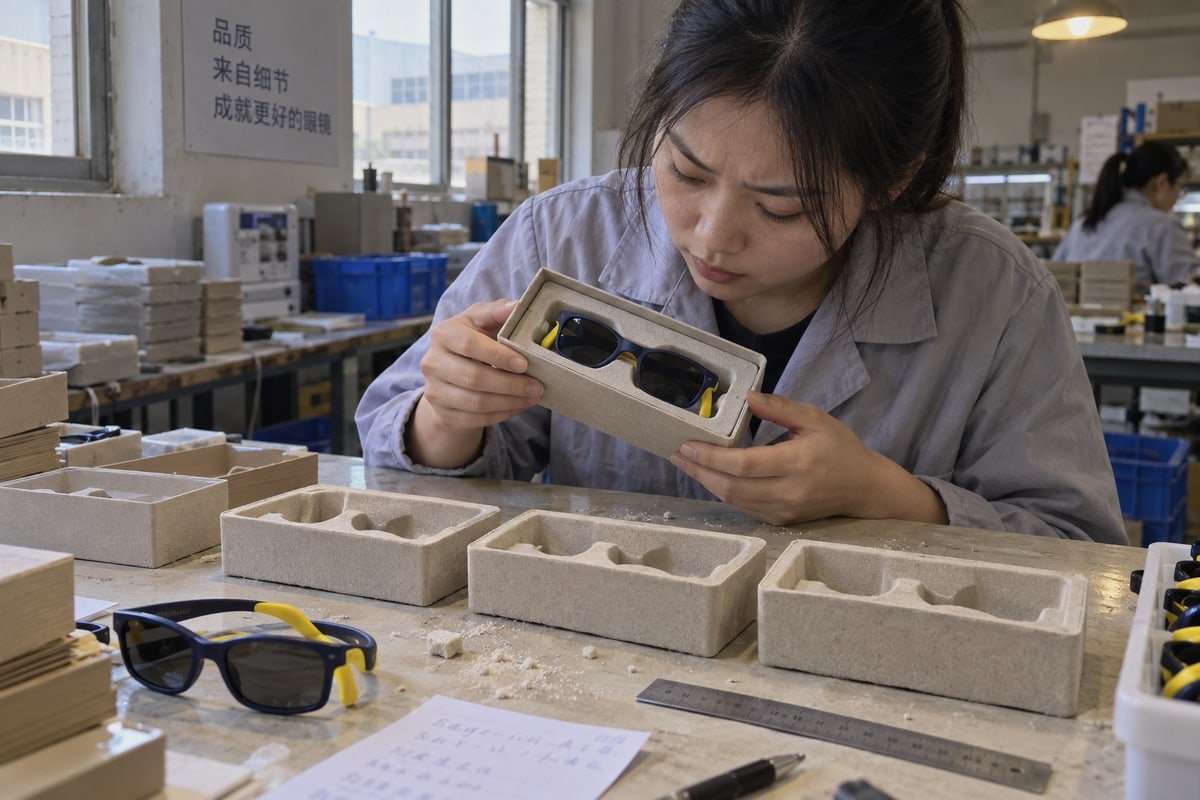
Buyers often present this as a trade-off. Protection on one side, branding on the other. In my experience, the trade-off is smaller than it looks. The same insert that holds the frame still also presents it nicely when the child opens the lid.
Matching packaging to the sales channel
Different channels need different stacks. Here is how I usually advise brands.
- E-commerce fulfillment: A branded retail box with insert, barcode label, QR code, and warning insert. The box must survive a single-parcel journey, so the box itself needs corrugated or rigid walls, not just a folding carton.
- Wholesale to retailers: Retail box inside a 12-piece inner box inside the master carton. Fragile and Do Not Stack marks on the carton influence how carriers handle it.
- Retail-ready export: Shelf-ready inner boxes with clear SKU marks, plus a microfiber pouch or rigid case that becomes part of the consumer product.
Resolving the sustainability objection
Many of our clients in Europe and Japan ask for recycled or minimalist packaging. That is a fair request. The concern is real too: minimalist packaging can lower freight cost and waste, yet leave a flexible kids' frame under-protected on an international route.
| Option | Coût | Protection | Waste | Our recommendation |
|---|---|---|---|---|
| Minimalist polybag only | Le plus bas | Bas | Le plus bas | Domestic bulk only |
| Rigid EVA case | Le plus élevé | Le plus élevé | Plus élevé | Premium or sport lines |
| Printed retail box with custom insert | Moyen | High if insert fits | Moyen | Most brand launches |
| Molded pulp tray in kraft box | Moyen | High with crumple zones | Low, biodegradable | Eco-positioned brands |
The answer is to prove it, not assume it. We run the same drop and stack tests on recycled board 5 as on virgin board. If the eco option passes, it ships. If not, we adjust the insert before we change the branding.
Why OEM packaging is product engineering
With about 800 existing styles available, a new brand can launch without heavy mold investment. Packaging is where that brand becomes visible. Our OEM/ODM team handles custom colors, logos, lenses, and the full packaging set: polybag, microfiber storage pouches, EVA or hard case, color box, barcode label, warning insert, hangtag, and carton mark. We treat the insert drawing as seriously as the frame drawing, because both decide whether the product arrives ready to sell.
Conclusion
TR90 survives kids; careless packaging does not survive shipping. Design the packaging as a transport-control system, test it, and your TR90 kids' sunglasses arrive retail-ready.
Interested in sourcing the products mentioned in this article? See details and request a quote here:
Notes de bas de page
1. ISTA is the leading global organization for developing testing protocols that simulate real-world transport conditions. ↩︎
2. ScienceDirect provides peer-reviewed technical definitions and data regarding the physical characteristics of thermoplastic polymers. ↩︎
3. The World Customs Organization establishes international standards for the movement of goods across global borders. ↩︎
4. ISO is the primary international body for setting global standards on packaging and quality management systems. ↩︎
5. The EPA provides authoritative data on the sustainability and recycling standards for paperboard and packaging materials. ↩︎
Plus d'articles que vous pourriez aimer
Vous recherchez un partenaire fiable en lunetterie pour enfants ?
Explorez plus de 800 styles prêts et un support OEM/ODM complet adapté à votre marque.
Contactez-nous English
  Español de México
  Deutsch
  Français
  日本語
日本語  العربية
  Português do Brasil