How to Get Chinese Suppliers to Pre-Apply Barcodes on Kids’ Sunglasses?
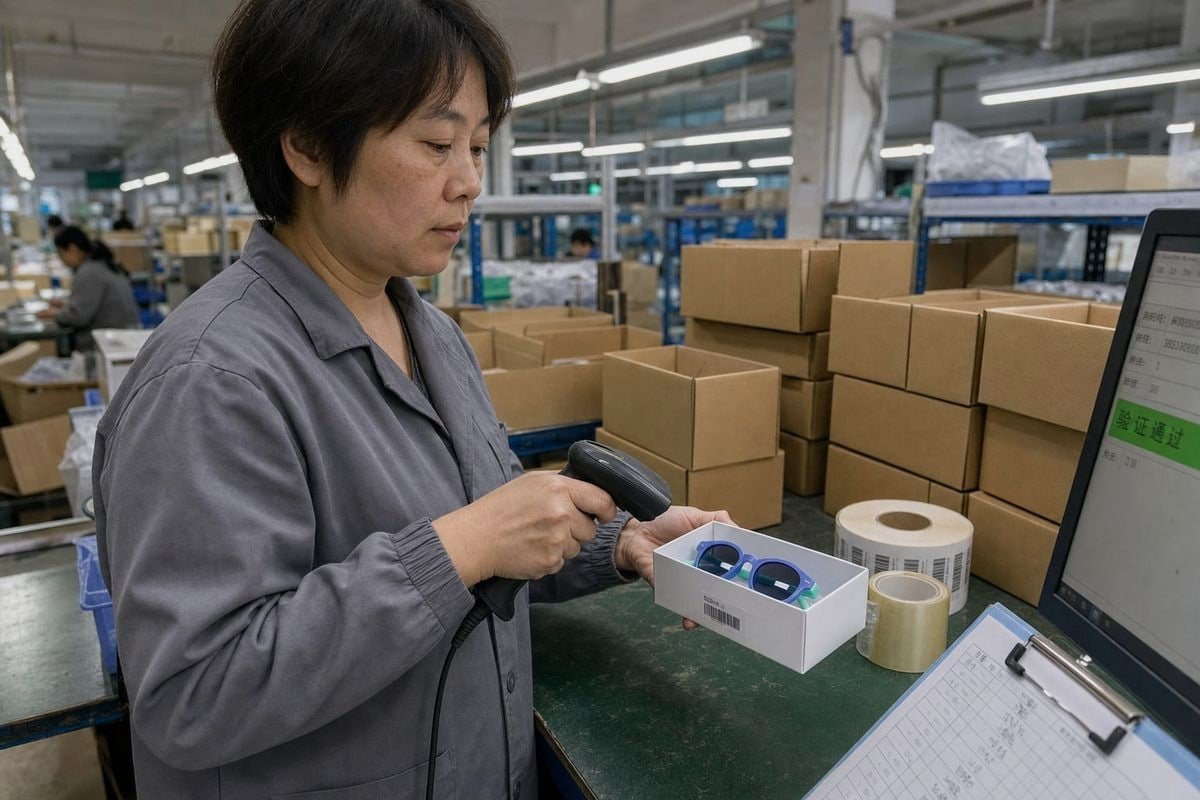
Getting Chinese suppliers to pre-apply barcodes on kids’ sunglasses sounds simple — until a container arrives at your warehouse with codes that won’t scan. On our production line, we’ve seen that mistake cost buyers weeks of relabeling. The fix is a clear briefing process, and I’ll walk you through exactly how we handle it.
To get Chinese suppliers to pre-apply barcodes on kids’ sunglasses, send your legitimately assigned GTIN barcode files, a labeling specification sheet with exact placement and size, an SKU-to-barcode mapping, and packaging artwork. Then approve a pre-production sample and verify scan quality with a pre-shipment inspection.
That is the short version. Below, I break down each step: what to send, how printing works at the factory, placement rules, and the quality checks that protect your order.
What information do I need to provide before my supplier can pre-apply barcodes?
A buyer from Australia once emailed us a blurry screenshot of a barcode and wrote "please add this to the boxes." We had to stop his order and ask for six more things first.
Before a supplier can pre-apply barcodes, provide high-resolution barcode files in PDF or AI format, the exact GTIN numbers, an SKU-to-barcode mapping table, placement instructions with dimensions, your packaging dieline or artwork, and any compliance text such as CPSIA tracking labels and country-of-origin marks.

The most important thing to understand is the difference between the barcode number, the barcode image, and the physical application. You own the number — the GTIN. GS1 barcode standards 1 require that you first register your product data, then generate the barcode image from that record. Your supplier does not "make up" a barcode. We only print what you assign. If you skip legitimate GTIN assignment and pull a random number from the internet, retailers and marketplaces will reject the product, and no factory can fix that after printing.
The complete information package
In our fifteen years of producing children's eyewear for brands in more than twenty countries, the smoothest barcode projects always start with a single document we call the labeling specification sheet. Here is what it should contain:
| Item to Provide | Why It Matters |
|---|---|
| Barcode file (PDF, AI, or high-res PNG) | Vector files prevent blurry, unscannable print |
| GTIN / UPC or EAN number list | Confirms legitimate ownership and correct region format |
| SKU-to-barcode mapping table | Prevents the blue frame getting the pink frame's code |
| Placement mockup with measurements | Removes guesswork on the factory floor |
| Packaging dieline or artwork file | Lets us integrate the code into custom box design |
| Compliance text (CPSIA tracking, origin mark, warnings) | Keeps the pack legal in your destination market |
Don't forget the safety layer
Kids' sunglasses are children's products, so barcode work overlaps with safety labeling. For the US market, CPSIA compliance 2 means a permanent tracking label on the product and packaging. "Made in China" origin marking 3 must stay clearly visible on the retail pack. If your sunglasses ship in individual poly bags, those bags need suffocation warnings. When we build packaging artwork for a client's TR90 or TPEE kids' frames, we lay out the barcode, the age grading, the UV400 claim, and the warning text together — so nothing overlaps and nothing gets cut.
Also tell us the barcode's purpose. A retail UPC, an Amazon FNSKU label for FBA labeling requirements, and an internal warehouse code are three different jobs. Amazon, for example, often requires the FNSKU to cover or replace the manufacturer barcode. If you sell in multiple channels, we need to know which code goes on which batch before printing starts.
Can my Chinese manufacturer print GS1 or custom barcodes directly on the packaging?
The trade-off we weigh most often with private label manufacturing clients is stickers versus printed artwork. Both work. But they behave very differently in cost, flexibility, and risk.
Yes. A capable Chinese manufacturer can integrate GS1 or custom barcodes directly into printed packaging artwork, apply pre-printed adhesive labels, or print stickers in-house. Direct artwork integration eliminates peeling risk and manual labor, while labels offer more flexibility for late SKU or marketplace changes.
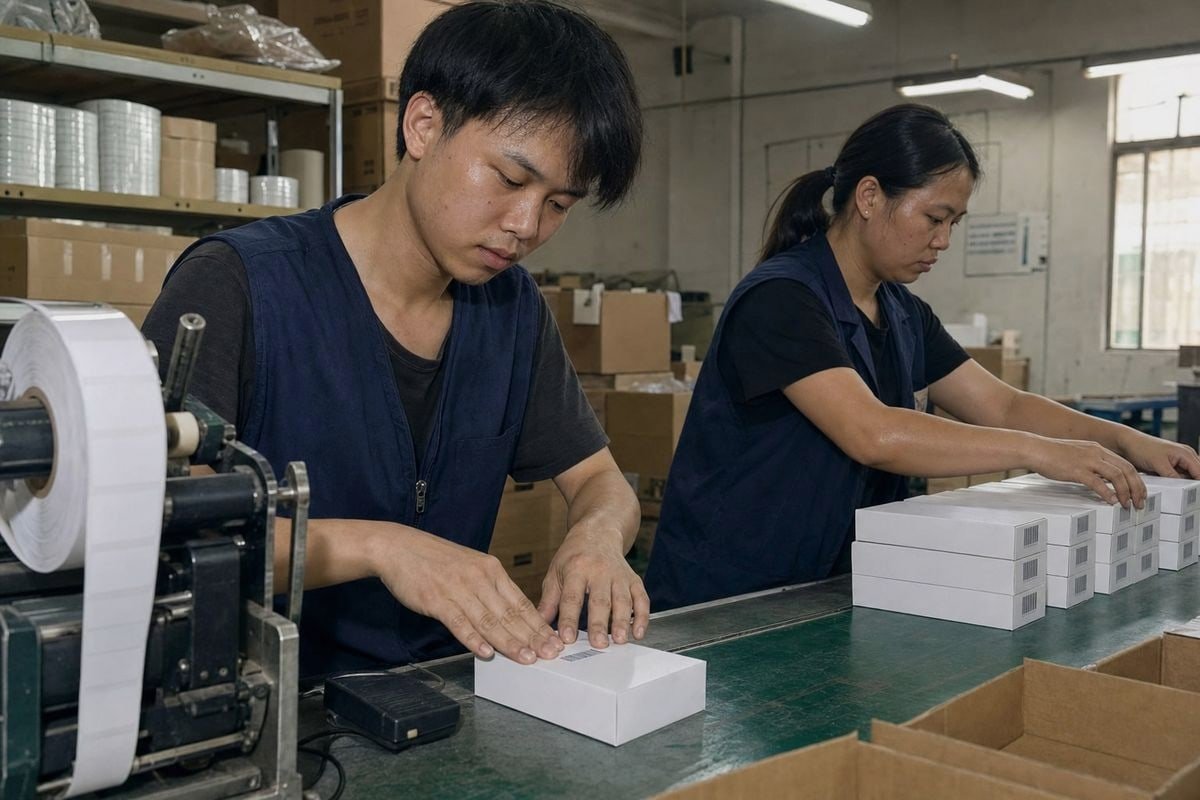
GS1 recognizes three standard application methods: integrating the code into the packaging artwork, applying pre-printed labels, and printing directly onto the packaging. All three are routine requests for a factory like ours. The right choice depends on how your kids' sunglasses ship — branded folding boxes, hang tags, poly bags, or bulk cartons.
Comparing the three application methods
| Méthode | Idéal pour | Strengths | Watch Out For |
|---|---|---|---|
| Barcode in box artwork | Custom retail boxes, stable SKUs | No peeling, no sticker labor, cleanest look | Artwork must be final; changes need reprints |
| Pre-printed adhesive labels | Poly bags, hang tags, FNSKU needs | Flexible, easy to swap per channel | Adhesive quality and application accuracy |
| Direct in-factory printing | Master cartons, mixed orders | Fast, printed at packing stage | Printer calibration and ink contrast |
For adhesive labels, we recommend thermal transfer printing 4 rather than direct thermal. Trans-Pacific containers get hot and humid. Direct thermal labels can fade or smear before they ever reach a scanner. Thermal transfer ribbon printing survives the trip.
One warning specific to sunglasses
Never place a standard sticker on the lens itself. Our polarized and UV400 mirror coatings sunglasses UV protection 5 — like the orange-gradient shield lenses we produce for sport styles — can be damaged by aggressive adhesive residue. If a lens sticker is unavoidable for merchandising, specify low-tack adhesive and test it on a coated sample first.
A common buyer objection here is control: "If the factory prints my barcodes, I lose oversight." That is a fair concern when your SKUs change every season. But if your SKU management is stable and the factory already produces your custom packaging, pushing barcode work upstream removes an entire relabeling step from your warehouse. For our long-term OEM clients with fixed style ranges, artwork integration is almost always the better economics. For new brands still testing styles from our 800-model catalog, labels keep options open.
One more note on regions: know whether you need UPC vs EAN codes. UPC-A suits the US; EAN-13 6 suits Europe, Australia, and most other markets. And if your goods enter China-related channels, be aware that China has introduced GS1 GTIN requirements 7 for customs clearance — overseas GTIN use in China can require documentation routed through GS1 China. That is more than a print job, so raise it early.
How do I make sure barcode placement passes retail scanning requirements?
Early in our export business, we learned a hard lesson: a beautifully printed barcode wrapped around a curved hang tag edge scans at the factory handheld — and fails at the retailer's flatbed scanner.
Place the barcode on a flat, smooth, non-reflective surface with an unobstructed quiet zone on both sides. Keep it at or above minimum GS1 size, use dark bars on a light background, avoid curves and gloss coatings, and confirm scanability on an approved pre-production sample.

Kids' sunglasses packaging is small. A folding box for a compact periwinkle-blue children's frame might give you one usable panel after the branding, age grading, and safety warnings claim their space. That is why placement must be planned in the artwork stage, not improvised at packing.
The placement rules we follow on every kids' eyewear order
- Flat surface only. Never across a fold, seam, or the curved face of a blister pack.
- Protect the quiet zone. The blank margins on both sides of the bars are part of the code. Artwork elements that creep into them cause scan failures.
- Mind the finish. Glossy lamination and metallic foils reflect scanner light. We print barcodes on matte areas or add a matte spot window.
- Respect minimum size. Shrinking an EAN-13 below the GS1 minimum magnification to save space is the most common cause of retail rejections we see.
- Keep contrast high. Black or dark blue bars on white. Never red bars — scanners read red as blank.
- Don't collide with compliance text. The barcode must not cover CPSIA tracking information, suffocation warnings, or origin marks.
Where to place it by packaging type
For retail folding boxes, use the bottom or back panel, aligned to a specified corner with measured margins. For hang tags, use the flat back face, never the edge. For poly bags, apply a label to a flat area of the bag, clear of the suffocation warning. For master cartons, place shipping labels on the side panel following your product packaging specifications, not on the top where stacking hides them.
Your labeling specification sheet should show all of this visually — a drawing or annotated photo with placement, orientation, and size in millimeters. When we receive one, our packing team pins it at the line. When we don't, we build one and send it back for your written approval before mass production. That single document prevents almost every placement dispute I have seen in fifteen years of children's eyewear production.
What quality checks confirm my barcodes are accurate before shipment?
A distributor client in Japan once caught a near miss with us: two similar mint-teal SKUs differed only by lens type, and the mapping table saved the batch. Ever since, we treat barcode verification as a formal QC gate, not an afterthought.
Confirm barcode accuracy through a pre-production sample scan test, an SKU-to-barcode cross-check against your mapping table, in-line verification during packing, and a third-party pre-shipment inspection that scans random samples, checks label adhesion, and photographs placement before you release final payment.
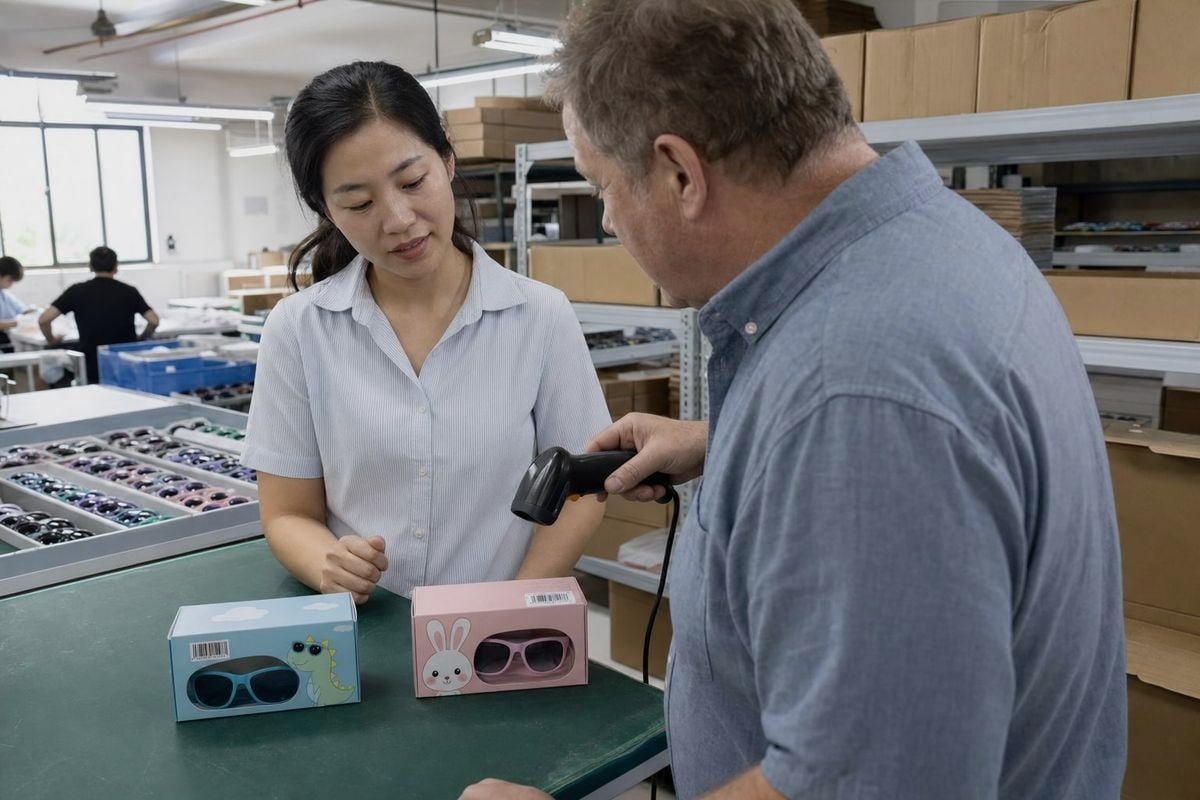
Barcode errors are silent. The box looks perfect, the print is crisp, and the number is still wrong. Only a structured, multi-stage check catches that. Here is the sequence we recommend to every buyer, whether they use our in-house QC or hire an independent inspector.
The four-stage verification sequence
| Étape | Timing | What Gets Checked |
|---|---|---|
| Pre-production sample | Before mass production | Scan test, decoded number vs. GTIN list, placement vs. spec sheet |
| First-article check | Start of packing | First packed units scanned and photographed for buyer approval |
| In-line verification | During packing | Random scans per SKU batch; correct code on correct color and style |
| Pre-shipment inspection 8 | Before container loading | Third-party barcode scan test on random samples, adhesion and smear check |
The pre-production sample is your cheapest insurance. Ask for physical samples or, at minimum, clear photographs of the barcode on the actual packaging, then scan the photo with a verification app and compare the decoded digits to your GTIN records character by character. Approve in writing. Nothing prints at scale until then.
Preventing mix-ups on the factory floor
Mixed-SKU orders are where errors breed. A kids' sunglasses order might combine a black sport shield style, a white wraparound, and a round two-tone frame — each with its own code. Two practices help enormously. First, color-coded master cartons let packing workers visually match barcode batches to the right product without reading tiny digits. Second, physical separation: we run one SKU's packing to completion before opening the next SKU's label stock, so wrong labels are never within arm's reach.
For the final gate, hire a third-party inspection service and put a barcode scan test explicitly in their checklist — many standard inspections skip it unless instructed. The inspector should scan random samples from multiple cartons, verify the decoded numbers against your mapping table, test label adhesion, rub-test for smearing, and photograph placement. Tie this pre-shipment inspection to your final payment. Suppliers sometimes resist pre-applying barcodes precisely because they fear liability for errors; a documented approval-and-inspection workflow protects both sides, which is why we welcome it. And remember to keep barcode QC in scope alongside your other paperwork — for the US, that includes CPSIA documentation and, where applicable, FDA registration for sunglasses with drop-ball impact test records, since sunglasses are regulated as medical devices there.
Conclusion
Getting Chinese suppliers to pre-apply barcodes on kids' sunglasses works when you brief clearly: legitimate GTINs, a specification sheet, approved samples, and verified scan tests before shipment.
Notes de bas de page
1. Official GS1 landing page for barcode standards, replacing the broken deep link. ↩︎
2. CPSC statute page detailing US children’s product safety labeling requirements. ↩︎
3. US Customs rules requiring visible country-of-origin marks on imported retail goods. ↩︎
4. Explains the durable printing technology recommended for shipping-resistant labels. ↩︎
5. Updated FDA consumer guide for sunglasses and UV safety. ↩︎
6. Background on the international barcode format used outside the US market. ↩︎
7. Direct authoritative source for GTIN identification standards. ↩︎
8. Background on the third-party verification process used before container loading. ↩︎
Plus d'articles que vous pourriez aimer

1 août 2026
L'usine doit-elle gérer l'emballage et l'étiquetage des lunettes pour enfants, ou utiliser un fournisseur désigné ?

1 août 2026
Entrepôt propre vs. exécution directe par le fournisseur : lequel réduit les coûts de retour pour les marques de lunettes pour enfants ?

1 août 2026
Entrepôt direct au port ou staging outre-mer : lequel permet d'économiser le plus sur l'expédition des lunettes pour enfants ?
Vous recherchez un partenaire fiable en lunetterie pour enfants ?
Explorez plus de 800 styles prêts et un support OEM/ODM complet adapté à votre marque.
Contactez-nous English
  Español de México
  Deutsch
  Français
  日本語
日本語  العربية
  Português do Brasil