How to Get a China Factory to Attach Price Tags and UPC Barcodes on Kids Optical Frames?
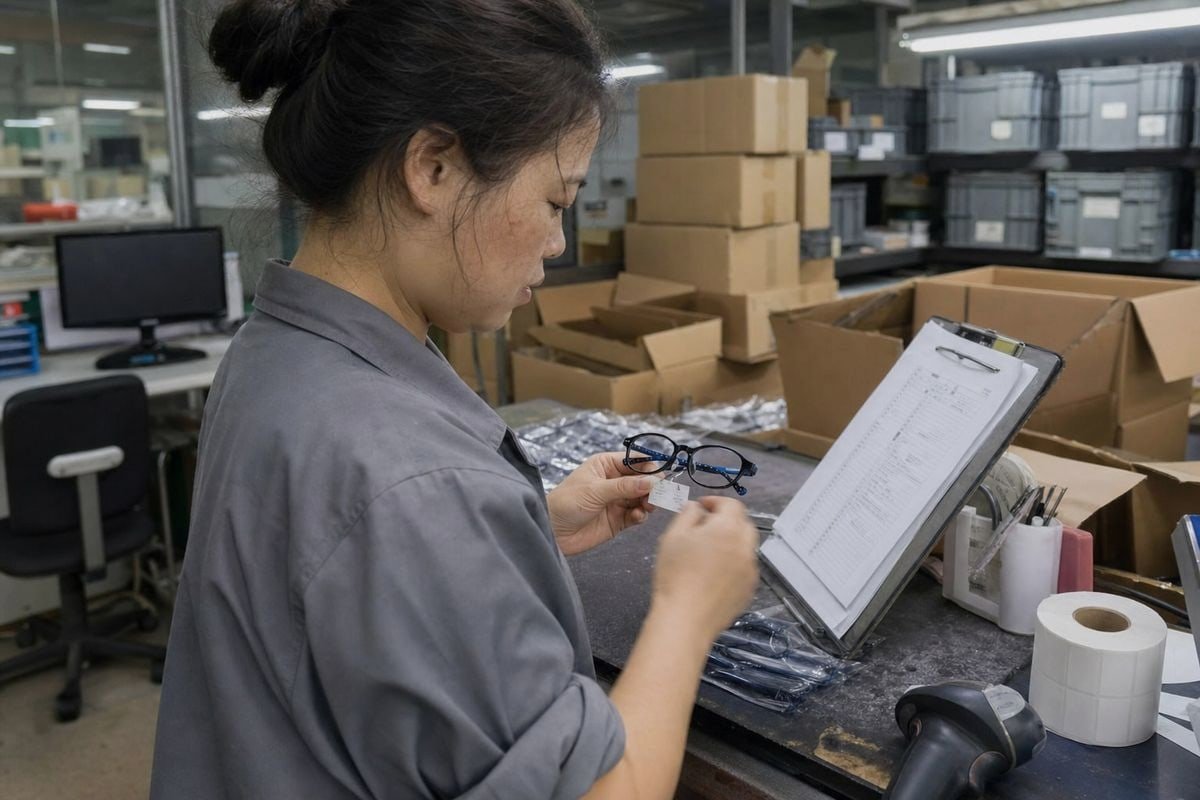
Getting price tags and UPC barcodes on kids optical frames [attached correctly at the factory](https://okayeyewear.com/how-get-chinese-suppliers-pre-apply-barcodes-kids-sunglasses/) saves buyers weeks of relabeling FDA compliance for frames 1. Yet on our Taizhou production line, we see briefs that guarantee mistakes.
A China factory can attach price tags and UPC barcodes on kids optical frames if you provide a GS1-issued UPC list mapped to each SKU, vector label artwork, exact placement instructions, and an approved pre-production sample. Confirm labeling terms during quoting, before bulk production begins.
That is the short answer. The details decide whether your frames scan at checkout or sit in a warehouse waiting for stickers. Let me walk you through the whole process, step by step.
Can I Send My Own UPC Barcode and Price Tag Files to a China Factory for My Kids Optical Frames?
A buyer from Australia once emailed us a screenshot of a barcode and asked us to "just copy it." Our packing team flagged it immediately — screenshots do not print cleanly, and copied codes cause retail chaos.
Yes, you can send your own UPC barcode and price tag files to a China factory. Send high-resolution vector files (AI or PDF), a SKU-to-UPC mapping table, and placement instructions. The factory prints and applies the labels; the UPC number itself must come from GS1.

There is an important distinction here that trips up many first-time importers. The barcode is two separate things: the number and the picture. GS1 issues the number. Anyone can render that number into a scannable graphic. But if the underlying UPC was never properly assigned through GS1 barcode standards 2, the prettiest label in the world will still fail at a retail point of sale or get rejected by a marketplace. In our fifteen years as an OEM eyewear manufacturer, we have printed thousands of barcode labels — but we have never issued a single UPC. That is not our job, and any factory that offers to "give you barcodes" should make you cautious.
Two Ways to Handle the Files
You have two workable options, and both pass through our workshop regularly:
- Factory-printed labels. You send digital artwork plus the UPC list. We print thermal transfer labels or hang tags in-house and apply them. This is the cheapest and fastest route when packaging is not yet finalized.
- Buyer-supplied preprinted labels. You print sticker sheets or swing tags in your home market and ship them to us. We only apply them. This gives you tighter control over color and material, but it adds coordination and freight time.
Factory-applied labels save handling after arrival, but they raise the risk of mislabeling if your SKU list is wrong. Buyer-supplied labels shift that risk back to you. Either way, the mapping table — not the artwork — is the compliance-critical asset. Get the table right, and the rest is printing.
What Information Do I Need to Provide So My Factory Can Print Accurate Barcodes and Price Tags?
The trade-off we weigh most often at our factory is speed versus certainty. A vague labeling brief lets production start sooner — and almost guarantees a rework. A complete label pack takes a buyer one extra day and saves everyone a month.
Provide a labeling specification sheet containing your UPC list matched to each SKU, vector artwork, label size and material, print colors, quantity per SKU, and exact placement — frame, case, hangtag, polybag, or carton. Include required compliance markings like country of origin and CPSIA tracking data.
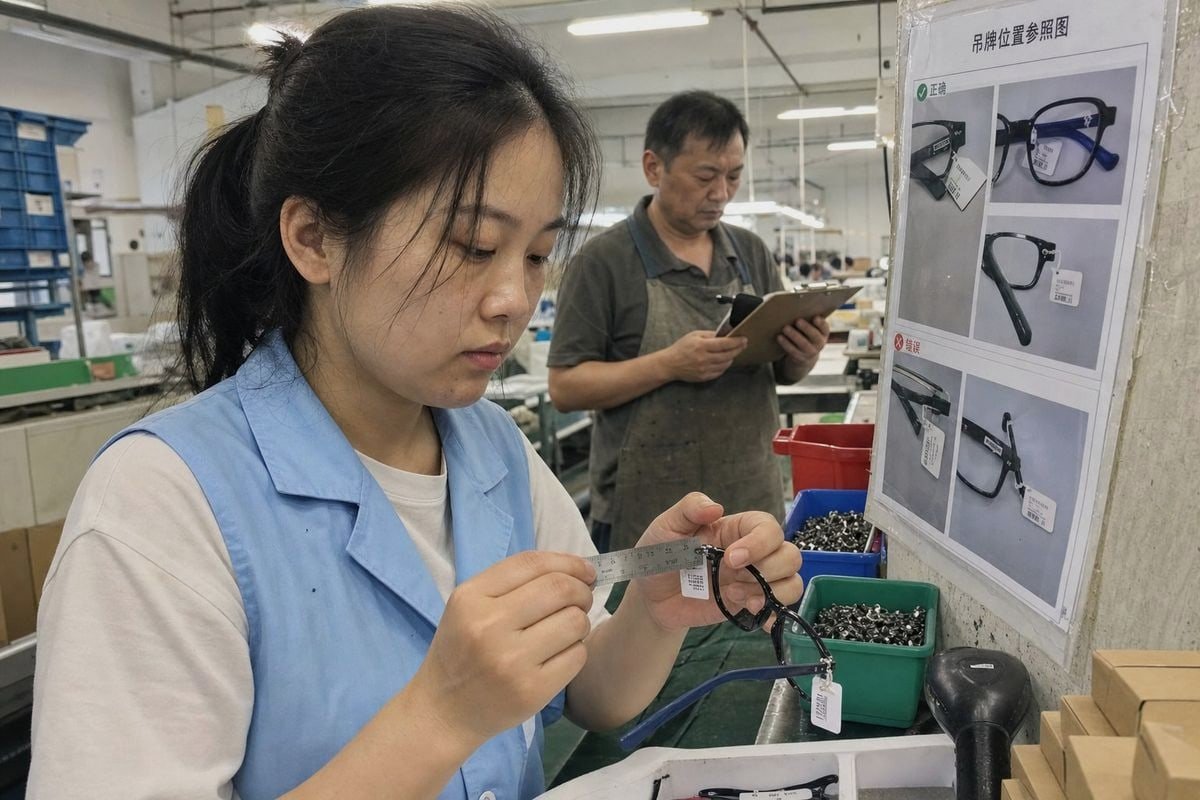
Kids optical frames are harder to label than most consumer goods. Temples are narrow and curved. Lenses cannot be covered. Legally required product markings — model, color code, eye size, temple length 3 — are molded or printed on the inside of the temple, and a careless sticker can hide them. That is why placement instructions matter as much as the artwork itself. On our line, we translate every labeling SOP into Chinese with photos, so the workers applying hang tags see exactly what "1cm from the hinge, tag facing outward" means. Visual SOPs cut manual application errors dramatically.
The Complete Label Pack Checklist
| Item | What to Send | Why It Matters |
|---|---|---|
| UPC-to-SKU table | Spreadsheet: model, color, eye size, UPC | Wrong mapping is the number one cause of retail returns |
| Artwork files | Vector AI or PDF, not screenshots | Low-resolution files blur and fail scan tests |
| Label size & material | Dimensions plus paper, synthetic, or thermal transfer labels | Tear-resistant synthetic paper survives kids' retail handling |
| Placement diagram | Photo or drawing with measurements | Frames offer very little flat surface |
| Compliance text | Made in China, CPSIA tracking info, importer details | Required for legal entry into the US and other markets |
| Price display | Currency, price point, whether price appears on tag | Some buyers prefer priceless tags for flexibility |
Do Not Forget the Quiet Zone
GS1 barcode standards require blank space — the quiet zone — around the code. If your designer crowds the barcode with playful kids' graphics, scanners fail. We always run a scan test on the first printed sheet before applying anything to frames.
Compliance Markings for Children's Products
Because these are children's products, US-bound orders need CPSIA tracking information 4, and frames sold as optical devices touch FDA compliance for frames territory, including drop-ball tested lenses 5. Build these markings into the tag design from day one rather than adding stickers later.
Will Adding Custom Price Tags and UPC Barcodes Increase My Order Cost or Lead Time?
Last year a European optical distributor asked us to quote two versions of the same order — one bare, one fully tagged. The tagged version cost only slightly more per piece. The untagged one cost him far more later, in domestic labeling labor.
Custom price tags and UPC barcodes typically add a small per-piece cost — often a few cents for labels, slightly more for hang tag application — and one to three days of lead time. Costs rise mainly when artwork changes late or labels arrive after production starts.
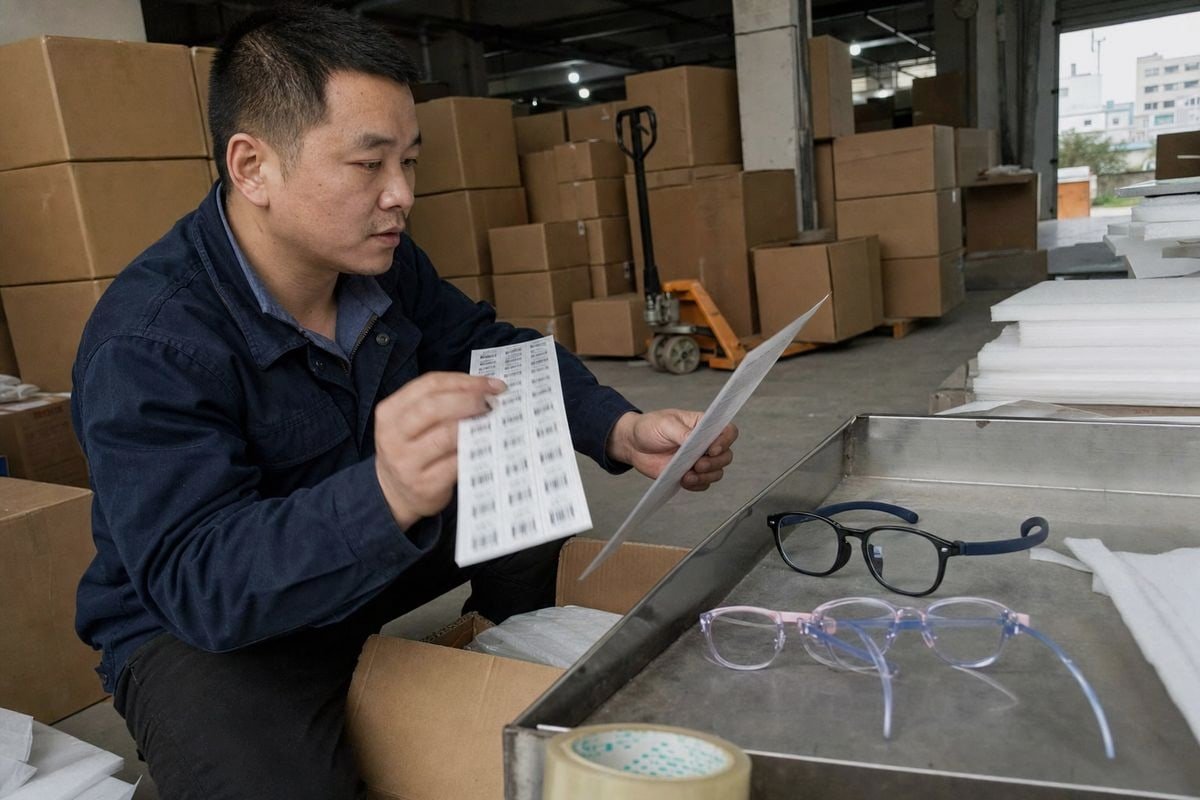
The honest answer is that labeling is cheap when planned and expensive when improvised. In private label eyewear manufacturing, packaging and labels should be part of the original quote, not a post-production afterthought. When a buyer confirms the label pack at the same time as frame colors, our team schedules printing in parallel with molding and assembly. The added lead time is nearly zero. When the label pack arrives after frames are already boxed, workers must unpack, tag, and repack every unit. That is where cost and delay explode.
Typical Cost and Time Impact
| Labeling Scenario | Cost Impact per Frame | Lead Time Impact |
|---|---|---|
| Factory prints adhesive labels, planned at quoting | Very low, often bundled into unit price | 0–1 day |
| Factory prints and ties hang tags | Low, small application labor charge | 1–2 days |
| Buyer ships preprinted labels to China | Application labor only, plus your freight | Depends on label arrival |
| Labels added after packing is complete | Highest — unpack, tag, repack | 3–7 jours |
| RFID-embedded price tags | Higher material cost, better inventory visibility | 2–4 days |
Some buyers now request RFID-embedded tags 6 for high-speed bulk inventory scanning from factory to storefront. The tags cost more, but for larger optical chains the supply chain visibility 7 can justify it. For marketplace sellers, remember that Amazon-style fulfillment requires exterior scannable labels on each unit — some factories, including ours, can handle basic FBA prep services such as FNSKU labeling and polybagging, which is usually cheaper than paying a prep center in your home country.
One negotiation tip: always ask whether label application is included in the unit price, billed per piece, or excluded. Ambiguity here is the most common source of invoice disputes we see.
How Do I Make Sure My Kids Optical Frames Arrive Retail-Ready with Correct Tags and Barcodes Every Time?
Early in our export history, we learned a hard lesson: a mixed-color order where pink frames received blue-frame barcodes. One column shifted in a spreadsheet. Since then, verification — not trust — drives our labeling process.
Require a golden sample with photos before mass production, use scan-to-pack verification matching each frame's SKU to its tag barcode, and add a dedicated labeling section to your pre-shipment inspection checklist verifying the correct barcode sits on the correct frame color and size.

Consistency comes from a repeatable system, not from a careful worker. Retail-ready packaging means every frame leaves China needing zero touches before it hits a shelf: tagged, bagged, cased, and carton-labeled. Here is the workflow we recommend, and the one we run in our own 5S-managed workshop.
The Five-Step Verification Workflow
- Golden sample approval. Before mass assembly, the factory sends high-resolution photos or a physical sample of one fully tagged frame per SKU. You approve tag placement, print quality, and barcode scannability.
- First-article scan test. The first printed label sheet is scanned with a retail-grade scanner. This catches contrast, sizing, and quiet-zone problems before a thousand labels exist.
- Scan-to-pack matching. Workers scan the frame's internal SKU marking and the tag barcode. A mismatch blocks boxing. This single step eliminates the shifted-spreadsheet disaster.
- In-process photo confirmation. Midway through packing, the factory sends photos or video of tagged units from each color batch. Given how similar kids' colorways can be — soft pink versus blush pink — this matters more than buyers expect.
- Pre-shipment inspection. Your PSI checklist gets a dedicated labeling and packaging section: sample frames from random cartons, scan each barcode, verify it matches the frame model, color, and eye size, and check adhesive durability and tag attachment strength.
What Your PSI Labeling Section Should Cover
| Check Point | Pass Criteria |
|---|---|
| Barcode scan | Every sampled code scans and returns the correct SKU |
| Frame match | Tag data matches molded frame markings (model, color, eye size) |
| Placement | Position within agreed tolerance across all sampled units |
| Durability | Tags survive handling; adhesive labels resist peeling and humidity |
| Compliance | Country of origin and CPSIA text present and legible |
| Carton labels | Outer carton barcodes match packing list and inner contents |
Good SKU inventory management on your side closes the loop. Keep one master spreadsheet as the single source of truth for UPC assignments 8, and never let the factory work from an outdated version. A growing trend among our buyers is adding a dynamic QR code on the price tag that links to safety certifications and kid-friendly care instructions — parents scan it in-store, and it doubles as a trust signal.
Conclusion
Mislabeled frames stall launches and burn margin. The fix is simple: GS1-issued UPCs, a complete label pack, golden sample approval, and scan-verified inspection. Brief your factory well, and your kids optical frames arrive truly retail-ready.
Notes de bas de page
<span
Plus d'articles que vous pourriez aimer

août 5, 2026
Bio-Based vs Regular Cellulose Acetate: What's the Difference for Kids' Frames?

août 5, 2026
How Recyclable Are Kids' Optical Frame Materials, and What Eco-Friendly Alternatives Exist?

août 5, 2026
Do Kids Optical Frames Whiten or Age in Storage, and How to Control Warehouse Conditions?
Vous recherchez un partenaire fiable en lunetterie pour enfants ?
Explorez plus de 800 styles prêts et un support OEM/ODM complet adapté à votre marque.
Contactez-nous English
  Español de México
  Deutsch
  Français
  日本語
日本語  العربية
  Português do Brasil