How to Fix TR90 & TPEE Kids Sunglasses That Keep Sliding Down?
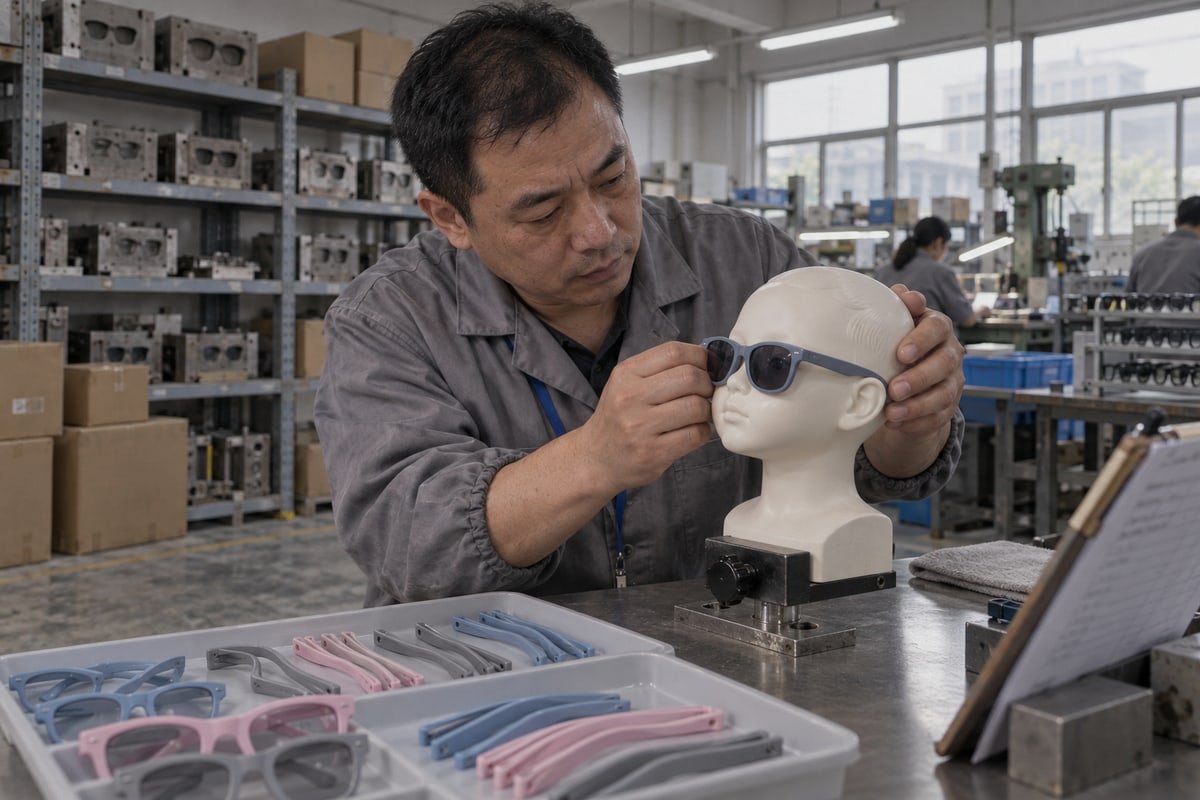
Buyers tell our production line the same story: parents love the TR90 and TPEE kids sunglasses 1, then complain they keep sliding down. Returns follow. The fix is simple.
TR90 and TPEE kids sunglasses that keep sliding down are a fit problem, not a material problem. Diagnose fit first, then grip, then hardware: clean the bridge and temple tips, tighten hinge screws, adjust the temple bend, add silicone nose pads or a strap, and replace oversized frames.
This guide walks through that order. I will show you how to spot a wrong fit, how far temple adjustment can go, what to check on the factory side, and when custom tooling is actually worth it.
How do I know if my TR90 frame is the wrong fit for my child's face shape?
During a fit check on our slate-blue kids wayfarer last spring, one sample passed every flex test and still slid down a five-year-old's nose within seconds.
A TR90 frame is the wrong fit if it slides when the child is dry and still, the eyes sit far inside the lenses, the lenses touch the cheeks, or the frame drops during a head-shake test. These signs point to wrong frame width or bridge width, not grip.

That sample taught me something. Flexibility is a comfort feature. It is not a retention feature. A TR90 front can bend and bounce back all day, and it will still slide if the geometry does not match the face in front of it.
The two-minute shake test
You do not need tools for this. Sit the child in a chair. Make sure the face and the frame are clean and dry. Then run four quick checks.
| What you see | Likely cause | Ce que cela signifie |
|---|---|---|
| Frame slides while the child sits still | Frame width or bridge width too large | Sizing problem, not grip |
| Frame stays put until the child runs or sweats | Low friction at the nose or temples | Grip problem, fixable at home |
| Child shakes head and the frame drops | Temples too straight or too short | Temple arm adjustment needed |
| Lenses touch the cheeks when the child smiles | Frame too deep or too wide | Frame is oversized |
| Eyes sit far inside the lens, near the nose | Frame too wide for pupillary distance | Frame is oversized |
If two or more rows in the "sizing" group match, stop adjusting. No amount of en silicone will make an adult-scale frame behave on a small face.
Why frame bridge width matters more than material
Children's size charts list narrower bridge widths and shorter temple lengths than adult frames. The margins are small. A few millimetres of extra frame bridge width lets the whole front drop until the lens rims catch on the cheeks. Face shape adds another layer. Kids with lower, flatter nasal bridges 2 need a bridge that sits wider and lower, with more contact area. Kids with higher bridges can use a narrower, taller keyhole. In our export work to Japan and parts of Europe, we regularly spec two bridge versions of the same front for exactly this reason.
One more sign is easy to miss. If the child constantly pushes the frame up with one finger, the frame is probably too large. Parents often read this as "the kid is fidgeting." It is usually the frame asking for a smaller size.
Can adjusting the TPEE temple tips really stop sunglasses from sliding down?
We weigh one trade-off constantly: a temple soft enough to feel safe on a toddler's ear versus one firm enough to hold its adjusted curve all summer.
Yes, adjusting TPEE temple tips can stop sunglasses from sliding down when the slip starts behind the ears. Warm the tips in warm water, curve them inward and downward, and make one small change at a time. It will not fix an oversized frame or a poor bridge match.
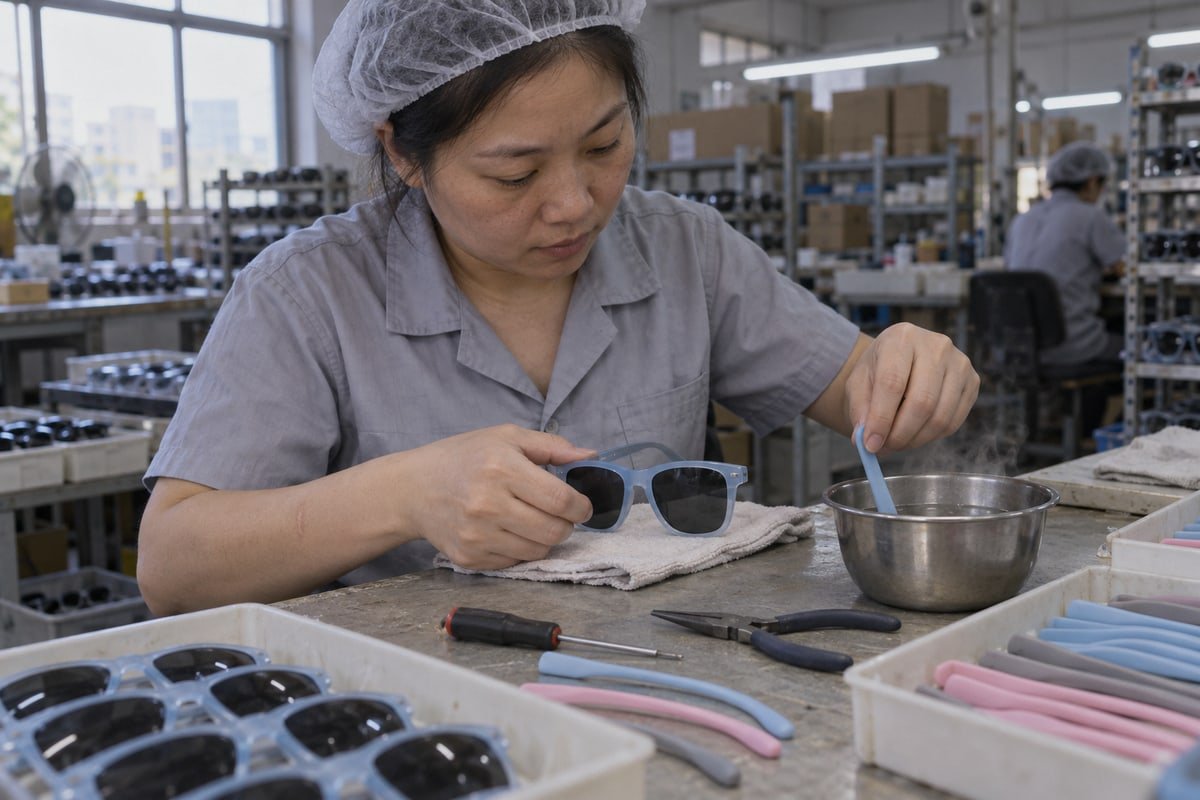
The honest answer is "yes, within limits." Temple adjustment works when the frame width is right but the temples are too straight or too open. It does nothing when the frame is simply too big. So run the shake test from the section above before you touch anything.
Temple arm adjustment, step by step
- Nettoyer d'abord. Wash the bridge, the temple tips, and the child's face with mild dish soap and water. Sunscreen and skin oil cut friction on TPEE and TR90 surfaces. Dry everything fully.
- Tighten the hinges. Use a small eyeglass screwdriver. Eyeglass hinge tightening takes ten seconds and often removes the wobble that lets a frame creep forward.
- Warm the tips. Dip only the last third of each temple in warm tap water for a short moment. Do not boil anything. Do not put a frame in a microwave.
- Curve gently. Bend the tip slightly inward toward the head and slightly downward behind the ear. Move one temple, let it cool, and retest on the child before touching the other side.
- Stop early. Small changes only. Never bend across the front rim or near the lens edge. Forcing a lens groove is how lenses pop out.
The flash-cool trick for TR90
TR90 has strong shape memory. It wants to return to the shape it was molded in. Some technicians use a flash-cool method: warm the temple, hold the new curve, then plunge it straight into ice water. The rapid cool locks the adjustment in place better than air cooling. I treat this as an advanced step. It works on thicker TR90 temples. It is unnecessary on soft TPEE temples 3, which take a curve with far less coaxing. Good thermoplastic frame care afterwards means keeping the frame out of hot cars, where the material can relax back toward its original shape.
When temple tips alone are not enough
| Add-on | Where it helps | Idéal pour |
|---|---|---|
| Anti-slip ear grips or "ear locks" | Behind the ears | Frames that shake loose |
| Adhesive silicone nose pads | On the bridge | Flatter or smaller nasal bridges |
| Spectacle straps for kids | Whole frame | Sports, beach, travel |
| Friction grip wax | On the bridge | Sweat during play |
| Rubber O-rings or temple spacers | At the hinges | Temples that over-extend outward |
| Slight pantoscopic tilt | Lens angle | Lenses that hit the cheeks and pump the frame down |
Eyewear retainers and straps are the most secure option for active days. For daily wear, I usually recommend anti-slip ear grips first because they are cheap, removable, and do not change how the frame looks.
What manufacturing details help prevent slipping issues before I place a bulk order?
A procurement manager from Australia once sent us three competitor samples and asked why hers slid and ours didn't. The answer was in the tooling, not the material.
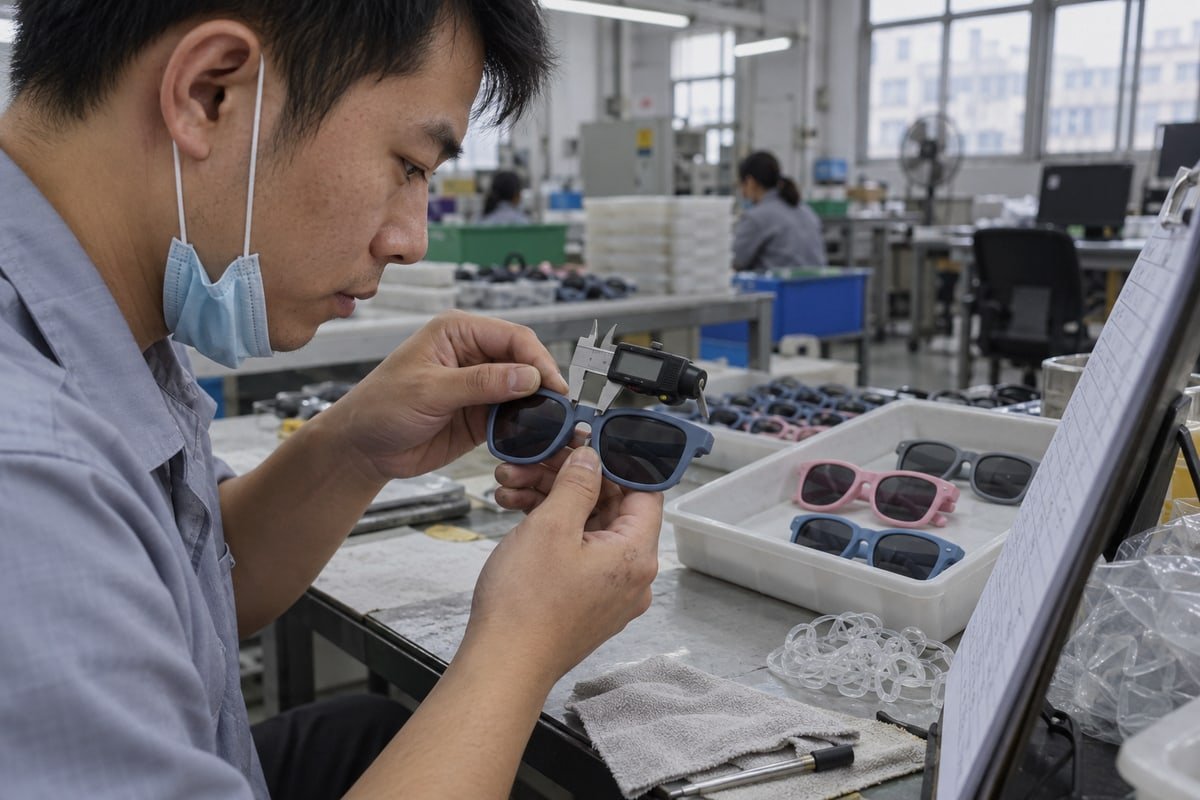
Before a bulk order, check the manufacturing details that control retention: age-graded frame width and bridge width, temple length and inward curve, integrated silicone nose pads or textured bridge, hinge screw torque, optical frame alignment on a jig, and a wear fit test on children's faces.
Her competitor samples looked fine on a white background. All three used TR90 fronts. Two of them had temples molded almost straight, with no inward lean at the tip. One had a bridge cut for an older child on a frame marketed for toddlers. None of this shows in a product photo. It shows the first time a real child wears the frame.
The checklist I send with every sample approval
| Point de contrôle | Why it prevents slipping | Ce qu'il faut demander à votre fournisseur |
|---|---|---|
| Age-graded sizing | Kids' bridges and temples run shorter and narrower than adult specs | Which age band is this mold cut for? |
| Temple inward curve | Creates lateral pressure that holds the frame without pinching | Is the tip curve molded in, or only bent after? |
| Bridge contact area | More contact means more friction on small noses | Is the bridge saddle, keyhole, or padded? |
| Integrated silicone nose pads | Adds grip on flat bridges without adhesive add-ons | Can this front take a soft pad insert? |
| Hinge screw torque | Loose hinges let the frame drift forward | Are screws torque-checked and locked at assembly? |
| Optical frame alignment 4 | A twisted front sits unevenly and slides on one side | Are frames checked on an alignment jig before packing? |
| Thermoplastic frame care insert | Prevents heat deformation after sale | Do you include a care card in the packaging? |
What a real factory can show you
I always encourage buyers to ask for process evidence, not just a spec sheet. At our Taizhou workshop, roughly 120 workers run under 5S management, and every batch passes an alignment check before packing. That check matters more than it sounds. A front that is twisted by even a small amount will ride higher on one ear, and the frame will slowly rotate and slide during the day.
We also do a wear test on the sample stage. A child or a child-scale fit head wears the frame, the head tilts forward, and someone watches whether the frame creeps. It is a simple test. It catches the two problems that photos hide: temples that are too open and bridges that are too tall.
One practical note for new brands. Because we hold around 800 existing styles, many buyers can pick a front whose bridge geometry already suits their age group instead of paying for a mold to fix a slip problem. Testing the market with an existing style is lower risk, and you learn what fit your customers actually need before you invest.
Should I ask my supplier for a custom nose bridge or temple design to fix this problem?
Fifteen years of eyewear taught us one lesson: buyers often request a new mold when a small spec change on an existing style would have solved the slip.
Ask for a custom nose bridge or temple design only after fit diagnosis shows a sizing mismatch your supplier's existing styles cannot cover. Start with accessory-level changes such as silicone nose pads, temple curves, or a strap; move to custom tooling when your target age group needs different bridge geometry.
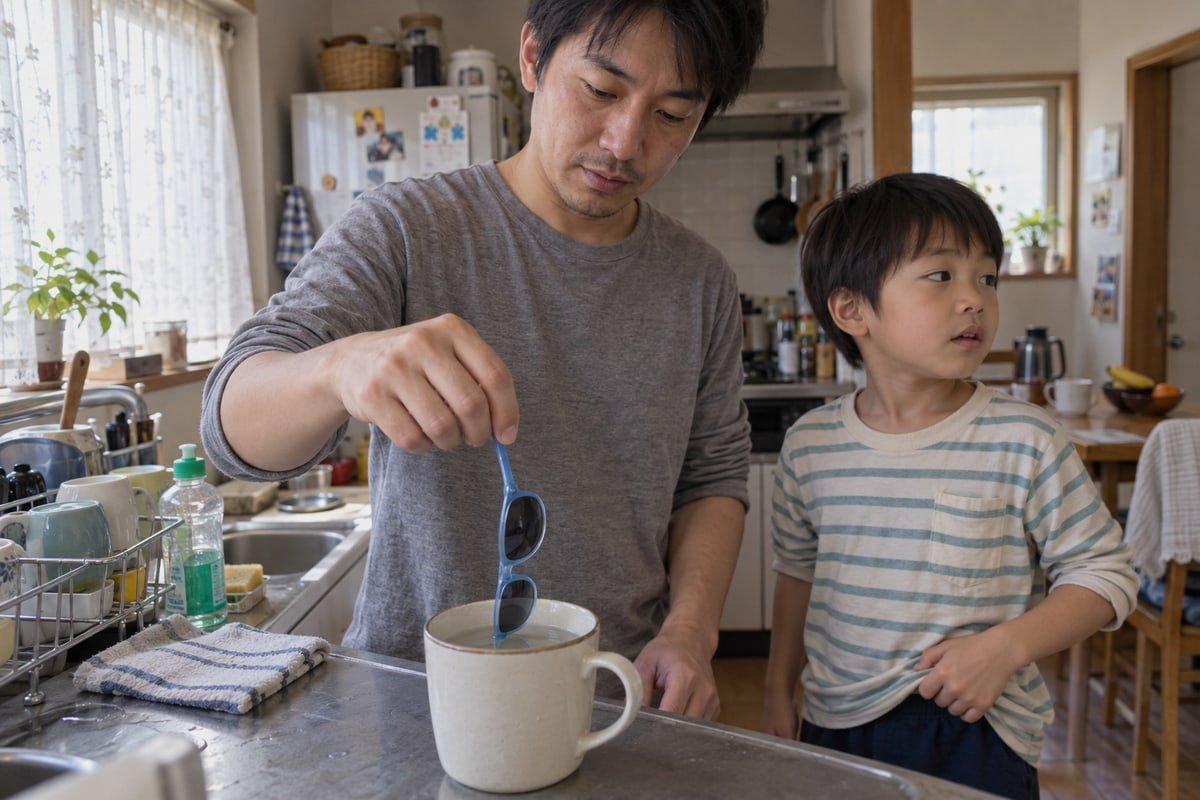
Custom tooling is a real option. We offer it, and it solves problems that nothing else will. But it also adds cost and lead time, and it locks you into one geometry before you have market feedback. So I like to walk buyers through a ladder, from cheapest to most involved.
Four options, from lightest to heaviest
| Option | What changes | When it makes sense |
|---|---|---|
| Accessory fix | Add silicone nose pads, anti-slip ear grips, or eyewear retainers to the current frame | Slip only during activity; frame size is correct |
| Assembly spec change | Tighter hinge torque, more temple inward curve, added care card | Frame is right but shakes loose or drifts |
| Switch existing style | Pick another front from the catalog with a lower or wider bridge | Bridge mismatch for your age group or market |
| Custom mold | New bridge or temple geometry designed for your brand | Existing styles cannot match the face shape of your target group |
Most sliding complaints I see land in the first three rows. A brand selling to toddlers in Japan, for example, often needs a lower, wider bridge than a European brand selling to eight-year-olds. We usually already have a front that fits, sometimes in a translucent gradient or a candy sky-blue that the brand likes anyway. Swapping the style costs far less than cutting steel.
When custom work is the right call
Custom design earns its cost when your product data says the same thing over and over. If your returns show the same slip complaint across several existing styles, the problem is your customer's face shape, not any one frame. That is the moment to talk about a custom nose bridge or a custom temple profile.
In our ODM work, a common route is a TR90 front paired with softer TPEE temples. The front holds its shape and its lens seat. The temples give and hold a curve behind small ears. On top of that, we adjust bridge height, bridge width, and the temple tip curve to the age band you specify. Custom colors, logos, UV400 or La vérification de la conformité doit être effectuée tôt, pas tard. Confirmez les exigences de conformité et de certification CPSIA avant le début de la production. Si des tests en laboratoire sont nécessaires pour votre marché, les échantillons doivent être envoyés au laboratoire des semaines à l'avance. Les audits de contrôle qualité d'usine par des tiers nécessitent également une réservation à l'avance — les agences d'inspection sont également occupées pendant la haute saison. 5, packaging, and add-on accessories like spectacle straps for kids all sit on the same development sheet. The point is to fix the fit at the mold, so the parent never has to reach for friction grip wax.
Ask your supplier one direct question before signing off: "Which face measurements did you design this bridge for?" A reliable partner can answer with specifics. A trading company usually cannot.
Conclusion
Sliding TR90 and TPEE kids sunglasses frustrate parents and cost you reorders. Diagnose fit, adjust grip, fix hardware, then work with a partner whose styles match real children's faces.
Interested in sourcing the products mentioned in this article? See details and request a quote here:
Notes de bas de page
1. International standards for spectacle frames ensure quality and safety in eyewear manufacturing processes. ↩︎
2. Describes the anatomy of the nasal bridge, which is critical for determining proper eyewear fit. ↩︎
3. The FDA regulates eyewear as medical devices to ensure safety and impact resistance for consumers. ↩︎
4. Outlines technical regulations and standards that govern the international trade of manufactured consumer goods. ↩︎
5. Provides essential information on eye safety and protection from environmental hazards like UV radiation. ↩︎
Plus d'articles que vous pourriez aimer



Vous recherchez un partenaire fiable en lunetterie pour enfants ?
Explorez plus de 800 styles prêts et un support OEM/ODM complet adapté à votre marque.
Contactez-nous English
  Español de México
  Deutsch
  Français
  日本語
日本語  العربية
  Português do Brasil