How Can I Ensure Kids’ Optical Frame Packaging Meets Distributor Labeling Rules?
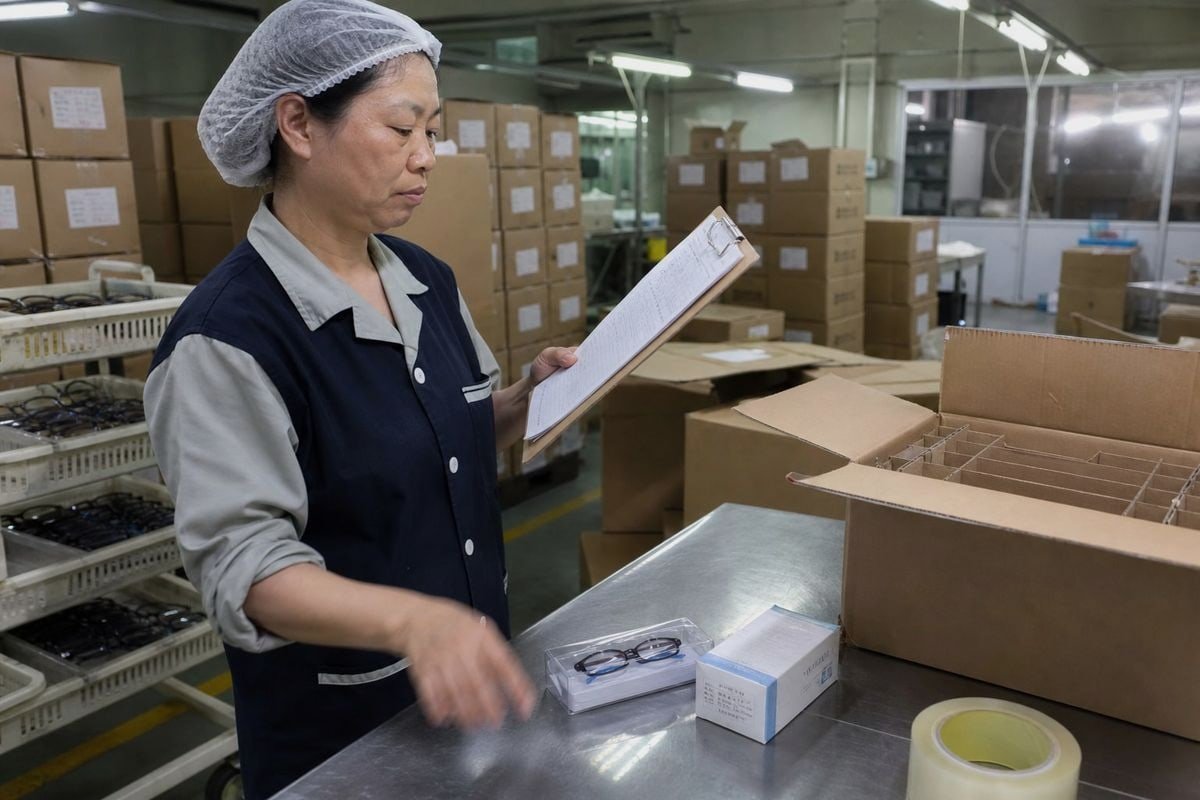
Kids’ optical frame packaging gets rejected at distributor warehouses more often than most brands expect FDA device identity 1. I have watched perfectly good montures TR90 2 sit in receiving bays over one missing label field. One refused shipment can mean chargebacks, relabeling fees, and a lost retail launch window. The fix, as our packaging team in Taizhou has learned over fifteen years, is to treat labeling as a system you design upfront — not a sticker you add at the end.
To ensure kids’ optical frame packaging meets distributor labeling rules, combine legal minimums — FDA device identity, CPSC tracking labels, business name and address, country of origin marking — with each distributor’s carton spec: SKU, model, color, size, quantity, and PO data, all matched consistently across frame, retail box, and master carton.
That answer covers a lot of ground. Let me break it down layer by layer, so you know exactly what your distributors expect and how to deliver it every time.
What Labeling Information Do My Distributors Actually Require on Kids' Optical Frame Packaging?
A buyer from Australia once sent me her distributor's vendor manual before placing her first order. It was twelve pages long — and only two of those pages repeated actual law. The rest was pure warehouse logic.
Distributors typically require kids' optical frame packaging to show SKU, model number, color code, size, quantity per carton, purchase order reference, consignee details, country of origin, business name and address, and batch tracking labels — a stricter operational layer stacked on top of FDA and CPSC legal minimums.

The key insight here is that you are dealing with two different rule sets that overlap but do not match. Understanding the gap between them is what keeps your shipments moving.
Legal Minimums vs. Distributor Requirements
In the U.S., kids' optical frames sit under a medical device classification. The FDA treats spectacle frames as 510(k)-exempt devices 3, but they remain subject to registration, listing, and the labeling requirements in 21 CFR 801 4. That means your packaging must clearly identify the product — using the common name, in English, in bold face — and show the name and full street address of the manufacturer, packer, or distributor. An email address alone does not satisfy this rule. On top of that, CPSC children's-product rules add tracking label obligations, and imported frames need proper country of origin marking. CPSC tracking label obligations 5
Distributors then add their own commercial layer. These fields are not federal law, but skipping them triggers chargebacks and refused deliveries just the same.
| Label Field | Legal Requirement? | Typical Distributor Requirement? |
|---|---|---|
| Product identity (e.g., "spectacle frames") | Yes (FDA) | Yes |
| Business name + street address | Yes (FDA/FPLA) | Yes |
| Batch/lot tracking label | Yes (CPSC) | Yes |
| Country of origin marking | Yes (customs) | Yes |
| SKU / model / color / size codes | No | Yes |
| Quantity per carton | Sometimes (FPLA net contents) | Yes |
| PO number / consignee | No | Yes, very often |
| Scannable barcode (UPC/EAN) | No | Yes, almost always |
Why Compliant Products Still Get Rejected
Here is the frustrating part I explain to new brand clients: your frames can be fully legal and still bounce at intake. Distributors reject packaging for missing business identity, unclear product identity, absent lot or date traceability, or carton labels that do not match the retail box. The product itself was never the problem. The paperwork on the box was. So request the distributor's packaging spec before production starts — we ask every OEM client for it during artwork approval, not after.
How Can I Work With My Manufacturer to Customize Packaging for Different Country Regulations?
When we shipped our first mixed order — half the TR90 kids optical frames going to Germany, half to the U.S. — our client assumed one artwork file would cover both. It could not. The two markets demanded different marks, different warnings, and different language rules.
Work with your manufacturer by building a master label spec sheet per SKU per market, mapping FDA and CPC requirements for the U.S., CE marking for Europe, UKCA marking for Britain, and AS/NZS for Australia, then locking approved artwork through quality control before mass production begins.

A capable OEM/ODM partner should manage this complexity for you, but you still need to drive the process. Here is how we structure it at our factory for clients across twenty-plus countries.
A Five-Step Customization Workflow
- Collect requirements first. Send your factory the destination market, distributor vendor manual, and any private-label details before artwork begins. Changing a printed box after production is expensive; changing a PDF is free.
- Build the master label spec sheet. One document per SKU listing every required field for every market: certifications, warnings, addresses, origin marks, and barcode formats.
- Review market-specific marks. The U.S. needs FDA-compliant device identity plus a Children's Product Certificate backed by third-party testing. Europe needs Marquage CE 6. Post-Brexit Britain needs UKCA marking. Australia and New Zealand follow AS/NZS standards 7 for sunglasses.
- Approve artwork formally. We send digital proofs, then physical pre-production samples. Nothing prints until the client signs off in writing.
- Lock the artwork in QC. Once approved, no one on the line can change a label without triggering a fresh compliance review. Our 5S-managed workshop treats label files as controlled documents.
| Market | Key Mark/Certificate | Common Extra Requirement |
|---|---|---|
| United States | FDA labeling + CPC | CPSC tracking label, English text |
| Union européenne | Marquage CE | EU responsible person address |
| United Kingdom | UKCA marking 8 | UK importer address |
| Australia/NZ | AS/NZS compliance | Lens category labeling |
Watch the Wording on Business Identity
One subtle trap: if your brand name appears on the box but you are not the actual manufacturer, U.S. labeling guidance expects qualifying phrases like "Manufactured for" or "Distributed by" before your name and address. We flag this on every private-label artwork we produce, because distributors check it and so do regulators.
What Safety and Compliance Symbols Should I Include on Children's Eyewear Packaging?
The trade-off we weigh on every retail box is real estate. A kids' frame box is small, parents' attention is short, and yet the list of safety marks keeps growing. Deciding what must go on the box — versus what can live behind a QR code — is a design decision with legal consequences.
Children's eyewear packaging should include the destination market's certification mark (CE, UKCA, or CPC reference), CPSC tracking label data, choking hazard warnings for small parts, age grading, UV400 protection claims for sunglasses, country of origin, impact-resistance statements, and material safety disclosures such as BPA-free.

Let me sort these into groups, because they serve different audiences: regulators, distributors, and parents.
Mandatory Safety and Traceability Marks
The CPSC tracking label is the non-negotiable core for any children's product. It must be visible, legible, and permanently affixed to both the product and its packaging to the extent practicable. It needs to trace the source: manufacturer or importer name, production location and date, and batch or run information. Distributors increasingly test this at intake because it supports recalls and SKU-level verification. On our lines, we laser-mark batch codes on the inner temple of TR90 frames — like the faint engraved text you may notice on our translucent pink acetate-style styles — and print matching batch tracking labels on the retail box and master carton.
Choking hazard warnings apply when packaging or detachable parts pose a risk for children under three. Age grading statements help both compliance and retail placement.
Performance and Material Claims Parents Look For
| Claim Type | Example Wording | Why It Matters |
|---|---|---|
| UV protection | "UV400 / 100% UVA-UVB" | Top parental purchase driver for kids' sunwear |
| Conformité au test de chute de bille de la FDA | "Lenses meet FDA impact resistance requirements — ARE NOT SHATTERPROOF" | Required disclaimer logic for U.S. lenses backed by impact resistance testing |
| Material safety | "BPA-free, phthalate-free" | Addresses chemical exposure concerns and material safety standards |
| Lens category | "Category 3" | Required in AS/NZS markets |
Reducing Clutter with Digital Labels
A QR code linking to a multilingual product passport can carry extended safety data, warranty details, and test reports. We add these for several European clients. But remember: digital labels supplement, never replace, the mandatory printed marks.
How Do I Avoid Delivery Delays Caused by Incorrect or Missing Labeling on My Orders?
The most expensive lesson I learned early in my export career involved a shipment where the master carton said "Model K-2041" and the retail boxes said "K2041-BLK." Same product. The distributor's receiving system saw two different items, and the whole pallet sat in exception handling for eleven days.
Avoid labeling-related delivery delays by obtaining distributor specs before production, keeping SKU and batch codes identical across frame, retail box, and shipping carton, verifying country of origin placement pre-shipment, and adding a dedicated label-check step to pre-shipment quality control inspection.

Delays almost never come from missing labels entirely. They come from small mismatches between layers. So the practical solution is a process, not a poster of rules on the wall.
Align the Three Packaging Layers
Every order has three labeling layers: the product itself (temple marking), the retail package (consumer-facing box or polybag), and the shipping carton (warehouse-facing). FDA and CPSC rules mostly govern the first two. Distributor vendor manuals mostly govern the third. Delays happen when the layers disagree — a model number on the temple that does not match the box, or a carton quantity that does not match the packing list. Our QC team cross-checks all three layers against the master label spec sheet on every OEM order, using the same document the client approved at artwork stage.
A Pre-Shipment Labeling Checklist
- Confirm the distributor's current vendor manual version — specs change without notice.
- Verify product identity and business name with full street address on retail packaging.
- Match SKU, model, color, and size codes across all three layers.
- Check batch codes on frames against tracking labels on boxes and cartons.
- Confirm country of origin marking appears on both product and outer packaging where required — an outer carton mark alone is not always enough.
- Scan every barcode physically; do not trust the artwork file.
- Photograph labeled cartons and send them to the buyer before the container closes.
- File the approved label set so reorders reproduce it exactly.
One more habit worth copying: get your distributor to approve a labeled photo sample in writing before mass production. It takes two days and has saved our clients from more refused shipments than any other single step. When Quality System Regulation thinking is applied to labels — controlled documents, sign-offs, traceable changes — delays stop being a recurring surprise.
Conclusion
Non-compliant kids' optical frame packaging costs you shipments, money, and trust. Design labeling as a synchronized traceability system — legal marks plus distributor specs, locked in QC — and your orders clear intake first time, every time.
Notes de bas de page
1. Provides official FDA general labeling requirements for medical devices, including identity and manufacturer information. ↩︎
2. Explains TR90 material properties, including flexibility, durability, and lightweight nature for eyewear. ↩︎
3. Replaced with the official eCFR regulation for Ophthalmic Devices (21 CFR Part 886), which includes limitations of exemptions from 510(k) requirements, providing an authoritative source. ↩︎
4. Official FDA source outlining general labeling provisions for medical devices under 21 CFR Part 801. ↩︎
5. Official CPSC guidance on tracking label requirements for children’s products, including required information. ↩︎
6. Explains CE marking for medical devices in Europe, including conformity assessment and quality system audits. ↩︎
7. Official Australian government information on AS/NZS 1067.1:2016 for sunglasses, covering UV protection. ↩︎
8. Provides guidance on the UKCA marking, the new product marking for goods placed on the market in Great Britain. ↩︎
Plus d'articles que vous pourriez aimer

août 5, 2026
Bio-Based vs Regular Cellulose Acetate: What's the Difference for Kids' Frames?

août 5, 2026
How Recyclable Are Kids' Optical Frame Materials, and What Eco-Friendly Alternatives Exist?
août 5, 2026
Do Kids Optical Frames Whiten or Age in Storage, and How to Control Warehouse Conditions?
Vous recherchez un partenaire fiable en lunetterie pour enfants ?
Explorez plus de 800 styles prêts et un support OEM/ODM complet adapté à votre marque.
Contactez-nous English
  Español de México
  Deutsch
  Français
  日本語
日本語  العربية
  Português do Brasil