How to Define Acceptable Color Variation for Kids’ Sunglasses with Your Supplier?

Acceptable color variation for kids’ sunglasses is a question I hear constantly on our production line in Taizhou REACH limits 1. One buyer’s “same blue” is another buyer’s rejected shipment — and that gray zone kills relationships fast.
Define acceptable color variation by approving a signed physical master sample, setting a measurable Delta E tolerance (typically ΔE ≤ 2.0), specifying inspection lighting such as D65, and writing pass/fail rules into your purchase order. The goal is predictable, repeatable color — not impossible perfect sameness.
That single sentence saves buyers thousands of dollars in disputes. But the details matter. Let me walk you through how we handle this with brands in over 20 countries.
How much color variation should I expect from batch to batch with TPEE and TR90 frames?
Last year, a European buyer sent me a photo of two periwinkle-blue frames from different reorders, asking why they looked slightly different. Both were within spec — and here is why that happens.
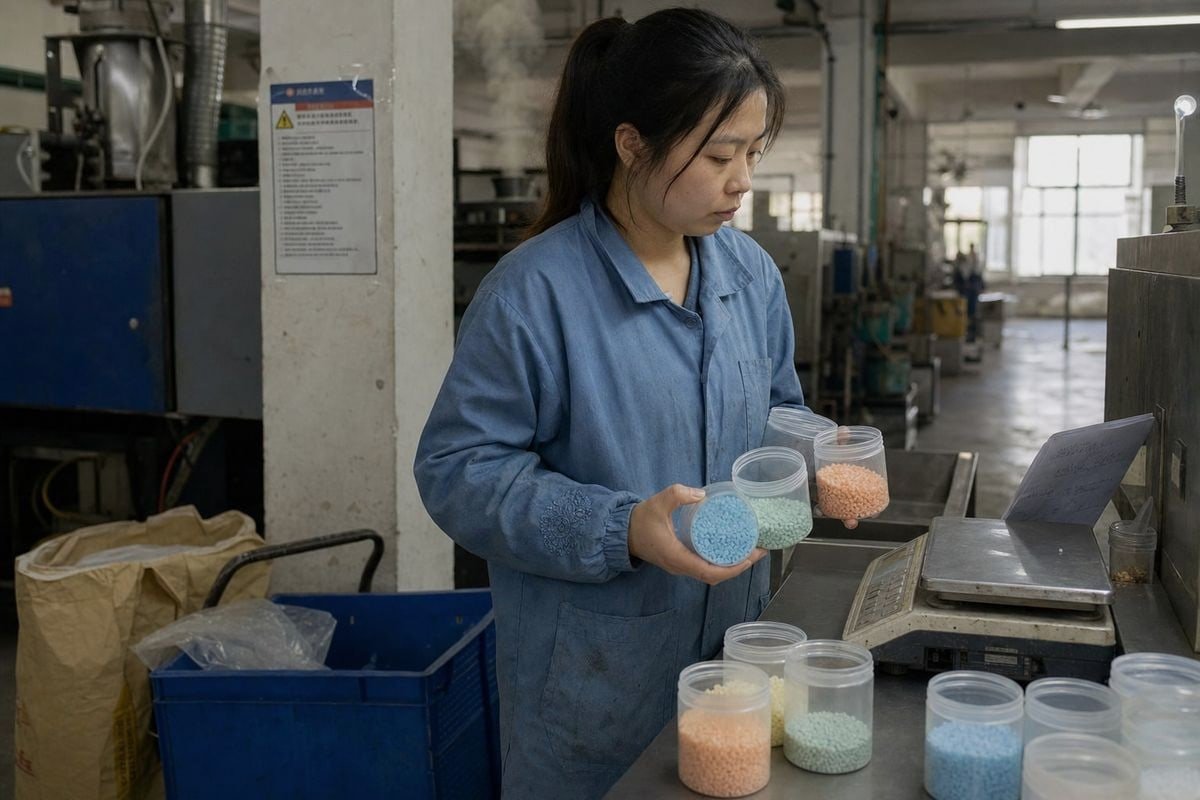
Expect a small, normal shade drift between batches of TPEE and TR90 frames, usually within a Delta E of 1.0–2.0 for solid colors. Pigment lots, regrind ratios, mold cavities, and material absorption all cause minor variation that cannot be fully eliminated, only controlled.
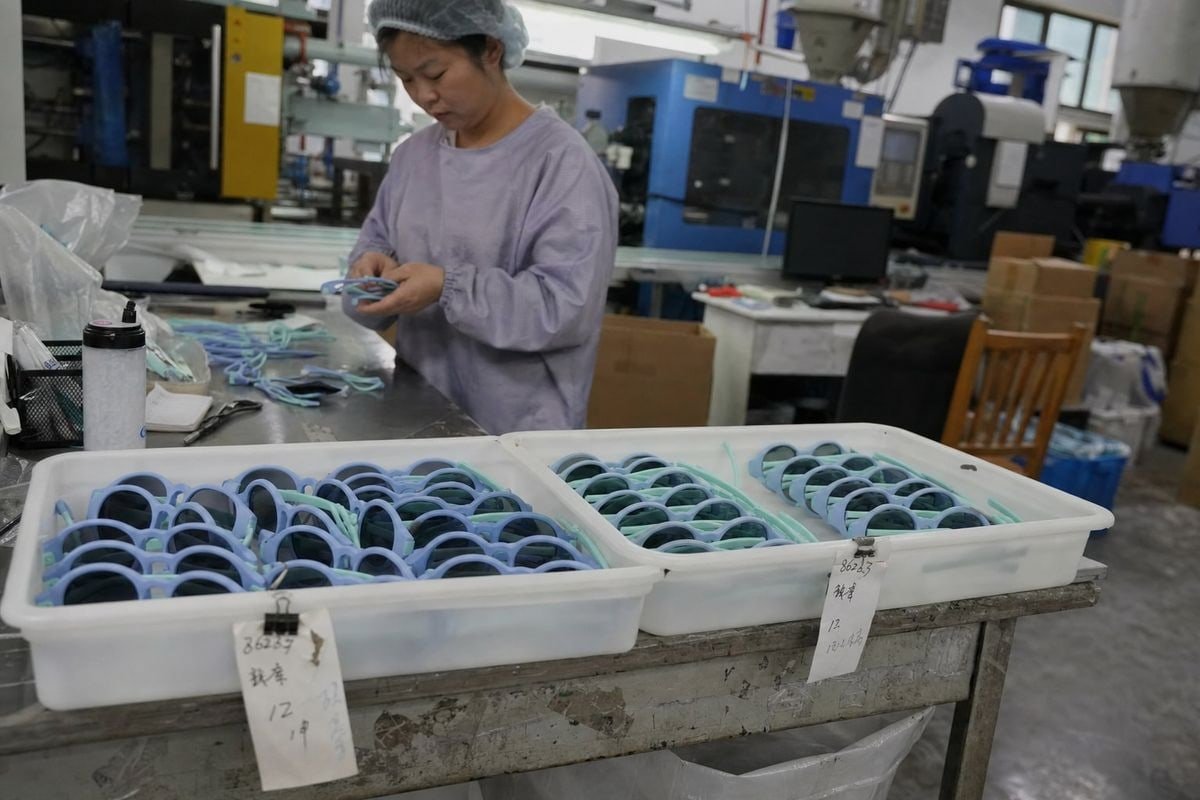
Molded plastic is not printed paper. Every production run of flexible TPEE or TR90 involves raw resin lots, masterbatch pigments, machine temperatures, and cooling cycles. Each variable nudges the final color slightly. In our 15 years making children's eyewear, we have never seen two batches that are pixel-identical under a spectrophotometer measurement 2 — and neither has any honest factory.
Why kids' products vary more than adult eyewear
Here is a constraint many buyers do not know about. Children's sunglasses must meet CPSIA compliance standards 3 and REACH limits, which means we use non-toxic, heavy-metal-free pigments. These safer pigments have a narrower stability window than industrial-grade dyes. So a neon orange for a kids' wraparound style will naturally drift more between lots than the same shade on an adult industrial product. That is a safety trade-off worth accepting.
Typical variation sources and realistic expectations
| Variation source | Typical impact | Controllable? |
|---|---|---|
| New pigment masterbatch lot | Slight hue shift (ΔE 0.5–1.5) | Partially — via lab dip approval |
| Different mold cavities | Minor gloss or tone difference | Yes — cavity balancing |
| Regrind material ratio | Duller or lighter shade | Yes — fix regrind % in contract |
| TPEE vs TR90 absorption | Same pigment reads differently | Yes — separate standards per material |
| Two-tone assembly (frame + temples) | Contrast mismatch | Yes — match parts as a set |
One practical note: TPEE temples paired with TR90 fronts — a combination we build often for flexibility and safety — absorb pigment differently. If your design uses two materials in one colorway, like a periwinkle front with mint-teal temples, define a tolerance for each material separately. A single number for the whole product will cause arguments later.
Which inspection method should I use to check color consistency before shipment?
A buyer from Australia once rejected a shipment based on photos taken under warm office lighting. When we re-checked the same units in our light booth, they matched perfectly. Lighting was the whole problem.
Inspect color under a standardized D65 light source inspection booth, compare units directly against the signed master sample at a fixed distance and angle, and back visual checks with spectrophotometer measurement where possible. Always define lighting, sample size, and viewing conditions before production starts.
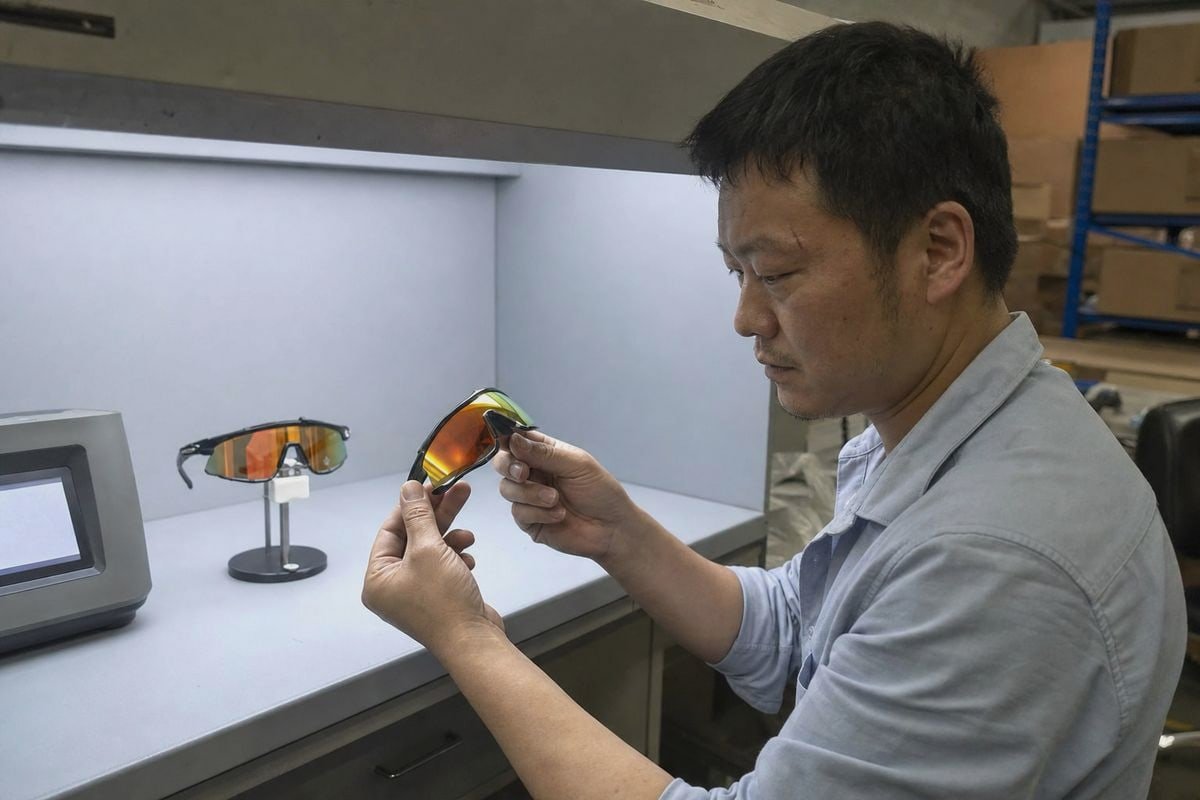
Color is not absolute — it changes with light. This is the metamerism effect 4: two parts can match under daylight and mismatch under store fluorescent light. That is why our quality control checklist specifies the light source for every color judgment ISO 9001 quality standards 5, usually D65 (daylight) as primary and TL84 (store light) as secondary. If you skip this step, you and your supplier are literally not seeing the same product.
A practical pre-shipment inspection sequence
- Pull a statistically fair sample. Use AQL sampling 6 across cartons, not just the top layer.
- Compare against the master sample reference under D65, at roughly 45 degrees and arm's length.
- Check part-to-part uniformity. Left temple vs right temple, frame front vs temples, unit vs unit.
- Check lens tint separately. Gradient lenses should shift smoothly in one direction; SGS guidance notes gradient transmittance difference should stay within 10% and wide-angle scattering within 3% — uneven tint or haze is a functional defect, not a cosmetic one.
- Photograph everything. We send buyers photos under both daylight and controlled booth light before shipment, so approval is documented, not verbal.
Visual vs instrumental checks
| Méthode | Idéal pour | Limitation |
|---|---|---|
| Visual vs master sample | Overall impression, finish, gloss | Subjective; needs controlled light |
| Spectrophotometer + color matching software | Objective ΔE numbers, dispute-proof records | Flat areas only; curved lenses are tricky |
| Limit sample comparison | Fast pass/fail on the line | Requires pre-approved light/dark limits |
For mirrored gradient lenses — like the orange-to-yellow shield lenses on sport wraparound styles — visual inspection matters more, because iridescent coatings shift with angle. For those, we agree on viewing angle in advance and use side-by-side photos of approved vs production units.
Can I set clear color tolerance standards in my supplier contract or quality agreement?
Whenever a new brand asks us to quote a custom colorway from our 800 existing styles, the first document we build together is the color spec — before any mold or pigment order. It prevents almost every downstream dispute.
Yes. Write the Pantone Matching System code, a Delta E tolerance (commonly ΔE ≤ 2.0 for kids' eyewear), the approved master sample number, inspection lighting conditions, and pass/fail consequences directly into your purchase order or quality agreement. Both parties sign the physical golden sample.
Vague language is the enemy. "Nice pink" or "similar blue" means nothing in a dispute. A proper spec replaces adjectives with references and numbers. Here is what we recommend putting in writing, based on what has actually protected our long-term buyers.
The five elements of a written color standard
| Element | What to specify | Example wording |
|---|---|---|
| Reference color | Pantone Matching System code per part | "Frame front: PMS 2717 C; temples: PMS 3242 C" |
| Master sample | Signed golden sample, stored light-protected at both sides | "Production must match Golden Sample #KS-042, signed 2024-03" |
| Tolerance | Delta E tolerance per material and part | "Solid frame colors: ΔE ≤ 2.0 vs master under D65" |
| Limit samples | Lightest and darkest acceptable pieces | "Three-piece limit set: target, light limit, dark limit" |
| Inspection terms | Light source, distance, AQL, evidence | "D65 booth, 50 cm, AQL 2.5, photo report pre-shipment" |
Separate standards for frame, lens, and printing
One line item is not enough. Frame plastic, lens tint, and logo printing behave differently, so your agreement should keep separate standards for each. Also require a lab dip approval — a small material swatch molded from each new raw plastic lot — before mass production begins. We do this routinely for TPEE and TR90 because the same masterbatch reads differently in each resin. Finally, add a pre-production sample stage: ask for 2–3 samples from different trial batches, so you can compare color, finish, and logo position before committing the full order. A supplier who resists these steps is telling you something about how disputes will go later.
What should I do if a finished batch doesn't match my approved color sample?
A few years ago, a Japanese buyer flagged a mint-teal temple batch that leaned slightly greener than the master. Because we had a signed golden sample and a written ΔE limit, the conversation took one email, not one month.
First, verify the mismatch objectively: compare units against the signed master sample under the agreed D65 conditions and measure the Delta E. If it exceeds the written tolerance, invoke your contract remedy — rework, sorting, discount, or replacement — using photo evidence and instrument data as proof.

Do not start with accusations. Start with verification, because roughly half of reported "mismatches" turn out to be lighting or camera issues, not production faults. Here is the sequence I recommend to every buyer we work with.
Step-by-step dispute resolution
- Freeze the shipment. Ask the factory to hold goods before they leave.
- Re-inspect under agreed conditions. Same booth, same distance, same master sample reference. Request video of the comparison.
- Get numbers, not opinions. A spectrophotometer measurement turns "it looks off" into "ΔE is 3.4 against a 2.0 limit."
- Classify the problem. Is it uniform drift across the whole batch, or unit-to-unit inconsistency? Uniform drift slightly beyond tolerance may still be sellable; mismatched left/right temples or blotchy tint are true defects.
- Choose a proportionate remedy. Sorting out bad units, partial discount, rework, or remake — matched to how far outside tolerance the batch sits and how visible it is at retail.
- Fix the root cause. Require a corrective action note: new lab dip approval on the next pigment lot, tighter regrind control, or an updated limit sample set.
Know the difference between drift and defect
Acceptable variation means slightly lighter or darker but still recognizably the approved color, with even distribution. Rejectable defects include mismatched pairs, streaks, chalky pigment bloom on flexible TPEE surfaces, haze in lenses, or uneven gradients. For kids' sunglasses, also re-check the functional side: lens color says nothing about UV protection. A batch could match color perfectly and still fail on UV400 performance 7, so keep optical testing separate from cosmetic checks. Batch-to-batch consistency protects your brand; lens performance protects the child. Never trade one for the other.
Conclusion
Vague color talk creates disputes; disputes destroy reorders. The fix is simple and written: approve a signed master sample, set a Delta E tolerance, and inspect under the same D65 conditions every time. At our Taizhou factory, this discipline is how we keep kids' sunglasses colors predictable across 800 styles and every reorder — and it is a standard any serious buyer should demand.
Notes de bas de page
1. Official EU chemical regulation defining heavy-metal and pigment safety limits mentioned. ↩︎
2. Background on the instrument used for objective color measurement in disputes. ↩︎
3. Official US safety law reference for children’s product pigment and material requirements. ↩︎
4. Background concept explaining why colors shift under different light sources. ↩︎
5. Authoritative overview of ISO 9001 quality management systems and requirements. ↩︎
6. Explains the statistical sampling standard referenced for pre-shipment inspection. ↩︎
7. FDA guidance on UV protection standards relevant to children’s sunglasses safety. ↩︎
Plus d'articles que vous pourriez aimer

1 août 2026
L'usine doit-elle gérer l'emballage et l'étiquetage des lunettes pour enfants, ou utiliser un fournisseur désigné ?

1 août 2026
Entrepôt propre vs. exécution directe par le fournisseur : lequel réduit les coûts de retour pour les marques de lunettes pour enfants ?

1 août 2026
Entrepôt direct au port ou staging outre-mer : lequel permet d'économiser le plus sur l'expédition des lunettes pour enfants ?
Vous recherchez un partenaire fiable en lunetterie pour enfants ?
Explorez plus de 800 styles prêts et un support OEM/ODM complet adapté à votre marque.
Contactez-nous English
  Español de México
  Deutsch
  Français
  日本語
日本語  العربية
  Português do Brasil