How to Clean Sunscreen and Sweat Off TR90 & TPEE Kids Sunglasses?
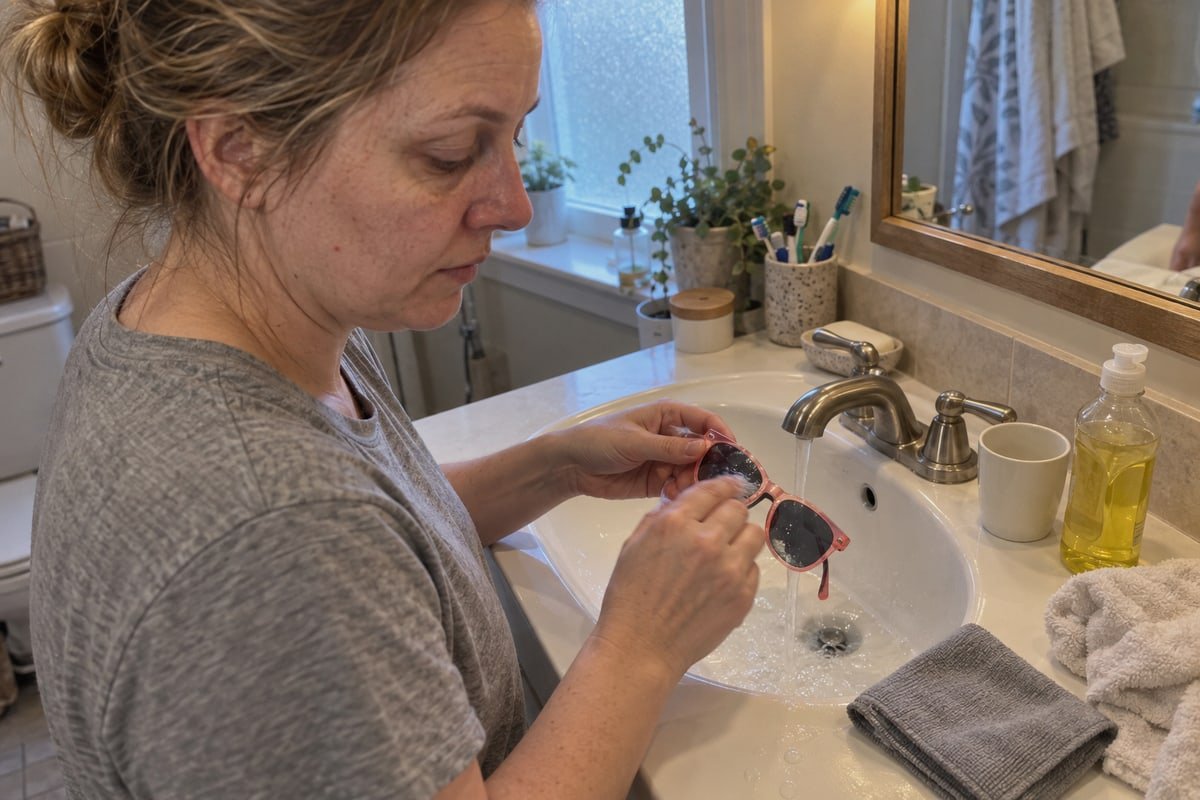
Every July, our factory inbox fills with photos of sticky, cloudy kids’ sunglasses TR90 polyamide 1. Cleaning sunscreen and sweat off TR90 & TPEE kids sunglasses the wrong way ruins them.
To clean sunscreen and sweat off TR90 & TPEE kids sunglasses, rinse them under lukewarm water first, rub on one drop of lotion-free mild dish soap with clean fingers, rinse again, and dry with a microfiber cleaning cloth. Never use alcohol wipes, hot water, or paper towels.
That short routine is the whole secret. But the details matter, especially with flexible frames and polarized lenses. Below, I walk through the safest method, why Branches en TPEE 2 get grimy so fast, which household products are dangerous, and how often a summer cleaning schedule should run.
What's the safest way to clean sunscreen residue off my kids' TR90 sunglasses without damaging the lenses?
Last spring our QC team ran a simple test: we smeared sunscreen on TR90 sample frames and cleaned them several ways. Only the water-first method left the lenses unmarked.
The safest way is a water-first routine: rinse under lukewarm water to float away grit, apply one drop of lotion-free dish soap, rub gently with fingertips, rinse thoroughly, and pat dry with a clean microfiber cloth. Never wipe dry lenses or use alcohol, solvents, or hot water.
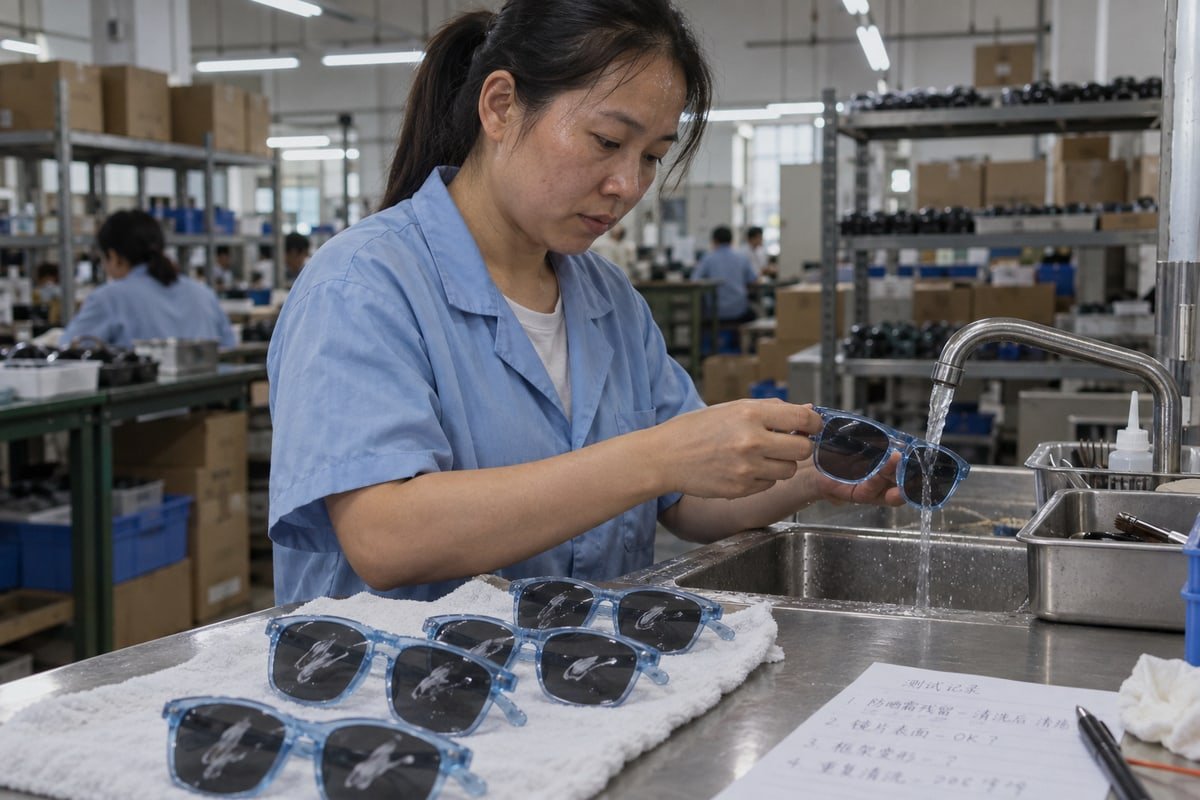
The reason this method works is simple. Sunscreen is an oily stain. Water alone slides off oil. Soap breaks the oil down so water can carry it away. The reason the order matters is grit. Sand, salt crystals, and dust sit on the lens after a beach day. If you wipe first, you drag those particles across the surface. That is how most "mystery scratches" appear. Lens scratch prevention starts before you ever touch the lens.
The seven-step routine we print on our care cards
- Wash your own hands first. Fresh hand oil just moves the problem around.
- Hold the frame under a lukewarm water rinse for ten to fifteen seconds. Let the water do the lifting.
- Put one small drop of mild dish soap on your fingertip. It must be lotion-free. Moisturizing soaps leave a cloudy film.
- Rub both sides of each lens and the whole frame with light fingertip pressure.
- Rinse again until the frame feels squeaky, not slippery.
- Shake off the water and pat dry with a clean microfiber cleaning cloth. Do not scrub.
- If hinges or nose pads still feel tacky, use a cotton swab or soft toothbrush on those spots only.
Polarized lens care on kids' frames
Most of our polarized lens options carry a thin film and a surface coating. Those layers are the fragile part, not the TR90 frame. Hot water can lift coatings at the edge. Alcohol can haze them. Fingernails can chip them. So the rule I give buyers is short: treat the lens as the weakest link and clean around its needs.
| Étape | What to use | What to avoid |
|---|---|---|
| Pre-rinse | Lukewarm running tap water | Hot water, standing dirty water |
| Wash | One drop of lotion-free dish soap | Hand soap with moisturizer, glass spray |
| Rub | Clean fingertips | Fingernails, sponges, brushes on lenses |
| Dry | Chiffon microfibre propre | Paper towels, tissues, T-shirts |
| Détail | Cotton swab, soft toothbrush on frame only | Toothpicks, metal tools |
One more detail for matte-finish TR90. Mineral sunscreens leave zinc oxide particles trapped in the tiny texture of a matte surface. A damp microfiber cloth moved in small circles lifts them out. A straight wipe just smears them.
Why do sweat and sunscreen build-up so quickly on TPEE temples, and how can I prevent it?
Soft TPEE temples are a trade-off we weigh on every project. Softer grip means more comfort behind a child's ear, but also more surface for oils to cling to.
Sweat and sunscreen build up fast on TPEE temples because the soft, slightly grippy surface sits against skin all day and holds oils, salt, and dust. Prevent it by applying sunscreen before putting glasses on, rinsing after each outing, and drying temples fully before storage.

Here is what is actually happening on the temple. A child's skin behind the ear and along the side of the head is warm and sweaty. Sunscreen gets applied by hand, often after the glasses are already on. The soft temple tip presses against that skin for hours. Sweat evaporates and leaves salt and body oil behind. Sunscreen adds an oily layer on top. Then playground dust and beach sand stick to the oil. By evening the temple feels gritty and tacky. This is the same on all thermoplastic frames, but TPEE shows it first because its surface is softer and slightly matte.
The chemical problem most parents never hear about
Certains chemical sunscreen filters 3, avobenzone in particular, can act as a mild solvent on soft polymers. If that residue is left on TPEE for days, it can pull plasticizer toward the surface. The result is a permanently sticky feel that no amount of washing removes. Chemical filters left to bake in the sun can also bond with the frame material and cause yellowing. That is why our production team pushes back hard when a buyer asks whether kids can "just rinse them at the end of the week." The answer is no. Oily residue removal has to happen the same day.
| Dérive des spécifications | What you see on TPEE temples | How to prevent it |
|---|---|---|
| Sweat salt | Gritty, white film in the temple bend | Lukewarm rinse after every outing |
| Body oil | Dull, greasy sheen | Wash with a drop of mild dish soap |
| Chemical sunscreen | Tacky surface, possible yellowing | Apply sunscreen first, then put glasses on |
| Mineral sunscreen | White zinc oxide streaks in texture | Damp microfiber in small circles |
| Heat plus sweat | Temple feels too soft or slightly warped | Dry in shade, store in a hard case |
Prevention habits that work in real families
I tell brand partners to print three habits on their packaging insert. First, sunscreen goes on and dries before the sunglasses go on. Second, the glasses get a rinse the moment the child comes indoors. Third, they get stored dry, not tossed wet into a beach bag. Our TPEE and TR90 grades are chosen as BPA-free materials with good chemical resistance, but no polymer beats a week of avobenzone and sweat cooking in a hot car. If a temple has gone soft from heat, some care guides suggest a short dip in cold water after cleaning to help it firm back up. I treat that as a helpful extra, not a fix for neglect.
Can I use household cleaning products on TR90 and TPEE kids' sunglasses, or will they cause damage?
A distributor in Australia once asked me whether her retail staff could wipe demo frames with alcohol wipes between customers. My answer was a firm no, and here is why.
Most household cleaners will damage TR90 and TPEE kids' sunglasses. Alcohol wipes, glass sprays, acetone, and bleach can make TR90 polyamide brittle, soften TPEE, and strip polarized lens coatings. The only safe household product is a drop of lotion-free mild dish soap in lukewarm water.
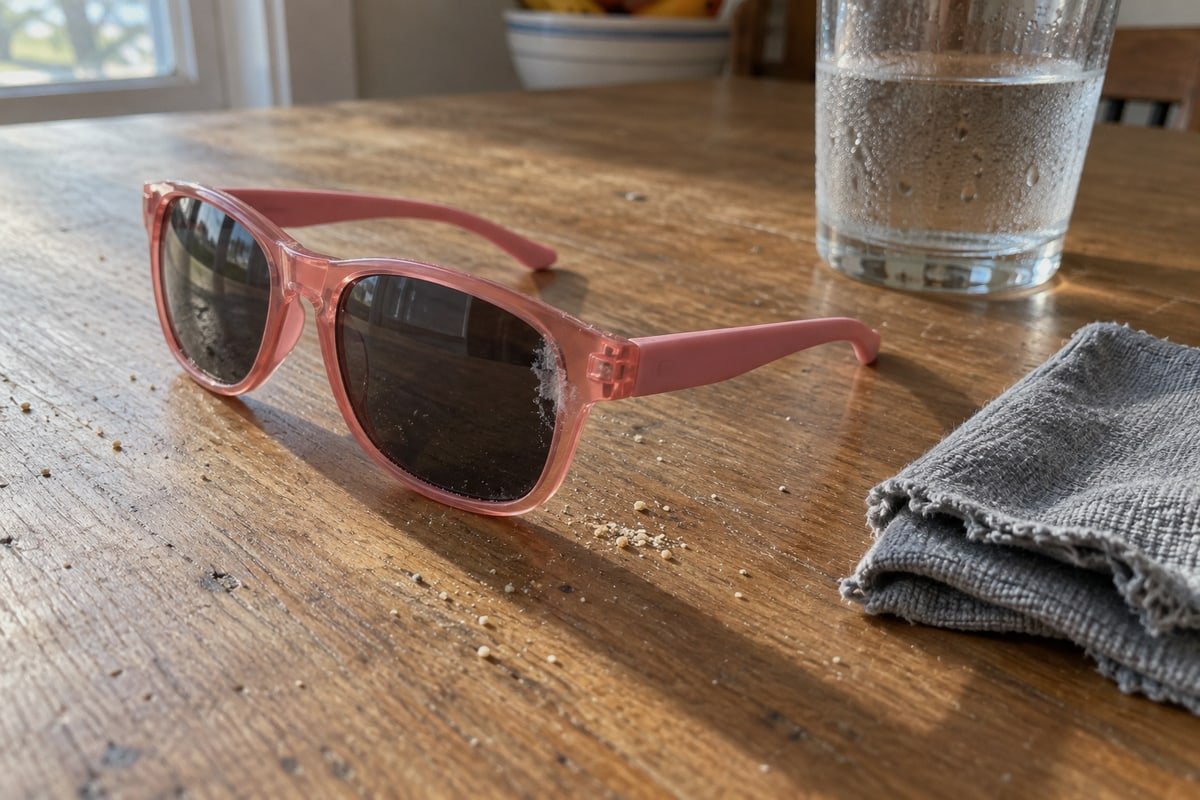
TR90 is a polyamide. It is flexible, light, and hard to snap, which is exactly why we use it for kids. But polyamides do not like solvents. Alcohol pulls moisture and plasticizer out of the surface. The frame looks fine at first. Then, weeks later, a stress point near the hinge turns brittle and cracks under normal bending. TPEE has the opposite problem. Solvents soften it and leave it tacky. Both failures get blamed on "cheap frames" when the real cause was a disinfecting wipe.
A quick safe-or-not list for the bathroom cabinet
| Produit | Safe on TR90 / TPEE frames? | Safe on polarized lenses? | Remarques |
|---|---|---|---|
| Lotion-free dish soap | Oui | Oui | One drop is enough |
| Plain lukewarm water | Oui | Oui | Best for light dust |
| Baby wipes | Non | Non | Contain lotions and often alcohol |
| Alcohol or disinfectant wipes | Non | Non | Embrittles TR90, hazes coatings |
| Glass cleaner with ammonia | Non | Non | Attacks lens coatings |
| Acetone or nail polish remover | Non | Non | Dissolves both polymers |
| Vinaigre | Not recommended | Non | Acidic, can dull coatings over time |
| Hand sanitizer | Non | Non | High alcohol content |
What about an ultrasonic cleaner?
Buyers in the optical trade ask this a lot. An ultrasonic cleaner is common for metal adult frames. For kids' thermoplastic frames with soft nose pads, I am cautious. The tank must hold only water and a trace of mild soap, cycles must stay short, and the water must stay lukewarm. Even then, I would not put screwless snap-fit kids' frames in for long. Soap and vibration can loosen the friction fit that keeps the temples attached. And the paper "POLARIZED" and CE stickers on new demo pairs will peel off. For a home routine, fingertips and a microfiber cloth do the same job with less risk.
Is plain water ever enough?
Yes, and this is a fair objection. If the problem is only dust from a car ride, water and a microfiber cloth are enough. Soap is for oil. So the rule is water-only for light dust, soap-and-water for sunscreen, sweat, and greasy fingerprints. Using soap every time does no harm. Skipping it on an oily frame just spreads the film.
How often should I clean my children's sunglasses to keep them hygienic and long-lasting during summer activities?
One lesson from fifteen years of making kids' eyewear: frames rarely fail from a single beach day. They fail from a whole summer of residue nobody rinsed off.
Rinse children's sunglasses with lukewarm water after every outdoor session, especially after sunscreen, sweat, sand, or pool water. Do a full soap-and-microfiber wash at least once a week in summer, and clean hinges and nose pads with a soft toothbrush whenever they feel tacky.
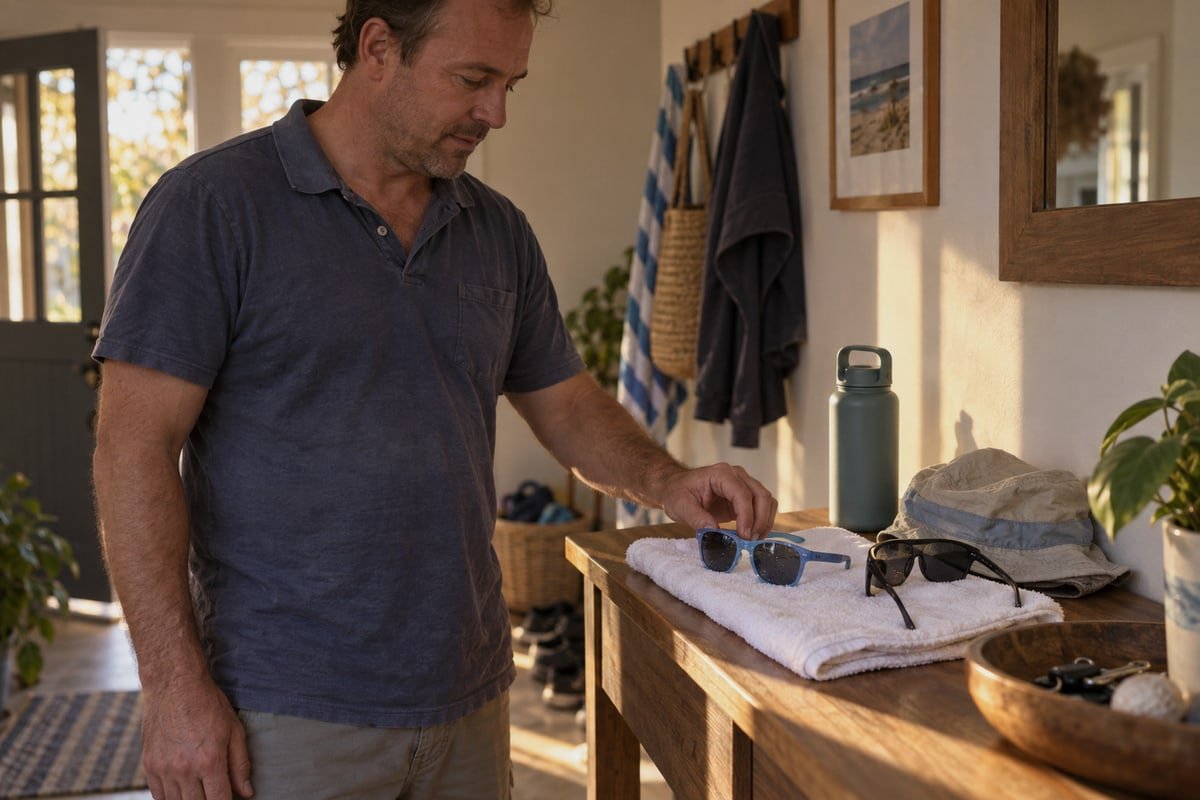
Frequency is where most families slip. The lenses still look dark, so the glasses "seem fine." But protection UV400 4 is built into the lens, and it does not fade from dirt. What fades is comfort and clarity. A smeared polarized lens makes a child squint. A tacky nose pad makes them pull the glasses off. That is when frames get sat on, dropped, and lost. So the goal of frequent cleaning is not just hygiene. It keeps the child actually wearing the eyewear.
A summer schedule that fits real life
| Activity | Clean how often | Méthode |
|---|---|---|
| Daily wear, no sunscreen | Every two to three days | Water rinse plus microfiber |
| Sunscreen applied | Same day, every time | Soap, rinse, microfiber |
| Beach or sandbox | Immediately after, before any wiping | Long rinse, soap, microfiber |
| Pool or seawater | Immediately after | Fresh water rinse, then soap |
| Sports practice, heavy sweat | Same day | Soap, toothbrush on hinges |
| Weekly deep clean | Once a week all summer | Full routine plus cotton swab detailing |
Salt from seawater and pool chemicals deserve their own line. Both dry into crystals. Both scratch on the first wipe. A fresh water rinse before anything else is the one non-negotiable step. I would rather a child rinse and air-dry than skip the rinse and wipe.
Storage habits that cut cleaning in half
Clean frames get dirty faster when stored badly. A hard-shell case keeps sand and bag grit off the lenses. It also keeps a frame from being crushed. We include cases or pouches in most retail-ready packaging for exactly this reason. Wet frames should air-dry in shade before going into a case. Damp TPEE temples closed in a hot case can pick up odor and a soft feel. When we help a brand develop packaging, I always suggest a small printed care card. Parents follow simple instructions when they are sitting in the box.
When cleaning is no longer enough
If a temple stays sticky after a proper soap wash, plasticizer migration has probably already happened. If a lens shows a web of fine scratches, the coating is gone. Neither is a cleaning problem anymore. That is the moment for a brand to offer a replacement, and the moment for parents to start the rinse-first habit with the new pair.
Conclusion
Sunscreen and sweat will keep attacking kids' sunglasses every summer. Rinse first, soap second, microfiber last, and those flexible TR90 and TPEE frames will outlast the season.
Interested in sourcing the products mentioned in this article? See details and request a quote here:
Notes de bas de page
1. Authoritative scientific database explaining the chemical properties and solvent sensitivity of polyamide materials like TR90. ↩︎
2. Technical overview of thermoplastic elastomers, the flexible material used for comfortable, durable eyewear components. ↩︎
3. Federal resource explaining sunscreen ingredients and their chemical interactions with various surfaces and skin. ↩︎
4. Official FDA guidance on ultraviolet radiation and the importance of eye protection standards. ↩︎
Plus d'articles que vous pourriez aimer
Vous recherchez un partenaire fiable en lunetterie pour enfants ?
Explorez plus de 800 styles prêts et un support OEM/ODM complet adapté à votre marque.
Contactez-nous English
  Español de México
  Deutsch
  Français
  日本語
日本語  العربية
  Português do Brasil