Do Children’s Sunglasses Lenses Age or Fade Over Time?
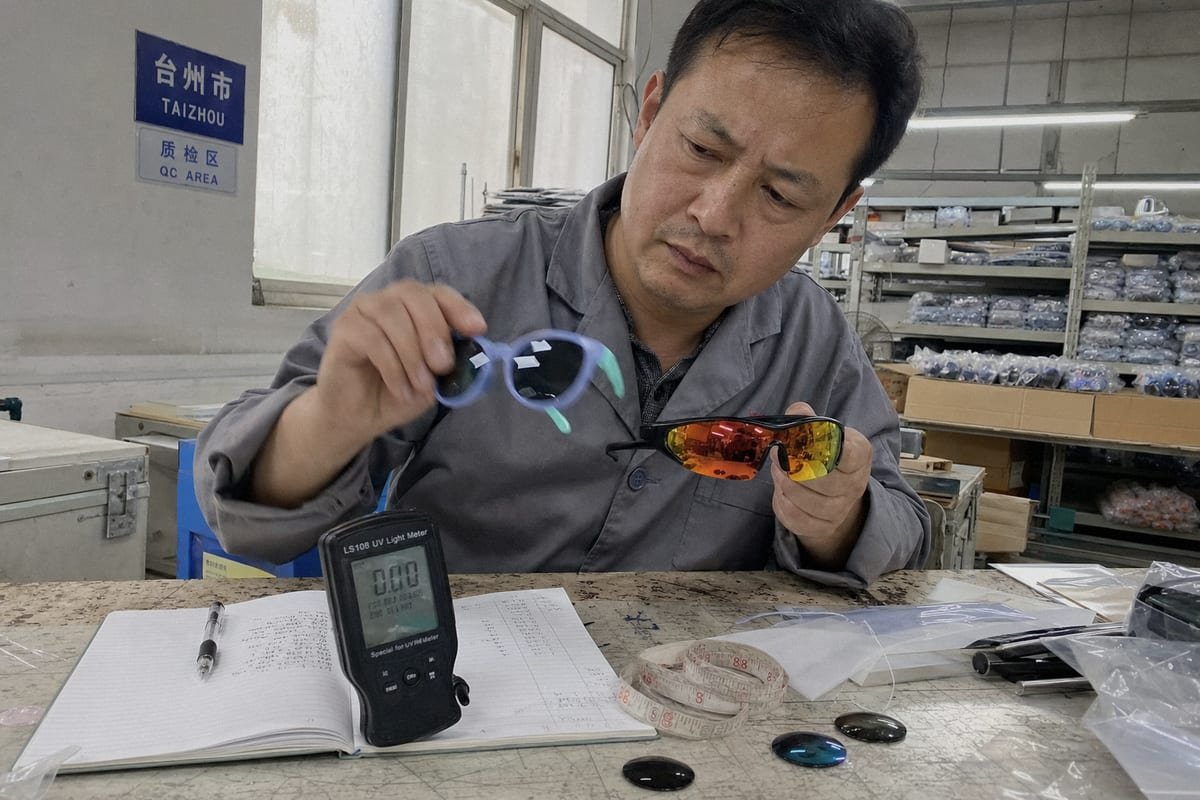
Buyers ask me about children’s sunglasses lenses aging almost every week norme ISO 12312-1 1. A pair can look perfect on the shelf, yet quietly lose protection. On our production line, we take that risk seriously.
Yes, children’s sunglasses lenses can age over time. UV-blocking compounds and coatings degrade gradually through heat, sunlight, scratches, and wear, so UV protection may weaken even while lenses still look clear. Quality lenses typically hold full protection for two to three years of regular use.
This matters for anyone selling kids’ eyewear. Below, I will walk through [how long protection lasts](https://okayeyewear.com/how-long-kids-sunglasses-typically-last-do/), what causes fading, how to test lens quality, and whether a warranty makes sense.
How long can I expect my children's sunglasses lenses to maintain full UV400 protection?
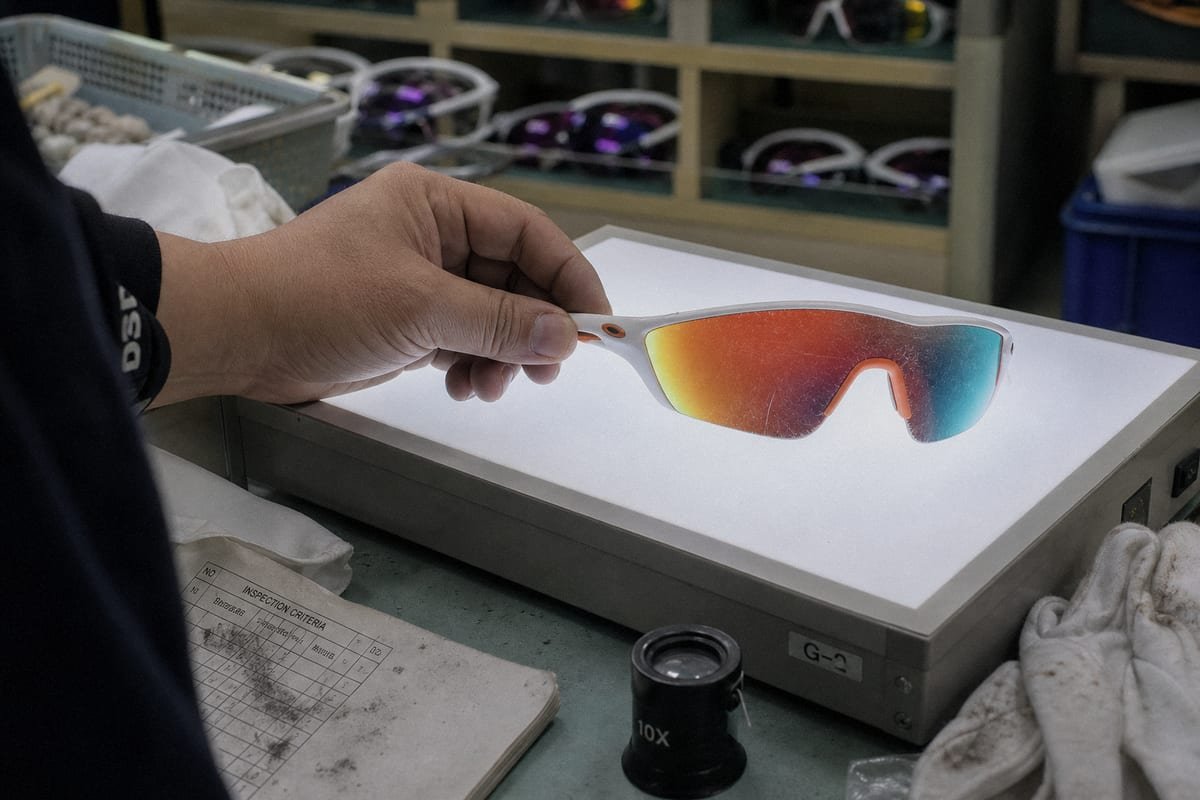
During a lens audit at our Taizhou factory last spring, we compared new UV400 lenses against samples that had been through accelerated aging. The difference in UV absorption levels surprised even our QC team.
Quality UV400 lenses generally maintain full protection for two to three years of regular use. Lenses with UV blockers molded into the material, such as polycarbonate or TAC, hold protection longer than coated lenses, which can degrade faster under heat, scratching, and daily wear.
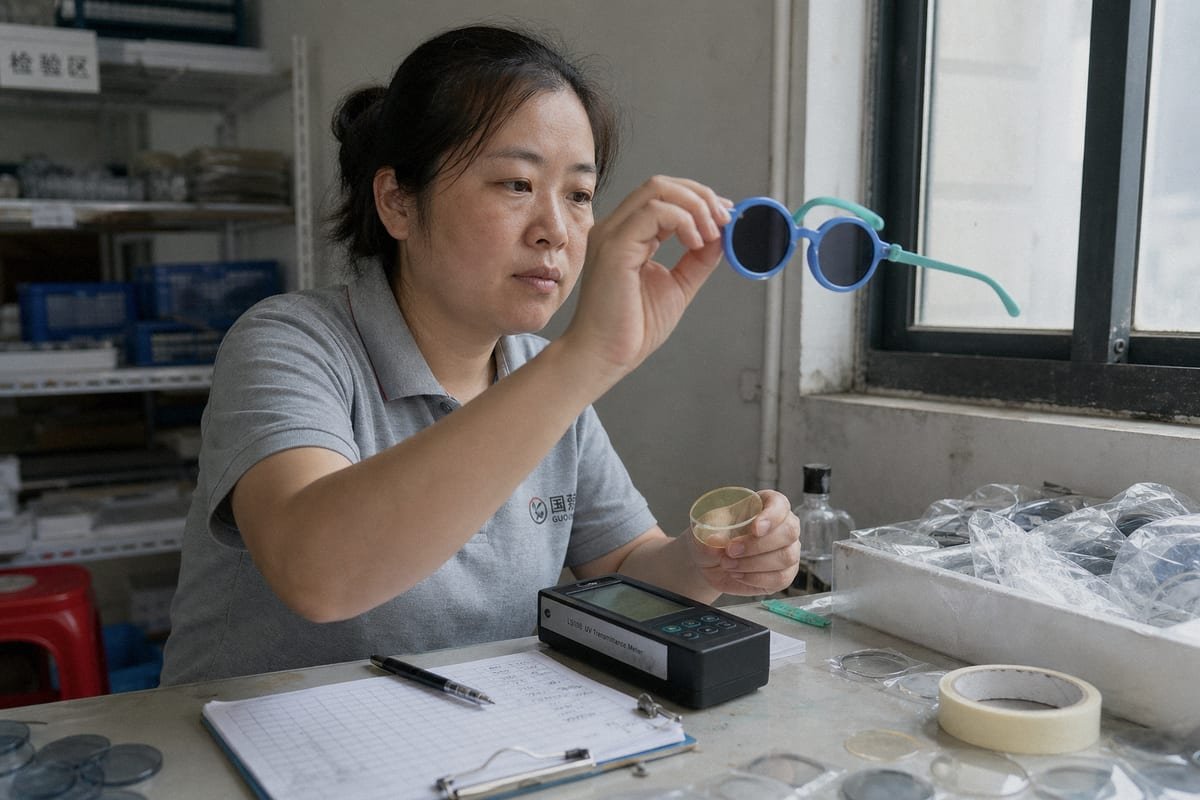
There is no hard expiration date printed on a lens, but the science is clear enough to plan around. UV protection degradation is a real, gradual process. One widely cited study reported in the Journal of the American Academy of Dermatology found that after roughly three years of regular use, close to 40% of tested sunglasses showed measurable drops in UV absorption. Some blocked as little as 70% of UVA rays despite carrying a la classification UV400 when new. NIST research adds another layer. Long-term irradiation can degrade sunglass filters within their design life, even when the lenses still pass safety standards at the time of testing.
Why the material matters more than the label
The lifespan of UV protection depends heavily on where the protection lives. If the UV blocker is a surface coating, it wears with every wipe, scratch, and heat cycle. If it is built into the lens substrate itself, it lasts much longer. This is why we favor polycarbonate and quality injected lenses 2 for children's lines. Polycarbonate lens durability comes from the fact that UV absorption is inherent to the material, not painted onto it.
Typical protection lifespans by lens type
| Type de lentille | UV protection location | Realistic full-protection window |
|---|---|---|
| Polycarbonate | Built into material | 3+ years with normal care |
| TAC / injected with UV absorber | Mixed into substrate | 2–3 years |
| Coated acrylic (budget) | Surface coating only | 1–2 years, less with heat exposure |
| Photochromique | In material, but activation fades | UV block lasts; darkening declines after 2–3 years |
For children, one more factor applies. Pediatric eye health experts note that young eyes 3 transmit more UV to the retina than adult eyes. So the tolerance for degraded lenses should be lower, not higher, in kids' products. When we advise our B2B partners, we suggest positioning replacement at 24 to 36 months, and sooner if the lenses show visible damage.
What causes sunglasses lenses to fade or discolor, and how can I choose materials that resist it?
One trade-off we weigh constantly in product development is cost versus material stability. A cheaper lens saves cents per unit, but lens discoloration complaints can cost a brand its reputation.
Lenses fade or discolor mainly due to photobleaching from intense sunlight, heat exposure, harsh cleaning chemicals, saltwater or chlorine etching, and coating wear. Choosing polycarbonate or quality TR90-paired lenses with molded-in UV blockers and hard anti-scratch coatings resists these effects best.
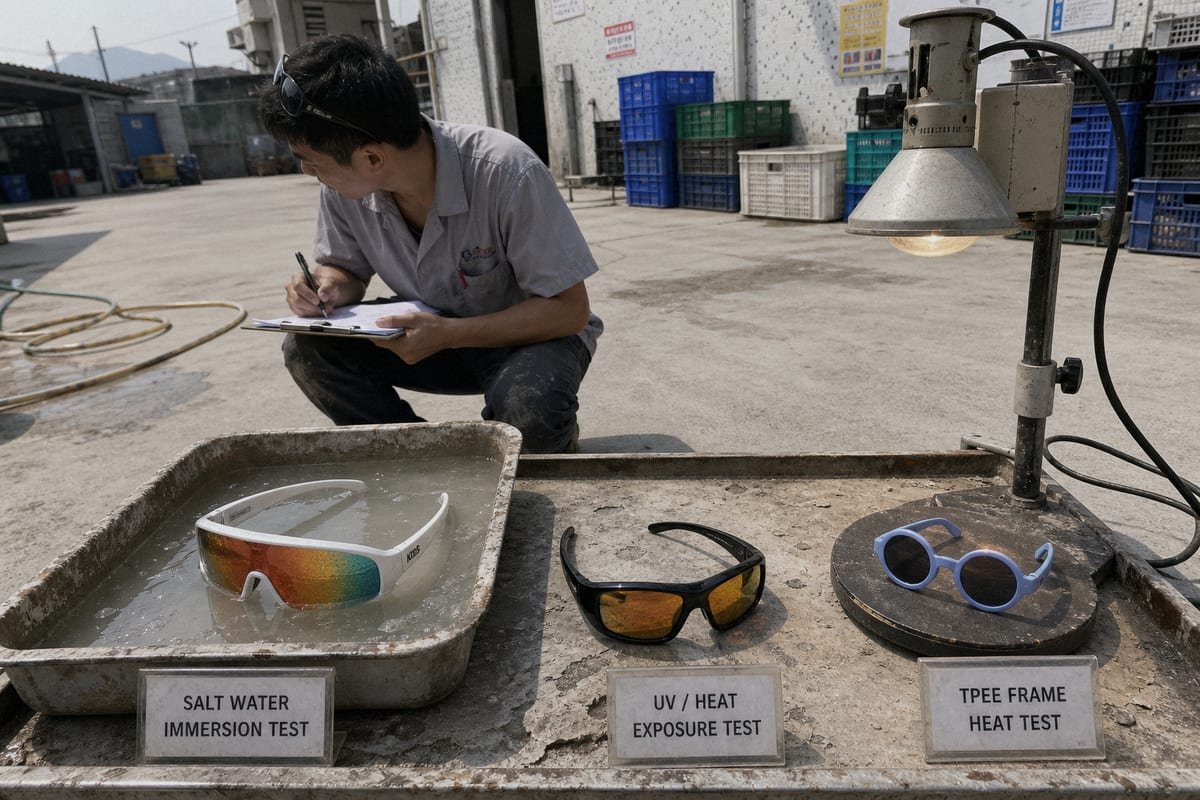
Fading is not one process. It is several processes happening at once, and each one attacks a different part of the lens. Understanding them helps you write a better spec sheet for your supplier.
Les principales voies de dégradation
First, photobleaching. Intense sunlight breaks down the chemical bonds in UV-absorbing additives over time. The lens may keep its tint while its invisible filter weakens. Second, heat. Storage in hot cars accelerates chemical breakdown and can physically warp lens treatments. Third, thermal cycling. Moving repeatedly between hot and cold causes crazing, which is micro-cracking of the coating. Crazing scatters light and causes optical clarity loss, which children notice as haze. Fourth, chemical attack. Chlorinated pool water and saltwater can etch coatings faster than normal atmospheric exposure ever would. That matters for kids' beach and swim brands. Fifth, mechanical wear. Abrasive cloths and harsh cleaners thin the anti-scratch coating, and microscopic scratches act like cracks in the UV shield, letting radiation bypass the filter.
Material choices that resist fading
| Risk factor | Weak choice | Resistant choice |
|---|---|---|
| Photobleaching | Surface-coated acrylic | Polycarbonate with molded-in UV blocker |
| Heat warping | Thin, low-grade injection lens | Thicker PC lens in flexible TR90/TPEE frame |
| Coating crazing | Single soft coating | Hardened anti-scratch coating, tested adhesion |
| Water etching | Uncoated mirror finish | Sealed mirror coating with hydrophobic layer |
| Scratch wear | No hard coat | Dual-side anti-scratch coating |
One more nuance worth knowing: high-energy visible (HEV) blue light 5 filters can degrade independently of the UV blockers. So a lens can keep blocking UV while its blue-light balance shifts. If your brand markets HEV protection, specify that separately with your factory. On our side, we pair stable lens substrates with flexible TPEE and TR90 frames, because a frame that flexes instead of stressing the lens also slows anti-scratch coating wear at the rim.
How do I test or verify lens quality before placing a bulk order with a manufacturer?
A buyer from Australia once visited our workshop and asked to test lenses on the spot. We handed her our UV meter and let her pick random samples from the line. That is exactly the right instinct.
Verify lens quality by requesting third-party test reports for UV400 transmission and impact resistance, checking samples with a UV light meter, performing scratch and coating-adhesion checks, and auditing the factory's QC process. Always test random production samples, not just golden samples.
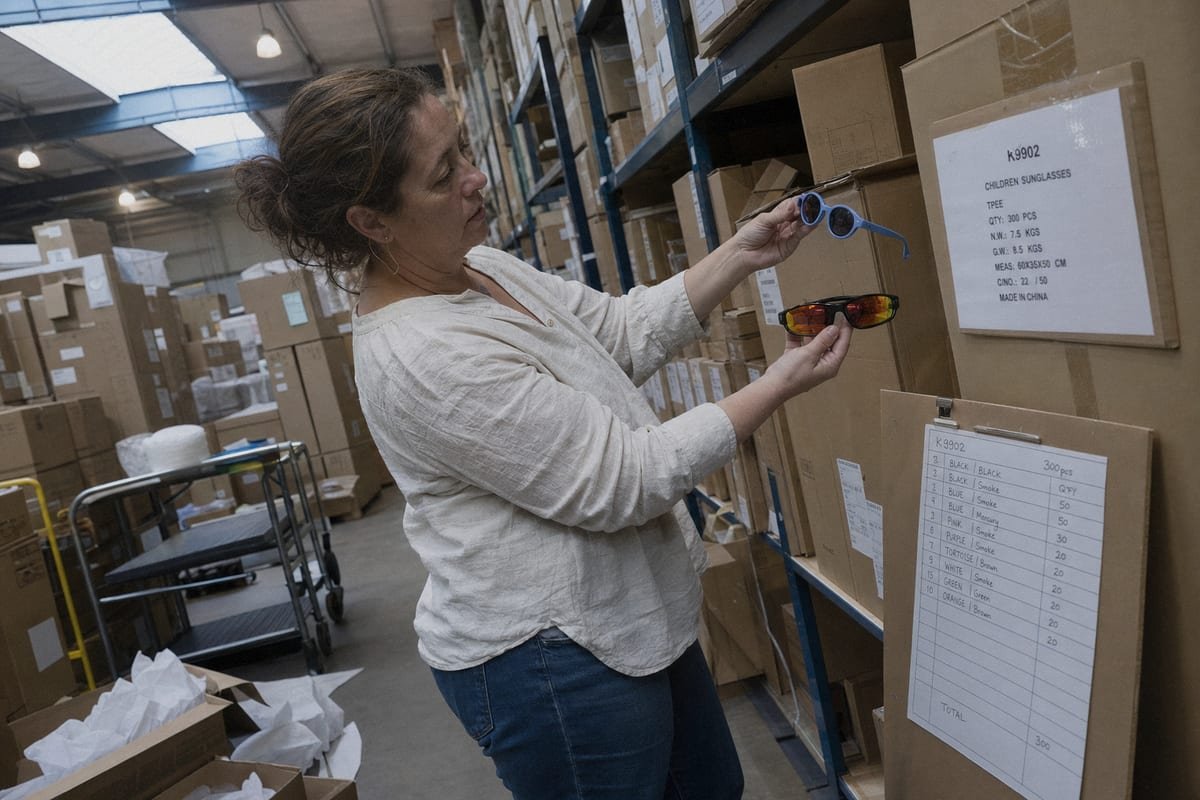
Trust is good. Verification is better. In fifteen years of making children's eyewear, I have seen buyers burned by suppliers who submitted perfect pre-production samples and then shipped something else. Here is a practical process you can follow before any bulk order.
A step-by-step verification process
- Request documentation first. Ask for UV transmission test reports referencing standards like norme ISO 12312-1 6, EN 1836, or ANSI Z80.3. For kids' products, also request impact resistance standards documentation and relevant safety compliance for your market, such as CE for Europe or AS/NZS for Australia.
- Test UV blocking yourself. A handheld UV light meter costs little. Shine a UV source through the lens onto the sensor. A genuine UV400 lens should block essentially all UVA and UVB rays up to 400 nanometers.
- Check optical quality. Look through the lens at a straight line, such as a door frame, and move the lens. Waviness or distortion signals poor injection quality and future optical clarity loss.
- Stress the coating. Run a standard steel-wool or eraser abrasion check on a sacrificial sample. Then do a cross-hatch tape test on mirror coatings to check adhesion. Peeling now means peeling in the field later.
- Simulate real life. Leave a sample on a car dashboard for a week. Soak another in salt water overnight. Then re-test UV transmission and inspect for lens discoloration or haze.
- Audit the factory. Ask how they control lens sourcing batch to batch. At our 5S-managed workshop, we log lens batches so a buyer can trace any shipment back to its raw material lot.
- Test random mass-production units. Pull units from sealed cartons during pre-shipment inspection, not just approval samples.
If you are testing polarized options, also check polarized lens lifespan factors: film lamination quality and edge sealing, because delamination is the most common early failure in polarized kids’ lenses.
Should I offer a warranty or replacement policy to reassure my customers about lens durability?
Several of our long-term brand partners in Europe have asked us this exact question, usually right before a retail launch. Our answer has stayed consistent over the years.
Yes, offer a 12-month warranty covering lens defects like delamination, peeling coatings, and premature fading, plus a goodwill replacement option for accidental damage. A clear warranty builds trust, differentiates you from cheap competitors, and costs little when your lens quality is verified upfront.
A warranty is not just a customer-service expense. It is a marketing asset and a quality signal, especially in the children's category where parents are cautious and skeptical of cheap sunglasses. The key is to structure it so it reassures parents without exposing you to unlimited claims from a product category that children will inevitably sit on, drop, and bury in sandboxes.
What to cover and what to exclude
Cover manufacturing defects: coating delamination, bubbling, premature lens discoloration, hinge failure, and frames cracking under normal use. Exclude obvious abuse: chewed temples, lenses scratched on pavement, and losses. Many successful kids' brands add a paid or discounted replacement program for accidental damage. Parents love it, and it drives a second purchase touchpoint.
Warranty structures compared
| Policy type | Typical terms | Cost to brand | Trust impact |
|---|---|---|---|
| Basic defect warranty | 6–12 months, defects only | Bas | Modéré |
| Defect warranty + discounted replacement | 12 months + 40–50% off replacements | Faible à modéré | Élevé |
| No-questions-asked replacement | 12 months, one free replacement | Plus élevé | Very high, strong marketing angle |
There is a manufacturing side to this decision too. Your warranty is only as affordable as your defect rate. When we co-develop a line with a brand, we align the lens spec, the QC sampling plan, and the intended warranty terms before production starts. Flexible TR90 frames with TPEE temples also reduce claims indirectly, because frames that bend instead of snapping protect both the child and the lens edge. A durable product makes a generous policy cheap. Finally, use your warranty copy to educate parents: recommend replacing kids' sunglasses 7 every two to three years, since even well-made lenses experience gradual UV protection degradation. That honesty builds credibility and, conveniently, repeat sales.
Conclusion
Children's sunglasses lenses do age, often invisibly. Verified UV400 materials, honest replacement timelines, and a smart warranty protect young eyes and your brand. We are glad to help you build both.
Notes de bas de page
1. Official international standard for sunglasses and related eyewear requirements. ↩︎
2. Technical overview of polycarbonate, a primary material used for durable, UV-blocking sunglass lenses. ↩︎
3. Expert medical advice from the American Academy of Ophthalmology regarding children’s eye vulnerability to UV. ↩︎
4. WHO reference explains UVA/UVB radiation risks, supporting the lens UV-blocking testing claim. ↩︎
5. Scientific overview of high-energy visible light and its interaction with optical filters. ↩︎
6. Official ISO standard page defining sunglasses UV transmission and safety requirements referenced in testing. ↩︎
7. Pediatric health guidelines from the American Academy of Pediatrics regarding sun safety for children. ↩︎
Plus d'articles que vous pourriez aimer


Vous recherchez un partenaire fiable en lunetterie pour enfants ?
Explorez plus de 800 styles prêts et un support OEM/ODM complet adapté à votre marque.
Contactez-nous English
  Español de México
  Deutsch
  Français
  日本語
日本語  العربية
  Português do Brasil