Can I Bend Back a Stretched TPEE Kids Sunglasses Temple?
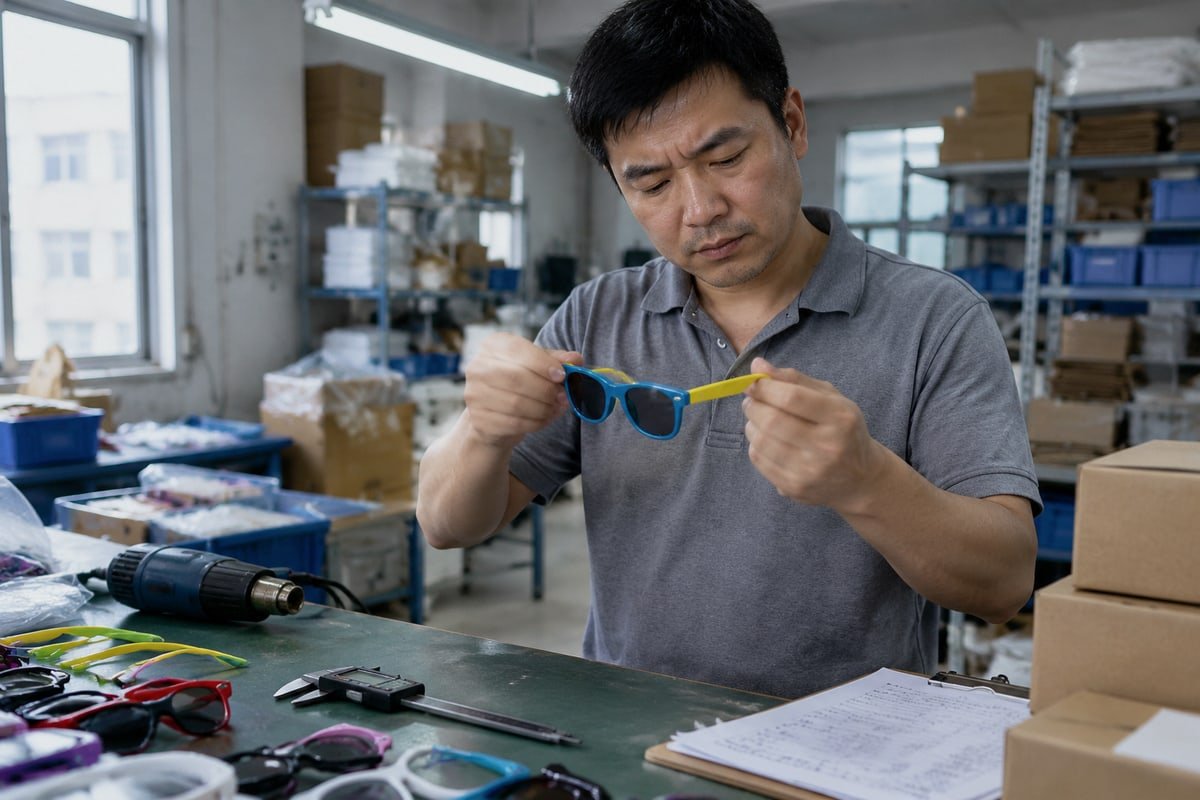
Every summer, stretched TPEE kids sunglasses temples land on our QC bench in Taizhou after months of tugging. Left alone, they slip off. Bent wrong, they snap.
Yes, a stretched TPEE kids sunglasses temple can usually be bent back, because thermoplastic polyester elastomer has shape memory. Warm it gently to about 120°F, reshape, then cool it. If the temple shows white stress marks, cracks, or feels stiff, stop and replace it instead.
That short answer hides a lot of detail. The material matters. The heat matters. The hinge matters more than most people think. Below, I walk through why a stretched TPEE kids sunglasses temple loses its grip, how to fix it safely, what a supplier can change upstream, and when to stop fixing and start replacing.
What Causes TPEE Temples to Stretch Out of Shape Over Time?
During drop-and-twist checks on our montures TR90 1 with TPEE temples, we noticed something. The temples rarely failed from one big bend. They loosened from countless small ones.
TPEE temples stretch out of shape mainly through creep, a slow molecular shift caused by repeated low-level stress like resting glasses on the head or pulling them off one-handed. Loose hinge screws, heat exposure, and long-term UV degradation speed up the loss of tension.
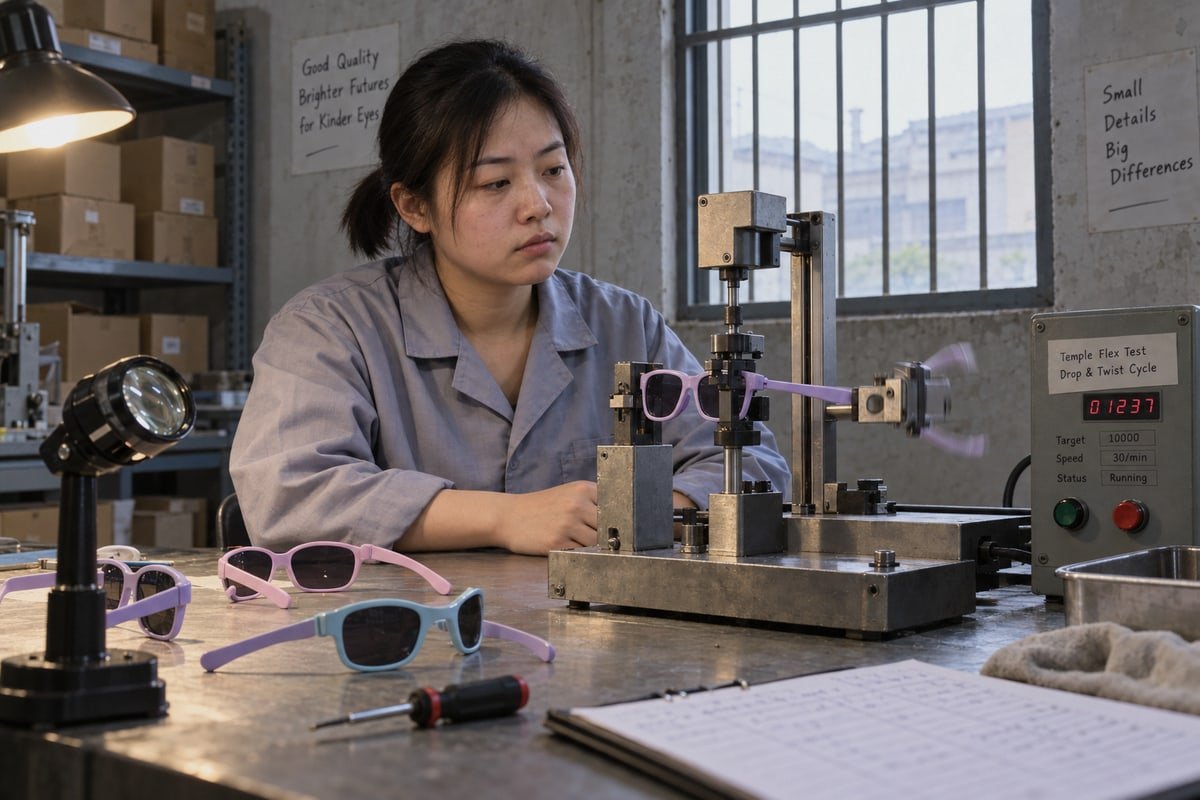
Memory material properties explained simply
Thermoplastic polyester elastomer is built from two kinds of segments. Hard polyester segments act like anchors. Soft polyether segments act like springs. When a child twists the arm, the springs stretch and the anchors pull them back. This is what people mean by memory material properties. It is also why brands market these frames as unbreakable children's sunglasses. A Celanese case study on kids' eyewear describes exactly this use case: children bend, twirl, and flex temples all day, so the material has to recover without going loose.
Creep is the real enemy
The problem is not one dramatic bend. The problem is creep. Creep is a slow displacement of the polymer chains 2 under low, steady stress. Think of a child wearing sunglasses pushed up on the head for two hours at the beach. The temples sit wider than their natural angle the whole time. Do that every weekend and the arms slowly accept the wider position as normal. Once the material reaches what engineers call permanent set, no amount of bending brings the tension back.
The four stretch triggers I see most
| Dérive des spécifications | Remèdes maison courants, honnêtement évalués | Early warning sign |
|---|---|---|
| Resting frames on the head | Temples held wide for hours, feeding creep | Arms sit slightly open when folded |
| Retrait d'une seule main | Twists one hinge past its stop every time | One temple bows more than the other |
| Vis de charnière desserrées | Hardware, not polymer, lets the arm splay | Arm wobbles side to side at the hinge |
| Heat and UV exposure | Soft polyether segments degrade, material stiffens | Surface feels dry or crunchy, not rubbery |
Vis de charnière desserrées deserve special attention. In our returns inspection, this is the most frequent cause of arms that look stretched. The TPEE is fine. The screw has backed out a quarter turn. Tightening it restores the fit in seconds. So before anyone blames the durability of TPEE, I always ask them to check the hardware first.
One more cause hides in plain sight. Sometimes the temple is not stretched at all. The frame is simply one size too small, and the arms have been splaying outward to compensate for a face they were never designed to fit.
How Do I Safely Reshape a Bent or Stretched TPEE Temple at Home?
A procurement manager from Australia once asked us whether her customer-service team could coach parents through a fix by phone. We wrote her a script. Here it is, expanded.
To reshape a stretched TPEE temple at home, first tighten the hinge screws. Then warm the arm with a hairdryer on low or water around 120°F, bend the temple tip gently downward behind the ear, and dip it in ice water to set the new shape.
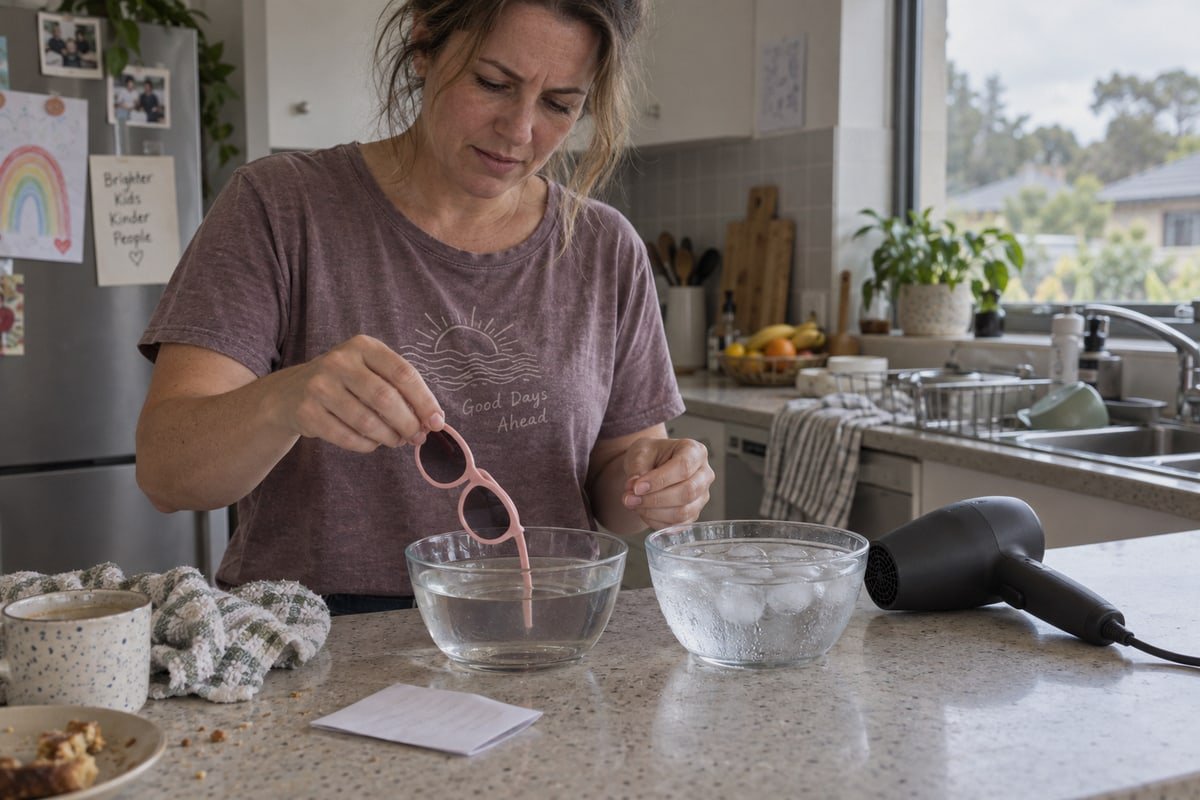
A six-step process for reshaping flexible frames
- Inspect before you touch. Look for whitening, cracks, or a hinge that sits crooked. If you see any of these, skip to the replacement section.
- Tighten the hinge screws. Use a small eyeglass screwdriver. Snug, not forced. Try the fit again. Many "stretched" temples are fixed right here.
- Warm the temple. Use a hairdryer on its lowest setting, moving constantly, or soak the arm in warm water near 120°F (about 49°C) for one to two minutes. This makes the polymer chains mobile enough to accept a new position.
- Adjust the temple tips, not the whole arm. Most fit problems are solved by bending the last inch of the temple downward so it hooks behind the ear. Trying to push the entire arm inward risks stressing the hinge.
- Cold shock the new shape. Immediately plunge the warmed section into ice water for thirty seconds. This locks the position before the material's memory pulls it back toward the stretched shape.
- Test on the child, then wait a day. If the temple returns to the stretched position by the next morning, the material has reached permanent set. Reshaping will not hold.
Why the boiling water method is a mistake
Online tutorials often recommend the boiling water method for plastic frames. Do not use it on TPEE. Water at 212°F sits far too close to the softening range of many elastomer grades. The arm can warp permanently, bubble at the surface, or lose the tension that made it useful in the first place.
| Heat source | Approximate temperature | Verdict for TPEE |
|---|---|---|
| Hairdryer, low setting, moving | Under 140°F at the surface | Safe with care |
| Warm tap water | About 120°F | Safe, best for beginners |
| Hot tap water | 130°F to 140°F | Use briefly only |
| Boiling water | 212°F | Never, permanent damage likely |
| Open flame or lighter | Extreme | Never, scorches and embrittles |
But my optician says never bend frames yourself
This is a fair objection. The American Association for Pediatric Ophthalmology and Strabismus 3 advises parents to take bent or poorly fitting glasses to an optical shop rather than bend them at home, because the frame may break. I take that seriously, and for prescription optical frames I agree without hesitation. Rigid acetate and metal frames break. Lenses shift. Prescriptions go out of alignment.
The two positions are not really in conflict. The clinical advice protects fit and prevents breakage. Consumer brands describe what the material can tolerate. For a non-prescription TPEE sunglass with a mild bow, gentle heat-induced frame repair at home is low-risk. For an optical frame carrying a child's prescription, or for any frame where the hinge or lens seat looks stressed, an optical shop is the right call. Opticians also have frame alignment techniques that go beyond home tools, such as applying a tiny drop of UV-curable resin at the hinge stop to shim the arms into a narrower resting angle. That is a shop-level fix, not a kitchen-table one.
Can My Supplier Adjust TPEE Flexibility to Prevent Future Stretching?
Softer TPEE feels kinder on a toddler's ears but loses tension sooner. Firmer grades hold shape longer but grip harder. We weigh that balance on every new style in Taizhou.
Yes. A capable supplier can tune TPEE flexibility by selecting the elastomer hardness grade, adjusting temple thickness and cross-section, reinforcing the hinge stop, and pairing a TR90 front with TPEE temples. These choices reduce creep and help temples hold tension through repeated bending.
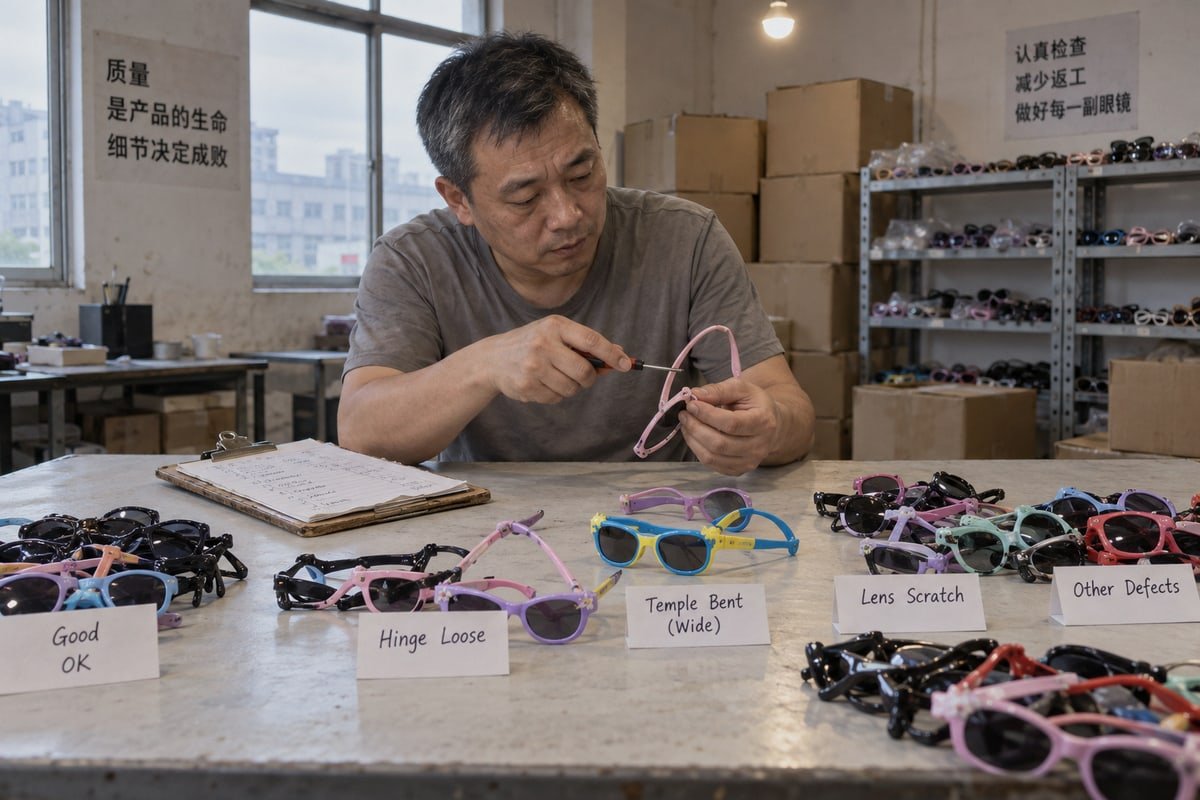
The levers a factory can actually pull
Flexibilité is not a single dial. It is a set of decisions made before the first mold is cut. Here is how our engineering team thinks about it.
| Lever | Effect on stretching | Trade-off to weigh |
|---|---|---|
| Elastomer hardness grade | Firmer grade resists creep and holds tension longer | Slightly less "squish" for infants and toddlers |
| Temple thickness and cross-section | Thicker or ribbed arms recover faster from twisting | Adds a little weight; changes the look of slim styles |
| Hinge stop design | A solid stop prevents over-opening past the natural angle | Requires precise molding and tighter QC |
| TR90 front with TPEE temples | Rigid front locks the lens seat; flexible arms take the abuse | Two materials mean color matching needs care |
| Temple tip shape | A pre-curved tip hooks the ear and needs less inward tension | Must be sized to the target age band |
Why the front matters as much as the temple
Reviewers who test flexible kids' frames keep pointing out the same thing. The temple survives. The lens-frame junction fails. In low-cost all-TPEE frames, the lens is often held by friction alone. Bend the frame enough times and the lens seat opens up. The lens pops out, or worse, it shifts and exposes a gap at the edge of the eye.
This is why most of our children's range uses a TR90 front with TPEE temples. TR90 holds the lens seat firmly and keeps a UV400 or options polarisées précisément pour que nos acheteurs puissent passer la douane sans délai. Quel que soit le mode que vous choisissez, confirmez vos documents de conformité avant la fin de la production, pas après l'atterrissage des marchandises. 4 locked in place. The TPEE arms do the flexing. The two-tone look many buyers love, say a royal blue front with bright yellow arms, comes directly from this two-material construction. It is not just a color-blocking style choice. It is a structural one.
What to ask when you brief a supplier
Marketing pages love to claim 180-degree twisting or unlimited bend cycles. Ask for the sample instead of the claim. Twist it. Sit on it. Leave it in a warm car. Then check whether the temples still fold flat and grip evenly.
Also ask about material basics. TPEE is a BPA-free flexible plastic 5, and it can be specified in environmentally friendly grades. We have around 800 existing styles that buyers can sample in different temple grades and cross-sections. That means a new brand or importer can test which flexibility level suits its market, whether that is a toddler line for Japan or a sports range for Europe, without paying for a custom mold first. Once the grade is right, full OEM/ODM support covers colors, logos, lenses, and retail-ready packaging.
When Should I Replace TPEE Temples Instead of Trying to Fix Them?
Years ago on our line, I learned a lesson: a temple that keeps returning to its stretched shape is telling you the polymer has already given up.
Replace TPEE temples when the arm shows white stress marks or cracks, feels stiff or crunchy instead of rubbery, will not hold a reshaped position, or when the hinge is warped or the lens no longer sits securely. Also replace them when the child has simply outgrown the size.

A quick fix-or-replace decision table
| What you see or feel | Fix it | Replace it | Pourquoi |
|---|---|---|---|
| Mild bow, arm still springy, hinge tight | Oui | Material is elastic; gentle reshaping will hold | |
| Arm wobbles at the hinge | Tighten screw first | Hardware, not polymer, is the cause | |
| White stress lines along the arm | Oui | Polymer chains are already fractured at the surface | |
| Arm feels dry, stiff, or crunchy | Oui | Photo-oxidation has degraded the soft segments; it will snap | |
| Reshaped arm drifts back within a day | Oui | Creep has reached permanent set | |
| Lens pops out or shifts in the seat | Oui | Lens-frame junction has failed; safety risk | |
| Hinge area warped or misaligned | Oui | Bending will stress the weakest point further | |
| Child's face has grown | Yes, new size | Temple was compensating for a fit mismatch |
Fit is the goal, not tension
A repaired temple only counts as fixed if the sunglasses work on the child. Kids' frames should not pinch the nose or the ears. They should stay put when the child runs, jumps, or looks down. Side gaps should be small enough that light does not sneak around the lens. If a child has to keep pushing the frame back up, they will stop wearing it. At that point the repair achieved nothing.
This is where I push back gently on the "just bend it harder" instinct. If the arms need to be forced inward to grip, the frame is probably too wide for the child. Reshaping flexible frames cannot shrink them. A size down, or a style with a shorter temple, solves the problem properly.
Spare parts as a brand strategy
For the brands we work with, replacement temples are a customer-service asset rather than an admission of failure. Because TR90 fronts with TPEE temples use a screw hinge, a matching spare arm can be swapped in minutes. We can supply spare temples in the same color batch as the original run so a lavender cat-eye or blush-pink round frame gets a perfect match, not a near match. Some of our partners in Europe include a spare pair of temples in the retail box. Parents see it as a promise about the durability of TPEE. We see it as fewer full-frame returns.
Conclusion
A stretched TPEE kids sunglasses temple is usually recoverable with gentle heat and care. When it will not hold, fit and safety come first. Replace it.
Interested in sourcing the products mentioned in this article? See details and request a quote here:
Notes de bas de page
1. Technical background on Nylon 12, the polymer commonly known as TR90. ↩︎
2. Technical explanation of the creep mechanism in polymers and permanent deformation. ↩︎
3. Official site of the leading authority on pediatric eye care and eyewear safety. ↩︎
4. International standard specifying requirements for sunglasses and related eyewear. ↩︎
5. Authoritative scientific overview of TPEE material properties and molecular structure. ↩︎
Plus d'articles que vous pourriez aimer
Vous recherchez un partenaire fiable en lunetterie pour enfants ?
Explorez plus de 800 styles prêts et un support OEM/ODM complet adapté à votre marque.
Contactez-nous English
  Español de México
  Deutsch
  Français
  日本語
日本語  العربية
  Português do Brasil