Which Kids Optical Frame Parts Need CPSIA Testing from Chinese Suppliers?

Kids optical frame parts and CPSIA testing confuse many importers 100 ppm lead limit 1. On our production line in Taizhou, I see buyers order frames first — then panic when U.S. customs asks for paperwork.
All accessible components of kids optical frames need CPSIA testing: frame fronts, temples, nose pads, temple tips, hinges, screws, and decorations must meet the 100 ppm lead limit; surface coatings must meet 90 ppm; and plasticized parts must pass phthalate testing at 1,000 ppm.
That answer sounds simple. In practice, it is not. Let me break down each part, each limit, and each document you need from your Chinese supplier before you commit to a bulk order.
Which Components of Kids Optical Frames Require CPSIA Lead and Phthalate Testing?
Last year, a buyer sent us a competitor's frame that failed lab testing. The base plastic was clean. The printed logo ink was not. That single detail delayed their whole launch.
Every accessible component requires testing: frame fronts and temples for lead content in substrate materials (100 ppm max), paints and inks for surface coating limits (90 ppm max), and soft plasticized parts like nose pads and temple tips for regulated phthalates (1,000 ppm max).

The first thing to understand is the word "accessible." CPSIA does not care whether a part looks risky. It cares whether a child can touch it during normal use — or reach it after foreseeable use and abuse. A hinge screw that can work loose counts. A rivet under a decorative badge counts if the badge can detach. This is also why the small parts regulation matters for very young wearers; a detachable temple tip is both a chemical question and a choking question.
Breaking Down a Kids Frame, Part by Part
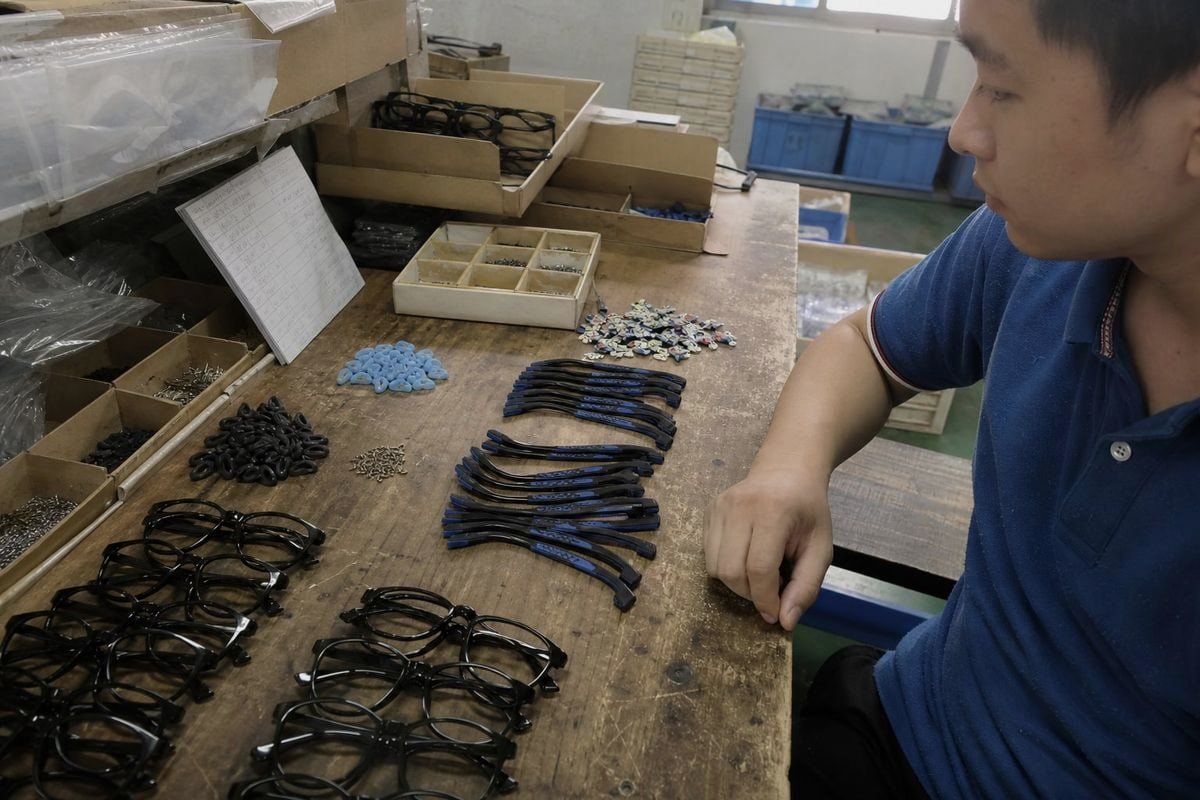
Here is how I map a typical children's frame — like our glossy black front with two-tone flexible temples and silicone ear hooks — against CPSIA requirements:
| Frame Component | Primary CPSIA Concern | Applicable Limit |
|---|---|---|
| Frame front (acetate, TR90, injected plastic) | Lead in substrate materials | 100 ppm |
| Temples and temple cores (plastic or metal) | Lead content | 100 ppm |
| Nose pads, temple tips (silicone, TPEE, PVC) | Phthalate testing 2 if plasticized; lead | 1,000 ppm / 100 ppm |
| Screws, hinges, springs, rivets | Lead in accessible metal | 100 ppm |
| Paint, printed logos, inks, varnishes | Lead in surface coatings | 90 ppm |
| Glitter, badges, appliqués, decorative inserts | Both lead and phthalates | 90–100 ppm / 1,000 ppm |
Notice something important. The surface coating limits are stricter than the substrate limit. A frame can pass on its base material and still fail on a printed graphic. In our experience, decorative inks and metallic finishes are the most common failure points on budget kids eyewear from China — not the frame plastic itself.
One more clarification. Some suppliers argue eyewear is a medical device, so CPSIA does not apply. That is wrong. If the frame is designed and marketed primarily for children 12 and under — small lens sizes, playful colors, cartoon decoration — it is a children's product for chemical safety purposes. Design intent decides the classification, not the FDA category.
How Do I Verify My Chinese Supplier's CPSIA Test Reports Are Valid and Complete?
A procurement manager from Australia once forwarded me a "CPSIA certificate" from another factory. It was a one-page in-house statement with a stamp. It was worthless for U.S. import.
Verify that the report comes from a CPSC-accepted laboratory, matches your exact frame variant and colorway, lists every tested component and coating, covers lead content, surface coatings, and phthalates separately, and is recent enough to reflect current materials and suppliers.

The core rule is simple: a factory's internal lab cannot certify CPSIA compliance. Third-party testing by a CPSC-accepted laboratory is mandatory for children's products. You can check the lab's accreditation directly on the CPSC website. If the lab name on the report does not appear on that list for the specific test rules cited, the report cannot support a Children's Product Certificate.
Un proceso de verificación de cinco pasos
- Check the laboratory. Confirm the lab is CPSC-accepted for the exact rules on the report — total lead, lead in paint, and phthalates each require separate accreditation scopes.
- Match the sample description. The tested item must match your frame — same mold, same material, same colors, same decoration. A report for the black version does not cover the pink translucent acetate version.
- Read the component list. A complete report itemizes each accessible material: front, temples, tips, screws, inks. If the report shows only one or two line items for a multi-material frame, parts were skipped.
- Confirm the test standards. Look for the actual CPSC test methods for lead in substrate materials, lead in surface coatings, and the regulated phthalates.
- Check the date and traceability. Old reports may predate a resin change or a new pigment batch. Ask when materials were last changed.
At our factory, we run heavy metals testing on incoming pigments as internal QC — but we never present that as certification. We send production samples to accredited labs for the official reports, because that is what protects our buyers. When we developed our TPEE temple compound, we tested the base material and each color masterbatch, since a single pigment can change the result.
What CPSIA Documentation Should I Request Before Placing a Bulk Order?
Here is a trade-off I discuss with new buyers weekly: requesting full documentation upfront slows the quote stage by a few days, but it prevents weeks of delay at customs later.
Request a complete bill of materials, third-party test reports from a CPSC-accepted laboratory for every accessible component, coating and ink specifications, a draft Children's Product Certificate template, tracking label details, and a written material-change notification commitment before wiring any deposit.
One point trips up almost every first-time importer: your Chinese supplier does not issue the Children's Product Certificate. You do. Importer responsibility is written into the law — the U.S. importer of record issues the CPC based on valid third-party test reports. Your supplier's job is to give you documents strong enough to certify with confidence.
The Pre-Order Documentation Checklist
| Documento | What It Must Show | Por qué importa |
|---|---|---|
| Lista de materiales (BOM) | Every material, coating, and small part in the frame | You cannot certify what you cannot identify |
| Third-party test reports | Lead, coatings, and phthalate results per accessible component | The legal basis for your CPC |
| Coating and ink specifications | Pigment and ink sources, applied locations | Coatings are the most common failure point |
| Tracking label plan | Manufacturer, production date, batch on frame or packaging | CPSIA requires permanent tracking labels on children's products |
| Material-change agreement | Written promise to notify you before any sourcing change | Silent substitutions invalidate your existing test data |
| CPC data sheet | Product ID, citations, importer details, lab details | Speeds up your own certificate issuance |
I would add one commercial note from our export experience across 20-plus countries. Buyers who also sell in California often ask us about Proposition 65 3 and cadmium. That is separate from CPSIA, but requesting a combined heavy metals testing package in one lab submission is cheaper than testing twice. A good supplier will bundle these without complaint.
Finally, put the material-change clause in your purchase contract, not just email. OEM/ODM production involves masterbatch suppliers, ink vendors, and hardware sub-suppliers. Any one of them changing sources can quietly break your compliance chain.
Can Flexible Materials Like TPEE and TR90 Help My Frames Pass CPSIA Requirements More Easily?
Fifteen years of molding children's frames taught our engineering team one lesson: material choice at the design stage determines eighty percent of your compliance headaches later.
Yes, to a meaningful degree. Virgin TPEE and TR90 are inherently lead-free, phthalate-free polymers, so clean formulations pass substrate and phthalate testing reliably. However, they do not exempt you from testing — pigments, coatings, decorations, and metal hardware still require full CPSIA verification.

Let me be precise, because I do not want to oversell my own materials. TR90 is a nylon-based thermoplastic. TPEE is a thermoplastic polyester elastomer. Neither needs plasticizers to achieve flexibility — the softness is built into the polymer chain itself. Compare that with soft PVC, which typically relies on plasticizer additives, historically including regulated phthalates. That is why we standardized on TPEE for temples and tips across our roughly 800 existing styles: flexibility for active kids without the chemical risk profile.
Where the Risk Actually Comes From
Here is how I rank compliance risk when we develop a new children's frame:
| Risk Source | Risk Level with TPEE/TR90 | What We Do About It |
|---|---|---|
| Base polymer (virgin TPEE, TR90) | Baja | Source certified virgin resin, keep supplier declarations |
| Color masterbatch and pigments | Medio | Screen pigments internally, confirm via third-party testing |
| Printed logos and decorative inks | Higher | Test each ink; prefer laser engraving where possible |
| Metal hinges, screws, spring cores | Medio | Specify lead-free alloys, verify accessible metal parts |
| Recycled or blended resin | Alta | We avoid it for children's frames entirely |
Two caveats matter. First, "TR90" is a category label in the trade, and quality varies between resin suppliers. A cheap blend sold as TR90 may contain fillers or recycled content that changes the picture. Second, even a perfectly clean frame body still needs third-party testing, a CPC, and tracking labels — clean materials shorten the path, they do not remove it. There is also a durability bonus: flexible frames with embedded decoration, like the embossed dot patterns we mold directly into temple surfaces, survive twisting and drops better than surface-printed graphics, which reduces both breakage returns and the number of coated surfaces you must test in the first place.
Conclusión
Every accessible part of a kids optical frame is in CPSIA scope. Demand accredited lab reports, a full BOM, and material-change commitments — and choose clean materials from the start.
Notas al pie
1. Details the federal requirements and limits for total lead content in accessible components of children’s products. ↩︎
2. Official CPSC page providing comprehensive information on phthalate regulations, prohibitions, and testing requirements. ↩︎
3. Provides an overview of California’s Proposition 65, also known as the Safe Drinking Water and Toxic Enforcement Act. ↩︎
4. Explains thermoplastic elastomers, a class of polymers including TPEE, known for flexibility and durability. ↩︎
Más artículos que te podrían gustar

5 de agosto de 2026
Bio-Based vs Regular Cellulose Acetate: What's the Difference for Kids' Frames?

5 de agosto de 2026
How Recyclable Are Kids' Optical Frame Materials, and What Eco-Friendly Alternatives Exist?
5 de agosto de 2026
Do Kids Optical Frames Whiten or Age in Storage, and How to Control Warehouse Conditions?
¿Buscas un socio confiable en gafas para niños?
Explore más de 800 estilos listos y soporte OEM/ODM completo adaptado a su marca.
Ponte en contacto English
  Español de México
  Deutsch
  Français
  日本語
日本語  العربية
  Português do Brasil