What Material Differences Exist Between High-End and Budget Kids’ Sunglasses?
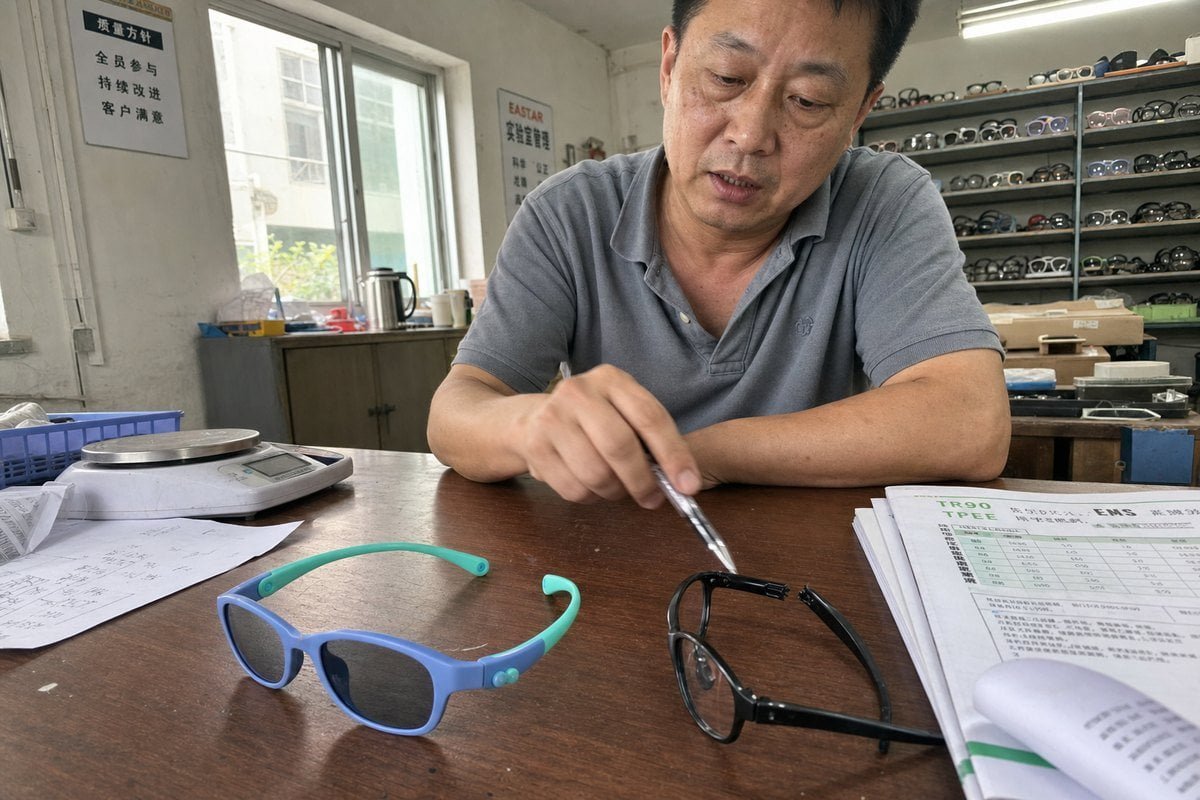
Material differences between high-end and budget kids’ sunglasses come up in almost every buyer call at our Taizhou factory. Brands fear paying premium prices for cheap plastic. That fear is justified — and solvable.
High-end kids’ sunglasses use flexible, impact-resistant materials like TR90 and TPEE frames with optical-grade polycarbonate lenses, while budget versions use rigid injection-molded plastics and thin lenses. UV protection can be similar, but premium materials deliver superior durability, comfort, safety, and long-term brand value.
The gap is not always visible on a product photo. It shows up in how the frame bends, how the lens performs, and how parents react. Let me break it down section by section.
How can I tell if a supplier is using real TPEE or TR90 instead of cheap plastic substitutes?
A buyer from Australia once mailed us a competitor's "TR90" sample. Our engineers snapped the temple in half with two fingers. It was ordinary rigid plastic with a matte finish sprayed on.
Verify real TR90 or TPEE by testing flexibility — genuine frames twist 180 degrees and spring back with full shape memory, while substitutes crack or stay deformed. Also check weight, surface feel, burn-test behavior, and request raw material datasheets from the resin supplier.
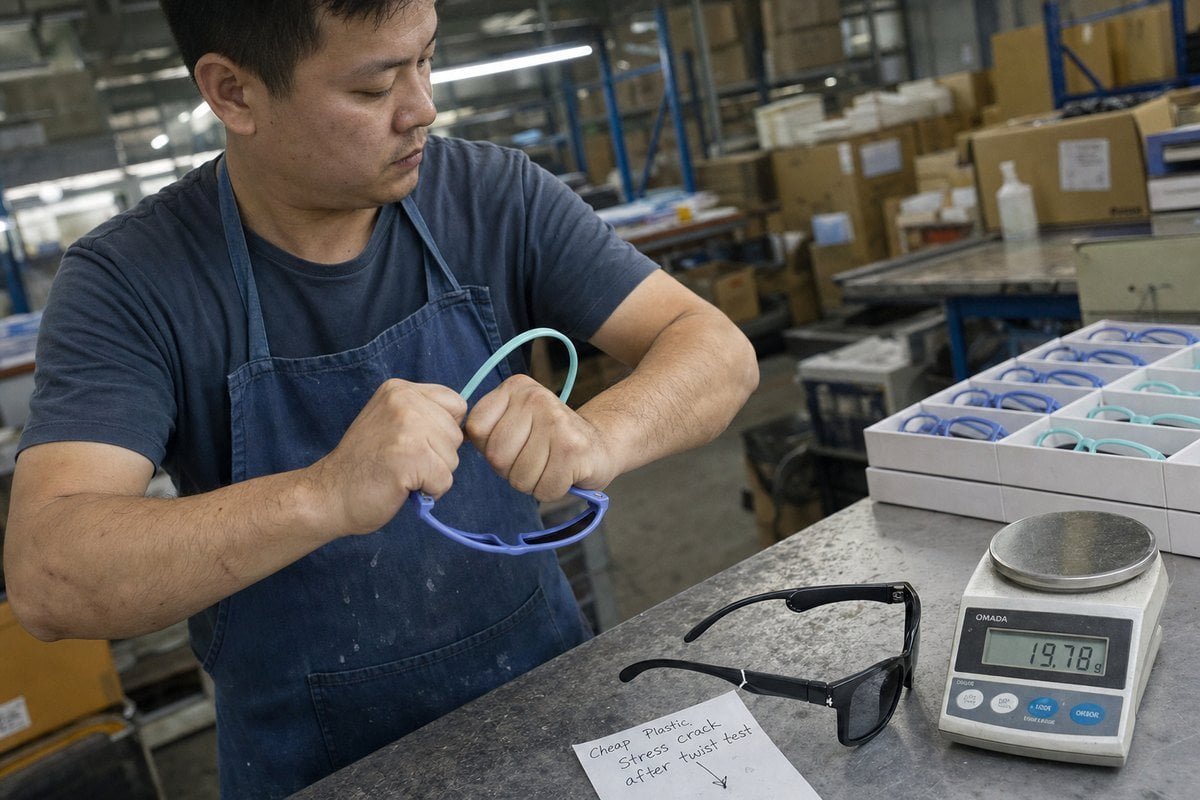
Fake material claims are one of the most common problems in children's eyewear sourcing. In our fifteen years of production, we have seen every substitute trick. The good news is that real TPEE 1 flexible frames and genuine TR90 behave in ways that cheap plastics simply cannot copy. You can test most of them yourself.
The Twist and Bend Test
Real TR90 has shape memory 2. Twist the temple arms, fold the frame flat, and let go. A genuine frame returns to its original shape instantly. TPEE goes even further — it is a rubber-like elastomer that can be tied in a loose knot on toddler frames. Cheap ABS or acrylic substitutes will whiten at the stress point, crack, or hold a permanent deformation. This one test filters out most fakes.
The Weight and Feel Test
TR90 is noticeably lighter than generic plastic. A typical kids' TR90 frame feels almost weightless in your palm. Substitutes feel dense and slightly cold. TPEE has a soft, slightly rubberized surface texture — like the periwinkle-blue toddler frames on our line, which parents can flex without worry.
| Comprobar | Genuine TR90/TPEE | Cheap Substitute |
|---|---|---|
| 180° twist | Springs back fully | Cracks or whitens |
| Peso | Muy ligero | Dense, heavier |
| Surface | Smooth matte, slightly warm | Glossy, cold, hard |
| Cold weather | Stays flexible | Turns brittle |
| El próximo Pasaporte Digital de Producto de la UE requerirá un registro de transparencia escaneable para EPP. Las marcas que solo tienen informes de prueba en papel tradicionales, comunes en las cadenas de suministro centradas en Australia, deberían comenzar a estructurar archivos de cumplimiento digital ahora. | Resin datasheet available | Vague "TR material" claims |
Ask for Paper, Not Promises
A serious factory will name its resin supplier and share the raw material datasheet. We keep ours on file for every batch. If a supplier hesitates, refuses, or only says "TR material," treat that as a warning sign. You can also commission a third-party polymer analysis for a small fee — genuine partners will welcome it.
Why does frame material matter so much for my brand's safety reputation with parents?
One returned shipment taught a client of ours this lesson before they found us. A rigid budget frame snapped at the bridge, left a sharp edge near a child's eye, and the complaint went viral in a parenting group.
Frame material directly determines whether kids' sunglasses break into sharp fragments, leach chemicals, or fail at hinges. Parents share safety failures publicly and permanently. Flexible, BPA-free materials like TPEE and TR90 protect children first — and by extension, protect your brand's reputation and repeat sales.
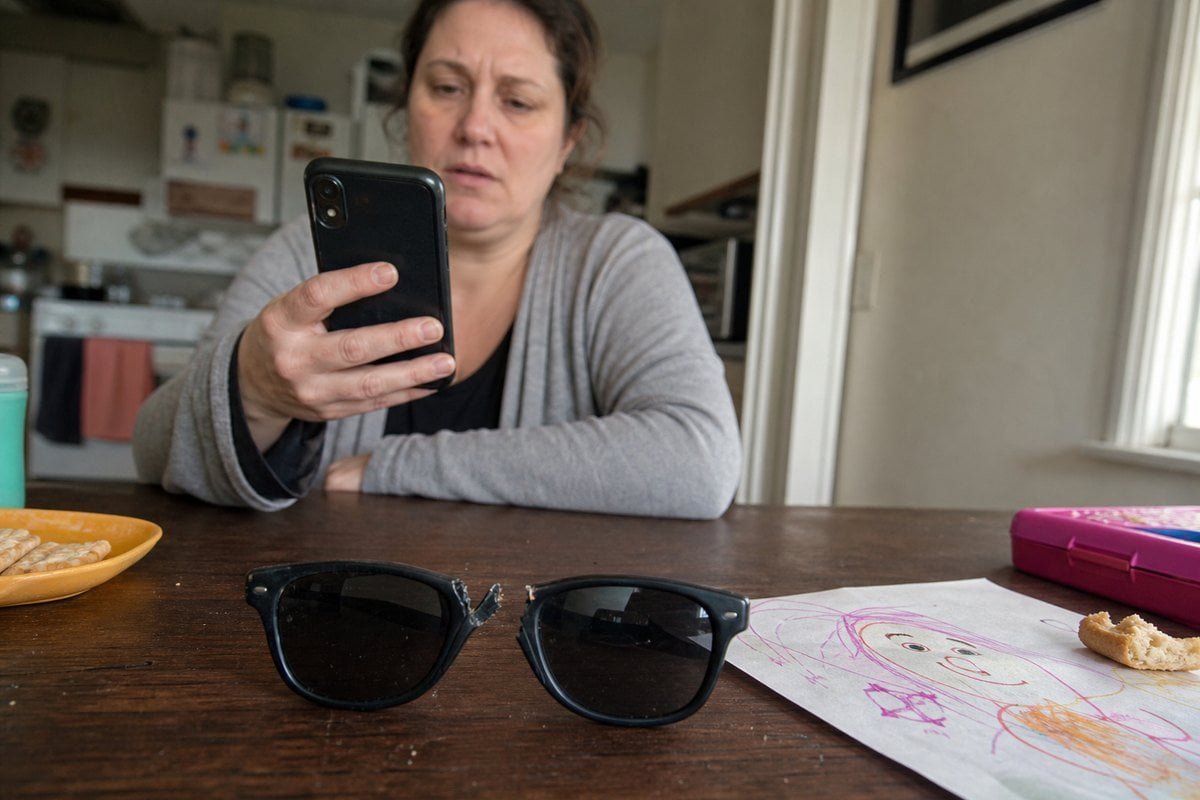
Parents do not read material datasheets. But they judge material quality every single day, in three specific moments. Understanding these moments explains why frame material is a reputation issue, not just a spec-sheet detail.
Moment One: The Break
Children sit on sunglasses. They throw them, chew them, and bend them backward. A rigid plastic frame fails at predictable stress points — the bridge, the hinge screw area, and the temple joint. When it fails, it often leaves a sharp edge close to a child's face. A TPEE frame in the same scenario simply flexes and survives. Our production team designs toddler styles specifically so there is no snap point at all. Shatterproof construction is not a marketing phrase for us; it is the reason parents rebuy the same brand.
Moment Two: The Chemical Question
Modern parents ask about materiales libres de BPA 3 the same way they ask about baby bottles. Budget industrial-grade plastics often come with no chemical documentation at all. Environmentally friendly, food-contact-adjacent material standards give your customer service team a confident answer instead of an awkward silence. We supply material safety documentation with our TPEE and TR90 frames for exactly this reason.
Moment Three: The Daily Wear Test
A heavy, poorly balanced frame slides down a child's nose. The child takes it off. Then the Protección UV400 4 you printed on the hang tag protects nobody. Lightweight, flexible frames stay on small faces, which means the safety promise is actually delivered. Consistent wear is the quiet reputation-builder — parents notice which sunglasses their child never fights against. Additional risks with budget frames include loose hinge screws that detach into small swallowable parts, and thermal instability that warps frames left on a hot car dashboard, ruining the fit permanently.
What material choices will affect my per-unit cost when I place a wholesale order?
Cost breakdowns are the first thing I walk new buyers through, because material decisions drive roughly the majority of the price gap between a budget pair and a premium pair on our quotation sheets.
Frame resin choice, lens grade, polarization method, coatings, and hinge hardware are the five biggest per-unit cost drivers. TR90 and TPEE cost more than generic plastic, and embedded polarized films cost more than sprayed tints — but they reduce returns, complaints, and replacement cycles.
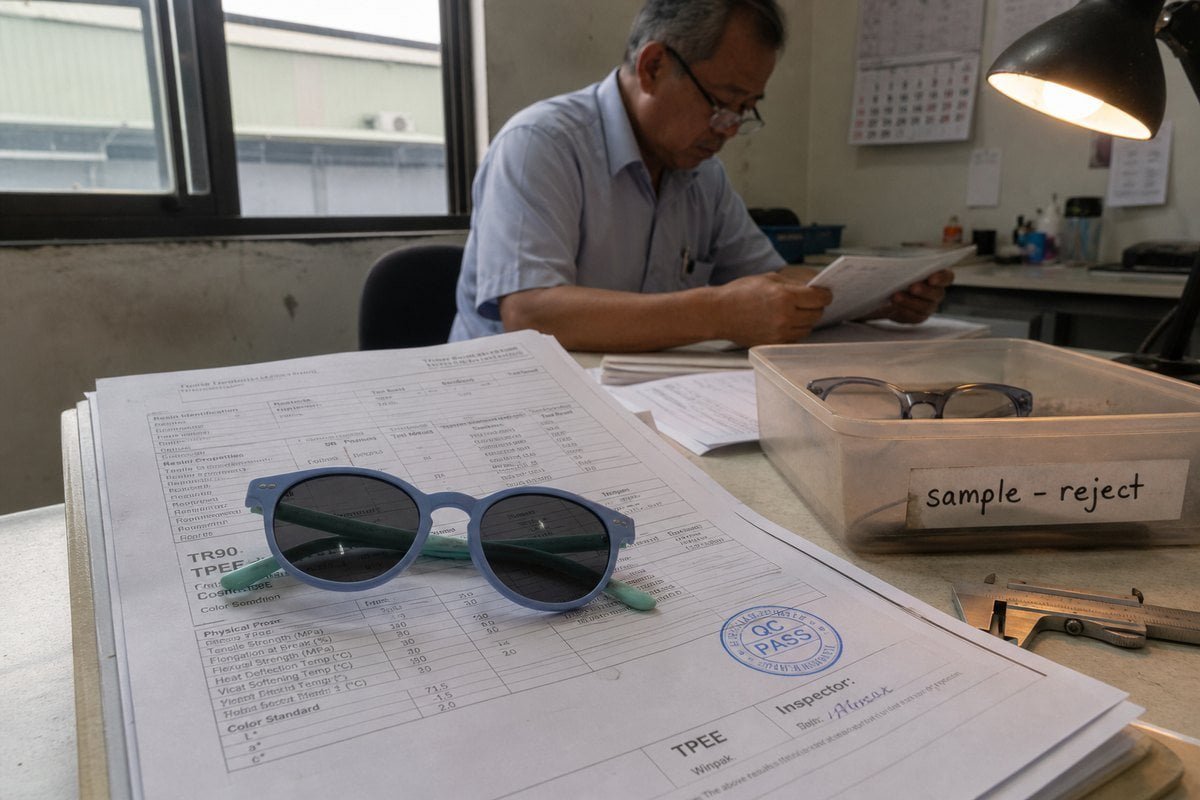
Every quotation we prepare in Taizhou is built from the same five cost blocks. Once you understand them, you can compare supplier quotes intelligently instead of just chasing the lowest number.
The Five Cost Blocks
| Cost Driver | Budget Option | Premium Option | Typical Cost Impact |
|---|---|---|---|
| Frame resin | Generic ABS/PC plastic | TR90, TPEE, acetate | Moderado a alto |
| Lens material | Thin acrylic | Optical-grade polycarbonate lenses 5, Trivex | Moderado |
| Polarization | Sprayed tint (fake) | Embedded polarized film | Alta |
| Coatings | Ninguno | Scratch-resistant coating, mirror coating | Low to moderate |
| Bisagras | Plastic-on-plastic joint | Metal screw or spring hinge | Baja |
Where Spending More Pays Back
Not every upgrade delivers equal value. In our experience exporting to twenty-plus countries, the highest-return upgrades for kids' lines are the frame resin and the lens grade. TPEE and TR90 dramatically cut breakage returns. Optical-grade polycarbonate lenses provide impact resistance and clean optical clarity, which prevents eye-strain complaints. Genuine polarized lens technology is worth it for sport and beach positioning — like our wraparound shield styles with gradient mirrored lenses — but it is optional for basic toddler styles where UV400 protection alone meets the need.
Where New Brands Overspend
Custom molds are the classic trap. Tooling for a brand-new frame shape ties up significant capital before you have sold a single unit. This is why we maintain around 800 existing styles — buyers select proven shapes, customize colors, logos, lenses, and packaging, and keep their per-unit cost focused on materials that parents actually notice. Mirror coatings, premium cases, and retail-ready packaging add smaller increments and can be phased in as your line proves itself. Order quantity matters too: material price gaps shrink at higher volumes, so a premium build at scale often lands closer to a budget build at small volume than buyers expect.
Should I request material certificates or lab test reports before I approve production?
A procurement manager from Europe once asked me whether requesting documents would offend us. My answer surprised her: we respect buyers who ask, because paperwork requests filter out the suppliers who cut corners.
Yes — always request material certificates and lab test reports before approving production. Ask for UV400 verification, impact resistance standards testing, chemical safety documentation for BPA-free materials, and regional compliance such as ANSI Z80.3 certification or EN ISO 12312-1, plus pre-production samples you can independently test.
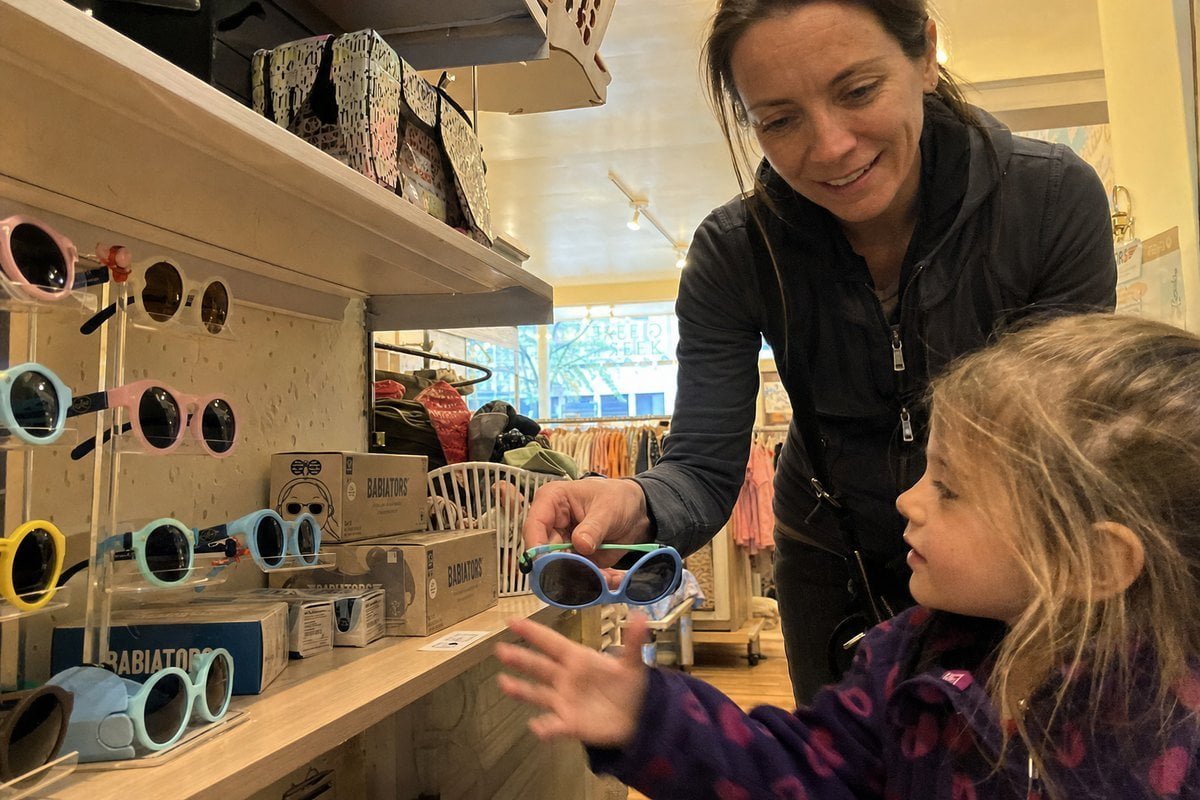
Documentation is your only real protection once containers are on the water. Verbal promises and website claims mean nothing to a customs inspector or a retail compliance auditor. Here is the practical checklist we recommend, based on what our own QC department prepares for clients.
The Document Checklist by Order Stage
- Before sampling: request raw material datasheets for the frame resin and lens material. This confirms the factory actually buys TR90 or TPEE from a named resin supplier.
- At sample approval: request a UV transmission test showing genuine UV400 protection, plus a drop-ball or equivalent impact test result for the lenses. For polarized styles, ask for a polarization efficiency reading to confirm embedded film rather than sprayed tint.
- Before mass production: confirm regional compliance. US-bound orders typically reference ANSI Z80.3 certification 6 and FDA impact requirements. European orders reference EN ISO 12312-1 7 and CE marking. Australian buyers reference AS/NZS 1067. Chemical documentation should cover BPA-free materials and restricted substances for children's products.
- During production: agree on an inspection plan. Our 5S-managed workshop runs in-line checks on hinge torque, lens fitting, and the scratch-resistant coating, and we welcome third-party inspections.
| Región | Estándar clave | Qué cubre |
|---|---|---|
| EE. UU. | ANSI Z80.3 / FDA drop-ball | UV claims, impact resistance |
| UE | EN ISO 12312-1 + CE | UV categories, optical clarity, safety |
| Australia/Nueva Zelanda | AS/NZS 1067 | Lens categories, UV performance |
The Sample Test You Should Run Yourself
Never rely on documents alone. Take pre-production samples and abuse them: twist the frames, leave one on a hot dashboard, check the lenses for waves or "rainbowing" against a light source, and wear-test them on real children if possible. A trustworthy factory expects this. When a buyer tells me their samples survived a week with a three-year-old, that approval means more than any single certificate.
Conclusión
Budget sunglasses can block UV, but cheap materials fail children through breakage, distortion, and discomfort. Verify TR90 and TPEE claims, demand documentation, and choose materials that protect both kids and your brand.
Notas al pie
1. Background on the flexible elastomer polymer class used in premium kids’ frames. ↩︎
2. Explains the polymer property that lets genuine TR90 frames spring back after twisting. ↩︎
3. Authoritative FDA resource explaining the safety and regulation of BPA in consumer products. ↩︎
4. WHO fact sheet on UV radiation exposure that UV400 lenses are designed to block. ↩︎
5. Explains the impact-resistant plastic used for premium children’s sunglasses lenses. ↩︎
6. Official standards body site for the US sunglasses impact and UV compliance standard. ↩︎
7. Official ISO standard for sunglasses safety referenced for European market compliance. ↩︎
Más artículos que te podrían gustar
1 de agosto de 2026
¿Debería la fábrica encargarse del embalaje y etiquetado de las gafas de sol para niños, o utilizar un proveedor designado?
1 de agosto de 2026
Almacén propio vs. Cumplimiento directo del proveedor: ¿Qué reduce los costos de devolución para las marcas de gafas de sol para niños?

1 de agosto de 2026
Directo al almacén del puerto o staging en el extranjero: ¿Cuál ahorra más en el envío de gafas de sol para niños?
¿Buscas un socio confiable en gafas para niños?
Explore más de 800 estilos listos y soporte OEM/ODM completo adaptado a su marca.
Ponte en contacto English
  Español de México
  Deutsch
  Français
  日本語
日本語  العربية
  Português do Brasil