What Does a Kids’ Anti-Blue-Light Glasses Warranty Cover, Including Accidental Drops?
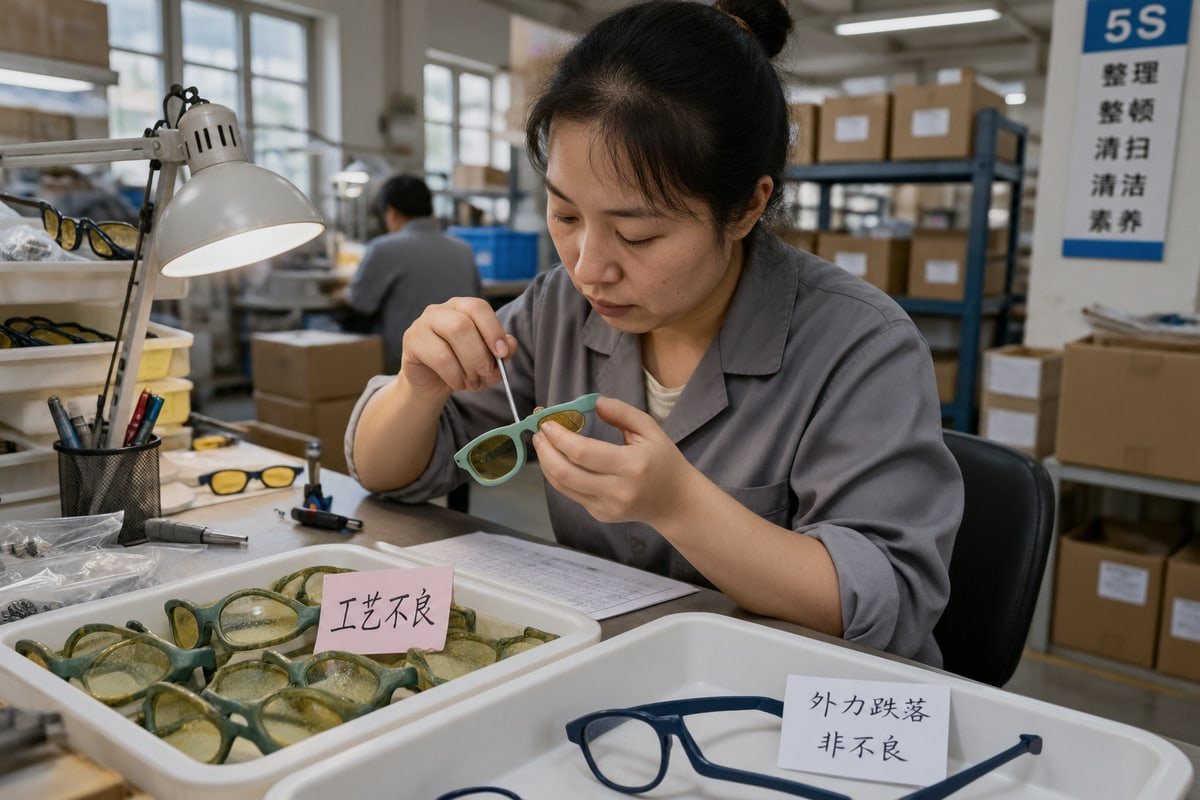
A kids’ anti-blue-light glasses warranty sounds simple until a frame snaps on the playground. On our production line, we see the returns that follow. Here is what coverage really means.
A kids’ anti-blue-light glasses warranty usually covers manufacturer defects only: peeling lens coatings, discolored frames, and faulty hinges. Accidental drops, crushed frames, scratches, and lost glasses are normally excluded unless the seller adds a separate accidental damage protection plan or a one-time replacement policy.
That short answer hides a lot of detail. I will break it down piece by piece. First, what a warranty actually includes. Second, how to read drop coverage. Third, what to check before you order. Finally, how to file a claim with your supplier.
What exactly is included in my kids' anti-blue-light glasses warranty?
Last month our QC team pulled TR90 frames with hinge screws that backed out too easily. That is a defect. A frame stepped on by a toddler is not.
A standard kids' anti-blue-light glasses warranty includes manufacturer defects in materials and workmanship: frame discoloration, peeling or bubbling blue-light coatings, loose or failing hinges, and lenses that fall out of the rim. It normally excludes accidental damage, scratches from wear, and lost or stolen glasses.
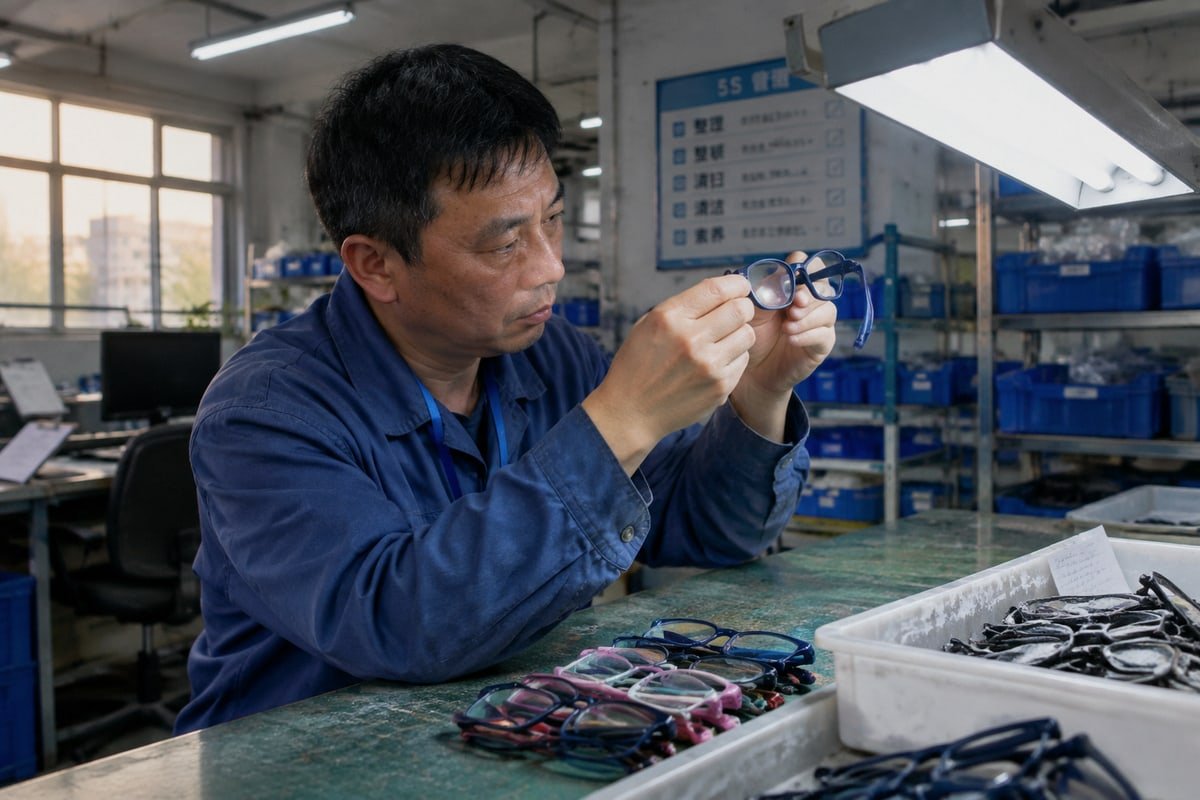
The word warranty gets stretched a lot in children's eyewear marketing. So let me pin it down. A warranty is a promise that the product left the factory without a flaw. It is not a promise that the product will survive a child. Those are two different promises. Parents often expect both. Most policies only give the first one.
Defects versus accidents in plain English
A defect exists before the child ever wears the glasses. The coating was applied badly. The hinge pin was undersized. The pigment was not stable and the matte teal frame turned chalky. In our Taizhou workshop, these are the things our 5S inspection stations 1 exist to catch. When one slips through, that is a warranty issue, and I expect a factory to stand behind it.
An accident happens after delivery. A drop on tile. A bend from being sat on. A chewed temple tip. None of these prove that the frame was made badly. So a defect-only warranty will not respond to them.
| Marca del producto | Usually covered | Usually excluded |
|---|---|---|
| Blue-light coating peeling or bubbling | Sí | — |
| Frame color fading or chalking | Sí | — |
| Fallo de la bisagra en condiciones de uso normal | Sí | — |
| Lens popping out of the rim | Sí | — |
| Cracked frame from a drop | — | Yes, unless breakage program added |
| Surface scratches | — | Yes, treated as wear and tear |
| Lost or stolen glasses | — | Yes, almost always |
| Sunscreen or bug spray damage | — | Usually, unless a chemical stress clause exists |
Are the frame and the lenses covered separately?
Often, yes. Many policies treat the frame, the lens substrate, and the lens treatment 2 as three separate items. Blue-light filtering is a lens treatment. So the coating may sit under a shorter term than the frame. On our optical frames, we bond the front and the TPEE temples with the same care as the lens work, but I always tell buyers to write the two parts into their consumer warranty as separate lines. That keeps claims clear.
One newer idea is the spectral integrity warranty. It promises that the blue-light filtration level 3 will not degrade from UV exposure or cleaning chemicals over time. I like the idea. It ties the warranty to the reason parents buy the product: la fatiga visual digital 4 and screen time eye health. But I have only seen it from a few brands, and the test method is rarely published. Ask for it in writing.
The return window is a de facto warranty
Most online retailers give a 14-to-30-day no-questions-asked return window. In practice, this covers any early problem, defect or not. After that window closes, the real warranty text takes over. That is when the wording matters.
How do I know if accidental drop damage is covered under warranty?
Every time we quote a private-label program, the buyer weighs two costs: a thicker TPEE temple that survives drops, or a cheaper frame plus a replacement fund.
Accidental drop damage is covered only when the warranty text says so. Look for the words accidental breakage, damage for any reason, or one-time replacement. If the policy says manufacturing defects only, a dropped and cracked frame is excluded, and you will need a separate accidental damage protection plan.

I cannot read a policy for you, but I can show you the three coverage levels that exist in this market. Nearly every kids' anti-blue-light glasses warranty falls into one of them. Once you know which one you are looking at, the drop question answers itself.
| Coverage level | Lo que dice | Drops covered? | Real-world example pattern |
|---|---|---|---|
| Defect-only warranty | Manufacturing defects only; accidental breakage and scratches excluded | No | A blue-light kids product that lists defects and then explicitly excludes breakage and scratches |
| Limited breakage warranty | Accidental frame breakage for a set term; lenses often excluded; one replacement cap | Frames yes, lenses often no | A kids' policy covering frame breakage for two years, excluding broken lenses, one replacement per patient |
| Full replacement program | Smashed frames and scratched lenses replaced once per period, usually for a fee | Yes, with limits | A children's optical guarantee replacing frames and lenses once a year for a fee, but not lost or stolen pairs |
Three phrases that tell you the answer
First, manufacturing defects only. This means no. A drop is not a defect.
Second, accidental breakage or damage for any reason. This means yes, but read the limits. The example I see most is one replacement inside a one-year or two-year term. Some broader blue-light programs cover damaged glasses for up to two years and handle lost-or-broken replacement as a separate line.
Third, one-time replacement. This is the middle ground. The brand replaces the pair once per year regardless of cause, often for a small deductible. It is honest and easy to explain to parents.
Why scratches after a drop are usually wear and tear
Lens scratch resistance is not scratch proof. A hard coat on a en sí. En nuestras líneas, las lentes polarizadas para niños pasan por la misma verificación UV y pruebas de caída de bola que todas las demás lentes, porque la película es una característica superpuesta a la seguridad, nunca un sustituto de ella. Cuando una hoja de especificaciones comienza con "polarizado" pero oculta la clasificación UV, lo considero una señal de alerta. 5 resists light abrasion. It does not resist a slide across concrete. So most policies file drop scratches under wear and tear, even when the frame breakage itself is covered. Impact-resistant lenses stop the lens from shattering. They do not stop it from marking.
The objection I hear from both sides
Parents say accidental damage protection should be standard, because children drop, sit on, and bend glasses every week. Retailers say a warranty should stay narrow, and accidents belong in an optional plan. Both are right about their own job. My view from the factory floor is that the argument shrinks when the frame is built for the child. Flexible frame durability in TPEE y TR90 means a drop bends the frame instead of cracking it. Fewer breaks mean fewer claims, and a brand can then afford a generous replacement policy without losing money on it.
A second objection is value. For a low-cost frame, a paid protection plan can cost close to a new pair. For a fitted optical frame with prescription blue-light lenses, the plan makes sense. So match the plan to the product price.
What should I look for in a manufacturer's warranty policy before placing my order?
A procurement manager from Australia once asked me one question before anything else: does your defect rate change the warranty I can promise my customers? Good question.
Before ordering, check the warranty term length and start date, whether frames, lenses, and blue-light coatings are covered separately, the replacement limit, any deductible or service fee, exclusions for lost or stolen glasses, proof-of-purchase rules, and whether claims must go through the original retailer or the factory.

Her question was smart because a brand's consumer warranty sits on top of the factory warranty. If the factory only backs defects for a short window, the brand carries the rest alone. So I now walk every new buyer through the same checklist before we finalize a program. It works for a first order from our existing styles just as well as for a full custom mold.
The parent-facing checklist you should build from the factory terms
| Comprobar | Pregunta a hacer | Señal verde |
|---|---|---|
| Term and start date | Does coverage start at purchase, dispensing, or delivery? | No start date stated |
| Frame vs lens vs coating | Are the three parts covered separately and for how long? | Coating not mentioned at all |
| Límite de reemplazo | One-time, once per year, or unlimited? | The word unlimited with no conditions |
| Fee or deductible | Is there a service, shipping, or restocking fee? | Fees only revealed at claim time |
| Exclusiones | Are lost, stolen, or misplaced glasses excluded? | Exclusions buried in a separate document |
| Proof required | Receipt, photos, original parts, or returned frame? | Proof rules that change after purchase |
| Claim channel | Original retailer only, or also the factory or brand? | Third-party purchases voided without notice |
Watch the marketing words
A limited lifetime warranty is not a promise of unlimited replacements. The limited part is the whole story. It normally means defects only, for as long as the original owner 6 keeps the pair, with proof of purchase. Worry-free and damage protection are also marketing labels. They can hide the same exclusions. Read the claim rules, not the headline.
Some buyers treat an extended protection plan as children's eyewear insurance. It is close, but the plan usually excludes theft and loss, which real insurance may cover. Say that clearly to parents so expectations match.
Emerging clauses worth asking about
I am seeing a few newer terms in buyer requests. A growth-fit guarantee allows a one-time frame size exchange within the first six months, because children outgrow a bridge width quickly. A chemical stress cracking clause covers frame failure caused by sunscreen or bug spray reacting with the frame polymer. We test our TPEE and TR90 blends against common kids' sunscreens for exactly this reason, because summer returns often trace back to it. I have also heard of smartphone stress-test apps that flag micro-fractures at the bridge for a proactive swap. I would treat that one with caution until the brand shows you how it works.
Why the factory matters as much as the policy
A warranty is only as good as the defect rate behind it. With roughly 800 existing styles, our buyers can launch without heavy mold investment and test the market with lower risk. That same catalog has fifteen years of field feedback in it. So when a brand writes a two-year frame breakage term, I can tell them which temple designs and hinge types will make that term affordable and which will not.
How do I file a warranty claim if my supplier's kids' glasses arrive damaged or defective?
We learned early that a claim without photos becomes a week of emails. Now we ask every buyer to open cartons on arrival and send damage images quickly.
To file a warranty claim, inspect the shipment on arrival, photograph the damage and carton labels, note the PO number and lot, and email your supplier within the agreed claim window. Keep the defective pairs until the supplier confirms whether to return them, then agree on replacement, credit, or repair.
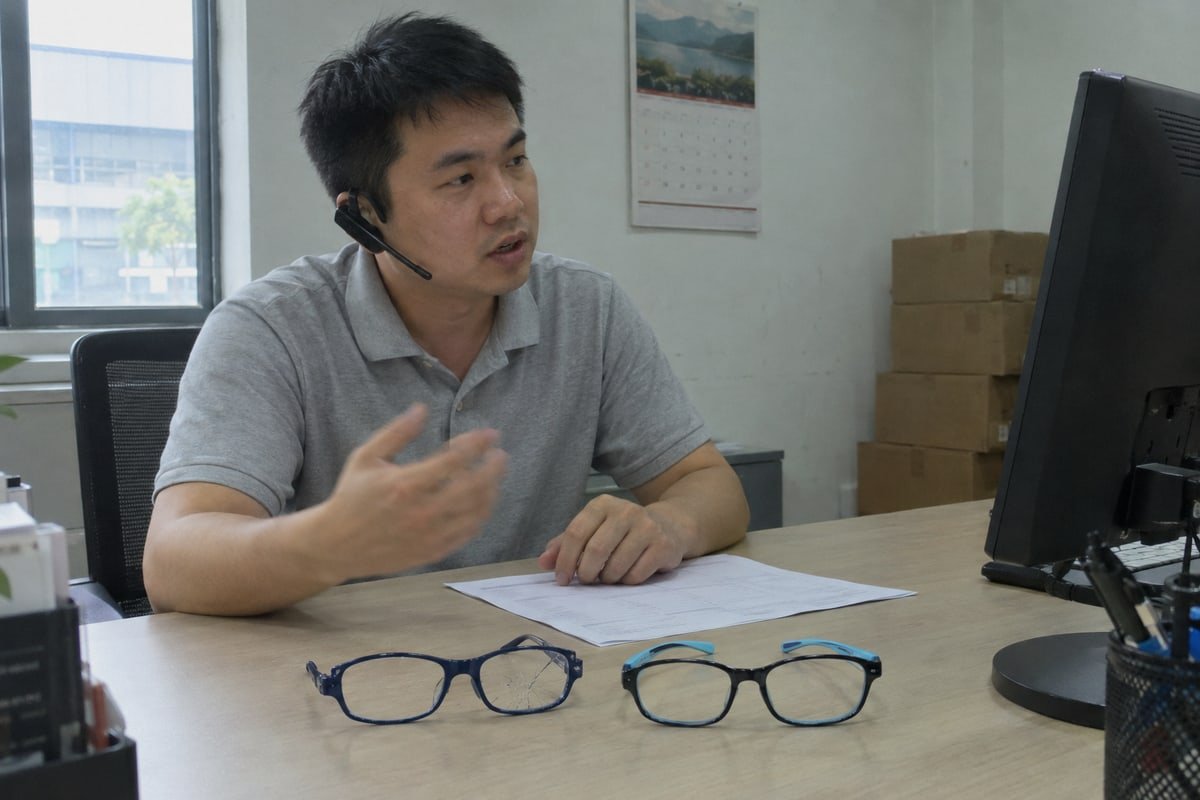
A B2B claim is different from a parent returning one pair to a shop. You are dealing with cartons, lots, and a contract. The good news is that a clear process makes it fast. Here is the one we use with our own customers, and it is the one I would ask any supplier to follow.
The claim process step by step
- Inspect on arrival. Open a sample of cartons the same day the goods land. Transit damage and factory defects look different, and the first hours tell you which one you have.
- Photograph everything. Shoot the damaged pair, the inner packaging, the carton label, and the shipping mark. Photographic evidence is the standard requirement in this industry, and it settles most disputes at once.
- Record the details. Write down the PO number, the lot or batch code, the style number, and the quantity affected. A matte navy frame with a lifted coating and a teal frame with a loose hinge are two claims, not one.
- Notify within the window. Most supply agreements set a claim period. Send the notice inside it, even if you are still counting.
- Hold the goods. Do not scrap or resell defective pairs until the supplier says so. Some warranties require the returned frame or original parts as proof.
- Agree the remedy. Replacement in the next shipment, credit note, or repair. Ask who pays return shipping. Many consumer policies push return shipping onto the customer, so make sure your supply contract does not.
Evidence that speeds a claim
| Evidence | Por qué importa |
|---|---|
| Close-up photos of the defect | Shows defect versus transit crush or handling damage |
| Carton and pallet photos | Proves whether damage happened in transit |
| Lot or batch code | Lets the factory trace the injection run or coating batch |
| Quantity count | Sets the size of the replacement or credit |
| Proof of purchase or PO | Confirms the claim sits inside the warranty term |
Where the factory claim meets the parent claim
Your consumer warranty is a promise you make. Your factory warranty is the promise that funds it. When a parent files a claim for a peeled blue-light coating, that pair should be traceable back to a batch. In our workshop, each lot gets a record from injection through lens fitting and packing. That record is what lets us honor a defect claim months later without argument. It is also what tells us whether a pattern of returns is a real defect or a design that needs a change. A supplier who cannot trace a lot cannot really back a warranty.
Conclusión
Kids drop glasses. A defect-only warranty won't save you. Read the coverage, add a replacement policy where it makes sense, and partner with a factory whose flexible frames fail less.
Interested in sourcing the products mentioned in this article? See details and request a quote here:
Notas al pie
1. International standards for quality management and inspection processes in manufacturing. ↩︎
2. Leading trade association providing industry standards for optical lenses and treatments. ↩︎
3. Comprehensive overview of blue light technology and its physiological effects. ↩︎
4. Authoritative medical guidance on digital eye strain from the American Academy of Ophthalmology. ↩︎
5. FDA regulatory information concerning medical device standards for spectacle frames and lenses. ↩︎
6. Official Federal Trade Commission resources regarding business guidance and consumer warranty regulations. ↩︎
Más artículos que te podrían gustar


¿Buscas un socio confiable en gafas para niños?
Explore más de 800 estilos listos y soporte OEM/ODM completo adaptado a su marca.
Ponte en contacto English
  Español de México
  Deutsch
  Français
  日本語
日本語  العربية
  Português do Brasil