What FDA QMSR Design and Complaint Records Are Needed for Private Label Kids Optical Frames?
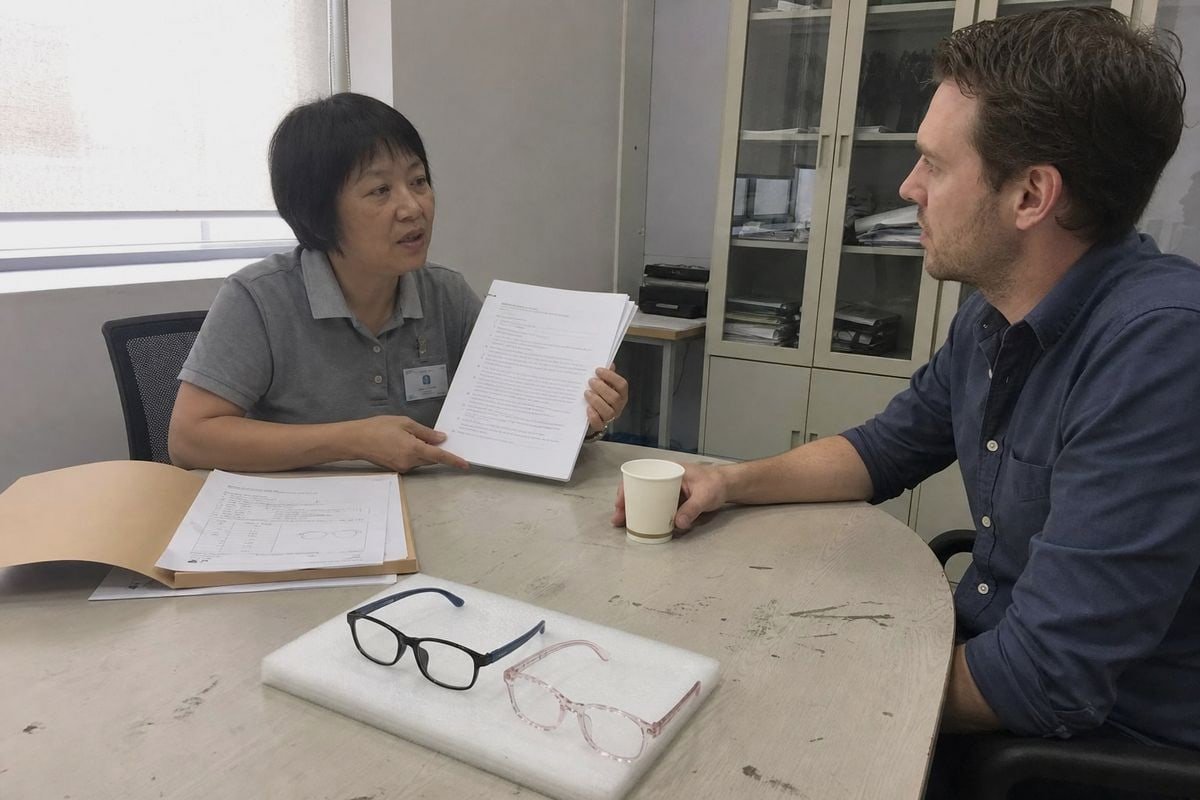
FDA QMSR design and complaint records for private label kids optical frames confuse many buyers who visit our Taizhou factory. They assume branding a frame means zero paperwork.
Private label kids optical frames need a design and development file (design plans, inputs, outputs, reviews, verification, risk analysis, change records) plus documented complaint handling records covering intake, investigation, MDR screening, escalation, and closure — with a quality agreement assigning each responsibility between brand and manufacturer.
That answer covers the essentials, but the details decide whether an FDA inspection goes smoothly. Let me walk you through each record set, based on what we prepare for our own private label clients.
What design history file documents do I need from my manufacturer to meet FDA QMSR requirements?
A procurement manager from Australia once asked me for "the DHF" of one of our ~800 stock frames. Her lawyer had warned her that QMSR renamed things, and she wanted to know exactly what to request.
Request a design and development file containing the design plan, design inputs (user needs, sizing, safety requirements), design outputs (drawings, material specs, labeling artwork), design review records, verification and validation results, risk management documentation, design transfer records, and all approved design changes.

Here is the key nuance. The QMSR replaced the old 21 CFR Part 820 terminology with ISO 13485-style language 1. So FDA no longer names the design history file, Device Master Record, or Device History Record the same way. But the underlying content is still required. Manufacturers must maintain a design and development file for each device type or family, and that file must include or reference records proving conformity to design controls, including changes. In our experience, nobody expects you to scrub old files of the term "DHF" — but you must keep the evidence.
What the file looks like for pediatric eyewear
Kids optical frames are simple products with real design risks. When our engineers develop a TR90 frame with TPEE temples, the design record has to reflect child-specific concerns: fit across age ranges, flexibility and breakage resistance, skin-contact material safety, and pinch-point or sharp-edge risks. A risk analysis such as an FMEA 2 should cover hazards unique to children — small detachable parts, silicone temple tip durability, and skin irritation.
| Record type | What it should show for kids optical frames |
|---|---|
| Design plan | Development stages, responsibilities, review points |
| Design inputs | Intended user age range, sizing data, material safety needs, labeling requirements |
| Design outputs | Drawings, dimensions, TR90/TPEE material specs, coatings, packaging specs, artwork |
| Design reviews | Signed review records at defined milestones |
| Verification | Dimensional checks, durability and flex testing records |
| Validación | Evidence the frame meets user needs in real wear conditions |
| Risk management | FMEA covering choking, skin contact, breakage hazards |
| Design changes | Controlled revision history after approval |
Your quality management system does not need to hold every raw file — but you need documented access to it, and evidence that your branded product stayed within the approved design family.
How do I set up a compliant complaint handling process for my private label kids optical frames?
One lesson we learned early in exporting to the US: a complaint about a snapped temple is never "just customer service." It is a regulatory record, and it must be handled that way from the first email.
Establish written complaint handling procedures covering prompt logging, categorization, investigation, Medical Device Reporting evaluation, escalation to the manufacturer, corrective action linkage, closure, and trending. Even CGMP-exempt devices still require complaint files, so retain records and define response timelines contractually.
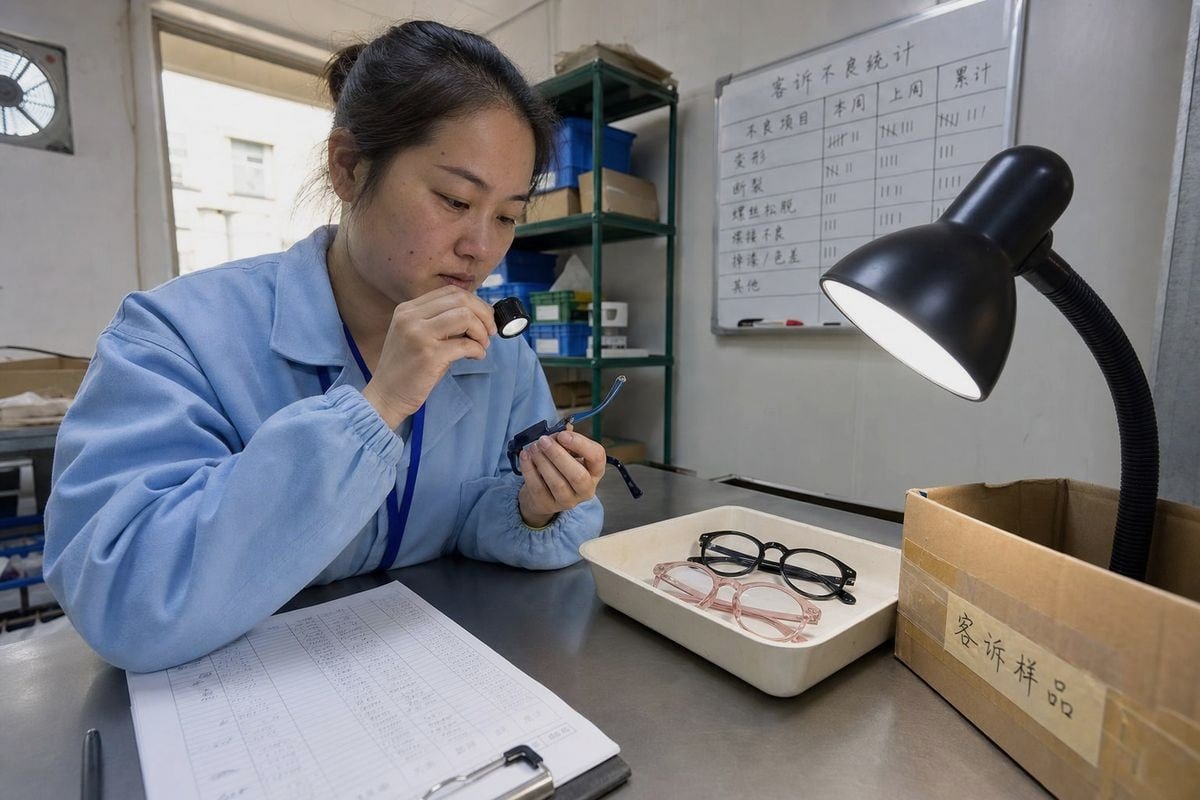
FDA has been explicit on one point: exemption from most CGMP requirements does not exempt finished-device manufacturers from keeping complaint files. That surprises many private label brands. Even for a Class I frame, complaints must be received, evaluated by a designated function, investigated where needed, and screened against medical device reporting criteria. The QMSR rulemaking deliberately kept specific requirements so MDR-relevant information gets captured in complaint records.
A practical intake-to-closure process
For a kids product, I recommend building the process around these steps:
- Intake. Log every complaint with date, product identifier, lot or batch, and description. Capture feedback from all channels — retail returns, email, social media, and online reviews, since modern complaints rarely arrive by phone.
- Clasificar. Categorize the issue. For pediatric eyewear, include a specific "fit and comfort" category, plus breakage, material reaction, and lens issues.
- MDR screening. Assess whether the event involves injury or could cause one. A scratched cornea from a broken frame is very different from a loose screw.
- Investigation. Escalate to the factory with photos, lot numbers, and wear conditions. At our workshop, we trace complaints back to production records within days.
- Corrective action. Link recurring complaints to CAPA, and watch trends that could justify corrections, removals, or recalls.
- Closure and retention. Document the disposition and keep records accessible, even if a partner runs the system.
The complaint file must contain enough information to decide whether an event becomes an MDR report. That determination — not the customer refund — is the regulatory heart of the record.
What records should I request from my OEM partner to prove design controls are in place?
There is a trade-off I discuss with almost every new brand client: audit us deeply before launch, or rely on our documentation package. The honest answer is you need both — and you need the right list.
Request the design and development file (or summaries), ISO 13485 certification or QMS evidence, production and release records, labeling and artwork approvals, material safety test reports, risk management files, change control logs, and a signed quality agreement defining complaint, MDR, and recall responsibilities.
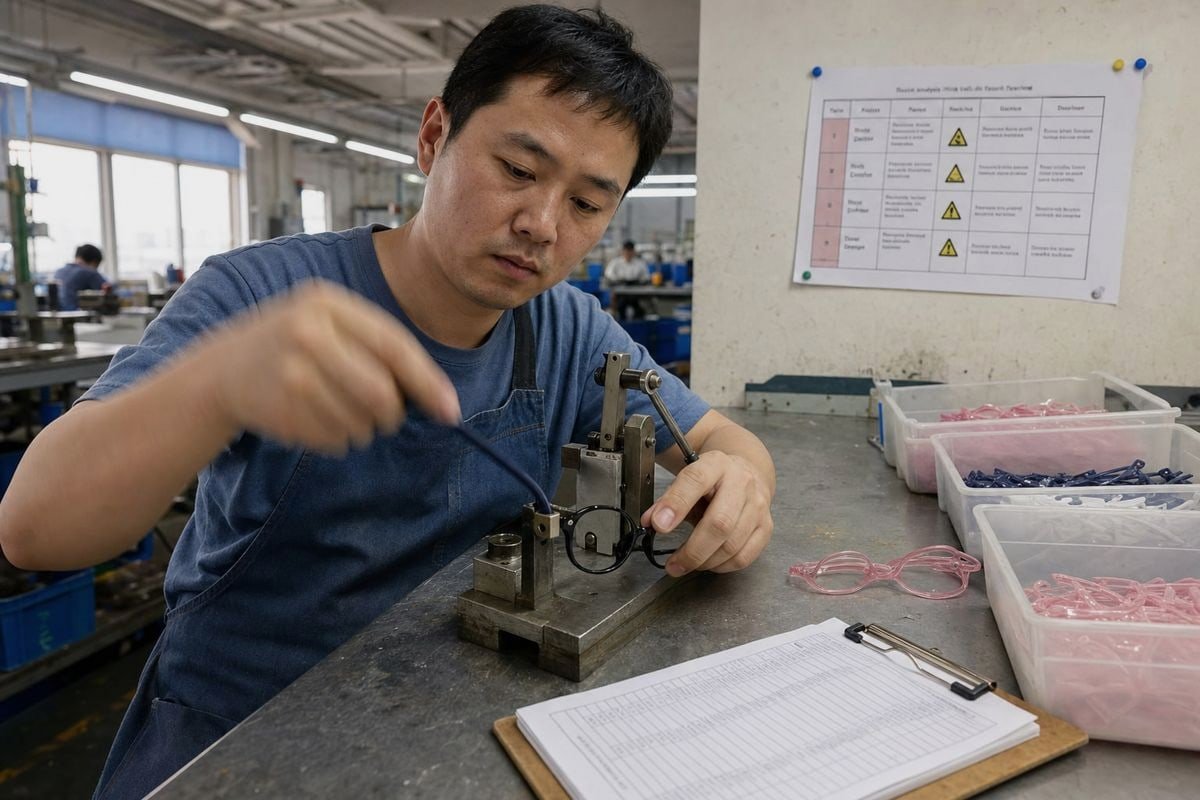
Think of the records in three buckets. This framing helps buyers avoid the common assumption that "QMSR means only a quality manual." The QMSR is record-based and process-based, not just policy-based.
The three-bucket record checklist
| Bucket | Records to request | Por qué importa |
|---|---|---|
| Device-specific design file | Design inputs, outputs, reviews, verification, validation, risk analysis, change history | Proves the branded frame was designed under design controls |
| Production and labeling evidence | Specifications, packaging specs, label approvals, artwork control, lot release records, Unique Device Identifier data where applicable | Proves the shipped product matches the approved configuration |
| Postmarket complaint file | Complaint intake, investigation, MDR screening, escalation, disposition, trends | Proves postmarket surveillance obligations are being met |
Verifying the partner, not just the paper
Documentation only means something if the factory behind it is real. When buyers audit our 5S-managed workshop in Taizhou, we walk them through how artwork changes flow through change control, and how each private label configuration is traced to the master design family. Ask your OEM partner these questions: Does your quality management system control design changes formally? Can you show the verification data for the exact frame model I am branding? Who holds establishment registration and device listing responsibilities in our arrangement? Remember that registration and listing alone do not replace QMSR records — a listing entry is an administrative record, not evidence of design controls.
One caution on private label manufacturing specifically: your name on the temple arm creates public accountability. If the design record cannot show your branded version stayed within the validated design, you carry that gap, not your supplier.
How can I avoid FDA compliance risks when launching private label kids eyewear under QMSR?
Early in my time working with US importers, a client nearly launched a pastel acetate kids frame with age claims on the packaging that nobody had reviewed against the design inputs. We caught it during artwork approval. That near-miss shaped how we structure every launch since.
Sign a supplier quality agreement assigning design, complaint, MDR, and recall duties before launch; verify the design file covers your branded configuration; control labeling and age claims; establish complaint escalation timelines; and retain documented access to all quality records.

The strongest mental model here is simple: private label is not the same as record-light. If you put your name on a medical device, the QMSR documentation burden exists somewhere in the chain, and the parties must clearly assign it. Some brands push back and say private label products are "just resale." I understand the appeal of that view — but it fails at the first FDA inquiry, because the agency looks at who the device is labeled for, not who molded the plastic.
The quality agreement is your safety net
Industry practice — not a regulatory rule, but a widely used one — is that the original manufacturer retains complaint handling, medical device reporting, and recall responsibility unless the contract says otherwise, and the private labeler forwards complaints within a defined number of business days. Put that timeline in writing. Vague escalation clauses are where compliance gaps hide.
| Common mistake | Consequence | Prevention |
|---|---|---|
| No quality agreement | Undefined MDR and recall ownership | Sign an SQA before first purchase order |
| Uncontrolled artwork changes | Branded product drifts from approved design | Route all labeling through change control |
| Complaints handled as returns only | Missed MDR determinations | Written complaint handling procedures with MDR screening |
| Relying on listing alone | No design or complaint evidence in inspection | Maintain the three record buckets |
| Ignoring child-specific risks | Safety gaps in risk file | FMEA tailored to pediatric hazards |
Also address labeling requirements deliberately. Age claims, warnings, and intended-user statements on kids eyewear are design inputs, not marketing afterthoughts. When we run OEM projects — custom colors, logos, lenses, and retail-ready packaging — the artwork approval step doubles as a labeling control record. That single habit closes more compliance gaps than any policy document.
Conclusión
Branding kids frames without QMSR records invites inspection failures and recalls. Secure the design file, complaint procedures, and a quality agreement — then launch with confidence and a documented paper trail.
Notas al pie
1. Official source for the ISO 13485 standard for medical device quality management systems. ↩︎
2. Provides a comprehensive overview of Failure Mode and Effects Analysis (FMEA). ↩︎
Más artículos que te podrían gustar

5 de agosto de 2026
Bio-Based vs Regular Cellulose Acetate: What's the Difference for Kids' Frames?

5 de agosto de 2026
How Recyclable Are Kids' Optical Frame Materials, and What Eco-Friendly Alternatives Exist?
5 de agosto de 2026
Do Kids Optical Frames Whiten or Age in Storage, and How to Control Warehouse Conditions?
¿Buscas un socio confiable en gafas para niños?
Explore más de 800 estilos listos y soporte OEM/ODM completo adaptado a su marca.
Ponte en contacto English
  Español de México
  Deutsch
  Français
  日本語
日本語  العربية
  Português do Brasil