What Certifications Are Required for Kids’ Sunglasses in Japan?
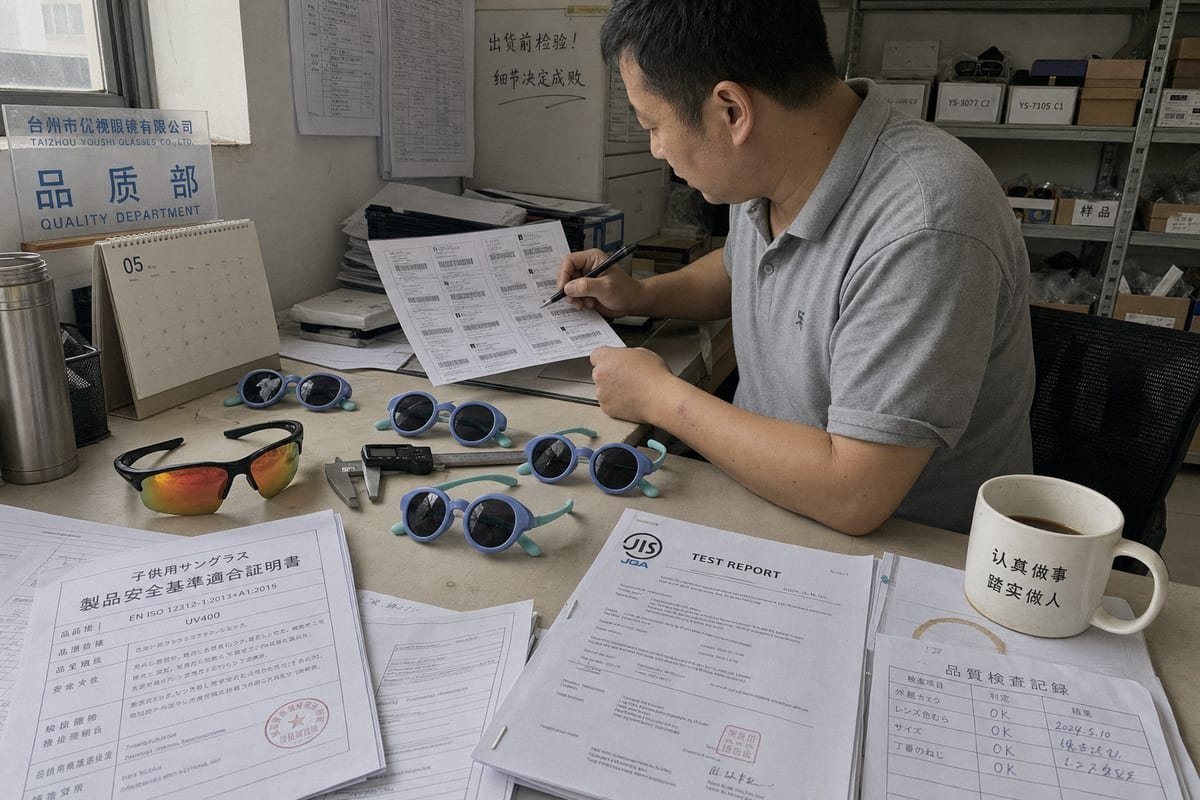
Last spring, a Tokyo buyer asked our factory one blunt question: which certifications for kids’ sunglasses in Japan do we actually need? Getting this wrong can freeze your shipment at customs.
Kids’ sunglasses in Japan require no single mandatory certification, but they must comply with the Household Goods Quality Labeling Act, meet expectations set by JIS T 7333, satisfy the Consumer Product Safety Act, and carry accurate Japanese-language labels for UV transmittance and visible light transmittance.
That sounds simple, but the details trip up many brands. Below, I walk through each rule, the tests behind it, and the documents your factory should hand you.
What Japanese safety standards must my kids' sunglasses meet before I can sell them?
During a recent 5S audit walk-through in our Taizhou workshop, a Japanese distributor spent more time checking our labeling files than our injection molds. That told me everything about how Japan approaches compliance.
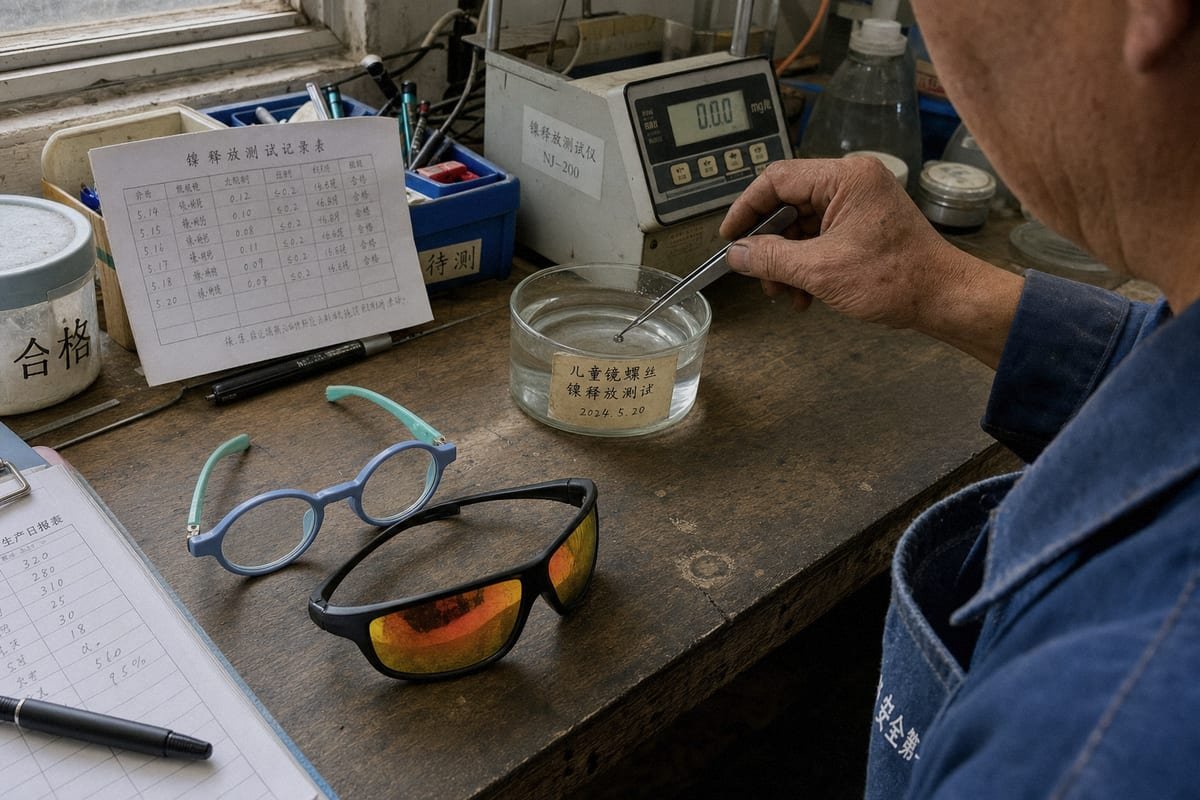
Before selling kids' sunglasses in Japan, you must satisfy the Household Goods Quality Labeling Act with Japanese-language labels, follow JIS T 7333 benchmarks for lens performance, comply with the Consumer Product Safety Act, and verify material safety, including nickel release limits on metal parts.
Japan does not run one giant approval system for eyewear. Instead, it layers several rules together. Miss one layer, and your product looks non-compliant even if the lenses are excellent.
The main legal and voluntary layers
Here is how I explain the framework to new buyers who plan to enter the Japanese market:
| Requisito | Mandatory or Voluntary | Qué cubre |
|---|---|---|
| Household Goods Quality Labeling Act | Mandatory | Japanese labels: frame material, visible light transmittance, UV transmittance |
| JIS T 7333 1 | Voluntary but expected | Optical lens quality, UV limits, transmittance categories |
| Ley de Saneamiento de Alimentos | Mandatory | General product safety; PSC Mark for sunglasses positioned as infant toys (under 36 months, from December 2025) |
| Food Sanitation Law | Mandatory for under-6 products | Heavy metals and phthalates in mouth-contact materials |
| ST Mark / SG Mark certification | Voluntary | Extra trust signals for children's product safety |
One naming rule deserves special attention. In Japan, a product may only be labeled サングラス (sunglasses) if UV transmittance is 1.0% or less. Otherwise, it must be sold as ファッション用グラス (fashion glasses). We flag this early with every buyer, because it directly affects packaging artwork.
Material safety matters too. Metal hinges and screws should pass nickel release checks 2, since children's skin is sensitive. Frames should also show basic impact resistance, so a fall on the playground does not create sharp fragments. Our TR90 and TPEE frames 3 were chosen precisely because they flex instead of snapping.
Finally, remember the age dimension. Products aimed at younger children face stricter chemical rules, and sunglasses marketed as infant toys will need the PSC Mark under the revised Consumer Product Safety Act.
How do I get UV400 protection verified for the Japanese market?
A trade-off we weigh on every lens order is cost versus proof. A UV400 sticker costs nothing; a credible test report costs money and time. Japanese buyers always want the report.
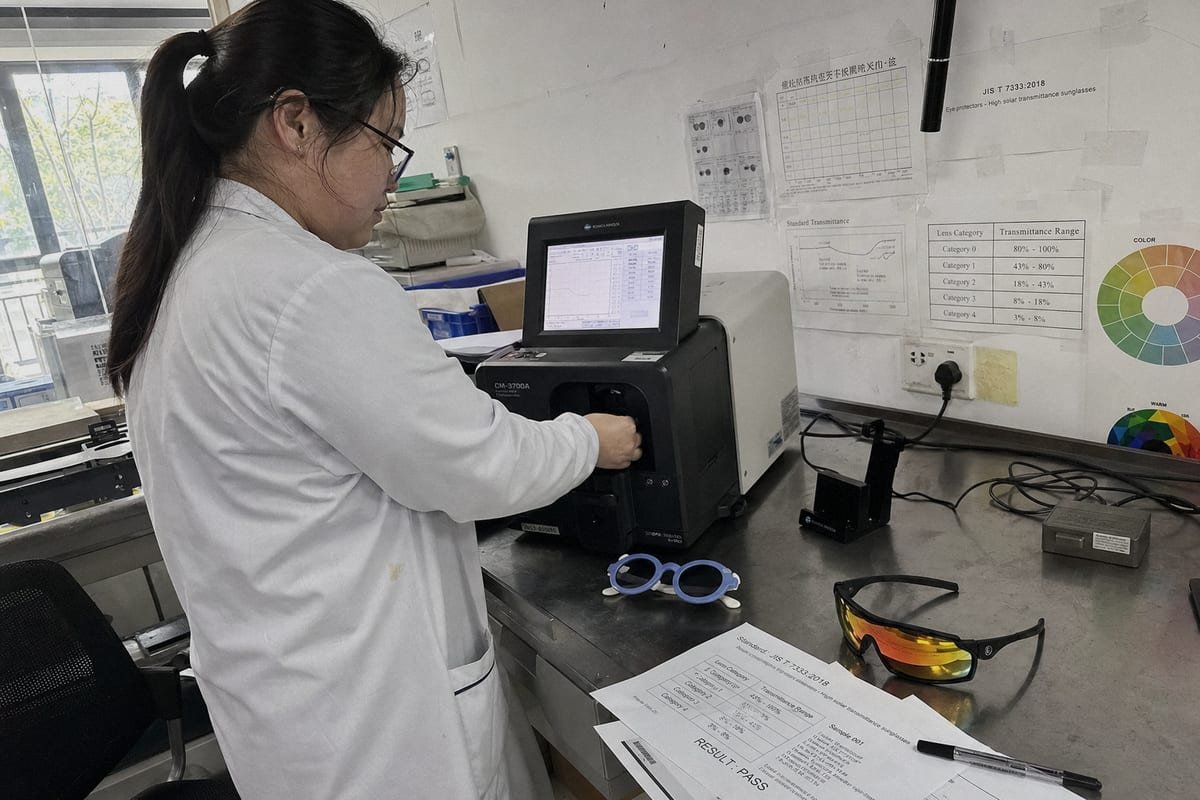
To verify UV400 protection for Japan, send lens samples to an accredited laboratory for spectrophotometer testing against JIS T 7333, confirming UV transmittance at or below 1.0% up to 400nm, then record the measured visible light transmittance and UV values on your Japanese product label.
UV400 is a marketing claim until a lab proves it. So the verification process is really about turning a claim into evidence. Here is the process we follow with our own polarized and UV400 lens options 4.
A practical verification workflow
- Select the right test method. Ask the lab to test against JIS T 7333, not only UE / Internacional 5 or EN ISO standards. The methods overlap, but Japanese customers and JSOI inspection routines reference the JIS framework.
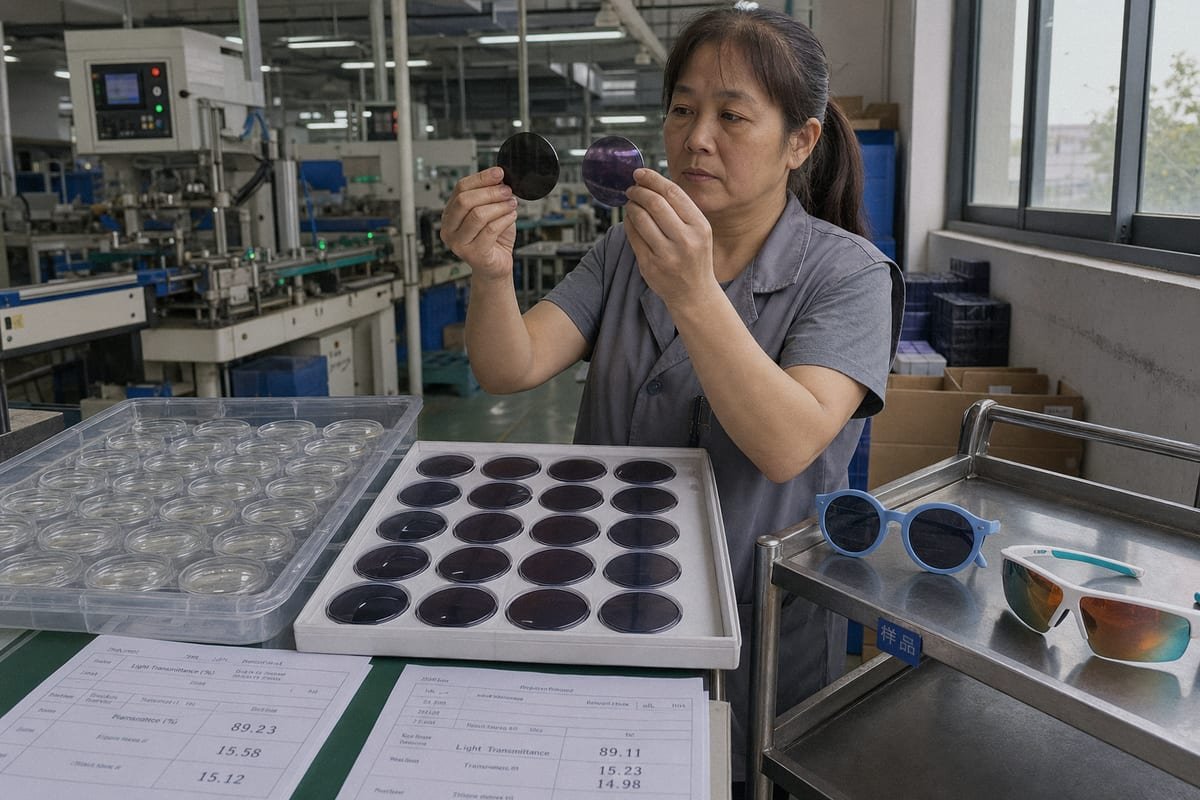
- Test finished lenses, not raw material. Tinting, coating, and molding can shift transmittance. We always cut samples from a finished production batch.
- Measure both UV-A and UV-B blocking. The report should show transmittance across 280–400nm. For a true Protección UV400 6 claim, transmittance up to 400nm must stay at or below 1.0%.
- Record visible light transmittance. Japan's labeling rules demand this value, and it also determines whether a lens is safe for driving or too dark for toddlers.
- Match the label to the data. The percentage printed on your Japanese label must reflect the tested batch, not a generic supplier claim.
Common pitfalls I see
Some brands re-use an old report for a new lens color. That fails, because darker tints change visible light transmittance even when UV blocking stays constant. Others confuse "99% UV Cut" wording with UV400; both are acceptable consumer labels in Japan, but each needs its own supporting data. There is also a rising interest in blue light reduction testing under JIS T 7333, driven by Japanese concern about screen time. We treat that as an optional selling point, not a legal must-have, and we advise buyers the same way.
Which documents should I request from my manufacturer to prove compliance?
One lesson I learned the hard way, years into exporting children's eyewear: a buyer once delayed a launch for six weeks because a single test report listed the wrong lens color code. Paperwork precision matters as much as product quality.
Request UV and visible light transmittance test reports referencing JIS T 7333, material safety certificates covering phthalates, heavy metals, and nickel release, impact resistance results, a Japanese-compliant label draft, and a signed declaration of conformity identifying the exact production batch.
Think of the document pack as your defense file. If a customs officer, a retailer, or a parent ever questions your product, this file answers for you. I recommend building it before your first purchase order, not after.
The essential document checklist
| Documento | Lo que prueba | Who issues it |
|---|---|---|
| Lens transmittance report | UV400 protection and visible light transmittance values | Accredited third-party lab |
| Material safety report | No banned phthalates, heavy metals; low nickel release | Third-party lab |
| Impact resistance / mechanical test | Frame and lens survive drops and flexing | Lab or factory QC with records |
| Optical lens quality report | No distortion, correct refractive properties | Lab, aligned with JIS benchmarks |
| Japanese label draft | Compliance with Household Goods Quality Labeling Act | Manufacturer plus importer review |
| Declaration of conformity | Links all reports to a specific batch and model | Manufacturer |
| Bill of materials | Frame and lens materials, coatings, metal parts | Manufacturer |
How to read these documents critically
Do not just file the reports. Check three things. First, the model number and color on the report must match your order exactly. Second, the test date should be recent; a five-year-old report on a reformulated material proves little. Third, the lab should be recognized, since some Japanese retailers and JSOI inspection processes will question unknown testing houses.
At our factory, we keep batch-linked QC records for every export order, so when a Japanese importer asks which resin lot produced their frames, we can answer in a day. That traceability is what separates a long-term supplier from a one-shipment vendor.
Can my OEM/ODM partner help me pass Japan's certification requirements smoothly?
A procurement manager from Osaka once told me she chooses factories by asking one question: "Show me how you handled your last failed test." How a partner responds to problems predicts your compliance journey.
Yes. An experienced OEM/ODM partner can pre-select compliant TPEE and TR90 materials, arrange third-party testing to Japanese standards, prepare Japanese-language labels, support SG Mark certification or ST Mark applications, and supply batch-traceable documentation, cutting your certification timeline and risk significantly.

A good factory does not just make frames. It removes compliance friction before you ever feel it. Let me break down where a capable partner adds value, based on how we run projects with buyers in 20+ countries, including Japan.
Where a partner helps most
| Etapa | What a strong OEM/ODM partner does | Risk if handled alone |
|---|---|---|
| Material selection | Chooses BPA-free, hypoallergenic TPEE and TR90 with clean chemical histories | Late-stage phthalate or heavy metal failures |
| Design | Sizes frames to child face geometry and builds in flexibility | Poor fit, safety complaints, returns |
| Pruebas | Books labs familiar with JIS T 7333 and Japanese chemical rules | Wrong test method, wasted fees |
| Labeling | Drafts Japanese labels with transmittance data and importer details | Customs holds, retailer rejection |
| El próximo Pasaporte Digital de Producto de la UE requerirá un registro de transparencia escaneable para EPP. Las marcas que solo tienen informes de prueba en papel tradicionales, comunes en las cadenas de suministro centradas en Australia, deberían comenzar a estructurar archivos de cumplimiento digital ahora. | Maintains batch-linked declarations and QC records | Gaps during audits or recalls |
Questions to ask before you commit
Ask whether the factory has shipped children's eyewear to Japan before. Ask who owns the test reports, you or the factory. Ask how they handle the new Domestic Supervisor rule 7, since overseas e-commerce sellers must appoint a Japan-based responsible person by late 2025. Also ask whether they can support voluntary marks like the ST Mark or SG Mark certification if your retail channel requests them.
One practical advantage worth mentioning: because we hold around 800 existing styles, buyers can start with a proven frame that already has material data behind it, then customize colors, logos, lenses, and packaging. That path is far faster than opening a new mold and testing an unknown design from zero. For a brand entering Japan, speed with documentation beats speed alone.
Conclusión
Japan demands layered compliance, not one badge: accurate labels, verified UV400 data, safe materials, and solid documents. Partner with a factory that proves all four, and market entry becomes smooth.
Notas al pie
1. Explains the Japanese Industrial Standards system that governs lens performance benchmarks like JIS T 7333. ↩︎
2. Official ISO standard 12870 specifying requirements and test methods for nickel release in spectacle frames. ↩︎
3. Background on thermoplastic elastomer materials clarifies why TR90 and TPEE resist snapping. ↩︎
4. Explains polarized lens technology referenced alongside UV400 protection in the verification workflow. ↩︎
5. Official ISO landing page for the current 2022 international standard for sunglasses and related eyewear. ↩︎
6. WHO provides authoritative background on UV radiation exposure risks that UV400 protection claims address. ↩︎
7. Japan’s Consumer Affairs Agency is the regulator behind the new Domestic Supervisor requirement for overseas sellers. ↩︎
Más artículos que te podrían gustar
1 de agosto de 2026
¿Debería la fábrica encargarse del embalaje y etiquetado de las gafas de sol para niños, o utilizar un proveedor designado?
1 de agosto de 2026
Almacén propio vs. Cumplimiento directo del proveedor: ¿Qué reduce los costos de devolución para las marcas de gafas de sol para niños?

1 de agosto de 2026
Directo al almacén del puerto o staging en el extranjero: ¿Cuál ahorra más en el envío de gafas de sol para niños?
¿Buscas un socio confiable en gafas para niños?
Explore más de 800 estilos listos y soporte OEM/ODM completo adaptado a su marca.
Ponte en contacto English
  Español de México
  Deutsch
  Français
  日本語
日本語  العربية
  Português do Brasil