What Are the Sizing & Marking Standards and Acceptable Error for TR90 Kids Optical Frames?
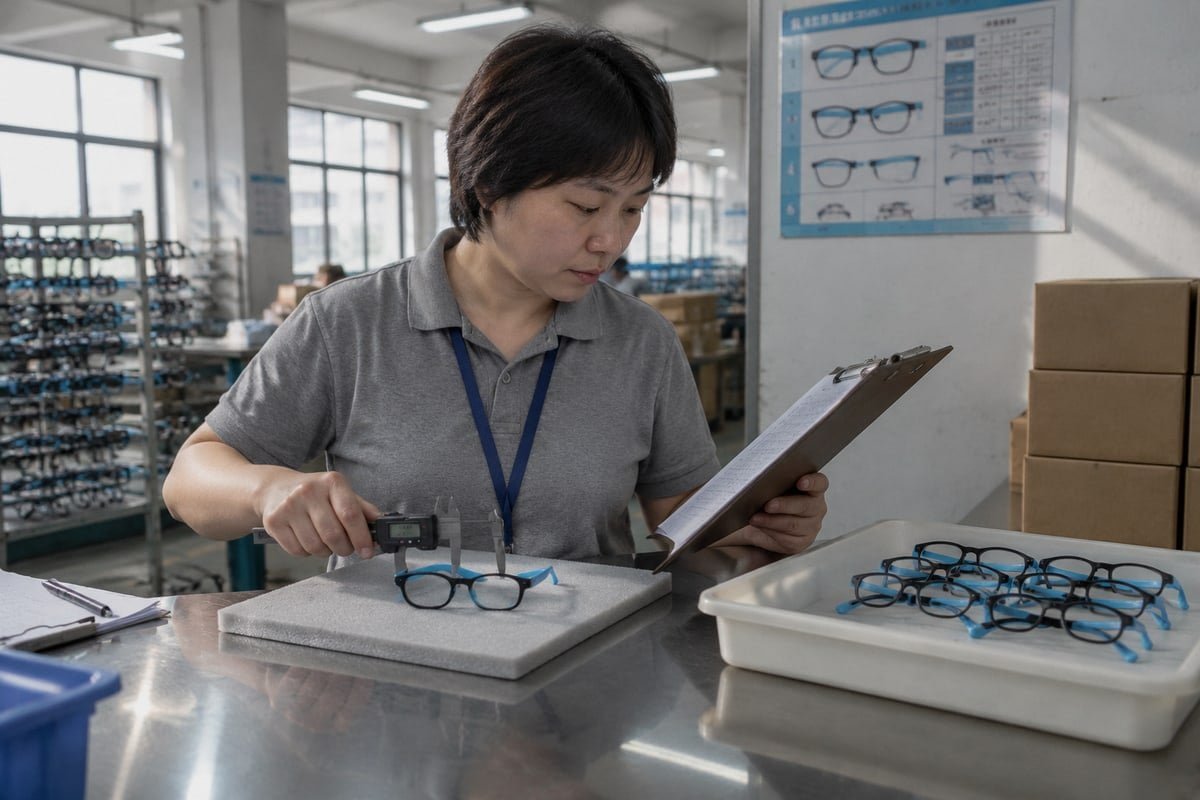
Every season, buyers send us TR90 kids optical frames from other suppliers that slide, pinch, or mis-center lenses. Wrong sizing wastes stock and trust. Clear sizing and marking standards fix that.
Las monturas ópticas infantiles de TR90 siguen las medidas del sistema de caja ISO 8624 para el ancho de la lente, el ancho del puente y la longitud de la varilla. Las marcas se encuentran en el interior de la varilla: fabricante, modelo y tamaño. Las tolerancias dimensionales de la norma ISO 12870 permiten aproximadamente ±0,5 mm en el tamaño de la lente y ±2,0 mm en la longitud de la varilla.
Those numbers are the short version. Below, I walk through how to read them, what to check on a sample, and when a batch should go back.
¿Cómo sé qué tamaño de montura se ajusta correctamente a la cara de mi hijo?
A product manager from Melbourne once asked me why her sample fit her daughter but slid on her son. Same frame, two faces. That question shaped how we explain fit.
Mida el ancho del rostro del niño y la distancia pupilar, luego elija la montura más pequeña que mantenga los ojos centrados en las lentes. El ancho de la montura solo debe ser ligeramente mayor que el del rostro, el puente debe apoyarse plano sin dejar espacios y las varillas deben llegar detrás de las orejas sin empujar la montura hacia adelante.
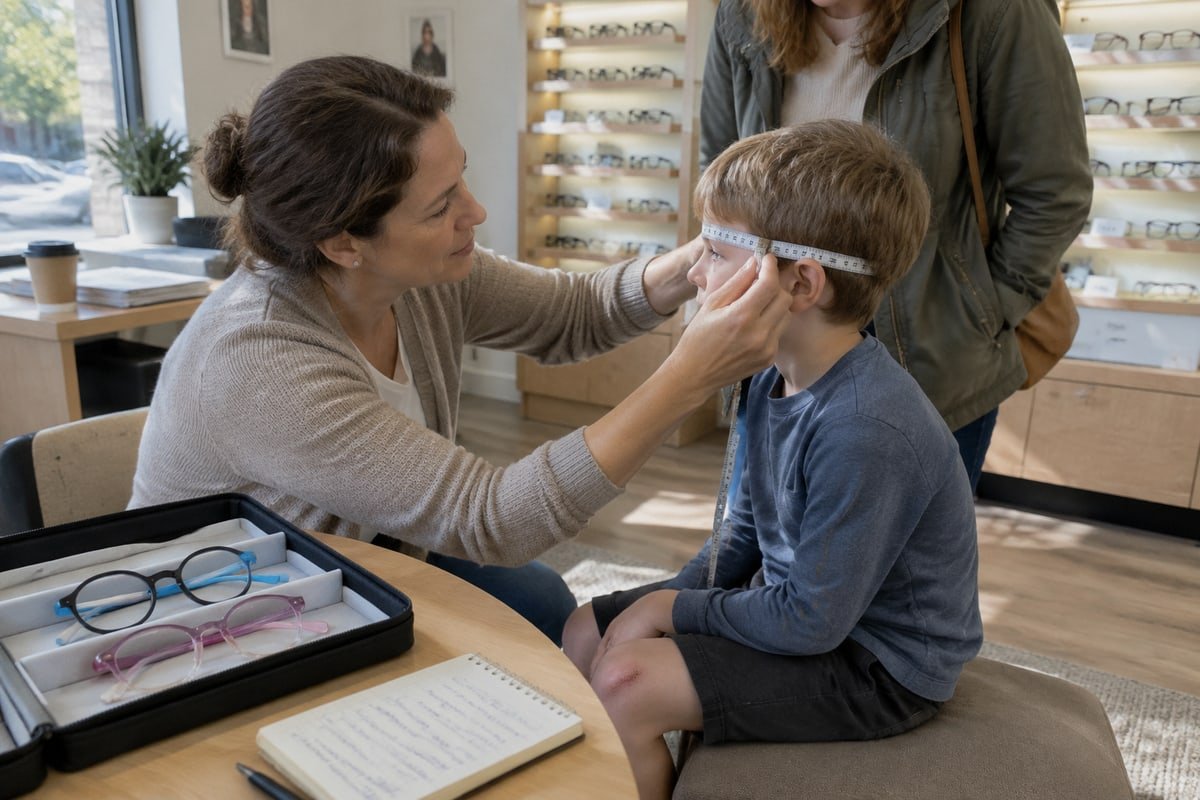
Pediatric eyewear fit is not one number. It is a set of numbers that must agree with each other. When one is off, the whole frame behaves badly. Let me break down the ones we check on every new mold.
Start with the boxing system numbers
Every frame we ship carries a code like 45□16-130. This is the ISO 8624 boxing system. The first number is the lens width, sometimes called eye size or lens diameter. The second is the bridge width, measured at the closest point between the two lenses. The last is the temple length, from hinge to tip. These three numbers are the first filter. If the lens width is too large, the child's eyes sit toward the inside of the lens and the optical center drifts. If the bridge is too wide, the frame rides down the nose. If the temple is too long, the frame slides forward when the child looks down.
Age tiers we use as a starting point
Children's faces change fast. We group our roughly 800 styles into tiers so buyers can pick a range, then refine with a fit check.
| Nivel de edad | Ancho de lente típico | Typical bridge width | Longitud típica de la patilla | Notas |
|---|---|---|---|---|
| Toddler (about 1–3 yrs) | 38–42 mm | 13–15 mm | 110–120 mm | Saddle bridge preferred; full rim only |
| Junior (about 4–8 yrs) | 43–46 mm | 15–17 mm | 120–130 mm | Most common school-age size |
| Teen (about 9–14 yrs) | 46–50 mm | 16–18 mm | 130–140 mm | Puente de ojo de cerradura 1s become workable |
These are our working ranges. Other suppliers quote frame widths around 40–48 mm for the whole kids' segment. The exact numbers matter less than the rule: pick the smallest size that centers the eyes, and refit as the child grows.
Why fit beats material
Some buyers tell me, "It's TR90, so it will be fine." I understand the thinking. Grilamid TR90 bends instead of snapping, and it is light on a small face. But a flexible frame that is 6 mm too wide still slides. A soft temple that is 10 mm too long still pushes the frame down. Material solves breakage. It does not solve geometry.
Bridge design deserves its own note. Young children have an undeveloped nasal crest. A saddle bridge with a large contact area spreads the weight and holds position. Our matte black and sky-blue round style uses a keyhole bridge, which looks great and suits older kids. For toddlers, we steer buyers toward saddle designs. That is a trade-off we talk about on almost every development call.
¿Qué marcas debo buscar en las monturas ópticas TR90 para niños?
Last spring our pad-printing line rejected a run of sky-blue temples because the size code smudged. Unreadable markings are a fail for us, even when the frame itself is perfect.
Look on the inner temple for the manufacturer or distributor trademark, model number, and boxing system size such as 45□16-130. Also expect a material declaration (TR90 or Grilamid TR90), color code, and compliance documents for your market, such as ISO 12870 and ISO 10993 test reports.

Markings do two jobs. They let an optician order the right replacement fast. They also prove who is responsible for the product. For children's eyewear, that second job matters more than most buyers expect.
Where markings sit and what they say
The standard location is the internal surface of the temple arm. On our frames the left temple usually carries the brand and model. The right temple carries the size and color code. Some buyers want both on one side to leave room for a custom logo. We can do that, as long as everything stays legible after the temple is flexed a few hundred times.
| Marking element | Where it appears | Por qué es importante para las monturas infantiles |
|---|---|---|
| Manufacturer or distributor trademark | Inner temple | Identifies the responsible party for safety recalls |
| Número de modelo | Inner temple | Allows exact reorders and part matching |
| Boxing system size (e.g., 45□16-130) | Inner temple | Lets opticians confirm fit without a gauge |
| Color code | Inner temple or tag | Keeps multi-color batches consistent |
| Material declaration (TR90) | Inner temple or packaging | Supports hypoallergenic and BPA-free claims |
| Lens spherical power | Lens edge or dispensing label | Added by the optician on finished spectacles |
The last row is easy to miss. General spectacle quality guidance says finished spectacles should be marked with the spherical power and the manufacturer or distributor name. The frame maker handles the name. The optical lab handles the power. Your frame supplier should leave clean space for both.
Material claims are not compliance
Here is the objection I hear most from procurement teams: "The temple says TR90, so we are covered." I push back on that. TR90 is a material name, not a certificate. A frame can be genuine Grilamid TR90 and still fail a hinge test or carry lead in its paint.
What actually protects a children's brand is documentation. EN ISO 12870 covers frame performance, including dimensional stability and hinge durability. ISO 10993 covers biocompatibility of materials 2 in skin contact. Together they back up the claims parents care about: hypoallergenic properties, no harmful plasticizers like Bisphenol A, and no sharp edges after breakage. When we ship to European and Japanese buyers, we pair the marked frame with these reports. The marking tells you what the frame is. The report tells you it was tested.
How Much Sizing Error Is Acceptable Before I Should Reject a Batch?
Tight tolerances cost money. Every extra gauge check adds seconds per frame across a 120-person workshop. We weigh that against the cost of one returned container. Tolerance wins.
Using ISO 12870 as the reference, reject a batch when lens groove size drifts beyond ±0.5 mm, temple length beyond ±2.0 mm, or bridge width beyond your specification limit. Also reject frames that fail 180-degree shape recovery, show left-right asymmetry, or carry illegible markings.
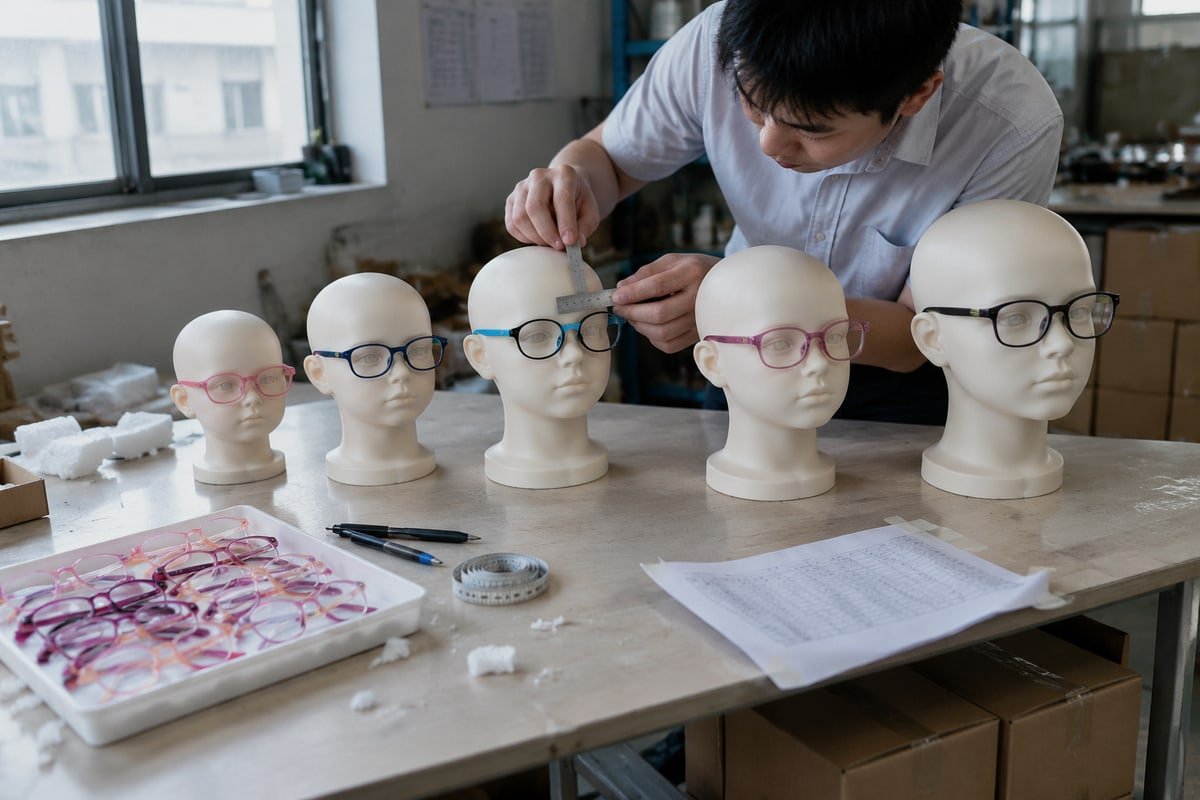
There is no single global "acceptable error" standard written just for TR90 kids' frames. That surprises many buyers. In practice, acceptable error comes from three places: the applicable eyewear standard 3, your own specification, and the QC agreement you sign with the factory. ISO 12870 gives the baseline. Your spec sheet tightens it where your product needs it.
Where manufacturing deviation comes from
Most deviation in monturas TR90 4 starts at the mold. TR90 shrinks as it cools. Our tooling engineers calculate molds at roughly 0.5% to 1.2% larger than the finished dimension to compensate. If the shrinkage estimate is off, every frame from that mold is off in the same direction. That is why we measure the first ten shots against the drawing before we run the batch.
The second source is heat. Acetate frames are warmed to insert lenses. TR90 must not be. We follow cold glazing practice and keep frames below 40°C during lens insertion. Heat above that point warps the eyewire and can whiten the surface. A warped eyewire changes the lens groove size and throws off centration. So heat is not just a cosmetic risk. It is a dimensional risk.
Tolerance checklist we apply
| Característica | Reference tolerance | How we check it | Reject or rework? |
|---|---|---|---|
| Lens groove size (A and B dimensions) | ±0.5 mm (ISO 12870) | Digital caliper, 5 pieces per carton | Rechazar |
| Longitud de la patilla | ±2.0 mm (ISO 12870) | Steel rule on flat jig | Rework if uniform, reject if random |
| Ancho del puente | Per buyer spec | Go/no-go gauge | Rechazar |
| Simetría izquierda-derecha | Visually even on flat plate | Flat-plate test | Rework (realign) |
| Riesgo de patillas sueltas | Full return after 180° temple flex | Manual flex, 3 cycles | Rechazar |
| Hinge opening force | Even, no play, no stiffness | Hand check + torque sample | Rework or reject |
| Weight variation | Consistent within batch | Sample weighing | Investigate mold or material |
| Marking legibility | Fully readable after flex | Visual under light | Rechazar |
Static numbers versus a moving child
Opticians measure a frame on a bench. Parents watch it on a running child. Both views are right, and they do not always agree. A TR90 frame can pass every static check and still shift 1–3 mm in effective distancia pupilar 5 during hard play, because the material is so elastic. We cannot design that out completely. We can reduce it. Spring hinges, softer temple tips, and cable temples on our TPEE-temple styles all improve retention. When a buyer's target is an active-kids brand, we treat dynamic fit as part of the acceptance discussion, not an afterthought.
Which Sizing Standards Should I Require From My Frame Supplier?
Years ago we shipped frames sized by eye. They fit, mostly. Then an optical chain asked for centration data we did not have. We never skipped a spec sheet again.
Require ISO 8624 boxing system measurements, ISO 12870 dimensional tolerances, and ISO 10993 biocompatibility reports. Ask for a full spec sheet: lens width, bridge width, temple length, lens height, optical centration distance, weight, material grade, and marking placement, plus age-tier sizing from roughly 38 mm to 50 mm.

A good supplier does not make you ask for these things. They arrive with the sample. But if you are vetting a new factory, here is the list I would hand to a procurement manager on day one.
The standards short list
- ISO 8624 for how sizes are measured and written. Without it, "size 45" means different things at different factories.
- ISO 12870 for frame performance and dimensional tolerances. This is the document your QC agreement should reference by name.
- ISO 10993 for material safety on skin. This is what supports hypoallergenic and BPA-free language on your packaging.
- Your own age-tier sizing table. Standards tell you how to measure. They do not tell you which sizes suit a four-year-old. That part is product knowledge.
The spec sheet to demand
| Data point | Por qué lo necesita | What we provide |
|---|---|---|
| Ancho de la lente (tamaño del ojo) | Primary fit filter | Per style, per size |
| Ancho del puente | Nose stability | Per style, per size |
| Longitud de la patilla | Retention behind the ear | Per style, per size |
| Lens height (B dimension) | Room for stronger or progressive Rx | Per style |
| Optical centration distance | Aligns lens center with child PD | Per size |
| Ancho total de la montura | Match to face width | Per size |
| Peso | Comfort for all-day wear | Per style, measured |
| Grado del material del marco | Verifies TR90 claim | Grilamid TR90, TPEE temples where used |
| Lens type and coating | Optical or UV400 / polarized | Per order |
| Marking content and position | Compliance and reorders | Drawing approved before mass production |
Lens height and centration distance are the two that buyers skip most often. For a low prescription, they barely matter. For a child with a higher power or an early progressive, they decide whether the child sees clearly through the right part of the lens. Ophthalmic optics does not care how nice the color is.
Beyond the paperwork
Standards set the floor. The ceiling is how the supplier works. When a brand comes to us with no molds and no size data, we start from our existing catalog. Roughly 800 styles across toddler, junior, and teen tiers means a buyer can test the market with real product before investing in tooling. Once a style proves itself, we move to custom colors, logos, lens options, and packaging. Every one of those changes goes back through the same dimensional check, because a new color batch can shrink differently from the last.
That is the practical answer to "which standards." Require the ISO numbers. Then require a partner who measures against them every time, not just on the first sample.
Conclusión
Flexible TR90 alone does not make a frame right for a child. Correct sizing, clear markings, and controlled tolerances do. Demand all three from your supplier.
¿Interesado en obtener los productos mencionados en este artículo? Ver detalles y solicitar un presupuesto aquí:
Notas al pie
1. Authoritative definition of eyewear bridge types including the keyhole design mentioned in the article. ↩︎
2. Official ISO page for ISO 10993-1, the standard governing the biological evaluation of medical device materials. ↩︎
3. Official ISO page for ISO 12870, the primary international standard for spectacle frame requirements. ↩︎
4. Official product documentation from the manufacturer of Grilamid TR90, the material discussed throughout the article. ↩︎
5. Explains the measurement used to align optical centers, critical for the sizing discussion in the text. ↩︎
Más artículos que te podrían gustar

7 de noviembre de 2026
¿Cuánto duran las monturas ópticas TR90 para niños antes de reemplazarlas?

6 de noviembre de 2026
¿Qué información de la etiqueta colgante revisan primero los padres en las monturas ópticas TR90 para niños?

5 de noviembre de 2026
¿Cómo emparejar los SKU de tamaño y color para monturas ópticas infantiles de TR90 por grupo de edad?
¿Buscas un socio confiable en gafas para niños?
Explore más de 800 estilos listos y soporte OEM/ODM completo adaptado a su marca.
Ponte en contacto English
 Español de México
 Deutsch
 Français
 日本語
 العربية
 Português do Brasil