Should Private Label Kids’ Sunglasses Show Your Brand or Chinese Factory Info?
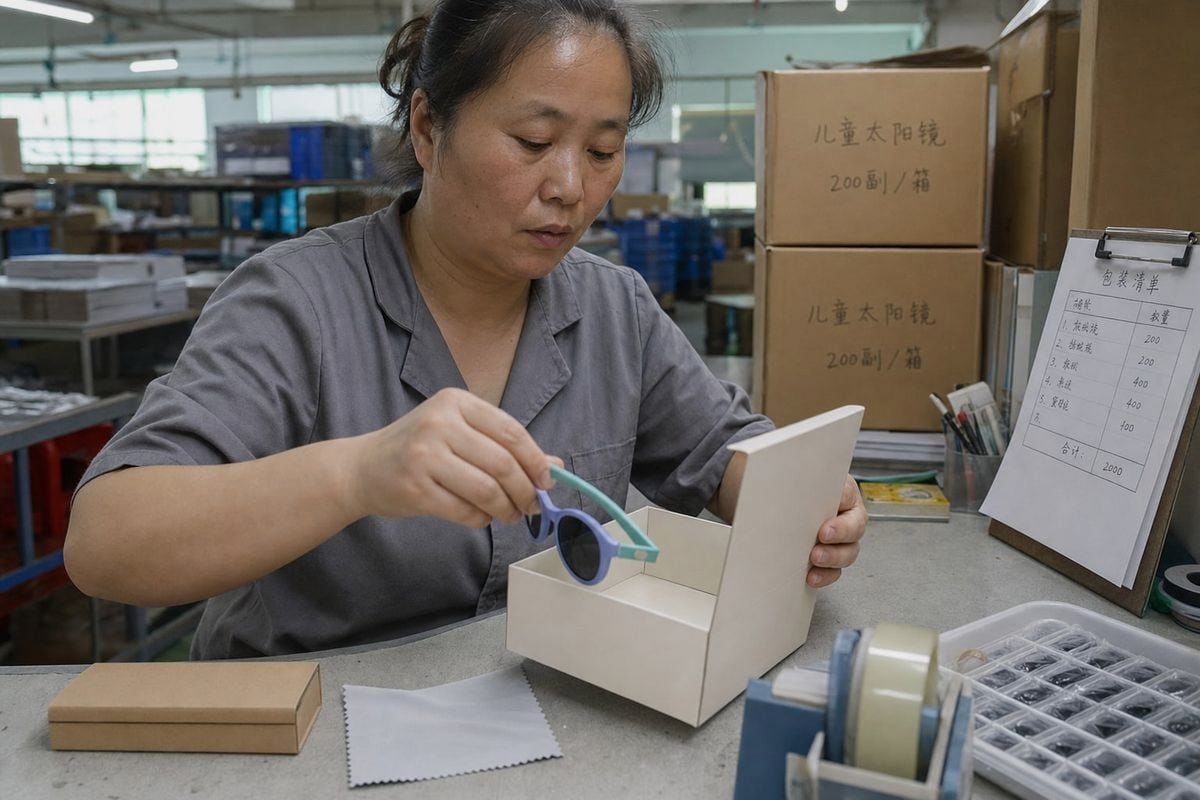
Every week, buyers ask me the same question about private label kids’ sunglasses 1: whose name goes on the product? Get it wrong, and you risk customs delays, recalls, or a weak brand. Get it right, and our production line becomes your invisible advantage.
Private label kids’ sunglasses should display your brand prominently on the frames, packaging, and accessories, while factory information appears only where the law requires it — such as CPSIA tracking labels and Country of Origin marks placed discreetly inside packaging or on the inner temple.
That is the short answer. But the details matter, especially for children’s products. Below, I break down the legal rules, the branding strategy, the “Made in China” question, and what to discuss with your factory before production starts.
What legal requirements determine whose information must appear on my kids' sunglasses packaging?
During a pre-shipment inspection last spring, our QC team flagged a US-bound order because the buyer's artwork had no tracking label. We paused printing for two days. That small catch prevented a potential customs problem — and taught the buyer why compliance comes before design.
US law requires a permanent CPSIA tracking label on children's products identifying the private labeler or manufacturer, production date, and location. Country of Origin labeling ("Made in China") is mandatory for customs. The EU requires CE marking; your brand can still dominate the visible design.
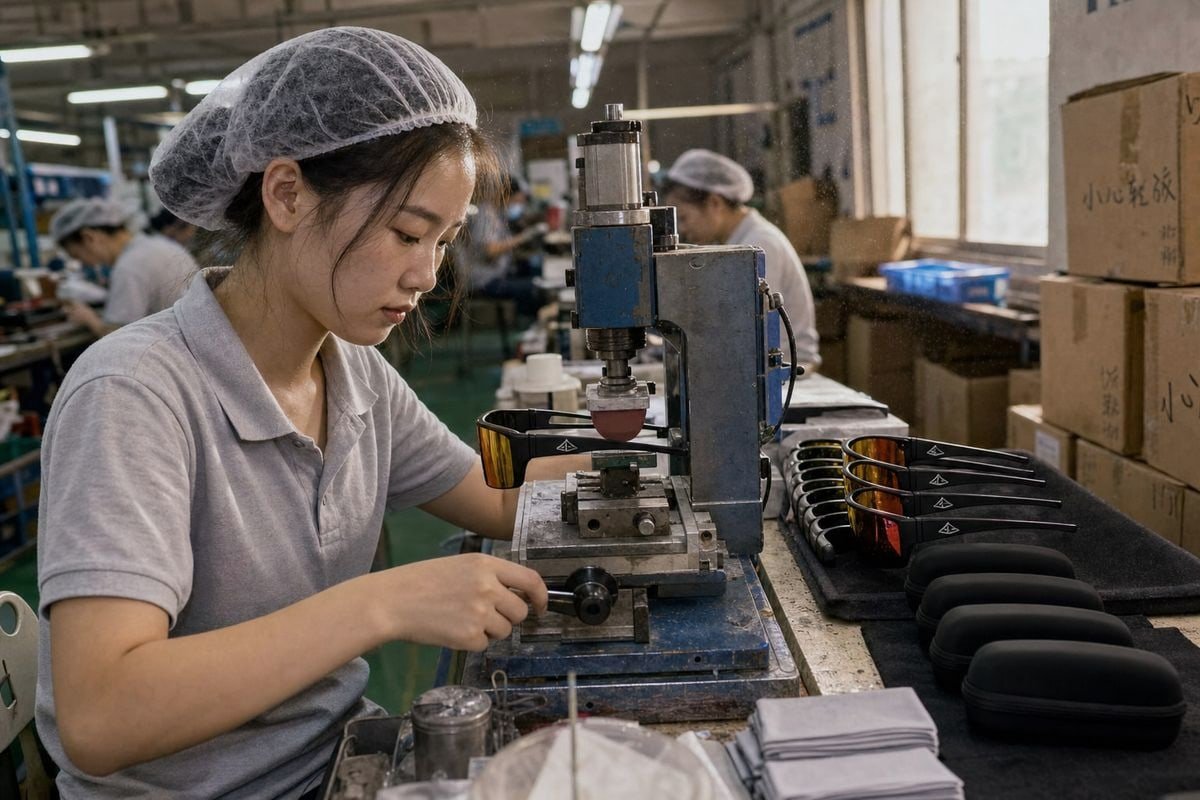
Here is the key distinction I always explain to new buyers: branding is a choice, but labeling is an obligation. The two are not in conflict. The law tells you what information must exist somewhere on the product or packaging. It does not tell you to make the factory name your headline.
The main markets and what they demand from private label kids' sunglasses
In our fifteen years exporting children's eyewear to more than twenty countries, these are the requirements we deal with most often:
| Mercado | Key requirement | Whose name appears | Where it usually goes |
|---|---|---|---|
| EE. UU. | CPSIA compliance, tracking label, FDA registration for sunglasses (drop-ball impact test) | Private labeler OR manufacturer — one is enough | Inner temple, hang tag, or inner packaging |
| UE | CE marking, EN ISO 12312-1, responsible person in the EU | Importer/brand plus CE mark | Packaging small print, temple interior |
| Reino Unido | UKCA marking (CE still accepted in some cases) | Brand or importer | Same discreet placements |
| Australia | AS/NZS 1067 sunglasses standard | Supplier/brand | Swing tag or packaging |
| All markets | Country of Origin labeling | Neither — just "Made in China" | Inner temple or packaging base |
Notice something important in that table. In the US, the CPSIA tracking label 2 can carry the private labeler's identity instead of the factory's name. That means your brand can legally be the identified party. The factory stays in your supplier records, not on the retail shelf.
Sunglasses sold in the US are also regulated as medical devices 3 in a limited sense, which is why Registro de la FDA y impact-resistance testing 4 of lenses matter. We handle the drop-ball testing on our side, but your artwork must still leave space for required marks. My advice: verify the destination market's children's product safety standards before you finalize any packaging file. It costs nothing to check and a lot to reprint.
How can I make sure my brand identity stands out even when using a Chinese manufacturer?
There is a trade-off I weigh with every OEM manufacturing project: how much branding a small child-sized temple arm can carry before it looks cluttered. A kids' frame gives you maybe 60 millimeters of usable logo space. That constraint shapes everything else.
Build brand identity through consistent logo placement on temples, cases, cleaning cloths, and custom packaging — not through more logos, but through repeated, clean ones. Choose one logo method (pad print, laser, or embossing), one color system, and apply it across every customer touchpoint.

Private label and white label products 5 both start life unbranded on our production line. The difference is what happens next. A white label buyer takes the stock item as-is. A private label buyer turns it into their own product — and the buyers who succeed treat branding as a system, not a sticker.
Where your logo should appear on private label children's sunglasses
We recommend this hierarchy of touchpoints, based on what our brand customers in Australia, Japan, and Europe consistently order:
| Touchpoint | Branding method | Impact on the parent buying decision |
|---|---|---|
| Temple exterior | Pad print or embossed logo | High — the visible signature |
| Lens corner (optional) | Subtle etch or print | Medium — premium cue, keep tiny |
| Case or pouch | Full-color print or debossing | Very high — parents keep and reuse it |
| Microfiber cloth | Edge-to-edge print | Medium — daily brand reminder |
| Retail box or hang card | Full custom packaging design | Very high — first impression at shelf |
| Insert card | UV400 claims, fit notes, age range | High — converts safety concern into trust |
Two practical notes from our workshop. First, keep the temple logo simple. A one-color mark survives pad printing on flexible TPEE material 6 far better than a gradient design. We rub-test every printed logo before bulk production, because a logo that wears off in a month damages your brand more than no logo at all. Second, invest in the case and box. Parents judge product care by packaging quality. A sturdy branded case signals that the sunglasses inside were made with the same attention — and it often carries more weight in a parent's quality assessment than anything printed on the frame itself.
Consistency beats volume. One clean logo, repeated across six touchpoints, builds more equity than six different treatments.
Will showing "Made in China" hurt my brand's credibility with parents?
A buyer from Melbourne once asked us to make the origin mark 7 "as invisible as legally possible." Six months later, she changed her mind — her customers were asking about sourcing, and hiding it looked worse than owning it. That shift taught me something about modern parents.
No — "Made in China" rarely hurts credibility when your brand leads with visible quality signals: UV400 protection, flexible safe materials, product safety standards, and professional packaging. Parents buy reassurance, not supplier names. Place the origin mark discreetly on the inner temple and let your quality story dominate.
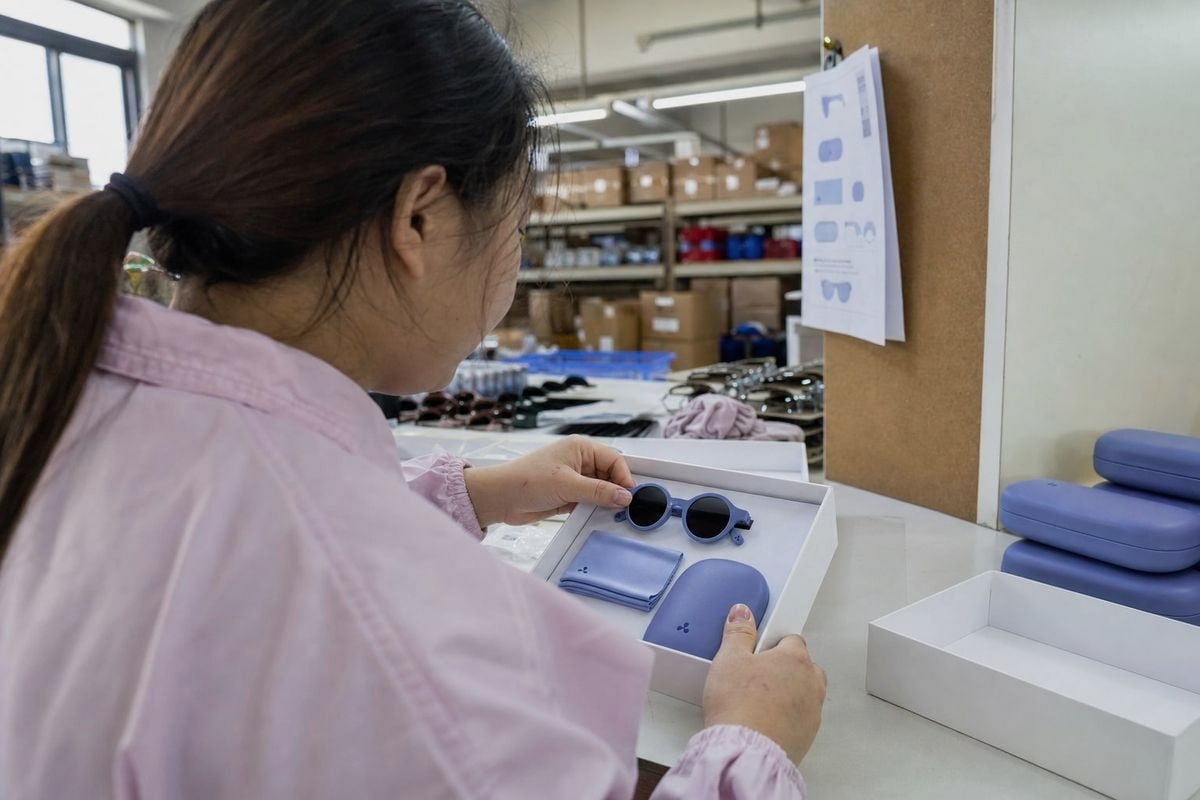
Let me be direct about the two viewpoints buyers bring to this conversation, because both deserve an honest answer.
Objection one: "I should hide the factory connection completely"
I understand the instinct, but total concealment is neither legal nor smart. Country of Origin labeling is mandatory for customs in every major market. Trying to bury it invites regulatory trouble. More importantly, parents are not naive. Most children's eyewear — including well-known international brands — comes from Chinese production lines. What parents actually evaluate is whether the product feels safe, fits well, and comes from a brand that stands behind it.
Objection two: "I should be fully transparent and feature the factory"
Some buyers swing the other way and want to name the factory on the box as a transparency gesture. Supply chain transparency is a real trend, and I respect it. But making factory identity the consumer-facing message dilutes your brand and invites price-shopping — a customer who can identify the factory can find the same molds elsewhere. The balanced path works better: a "Designed by [Your Brand]" line, an optional note about specialized eyewear craftsmanship from a dedicated children's eyewear region like Taizhou, and a QR code linking to your material safety documentation. Some of our forward-looking customers now treat that QR link as a lightweight digital product passport 8, letting parents view non-toxic material certifications for the batch. That is transparency in service of the brand, not instead of it.
The pattern is simple: brand as hero, origin as honest footnote, quality evidence one scan away.
What branding and labeling options should I discuss with my OEM/ODM factory before production?
Early in my career at our Taizhou facility, we shipped an order where the buyer approved frame colors but never confirmed the tracking label wording. The reprint delayed launch by three weeks. Since then, we run every private label project through a fixed pre-production conversation — and I recommend every buyer demand the same.
Before production, confirm five things with your factory: logo method and placement, required compliance marks and their locations, custom packaging artwork with legal small print, lens specifications and test reports, and a physical pre-production sample that shows all branding and labeling exactly as it will ship.
A good OEM/ODM partner should walk you through this process without being asked. If they do not, that silence tells you something. Here is the sequence we follow with our own brand customers, whether they choose from our roughly 800 existing styles or develop a semi-custom design:
- Define the brand brief. Target age range, market, price point, frame references, colors, and logo files. For kids' frames in flexible TR90 and TPEE, we also confirm which surfaces can physically accept your chosen logo method.
- Lock the compliance map. For each destination market, list every required mark: CPSIA tracking label content, CE marking, origin mark, and any FDA registration or test report references. Assign each mark a physical location before artwork begins.
- Design custom packaging around both. Front and top panels belong to your brand. Base and inner panels carry legal text. Cases, pouches, and cloths carry your logo only.
- Approve a full pre-production sample. Not just the frame — the complete retail unit. Check logo durability with a rub test, verify every printed label, and photograph the approved sample as your quality reference.
- Confirm QC and testing. Agree on inspection standards, lens testing (UV400 or polarized verification), and who holds the test documentation.
Questions worth asking your factory directly
| Pregunta a hacer | What a strong answer sounds like |
|---|---|
| Can the tracking label show my brand, not yours? | "Yes — you are the private labeler; we keep records for traceability." |
| Where will the origin mark go? | "Inner temple or packaging base, per your artwork approval." |
| What logo methods work on flexible materials? | Specific methods with durability testing, not vague promises. |
| Do you provide test reports for my market? | Named standards and documents, before you ask twice. |
| Can I see a complete branded sample first? | "Always — no bulk run without your signed-off sample." |
One more point on protection. Because private label products share molds across buyers, discuss exclusivity and anti-counterfeit options early. Distinct colorways, unique packaging, and batch-coded labels make it much harder for look-alike overruns to trade on your name.
Conclusión
Weak labeling choices can stall shipments and erode parent trust fast. The fix is simple: your brand leads everywhere visible, factory and origin information sits where the law requires, and quality evidence does the persuading. Brief your factory early, approve a full sample, and let compliance stay quietly correct while your brand does the talking.
Notas al pie
1. Defines the business model where a company markets products manufactured by another firm under its own brand. ↩︎
2. Official CPSC guidance on the mandatory permanent tracking information required for all children’s products sold in the US. ↩︎
3. Confirms the FDA’s classification of sunglasses as medical devices and the resulting regulatory requirements for manufacturers. ↩︎
4. The specific federal regulation governing the mandatory drop-ball test to ensure sunglass lenses are impact resistant. ↩︎
5. Defines products produced by one company that other companies rebrand to appear as if they made them. ↩︎
6. Technical data on high-performance thermoplastic elastomers used for durable and flexible children’s eyewear frames. ↩︎
7. Federal Trade Commission guidelines on correctly marking the country of origin for imported consumer goods. ↩︎
8. Information on the EU’s proposed system for providing digital access to product-specific compliance and sustainability data. ↩︎
Más artículos que te podrían gustar

1 de agosto de 2026
¿Debería la fábrica encargarse del embalaje y etiquetado de las gafas de sol para niños, o utilizar un proveedor designado?

1 de agosto de 2026
Almacén propio vs. Cumplimiento directo del proveedor: ¿Qué reduce los costos de devolución para las marcas de gafas de sol para niños?

1 de agosto de 2026
Directo al almacén del puerto o staging en el extranjero: ¿Cuál ahorra más en el envío de gafas de sol para niños?
¿Buscas un socio confiable en gafas para niños?
Explore más de 800 estilos listos y soporte OEM/ODM completo adaptado a su marca.
Ponte en contacto English
  Español de México
  Deutsch
  Français
  日本語
日本語  العربية
  Português do Brasil