Why Do TR90 Kids Optical Frames Turn Yellow and Brittle, and What Speeds This Up?
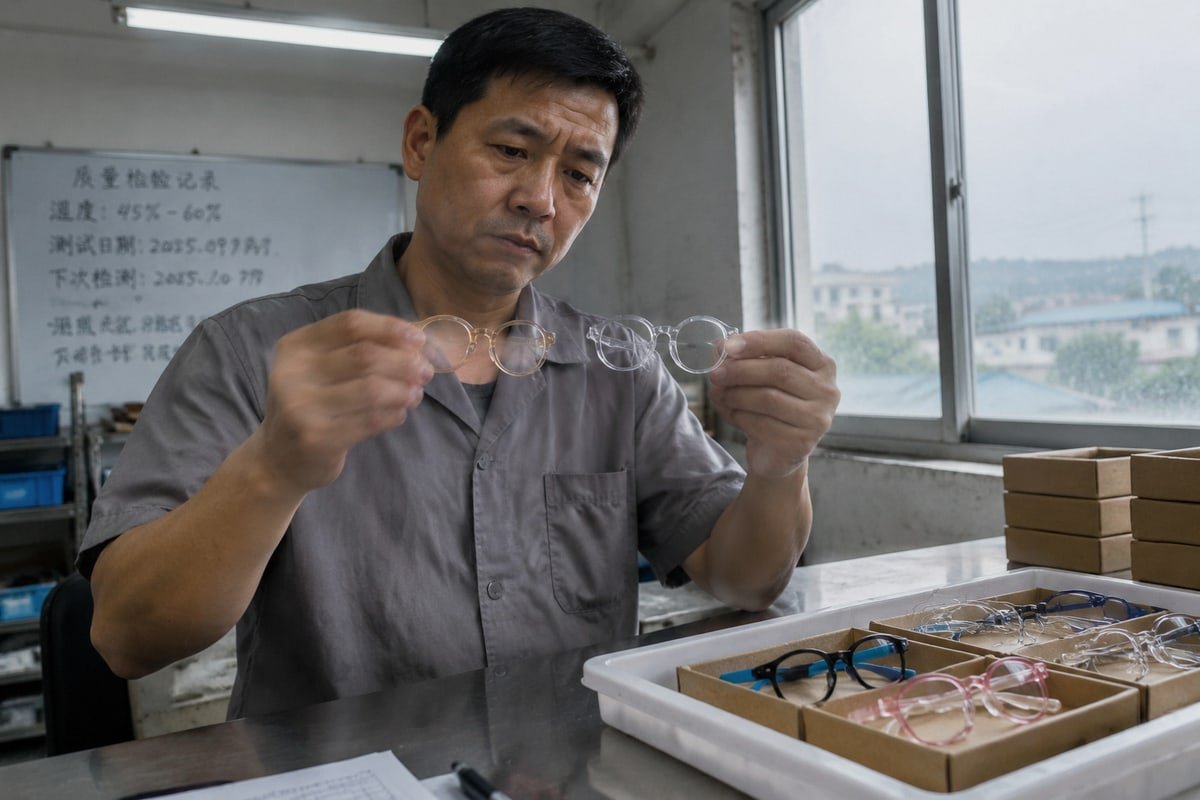
Parents ask us why TR90 kids optical frames turn yellow and brittle. It hurts a brand’s reputation fast. Our Taizhou production team has spent years learning what really causes it.
Las monturas ópticas de TR90 para niños se vuelven amarillas y quebradizas porque la exposición a la radiación UV, el calor, el oxígeno, el sudor y los productos químicos descomponen lentamente el polímero a base de nailon. La luz solar directa, los coches calientes, los aceites de la piel, los limpiadores agresivos y la resina de baja calidad con estabilizadores de UV débiles aceleran este envejecimiento drásticamente.
The good news is that this damage follows clear rules. Once you understand the chemistry, you can predict it, slow it, and choose products that resist it. Let me walk through each factor.
¿Qué provoca que mis monturas ópticas TR90 para niños se vuelvan amarillas después de meses de uso?
Last spring our QC team pulled a batch of clear retained samples from a sunny shelf near the window. Some had a faint amber tint. That started a useful investigation.
El amarilleo en las monturas ópticas infantiles de TR90 proviene de la fotooxidación. La luz UV rompe los enlaces poliméricos y luego el oxígeno altera la composición química y el color del material. Los aceites de la piel, la transpiración, los residuos de protector solar y los contaminantes urbanos generan reacciones químicas adicionales que manchan y opacan la superficie con el paso de los meses.

TR90 is a thermoplastic polyamide. In plain terms, it is a performance nylon. Nylon is tough, but its long molecular chains 1 are not immune to light. When UV energy hits the frame, it breaks some of the bonds inside those chains. Oxygen in the air then reacts with the broken ends. This oxidation process creates new chemical groups that absorb blue light. Absorbing blue light is exactly what makes a clear material look yellow.
Photo-oxidation is the root cause
Everything else builds on this first step. Without UV, oxidation is very slow. With UV, it speeds up. That is why the translucent pink gradient frames in our catalog age differently from the matte black ones. Dark pigments block light and hide early color shifts. Clear and pastel frames show every stage.
Sweat, sunscreen, and lotions add a second layer
Kids sweat. Their skin oils and perspiration are mildly acidic. That acidity slowly attacks the surface finish. Protector solar y lociones make it worse. One common sunscreen ingredient 2, avobenzone, can bond with the polyamide structure and leave a deep, irreversible stain. Urban air adds another factor. Nitrogen oxides from traffic act like a catalyst. They lower the energy needed for the polymer to oxidize, so city frames can yellow faster than country frames.
| Desencadenante | What happens inside the frame | Lo que ves |
|---|---|---|
| UV radiation exposure | Chain scission, then oxidation | Amber tint, loss of clarity |
| Skin oils and perspiration | Acidic attack on surface finish | Dull patches near nose and temples |
| Protector solar y lociones | Avobenzone bonds to polyamide | Deep stains that will not wipe off |
| NOx pollution | Catalytic oxidation | Faster, uneven yellowing |
| Harsh cleaners | Stripped protective coating | Hazy, chalky surface |
Dirty or degraded? A quick test
Wash the frame with mild soap and warm water. If the color comes back, it was dirt. If the tint stays, the polymer itself has changed. That change cannot be reversed.
¿Por qué mis monturas de TR90 se vuelven quebradizas en lugar de mantenerse flexibles con el tiempo?
Every time we spec a new frame, we weigh wall thickness against frame flexibility. Thinner looks sleeker, but it leaves less material to absorb years of bending.
Las monturas de TR90 se vuelven quebradizas porque la degradación del polímero acorta las largas cadenas de nailon que le otorgan al material su memoria de flexión y retorno. Los rayos UV, el calor, la oxidación, la flexión repetida y la pérdida de humedad cortan esas cadenas. Luego, la montura pierde elasticidad, se opaca y, con el tiempo, sufre microgrietas bajo una tensión normal.
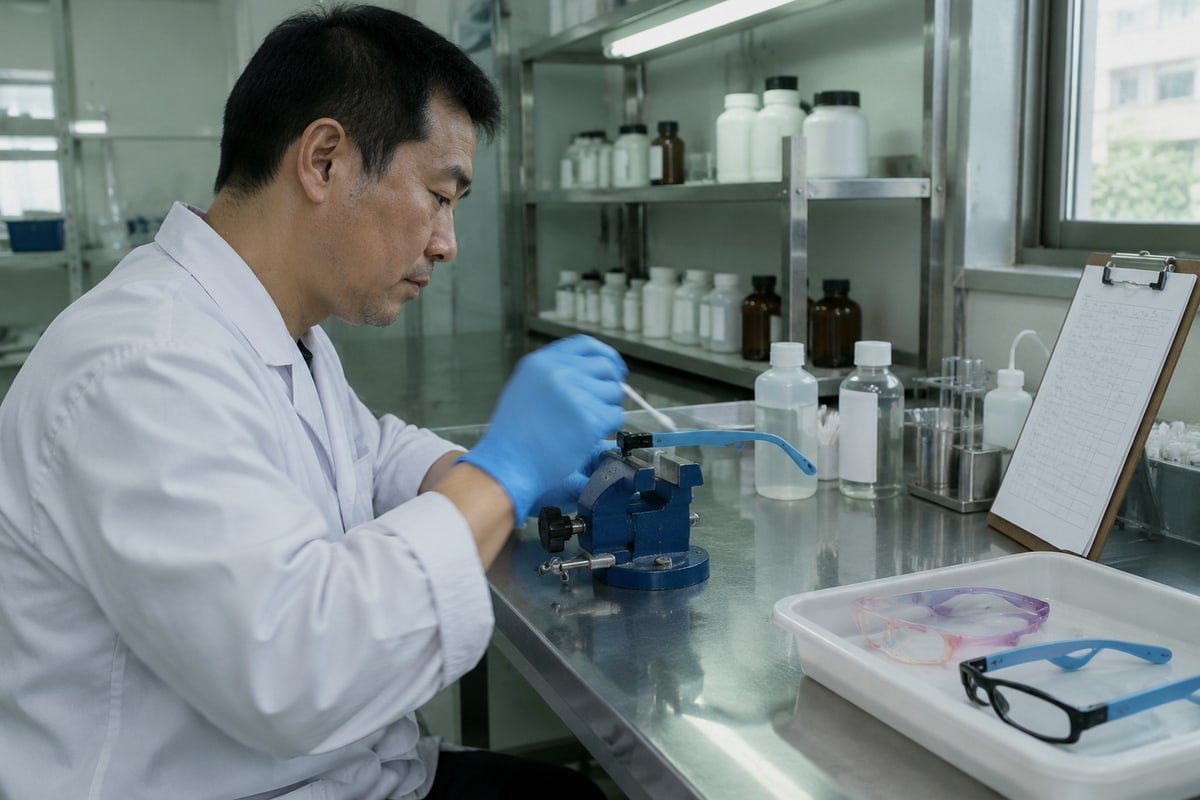
Yellowing and brittleness share the same root, but they are not the same symptom. Yellowing is a color change. Brittleness is a strength change. They usually arrive together, but one can lead the other. A dark frame may turn brittle while still looking fine. A clear frame may look amber while still bending well. Understanding the difference helps you diagnose the real problem.
Why long chains matter
TR90 gets its resistencia al impacto 3 from very long polymer chains that tangle together. When a child bends the temple, those chains slide, stretch, and pull back. That is the "memory" everyone praises. Each time UV or oxidation cuts a chain, the tangle gets a little weaker. The frame still looks the same. It just returns a bit slower. After enough cuts, it stops returning and starts cracking.
Three accelerators most people miss
- Stress crazing. Frequent flexing creates tiny surface cracks 4 called crazing. These cracks let UV and oxygen reach deeper into the material. Kids flex their temples hundreds of times a day.
- Moisture loss. Nylon holds a small amount of water inside its structure. That water acts like a plasticizer. In very dry climates or heated rooms, the polymer loses moisture and loses its memory with it.
- Heat cycling. Every hot-cold cycle in a backpack or car speeds up the chemical reaction rate. Heat does not need to melt the frame to damage it.
| Síntoma | Main cause | Dónde aparece primero | ¿Reversible? |
|---|---|---|---|
| Yellowing | Photo-oxidation, staining | Clear rims, brow line | No |
| Surface dulling | Sweat, harsh cleaners | Almohadillas nasales, puntas de las patillas | Partly, with polishing |
| Stiffness | Chain scission, moisture loss | Temple hinge area | No |
| Micro-cracks | Crazing plus oxidation | Bridge, temple bends | No |
Por qué combinamos frentes de TR90 con patillas de TPEE
This is a design answer to a chemistry problem. On many of our kids' styles, we mold the front rim in TR90 and the temples in TPEE. The temples take the most flexing, so we give them a material built for it. The front keeps its shape and optical alignment.
How much does UV exposure speed up yellowing in my children's TR90 frames?
A procurement manager from Australia once asked me point-blank whether summer sun would ruin her clear frames in one season. Her question deserved a straight answer, not marketing.
UV exposure is the single biggest driver of yellowing in TR90 frames. Poorly stabilized clear frames can show visible yellowing within months under strong sunlight, while well-stabilized frames age far slower. Heat multiplies the effect, so a hot car dashboard damages frames much faster than a shaded shelf.
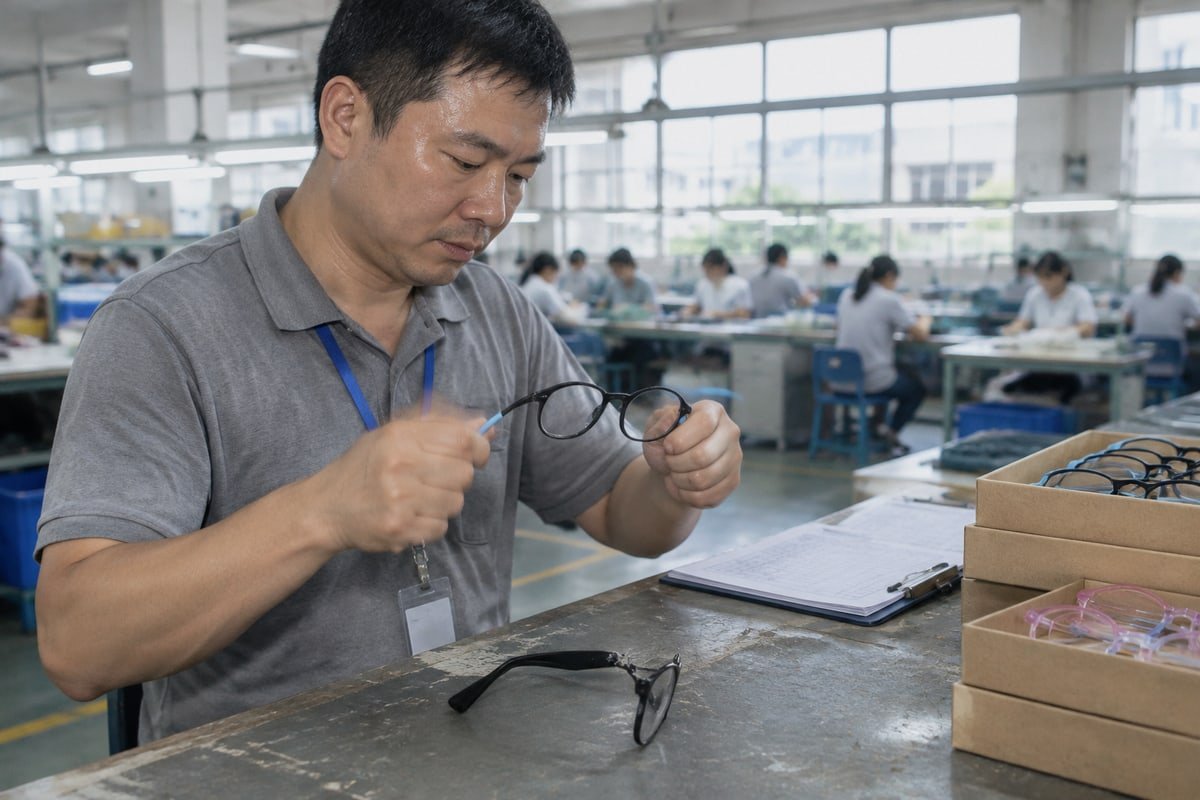
Many suppliers call TR90 "UV-resistant." That phrase is honest, but it is often misread. UV-resistant means the material tolerates light better than cheap plastics. It does not mean UV-proof. Nothing organic is UV-proof. The stabilizers inside the resin absorb or neutralize UV energy, but they get used up over time. Once they are spent, aging accelerates.
The heat multiplier
Heat and UV work together. TR90 handles short bursts of heat well. Its heat deflection performance sits around 115°C to 135°C depending on the test load. That is why a child can leave frames in a warm room without trouble. A car dashboard is different. The frames sit in direct sun, under glass, for hours. The surface climbs far above room temperature and stays there. Over repeated days, this softens the frame slightly, speeds the oxidation process, and can even deform the fit. We tell buyers that the glovebox case is worth ten reminders.
Real-world exposure levels
| Storage or use scenario | UV level | Heat level | Relative aging risk |
|---|---|---|---|
| Indoor drawer in a case | Muy bajo | Baja | Mínimo |
| Worn daily at school, cased at night | Moderado | Baja | Baja |
| Left on a windowsill | Alta | Moderado | Alta |
| Beach or pool all summer | Muy alta | Moderado | Muy alta |
| Car dashboard, closed windows | Muy alta | Alta | Extremo |
Why kids' frames age faster than adult frames
Children wear their glasses outdoors more. They play sports in them. They toss them into backpacks with sunscreen bottles. They clean them with a shirt sleeve or, worse, hand sanitizer. Each of these habits adds a small dose of UV, heat, or chemical stress. The doses add up. That is why we build optical frames for kids with the same care we give our UV400 sunglasses. The lens protects the eyes. The frame formulation protects the product.
Simple habits that cut UV damage
- Store frames in a hard case, out of direct sunlight.
- Never leave them in a parked car.
- Clean with mild soap and water only.
- Wipe off sweat and sunscreen after outdoor play.
- Rotate two pairs if one is used heavily for sport.
Can I choose a better TR90 supplier to prevent premature yellowing and brittleness?
Fifteen years in eyewear taught us one hard lesson: the resin pellet you buy decides the frame's fate before any mold opens. Cheap nylon looks identical on day one.
Yes, choosing a better TR90 supplier is the most effective way to prevent premature yellowing and brittleness. Look for a real factory that uses branded, UV-stabilized thermoplastic polyamide such as Grilamid TR-90, controls molding temperatures, documents quality checks, and can prove material consistency across repeat orders.
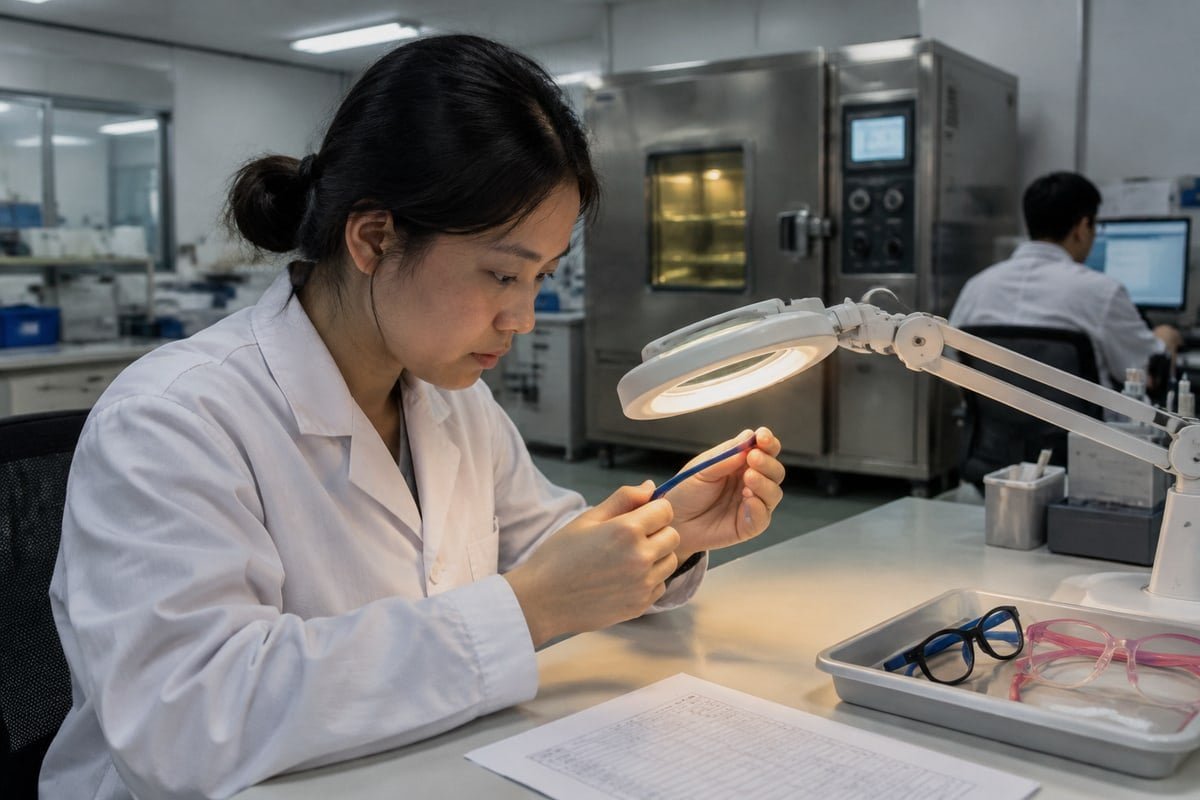
The market is full of frames labeled TR90 that are really generic nylon blends. They mold fine. They look fine in the showroom. Then they fail in the field, and the brand takes the blame. The difference lies in three things: the base resin, the stabilizer package, and the molding process. A supplier who controls all three can tell you exactly why their frames last.
Preguntas que separan fábricas de comerciantes
- Which resin do you use, and can you name the grade? Grilamid TR-90 from a known producer comes with UV stabilization built into the formulation. A vague answer usually means a cheaper substitute.
- What molding temperature and cycle time do you run? Overheated nylon starts degrading in the machine. Degraded frames yellow faster from day one.
- How do you test flexibility? Ask about hinge cycling and temple bend checks. We run these on our production line, not just on samples.
- Can I see your workshop? We run a 5S-managed factory in Taizhou with around 120 workers. A trading company cannot show you this.
- What happens if a batch drifts? A real factory keeps retained samples and can compare color and flex against the master.
| Supplier trait | Low-grade supplier | Reliable factory partner |
|---|---|---|
| Resin source | Unnamed nylon blend | Branded Grilamid TR-90 |
| UV stabilization | Unknown or none | Documented in material spec |
| Temple design | TR90 only, thin walls | montura frontal de TR90 con patillas de TPEE |
| Control de calidad | Final visual check | In-line flex, hinge, and color checks |
| Sample retention | Ninguno | Retained per batch |
| Personalización | Limited colors | Full OEM/ODM: colors, logos, lenses, packaging |
Reduce your risk before you commit
New brands often worry about mold investment. We solve that with roughly 800 existing styles, from the round two-tone black and sky-blue frame to translucent pastel pink gradients. Buyers can test the market with proven designs first. Once a style sells, we add custom colors, logos, lenses, and retail-ready packaging. The material stays the same across every order, which is what keeps frames from yellowing or cracking after a year on a child's face.
Conclusión
Yellowing and brittleness in TR90 kids optical frames signal environmental stress, not sudden defects. Choose stabilized resin, store frames wisely, and partner with a factory that proves quality.
¿Interesado en obtener los productos mencionados en este artículo? Ver detalles y solicitar un presupuesto aquí:
Notas al pie
1. Technical explanation of how polymer chain length and structure determine the physical properties of materials like nylon. ↩︎
2. Chemical profile of avobenzone, detailing its molecular behavior and common use in consumer sun protection products. ↩︎
3. Scientific definition of a material’s ability to absorb energy and deform plastically without fracturing. ↩︎
4. Explains the phenomenon of crazing and micro-cracking in polymers subjected to environmental stress and chemical exposure. ↩︎
Más artículos que te podrían gustar
7 de noviembre de 2026
¿Cuánto duran las monturas ópticas TR90 para niños antes de reemplazarlas?

6 de noviembre de 2026
¿Qué información de la etiqueta colgante revisan primero los padres en las monturas ópticas TR90 para niños?

5 de noviembre de 2026
¿Cómo emparejar los SKU de tamaño y color para monturas ópticas infantiles de TR90 por grupo de edad?
¿Buscas un socio confiable en gafas para niños?
Explore más de 800 estilos listos y soporte OEM/ODM completo adaptado a su marca.
Ponte en contacto English
 Español de México
 Deutsch
 Français
 日本語
 العربية
 Português do Brasil