How to Use ANSI Z80.3 Test Data to Prove Kids’ Sunglasses UV Protection?

Every month, buyers ask our Taizhou factory the same question: how do I prove these kids’ sunglasses really block UV? Marketing claims alone can sink a brand fast.
ANSI Z80.3 test data proves kids’ sunglasses UV protection when a third-party lab report shows measured UVA and UVB transmittance within the standard’s limits, matches the exact product sold, states the standard edition tested, and supports every labeled claim such as UV400.
Let me walk you through what the standard tests, how to read the report, which documents to request, and how to turn that data into sales.
What Does ANSI Z80.3 Actually Test For in Kids' Sunglasses?
During a recent audit of our TPEE sunglasses line, a European buyer asked me to explain exactly which numbers in our lab report mattered. That conversation shaped this section.
ANSI Z80.3 tests nonprescription sunglasses for UVA and UVB transmittance limits, luminous transmittance levels, optical quality standards like refractive power, impact resistance, and labeling accuracy. It sets permitted UV transmission thresholds by category rather than guaranteeing zero UV passes through the lens.
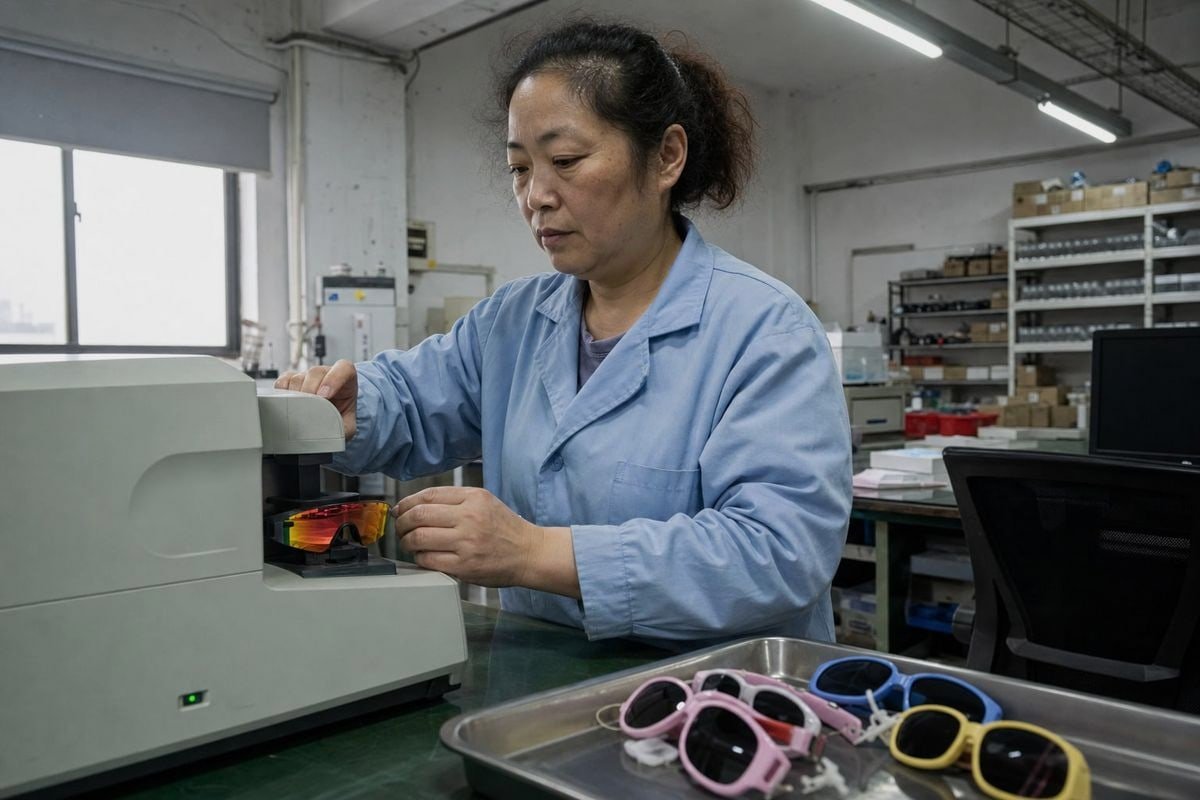
Claridad óptica e impacto para gafas sin graduación 1 is the U.S. standard for nonprescription sunglasses and fashion eyewear with essentially plano lenses. It does not test frames for child-specific fit by itself, but it does define the measurable performance a lens must deliver. In our experience exporting to more than 20 countries, buyers who understand these test areas negotiate better and avoid recalls.
The Core Requirements Buyers Should Know
The standard revolves around transmittance. A lab uses spectrophotometric analysis 2 to measure how much light passes through the lens at each wavelength. The results are then compared against thresholds.
| Área de prueba | What It Measures | Por qué importa para los niños |
|---|---|---|
| UVB transmittance (280–315 nm) | Lens must block at least 99% of UVB | Children's clearer crystalline lenses 3 let more radiation reach the retina |
| UVA transmittance (315–380 nm) | Limited to no more than 0.3 times visible light transmittance | UVA penetrates deeper into young eyes |
| Luminous transmittance | How much visible light passes through | Determines lens category classification and traffic signal recognition |
| Optical quality | Refractive power, prism, haze | Kids' developing binocular vision is less adaptable to lens distortion |
| Resistencia al impacto | FDA drop-ball test compliance | Active children drop and sit on glasses constantly |
The Nuance Most Marketing Ignores
Here is the point I always stress to new clients. ANSI Z80.3 sets permitted levels of UV energy transmitted in different labeling categories. It does not provide an absolute block of UV in every category. So a compliant lens meets defined limits — it is not automatically "100% UV proof." That is why the UV400 rating, which extends filtering up to 400 nm, is the stronger consumer-facing claim. We fit UV400 lenses into our children's frames precisely because the claim goes beyond the minimum thresholds.
Also note the impact side. In the U.S., FDA sunglasses regulations under 21 CFR 801.410 4 require lenses to survive a 5/8-inch steel ball dropped from 50 inches. ANSI compliance and FDA compliance work together, not interchangeably.
How Do I Read a Lab Report to Confirm Real UV400 Protection?
A procurement manager from Australia once sent me a competitor's one-page "certificate" and asked if it was enough. It was not — it lacked spectral data entirely.
Confirm real UV400 protection by finding the Transmittance Properties section of a third-party lab report, checking measured spectral transmittance shows near-zero UV up to 400 nm, verifying a Pass result for all UV bands, and matching the tested sample to your retail product.

Reading a lab report is a skill, and I have reviewed hundreds during my fifteen years in eyewear. The good news is that the critical fields follow a predictable pattern. Follow this sequence every time.
A Five-Step Reading Process
- Check the standard and edition. The report should name ANSI Z80.3 and the edition year. Editions change; a 2025 edition includes updated criteria for spectral transmittance and UV attenuation claims. An old report may not match current requirements. If you sell into Europe, look for UE / Internacional 5 compliance on the same report or a companion one.
- Find the spectral transmittance data. Real proof shows measured values by wavelength or wavelength band — not just a summary sentence. For UV400, transmittance should be effectively zero from 280 nm all the way to 400 nm.
- Verify the pass/fail thresholds. The report should state the limits used to judge results. UVB must be at or below 1% transmittance. UVA must stay at or below 0.3 times the luminous transmittance.
- Match the sample identity. The tested model number, lens tint, and material must match the exact product you will sell. A report for an adult mirrored shield lens does not cover a kids' round TPEE frame with gray lenses.
- Check the sampling plan. Compliance rests on statistically significant sampling. One golden sample proves little about a 50,000-unit production run.
Red Flags That Should Stop a Purchase Order
| Señal de alerta | What It Usually Means |
|---|---|
| No wavelength data, only "UV Protection: Pass" | The supplier may be summarizing or fabricating results |
| Report older than the current standard edition | Criteria may have changed; retesting is prudent |
| Tested model differs from quoted model | The report does not legally cover your product |
| No lab name, accreditation, or report number | The document cannot be verified with the lab |
| Claims like polarized or HEV protection with no supporting data | Each claim needs its own test evidence |
One more practical warning from our production floor: UV-absorbing molecules in budget polycarbonate lenses can degrade under high heat, such as a car dashboard in summer. Lens thickness matters too — thinner lenses need a higher concentration of UV absorbers to hit the same thresholds. Ask your supplier how the UV package is engineered, not just whether it passed once.
Which UV Test Documents Should I Ask My Manufacturer to Provide?
Before every new project kicks off at our workshop, we prepare a documentation pack — because I learned early on that a great product without paperwork is unsellable to serious brands.
Request a third-party spectrophotometric test report with full transmittance data, a Certificate of Conformity naming the standard edition, FDA drop-ball impact test results, a sampling plan record, and documentation matching the tested sample to your exact SKU, lens, and tint.
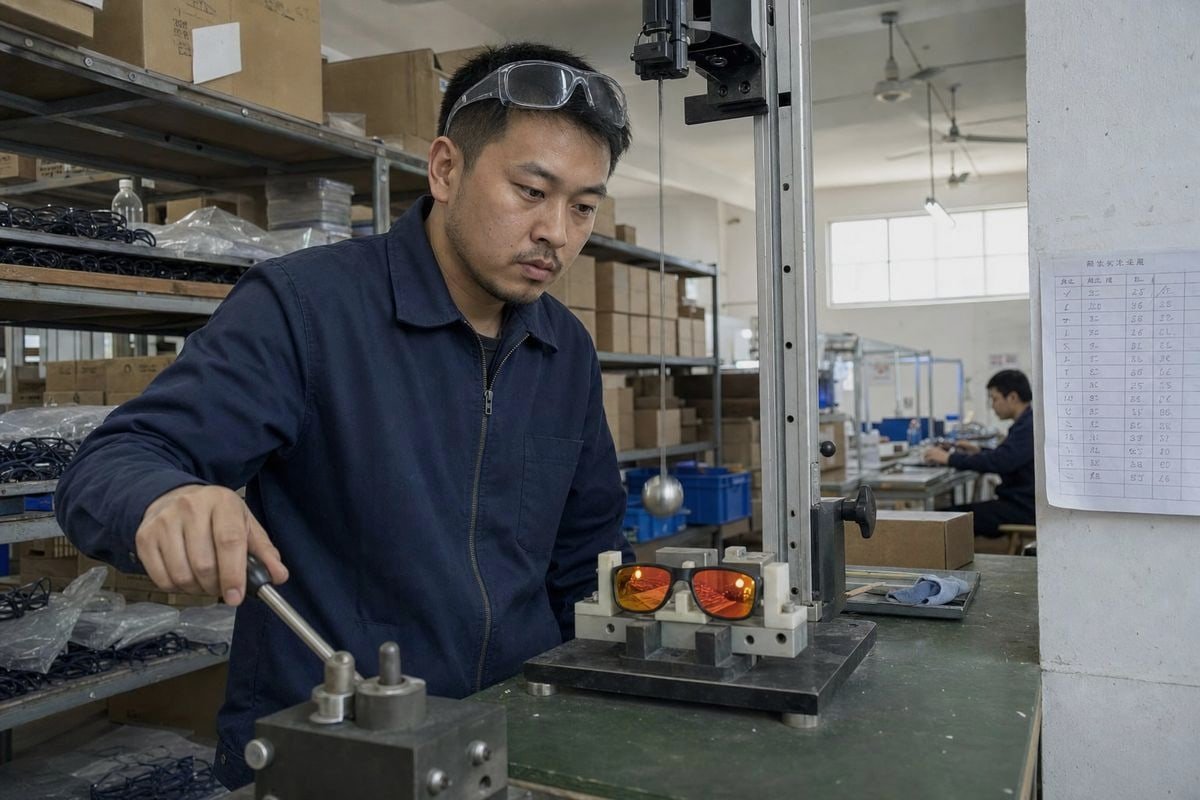
A single certificate is never enough. Serious retail buyers, especially in Australia, Japan, and Europe, expect a coherent document trail. Here is the full checklist we prepare for our own OEM/ODM clients, and what each document actually proves.
The Complete Document Checklist
| Documento | Lo que demuestra | Who Issues It |
|---|---|---|
| Third-party lab test report (ANSI Z80.3) | Measured UVA and UVB transmittance, luminous transmittance levels, optical performance | Accredited lab (e.g., SGS, Intertek, TÜV) |
| Certificate of Conformity | Formal declaration the product meets the named standard edition | Manufacturer or lab |
| FDA 21 CFR 801.410 impact test record | Lenses pass impact resistance testing for the U.S. market | Accredited lab or documented in-house per FDA rules |
| ISO 12312-1 report (for EU/AU markets) | Compliance with international sunglass requirements including lens category classification | Accredited lab |
| Sample and SKU matching sheet | Tested item equals the retail item, including tint and lens material | Manufacturer |
| Batch sampling and QC records | Ongoing production matches the tested sample | Manufacturer's QC department |
Why Batch-Level Records Matter Most
Here is the uncomfortable truth about our industry. Passing a lab test once is easy. Maintaining that performance across every production run is where factories separate themselves. In our 5S-managed workshop, we tie each batch to incoming material inspections and periodic retesting, because lens suppliers can quietly change resin formulas. If your manufacturer cannot show batch-level QC records, the original lab report slowly loses its meaning over time.
Also ask which markets each document covers. ANSI Z80.3 serves the U.S. market. ISO 12312-1 compliance covers Europe and underpins the Australian framework. Smart buyers request both up front, since dual-testing one sample costs far less than retesting after a rejected shipment.
How Can I Use UV Test Data to Build Trust With My Retail Buyers?
The trade-off I weigh with every client is this: do we keep test data in a filing cabinet, or do we turn it into a selling tool? The second option always wins.
Turn UV test data into retail trust by referencing the report number on packaging and B2B sales sheets, translating transmittance results into plain parent-friendly language, pairing lens data with child-fit coverage claims, and offering buyers direct access to verifiable third-party documentation.
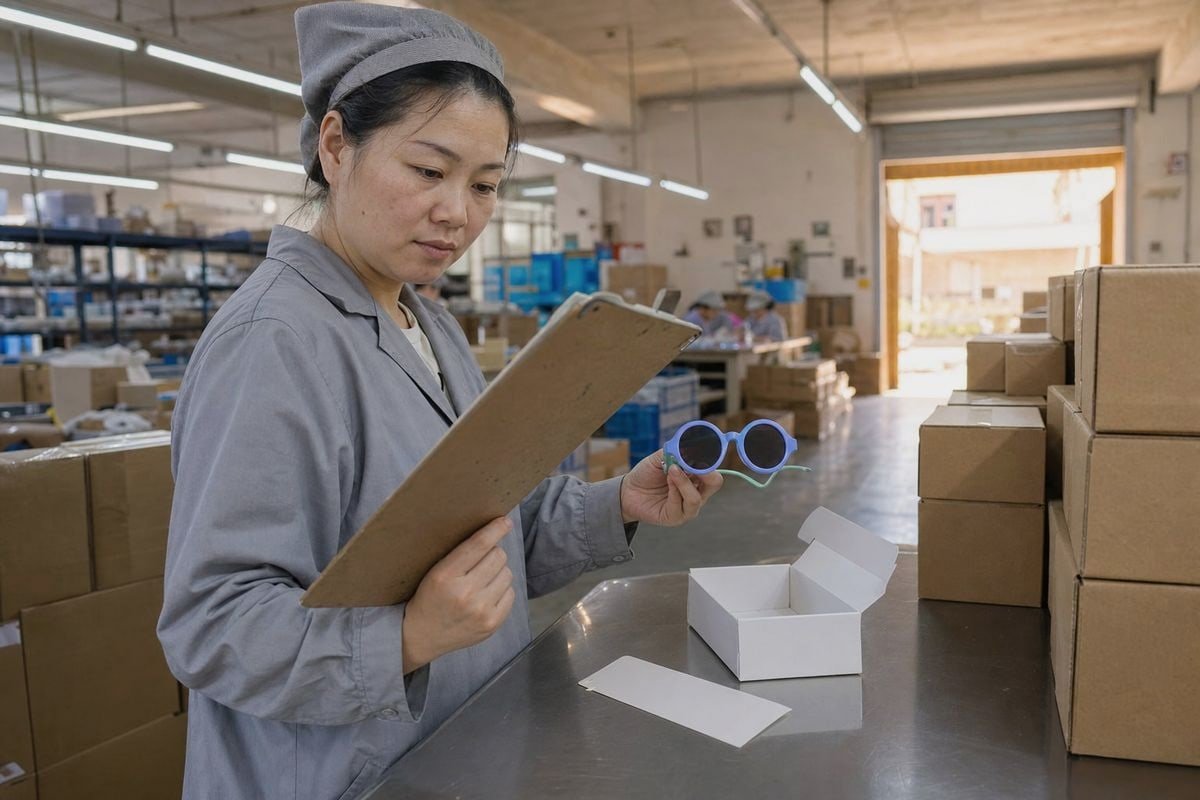
Test data is only useful if buyers and end consumers can understand it. Over the years, we have helped children's brands in 20+ countries convert lab numbers into shelf-ready trust. The method breaks into three layers.
Layer One: Translate the Data Honestly
Parents do not read spectral curves. But they respond to honest, specific language. "Blocks 99%+ of UVB and filters UV up to 400 nm — independently tested to ANSI Z80.3" is stronger and safer than a vague "100% UV blocking" claim that the data may not support. Overselling is the fastest way to lose a retail account. Under-claiming with proof is how you keep one for a decade.
Layer Two: Connect Lens Data to Real-World Fit
Here is the kids-specific point that most competitors miss. A lens can pass every transmittance test and still let sunlight leak around the edges of a badly fitting frame. Children's sunglasses are evaluated against smaller facial coverage geometry than adult sunglasses. So pair your UV data with fit claims: wraparound coverage, flexible TPEE temples that stay in place on small faces, and frames sized to child head dimensions. Our sport-style shield designs exist for exactly this reason — full coverage plus lab-verified lenses equals real-world protection. Buyers notice when you connect these two stories.
Layer Three: Make Verification Effortless
Give your retail buyers the report number, the lab name, and a contact for verification. Include a summary card in your line sheets. When a buyer can verify your claim in five minutes, the trust conversation is already over. When they cannot, price becomes the only conversation left — and nobody wins a race to the bottom in children's products.
A neutral spectral curve is another quiet selling point. Kids need accurate color perception to develop color constancy 7 and environmental awareness, so gray or neutral-tint lenses with documented luminous transmittance make a credible premium story.
Conclusión
ANSI Z80.3 test data proves kids' sunglasses UV protection only when the report, sample, edition, and claims align. Read the data carefully, demand full documentation, and let verified evidence — not marketing shorthand — win your buyers' trust.
Notas al pie
1. Background on sunglasses standards and UV protection concepts for context. ↩︎
2. Explains the measurement technique used to test lens transmittance. ↩︎
3. Peer-reviewed NIH study detailing UV radiation effects on children’s crystalline lenses. ↩︎
4. Official FDA database entry for the regulation on impact-resistant lenses. ↩︎
5. Authoritative Wikipedia section covering international sunglasses standards, including ISO 12312-1. ↩︎
6. WHO fact sheet on UV radiation health effects relevant to eye protection topic. ↩︎
7. Background concept explaining why neutral lens tints matter for children’s vision. ↩︎
Más artículos que te podrían gustar
1 de agosto de 2026
¿Debería la fábrica encargarse del embalaje y etiquetado de las gafas de sol para niños, o utilizar un proveedor designado?

1 de agosto de 2026
Almacén propio vs. Cumplimiento directo del proveedor: ¿Qué reduce los costos de devolución para las marcas de gafas de sol para niños?

1 de agosto de 2026
Directo al almacén del puerto o staging en el extranjero: ¿Cuál ahorra más en el envío de gafas de sol para niños?
¿Buscas un socio confiable en gafas para niños?
Explore más de 800 estilos listos y soporte OEM/ODM completo adaptado a su marca.
Ponte en contacto English
  Español de México
  Deutsch
  Français
  日本語
日本語  العربية
  Português do Brasil