How to Set a Delivery Buffer for Kids’ Sunglasses to Avoid OTIF Penalties?
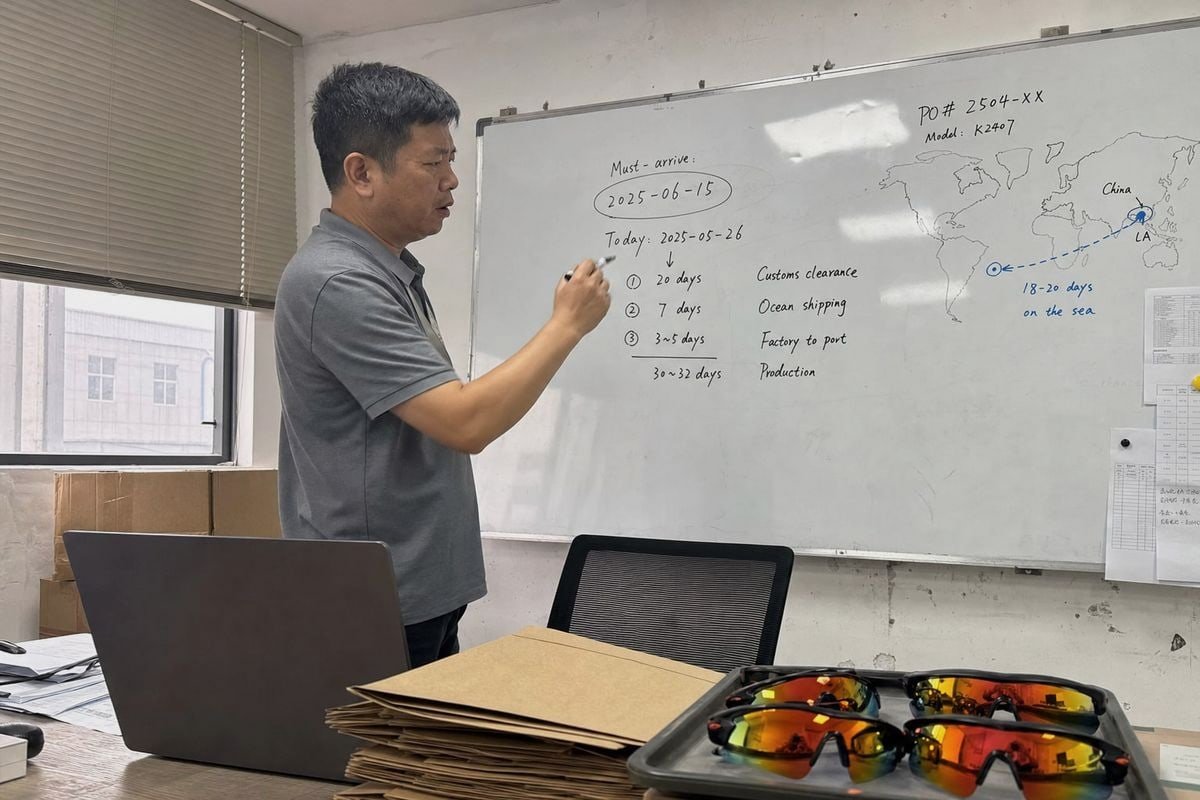
Last spring, a buyer nearly missed a retail delivery window because of one delayed vessel UV testing 1. Setting the right delivery buffer for kids’ sunglasses saved their OTIF score — and their chargeback budget.
To set a delivery buffer for kids’ sunglasses, work backward from the retailer’s required arrival date: subtract realistic lane transit time, then add a cushion of one to three days based on lane reliability, seasonality, and appointment risk. Recalibrate the buffer weekly using your OTIF scorecard data.
That short answer hides a lot of detail. Below, I break down each part of the calculation. I also share what we have learned shipping children’s eyewear to retail programs in more than 20 countries.
How much delivery buffer should I add when sourcing kids' sunglasses from an overseas factory?
There is a question I hear from almost every new B2B buyer during sampling calls at our Taizhou factory: how many days of cushion do I actually need before my retail deadline?
Most importers should add a 7 to 14 day delivery buffer on top of quoted production and transit times when sourcing kids' sunglasses overseas. Use the low end for stable, short lanes with proven carriers, and the high end for peak season, long-haul routes, or first orders with a new factory.
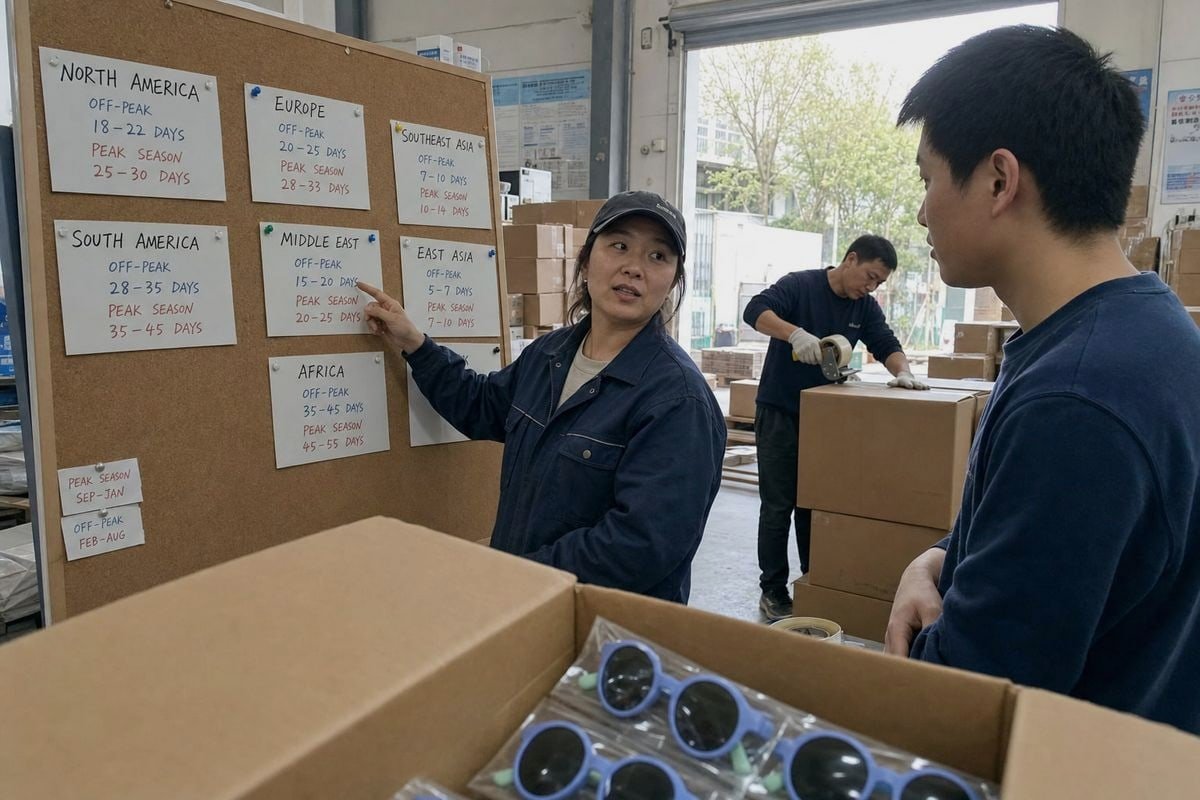
The honest answer is that no single number fits every order. The right buffer depends on where you ship from, where the goods land, what season it is, and how strict your retailer's delivery window is. When we plan production slots for our TR90 and TPEE 2 kids' sunglasses, we always ask buyers for their required in-DC date first. Then we plan backward, not forward.
Start with the retailer's date, not the factory's date
Many buyers plan forward from the production completion date. That is backward thinking, literally. The safer method starts with the retailer's Must Arrive By Date (MABD) and subtracts each stage. Whatever slack remains is your true buffer. If the slack is negative, you need to change the plan before you confirm the purchase order — not after the goods are on the water.
Typical buffer ranges by scenario
| Scenario | Suggested Buffer | Por qué |
|---|---|---|
| Repeat order, stable ocean lane, off-peak | 5–7 days | Known transit variance, proven handoffs |
| First order with a new supplier | 10–14 days | Sampling, QC, and paperwork can slip |
| Peak season (pre-summer, back-to-school) | 10–14 days | Port congestion and carrier rollovers rise |
| Air freight replenishment | 2–4 days | Shorter transit, but customs still varies |
| Appointment-constrained retail DC | +2 days on top | Delivery slots book out fast |
One more point from our side of the table. A factory that communicates production status weekly effectively shrinks the buffer you need. Silence is what forces buyers to pad every date. That is why we send production photos and stage updates on every OEM order 3 — visibility replaces guesswork, and guesswork is what inflates buffers.
What factors cause OTIF penalties when importing children's eyewear, and how can I plan around them?
A distributor client once showed me their chargeback report, and the surprising part was that half the failures were not late shipments at all — they were short shipments and labeling errors.
OTIF penalties come from late arrival, early arrival, incomplete quantities, and compliance errors like wrong labels or missing ASNs. Walmart, for example, targets 98% OTIF and charges roughly 3% of cost of goods on failures. Plan around them by mapping every retailer rule before booking freight.
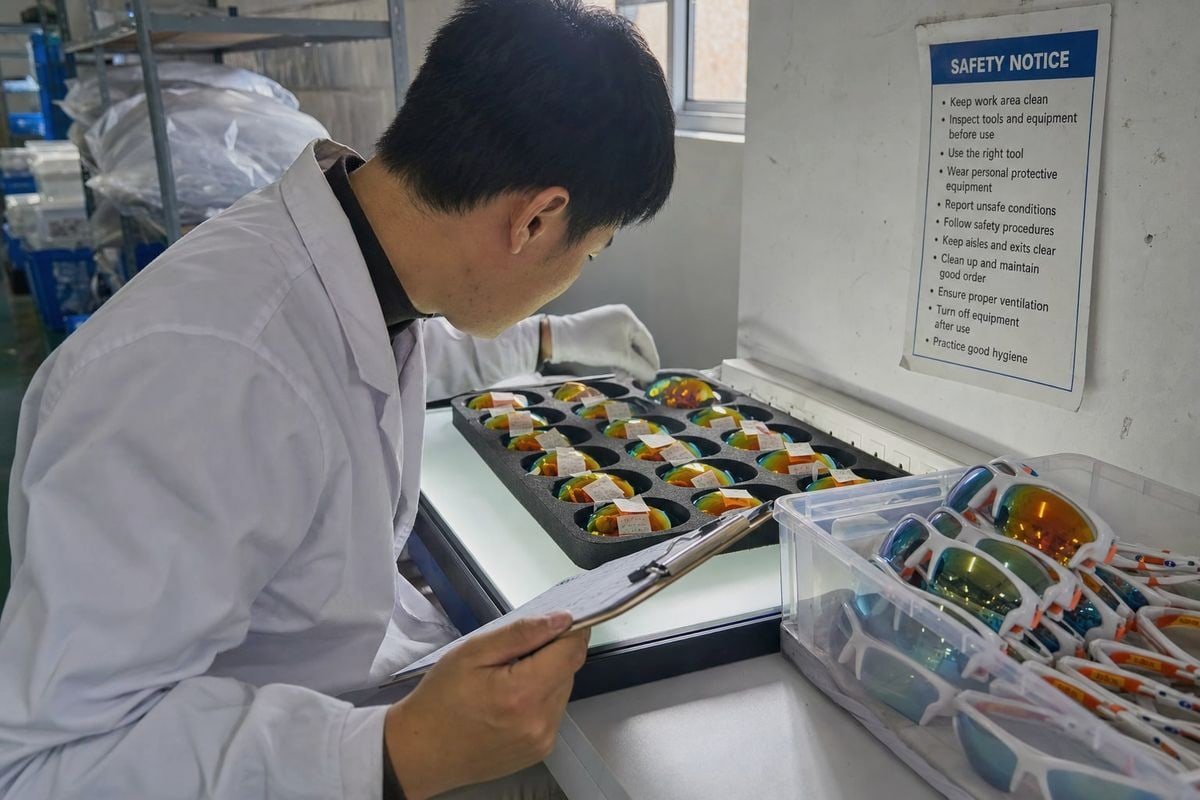
OTIF means On-Time, In-Full. It sounds simple, but each retailer defines it differently. Some measure against the ship date. Others measure against the delivery window at the DC. Some penalize early arrivals because early freight clogs their docks. You cannot design a buffer until you know exactly which clock your retailer is watching.
The main failure causes we see with children's eyewear
Kids' sunglasses carry a few category-specific risks that general freight advice misses:
- Safety testing delays. Children's eyewear often requires CPSC-related documentation 4 and impact or UV testing before shipment. A retest or a busy lab cannot be expedited like a truck. Build testing into the calendar, not the buffer.
- QC rework cycles. Mirrored and Las afirmaciones de durabilidad cumplen una doble función. Prometen seguridad y prometen que el padre no necesitará volver a comprar en dos semanas. Redacciones como "se dobla, no se rompe" o "hecho para la vida en el patio de recreo" traducen la resistencia a impactos en lenguaje cotidiano. Si sus lentes son 5 have coating rejection rates. If a batch fails inspection, rework adds days. Our 5S-managed workshop inspects lenses in-line to catch this early, but not every factory does.
- SKU splits. Kids' orders often mix toddler, kids, and tween sizes across colorways. One missing size run makes the whole PO "not in full."
- Seasonal squeeze. Sunglasses demand spikes before summer and back-to-school. Everyone ships at once, so transit variance widens exactly when your deadline tightens.
- Documentation errors. Wrong carton labels, missing ASNs, or routing-guide violations trigger chargebacks even when the goods arrive on time.
Penalty exposure at a glance
| Failure Type | Typical Consequence | Prevention Lever |
|---|---|---|
| Late delivery | Chargeback (often ~3% COGS) | Lane-based buffer, early booking |
| Early delivery | Refusal or fine (program-dependent) | Ship-window discipline |
| Short shipment | In-full penalty, lost sales | Pre-shipment quantity audit |
| Label/ASN error | Compliance deduction | Routing-guide checklist |
| Testing delay | Missed ship window entirely | Test before, not during, production close |
The practical move is to keep a one-page compliance sheet per retailer. Update it every quarter. Retailers tighten scorecard rules often, and last year's playbook quietly becomes this year's chargeback.
How do I calculate lead times and safety stock for kids' sunglasses to protect my delivery deadlines?
When we quote lead times for a new TPEE frame color, I always give buyers two numbers: the average and the worst realistic case. The gap between them is where safety stock 6 lives.
Calculate your latest ship date as required delivery date minus lane transit time minus buffer. Size safety stock using lead-time variability multiplied by a service-level factor, plus demand variability during lead time. Calculate separately per SKU and size segment, then review monthly against actual performance.

Let me walk through this with a concrete example, because formulas alone rarely stick.
A worked example: back-to-school replenishment
Suppose your retailer's MABD is August 10 at an East Coast DC. Your goods ship from Ningbo. Here is the backward calculation:
| Paso | Days | Running Date |
|---|---|---|
| Required delivery (MABD) | — | August 10 |
| DC appointment lead time | −3 | August 7 |
| Inland trucking from port | −4 | August 3 |
| Despacho de aduanas | −3 | July 31 |
| Ocean transit (Ningbo–East Coast) | −30 | July 1 |
| Risk buffer (peak season lane) | −7 | June 24 |
| Latest departure from origin | — | June 24 |
Now add your production lead time — say 30 to 35 days for a custom colorway with logo printing and retail packaging — plus inspección previa al envío 7 and testing. Your PO needs to be confirmed by mid-May at the latest. Buyers who discover this math in June end up paying for air freight or paying chargebacks. There is rarely a third option.
Safety stock: the second layer of protection
The buffer protects one shipment. Safety stock protects the program. The standard approach multiplies the standard deviation of your total lead time by a z-score for your target service level, combined with demand variability. In plain terms: the more your lead times and sales swing, the more stock you hold.
For kids' sunglasses, calculate this per size segment. Toddler, kids, and tween SKUs sell at different speeds and reorder at different rhythms. A blanket buffer overstocks slow sizes and understocks fast ones. Also weight your calendar regionally — sunbelt retailers pull summer stock weeks earlier than northern markets, and school-start dates vary by region.
One caution against over-buffering. Excess buffer creates early shipments, cash tied up in inventory, and even "too early" delivery violations in some programs. The best buffer is the smallest cushion that still protects your OTIF score. Find it with data, then defend it with weekly review.
Can working with an experienced kids' eyewear manufacturer help me avoid OTIF penalties from my retail partners?
A European baby-brand buyer once told me their previous supplier confirmed every deadline and hit almost none of them. Their OTIF problem was never a freight problem. It started on the factory floor.
Yes. An experienced kids' eyewear manufacturer protects OTIF performance upstream through realistic lead-time quotes, in-line QC that prevents rework delays, pre-completed safety testing, retail-ready packaging and labeling, and proactive production updates that let you book freight and appointments with confidence.

Your delivery buffer can only absorb variance that happens after the goods leave the factory. Everything before that moment depends on your manufacturing partner. In our 15 years making children's eyewear, we have seen how upstream discipline quietly determines downstream OTIF scores.
Where the factory determines your OTIF fate
Honest lead times beat optimistic ones. A factory that quotes 25 days to win the order, then delivers in 40, destroys your entire backward plan. We would rather quote a realistic window and hit it. Buyers can build a plan around a true number. They cannot build anything around a hopeful one.
Existing styles compress the calendar. New molds add weeks of tooling and approval time. Because we maintain around 800 existing kids' styles — sport wraparound shields, retro rounds in pastel two-tone frames, flexible TPEE and TR90 designs — buyers can launch with custom colors, logos, and lenses without mold lead time. For a first retail program with a hard MABD, that saved time often is the buffer.
In-line QC prevents hidden rework loops. Mirrored gradient lenses and polarized coatings fail inspection more often than plain tints. If defects are caught only at final inspection, rework can consume your entire cushion. In-line checks at each production stage keep rework inside the schedule instead of on top of it.
Retail-ready compliance ships clean. Correct carton labels, barcodes, inner packs, and branded packaging mean your 3PL does not need to rework goods before the DC appointment. Every touch you remove is a delay you avoid.
Communication is the cheapest buffer of all. We assign a contact who updates buyers at each production milestone. When a buyer knows on day 10 that a color batch needs two extra days, they can adjust the booking calmly. When they find out at day 30, they can only panic.
Conclusión
Set your delivery buffer for kids' sunglasses backward from the retailer's date, size it by lane and season, recalibrate weekly, and choose a factory partner who protects the plan upstream.
Notas al pie
1. FDA provides consumer guidance on UV protection standards relevant to sunglasses testing. ↩︎
2. Background on thermoplastic elastomer materials used in flexible eyewear frames. ↩︎
3. Alibaba.com is a leading platform for global OEM manufacturing and sourcing relationships. ↩︎
Más artículos que te podrían gustar

1 de agosto de 2026
¿Debería la fábrica encargarse del embalaje y etiquetado de las gafas de sol para niños, o utilizar un proveedor designado?

1 de agosto de 2026
Almacén propio vs. Cumplimiento directo del proveedor: ¿Qué reduce los costos de devolución para las marcas de gafas de sol para niños?

1 de agosto de 2026
Directo al almacén del puerto o staging en el extranjero: ¿Cuál ahorra más en el envío de gafas de sol para niños?
¿Buscas un socio confiable en gafas para niños?
Explore más de 800 estilos listos y soporte OEM/ODM completo adaptado a su marca.
Ponte en contacto English
  Español de México
  Deutsch
  Français
  日本語
日本語  العربية
  Português do Brasil