How to Request Regulatory-Ready Technical Documentation for Kids Optical Frames From Suppliers?

Requesting regulatory-ready technical documentation for kids optical frames sounds simple until a shipment gets held at customs EU Declaration of Conformity 1. Our team in Taizhou has seen buyers lose whole seasons over one missing test report.
Request a model-specific compliance package: an EU Declaration of Conformity, a complete technical file, accredited third-party test reports (ISO 12870, impact resistance, chemical safety), a bill of materials, labeling artwork with CE marking, and lot/batch traceability records tied to the exact kids frame model.
That is the short answer. The longer answer covers what each document proves, how to verify it, and what to do when a supplier falls short lista de materiales 2. Let’s break it down step by step.
What Technical Documents Should I Request From My Kids Optical Frame Supplier?
A procurement manager from Australia once asked us for "the certificate" for a TR90 kids optical frame 21 CFR 801.410 3. We sent back a folder of eleven documents instead — and explained why one certificate is never enough.
Request the EU Declaration of Conformity, the full technical file, third-party test reports, a complete bill of materials with material safety data, labeling and packaging artwork, product specification sheets, traceability identifiers, and a Children's Product Certificate for US-bound children's products.
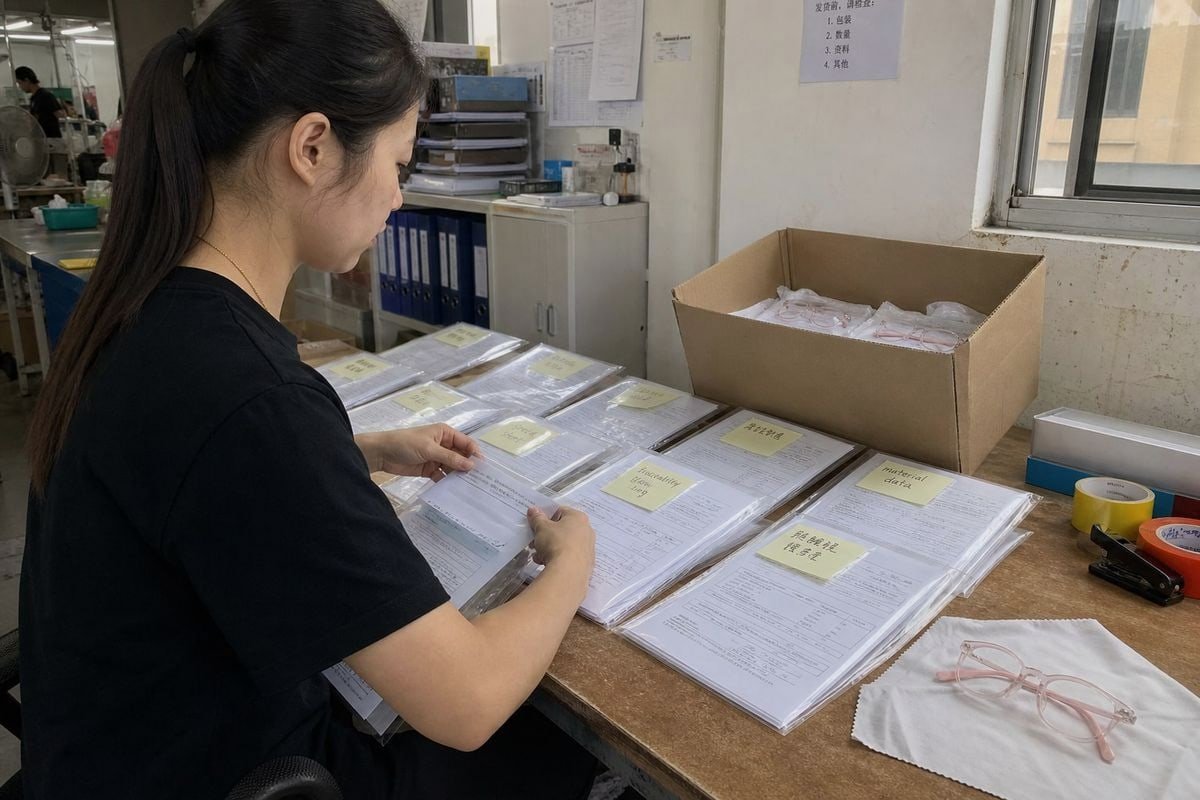
The core mistake buyers make is asking for a generic "compliance certificate." Regulators do not accept generic paperwork. They want evidence tied to the exact model, size, color, and material batch. So your request list should mirror what a market surveillance officer would ask for.
The Minimum Evidence Set
Here is the document package we prepare for our own kids optical frames, and what you should demand from any supplier:
| Documento | Lo que demuestra | Must Be Model-Specific? |
|---|---|---|
| Declaration of Conformity (DoC) | The supplier formally claims compliance with named regulations | Sí |
| Technical file (MDR Annex II/III style) | Design, intended use, risk evaluation, verification | Sí |
| Third-party test reports | Actual evidence, not just claims (ISO 12870 4, chemical limits) | Sí |
| Lista de materiales (BOM) | Every component: front, temples, hinges, screws, nose pads | Sí |
| Material safety data / declarations | Resin types, coatings, inks, plating, restricted substances | Sí |
| Labeling and packaging artwork | CE marking, manufacturer identity, lot code, model code | Sí |
| Product specification sheets | Eye size, bridge width, temple length, weight, materials | Sí |
| Traceability records | Lot/batch numbers, UDI-related identifiers where applicable | Sí |
Notice the pattern. Every single row must be model-specific. A DoC that names a broad product family but never mentions your exact kids model is a warning sign, not a comfort.
Why "Kids" Changes the Paperwork
Children's frames are not just smaller adult frames on paper. The technical file should describe the pediatric intended use: smaller dimensions, flexible hinges, softer temple tips, and child-specific risk scenarios like choking on small screws or breakage during play. When we developed our TR90 fronts with flexible TPEE temples, our risk file had to address bending, biting, and drop scenarios that adult frames rarely face. Ask your supplier to explain which parts of the file are specific to the children's version. If the answer is "it's the same file as the adult range," dig deeper.
How Do I Verify My Supplier's Documentation Meets FDA, CE, or EN ISO Standards?
During a supplier audit at our 5S-managed workshop last year, a European optical buyer spent two hours cross-checking our test reports against the standards named on our DoC. That is exactly the discipline I recommend to every buyer.
Verify by matching each document to the correct regulation: check that CE marking documents cite EU MDR for optical frames, test reports come from accredited labs and reference ISO 12870, US files address FDA regulations like 21 CFR 801.410, and every report names your exact model.
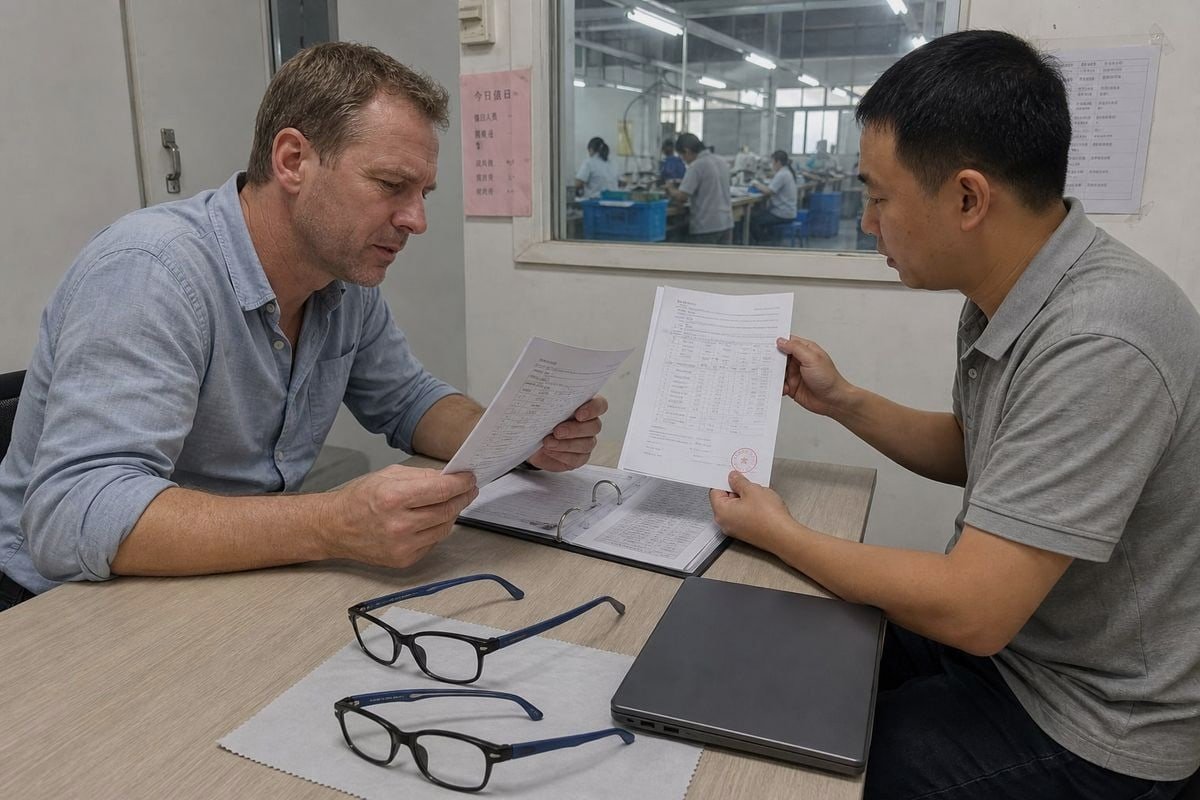
Verification is where claims get separated from evidence. A supplier can write anything on a cover letter. Your job is to test whether the underlying documents actually support it.
Map Each Market to Its Requirements
Different markets classify children's eyewear differently, and the paperwork must match:
| Mercado | Classification (Optical Frames) | Key Documents to Check |
|---|---|---|
| UE | Class I medical device under MDR | DoC, technical file, CE marking on labeling, ISO 12870 testing |
| EE. UU. | Device subject to FDA regulations; children's product under CPSIA | Impact resistance testing (drop ball), Certificado de Producto Infantil 5, CPSIA lead/phthalate reports |
| Sunglasses variants | PPE Category I under the PPE Regulation 6 (EU) | UV400 protection test data, EN ISO 12312-1 reports |
Note the split. If your supplier also sells you kids sunglasses, those fall under the PPE Regulation in the EU, not MDR — and the file must reflect that. Mixing the two frameworks in one vague folder is a common and serious error.
A Practical Verification Routine
I suggest a simple five-step check that takes under an hour:
- Open the DoC. Confirm it names your exact model code, the standards cited, and the legal manufacturer's name and address.
- Open each test report. Confirm the lab name, accreditation, test date, standard version, and the tested model photo match your product.
- Cross-check the BOM against the chemical reports. Every coating, ink, and nose pad material should appear in the material safety data.
- Check labeling artwork. The CE marking, lot code, and manufacturer details must appear exactly as they will on the shipped product.
- Ask for the traceability logic. The supplier should explain how a batch number on a temple arm links back to production and QC records.
If any link in that chain breaks — a report tests a different color variant, or the standard version is outdated — flag it before you pay a deposit. In our experience exporting to twenty-plus countries, buyers who run this routine once rarely face customs surprises later.
What Should I Do If My Supplier Can't Provide Complete Regulatory Documentation?
Early in our fifteen years of eyewear work, we lost a promising order because our chemical test reports covered the frame resin but not a new lacquer. That lesson shaped how we now handle documentation gaps — and how I advise buyers to respond to them.
First classify the gap: missing entirely, outdated, or not model-specific. Then set a written corrective deadline, require new accredited testing at the supplier's cost where feasible, and hold production. If the supplier resists or stalls, switch suppliers — never ship children's products on incomplete evidence.

Not every gap means the supplier is careless or dishonest. But every gap needs a clear response, because with children's products the liability lands on you as the importer or brand owner.
Triage the Gap Before You React
Treat documentation problems in three tiers:
| Gap Type | Example | Reasonable Response |
|---|---|---|
| Fixable paperwork gap | DoC exists but lacks your model code | Request a corrected, signed DoC within days |
| Missing evidence | No impact resistance testing or chemical report | Require new accredited lab testing before production |
| Structural gap | No technical file, no BOM, no traceability system | Walk away or fund a full remediation project |
Some suppliers will argue that simple optical frames are "low risk" and a short declaration should be enough. I understand the instinct — testing costs money. But that argument does not survive contact with a regulator. The technical file must still be organized, searchable, and substantiated with real evidence, not asserted in marketing language. Documentation depth can vary by market, yes. The need for model-specific evidence does not.
Negotiate Fixes Without Losing the Relationship
If the supplier is otherwise strong, a gap can become a partnership test. Put the corrective actions in writing with dates. Ask who pays for new testing — a confident factory usually absorbs testing costs for its own standard styles. Ask to see their quality management system evidence and their process for tracking regulatory changes. When a buyer asked us to add an updated REACH-oriented report for a new pastel acetate colorway, we treated it as normal business, not an insult. A supplier who gets defensive about evidence requests is telling you something important about how they will behave during a recall.
How Can I Build a Documentation Checklist Before Placing My First Bulk Order?
One trade-off we discuss with new brand clients is speed versus certainty: choosing from our roughly 800 existing styles gets you to market fast, but even then, the documentation checklist should be finished before the deposit, not after.
Build the checklist in four blocks: product identification (model, size, color, materials), compliance evidence (DoC, technical file, test reports), labeling proof (CE marking artwork, lot codes, user instructions), and supplier capability (quality system, post-market support, complaint handling). Sign off every item before ordering.
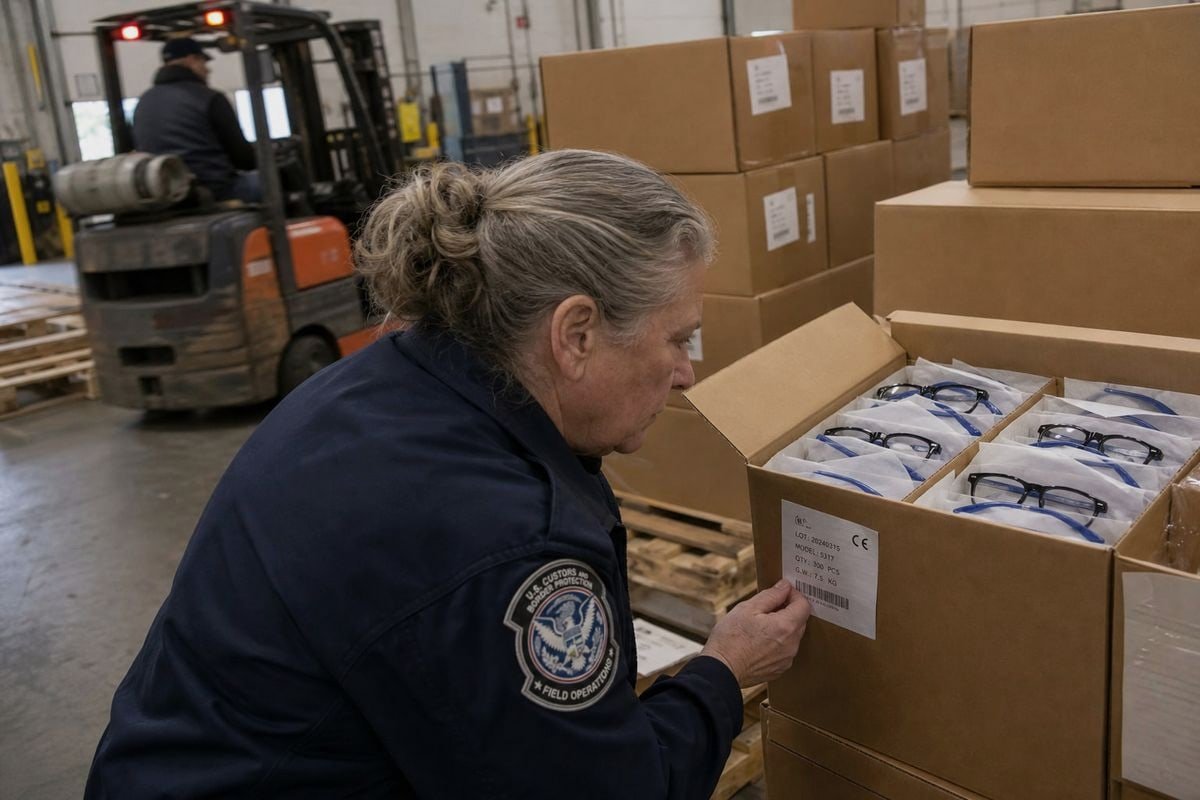
A checklist works because it converts a fuzzy request — "send me your compliance docs" — into a pass/fail exercise. Here is how I would structure it for a first bulk order of children's optical frames.
Block One: Product Identification
Pin down exactly what you are buying. Your product specification sheets should record eye size, bridge width, temple length, lens height, overall weight, frame material, and color. For our two-tone TR90/TPEE styles, we also document the temple tip material separately, because soft silicone tips have their own chemical compliance data. Every later document must reference these same identifiers.
Block Two: Compliance Evidence
List each required document next to each target market. EU orders need the DoC, technical file, and ISO 12870 test evidence. US orders need FDA-relevant impact resistance testing and a Children's Product Certificate with CPSIA chemical reports. Sunglasses variants need UV400 protection data. Mark each item received, verified, or pending.
Block Three: Labeling and Traceability
Approve labeling artwork showing the CE marking, manufacturer identity, model description, and batch code. Confirm the marking method is indelible on the small surfaces of a child's frame. Then confirm how batch codes map to production records — this is your recall insurance.
Block Four: Supplier Capability
Finally, look past the product. Ask about the quality management system, how the factory monitors regulatory changes, and how complaints and adverse events would be handled after shipment. Increasingly, buyers also ask us for a live document folder rather than static PDFs, so updated reports stay accessible. The industry is shifting from collecting certificates to managing documentation systems that survive audits — build your checklist for that world, not the old one.
Conclusión
Regulatory-ready documentation for kids optical frames means model-specific evidence: DoC, technical file, test reports, BOM, labeling, and traceability. Verify everything, close gaps early, and checklist before you order.
Notas al pie
1. Explains the EU Declaration of Conformity as a mandatory legal document. ↩︎
2. Original URL returned HTTP 404. Replaced with an authoritative Wikipedia page defining ‘bill of materials’. ↩︎
3. Details the FDA regulation for impact-resistant lenses in eyewear. ↩︎
4. Specifies fundamental requirements and test methods for spectacle frames. ↩︎
5. Explains the mandatory certificate for children’s products in the US. ↩︎
6. Outlines the EU regulation for personal protective equipment, including design and marketing. ↩︎
Más artículos que te podrían gustar

5 de agosto de 2026
Bio-Based vs Regular Cellulose Acetate: What's the Difference for Kids' Frames?

5 de agosto de 2026
How Recyclable Are Kids' Optical Frame Materials, and What Eco-Friendly Alternatives Exist?
5 de agosto de 2026
Do Kids Optical Frames Whiten or Age in Storage, and How to Control Warehouse Conditions?
¿Buscas un socio confiable en gafas para niños?
Explore más de 800 estilos listos y soporte OEM/ODM completo adaptado a su marca.
Ponte en contacto English
  Español de México
  Deutsch
  Français
  日本語
日本語  العربية
  Português do Brasil