How to Request REACH Test Reports for Kids’ Optical Frames from Suppliers?

Requesting REACH test reports for kids’ optical frames sounds simple — until a supplier sends you a one-line “REACH compliant” email. REACH Regulation 1 I see this happen to buyers constantly.
To request REACH test reports for kids’ optical frames, ask your supplier for a current third-party lab report covering the exact model and materials, including both SVHC screening and REACH Annex XVII testing, plus a signed declaration of conformity tied to your production batch.
That is the short version. The rest of this guide shows you exactly what to confirm first, how to verify the paperwork, which substances matter most, and how to make the whole process routine.
What Should I Ask My Supplier to Confirm Before Requesting a REACH Report?
A buyer from Germany once emailed our factory asking simply for "the REACH certificate." We had to reply with five questions before we could send anything useful. Those five questions are worth sharing.
Before requesting a REACH report, confirm the exact frame model and SKU, the full material breakdown of every component, the target market, whether testing covers the finished product or raw materials only, and whether the supplier uses accredited testing laboratories for third-party reports.
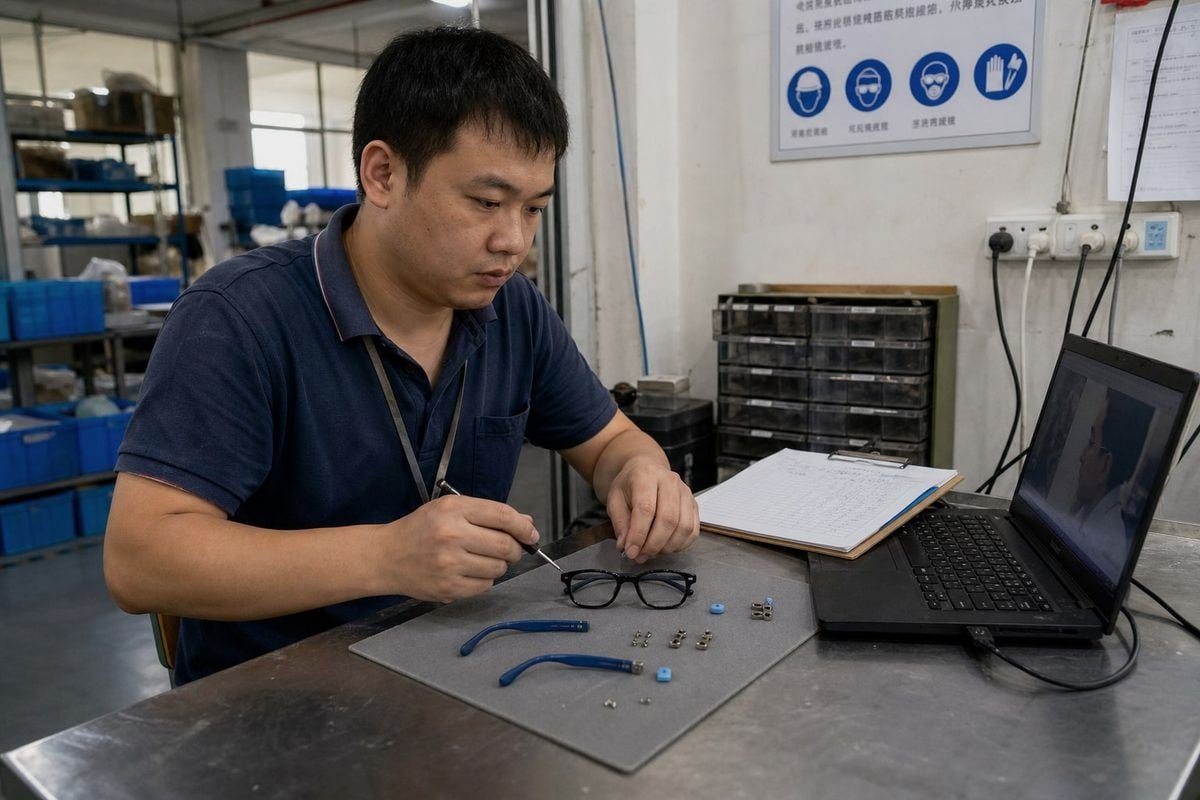
The reason these confirmations matter is that "REACH" is an umbrella, not a single test. When we quote testing for one of our TR90 kids optical frames with TPEE temples, the lab needs to know every material in the assembly before it can define a test plan. A frame is never one material. Take a typical child's frame: a rigid front, flexible rubber temples, silicone temple tips, metal hinges, screws, and sometimes decorative coatings or printed logos. Each component can carry different chemical risks, so each may need its own scope.
The Five Confirmations, In Order
- Model and SKU. A report must name the exact product, not a product family. A pink translucent acetate frame and a black frame with blue rubber temples are different material systems, even if they share a shape.
- Material breakdown. Ask for a full material declaration listing plastics, metals, coatings, and soft-touch parts. This is also your early warning system during the design phase.
- Target market. EU market access regulations drive the REACH scope. If you also sell in the US, you will layer CPSIA and Prop 65 on top — different regimes, different tests.
- Finished product vs. raw material. Pre-certified raw materials are helpful, and we do buy pre-certified TR90 and TPEE pellets ourselves. But raw-material claims do not prove the assembled frame complies, because coatings, inks, and hinge metals enter later in production. Insist on finished-product evidence.
- Lab accreditation. Confirm the lab is ISO/IEC 17025 accredited. A report from an unaccredited in-house lab is a data point, not proof.
Once these five points are confirmed, your request becomes specific — and specific requests get real reports back.
How Do I Verify a REACH Test Report Is Genuine and Not Outdated?
Early in our export business, a buyer showed us a competitor's report they had received elsewhere — the lab name was real, but the report number did not exist in the lab's system. That lesson stuck with me.
Verify a REACH report by checking it directly with the issuing lab's online verification system, matching the report number, tested SKU, and materials to your actual order, and confirming the report date still reflects the current design, colorway, and production batch.

Verification is where many buyers cut corners, and it is exactly where fraud and honest drift both hide. Fraud is the obvious risk: edited PDFs, borrowed reports, or reports for a different product. Honest drift is subtler. A supplier tests a frame in 2022, then changes the temple material or coating supplier in 2024 without retesting. The report is genuine but no longer describes your product. Both problems are caught the same way — systematic checks.
A Practical Verification Checklist
| Comprobar | Qué buscar | Señal de alerta |
|---|---|---|
| Lab identity | Named, recognized third-party lab with ISO/IEC 17025 accreditation | No lab name, or an unknown lab with no web presence |
| Report number | Verifiable through the lab's official online lookup tool | Number missing or not found in the lab's system |
| Sample identification | Model number, SKU, materials, and sample photos matching your order | Vague description like "plastic eyewear" |
| Test scope | Both SVHC screening 2 and Annex XVII restrictions listed with methods | Only "passes REACH" with no substance list |
| Results detail | Concentrations or release values with pass/fail per substance | Only a summary "PASS" with no data |
| Date | Recent enough to reflect current materials and design | Report older than the current material system |
Major labs run report verification portals precisely because forged PDFs circulate. Use them. It takes ten minutes and costs nothing. Also, ask your supplier a direct question: "Has anything in the material system changed since this report was issued?" At our factory, we log every material or coating change against affected SKUs, so we can answer that question honestly. A supplier who cannot answer it is telling you something important. Finally, remember that as the EU importer, importer responsibilities sit with you legally — market surveillance authorities will ask you, not your Chinese supplier, for chemical compliance documentation.
Which REACH Substance Restrictions Matter Most for Children's Optical Frames?
There is a real trade-off we weigh in every kids' frame design: soft, flexible, comfortable materials versus chemical risk. Plasticizers make plastics soft — and some plasticizers are exactly what REACH restricts.
For children's optical frames, the highest-priority REACH concerns are phthalates content in soft plastics, nickel release testing for metal parts touching skin, lead and cadmium concentration limits, PAHs in rubber components, and SVHC screening against the current candidate list.
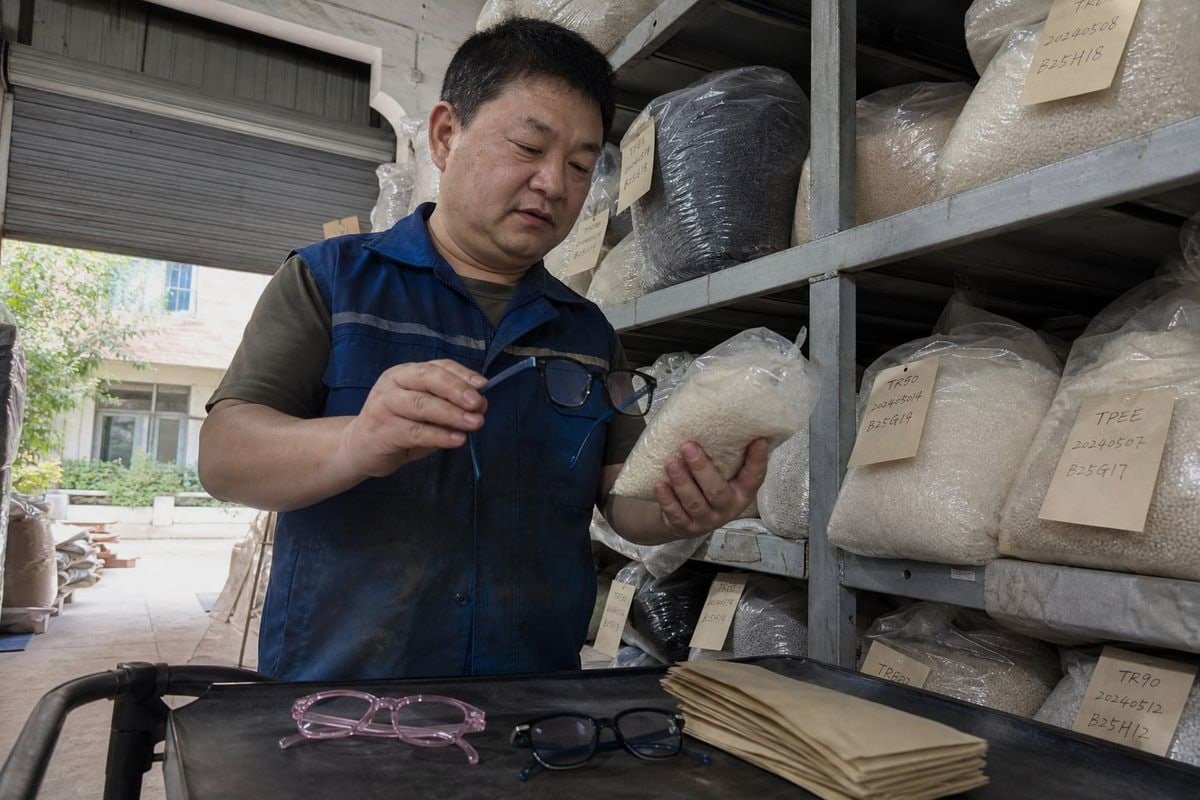
Children's product safety demands a stricter lens than adult eyewear. Kids' frames sit on skin for hours, get chewed, dropped, and handled with hands that go straight to mouths. Government surveys of spectacle frames have found measurable chemical presence in real products on the market, which is why we treat this as a practical risk, not a theoretical one. Here is how the main substance groups map to the parts of a typical children's frame — like a design with a rigid front, flexible rubber temples, and silicone tips.
Substance-to-Component Mapping
| Substance Group | Where It Hides in a Kids' Frame | Why It Matters for Children |
|---|---|---|
| Phthalates 3 | Soft PVC parts, flexible temple materials, nose pads | Mouthing and prolonged skin contact; strict limits for child-use articles |
| Nickel (release) | Hinges, screws, metal cores, decorative trims | Prolonged skin contact behind the ears and on the nose can trigger sensitization |
| Lead and cadmium | Pigments, coatings, stabilizers, metal alloys | Cumulative toxicity; lead concentration limits are strict for accessible parts |
| HAP | Rubber and soft-touch black components | Restricted in articles with direct, prolonged skin contact |
| Azo dyes | Colored textiles or coated parts, printed straps | Certain azo dyes release restricted aromatic amines |
| SVHCs (candidate list) | Any component, screened collectively | Above 0.1% by weight triggers communication duties |
Our material strategy at the factory is to design the risk out where possible. TR90 and TPEE do not need phthalate plasticizers to be flexible, which is one reason we standardized on them for children's frames years ago. That removes the largest single risk category by design. But design choices are not proof. You still need REACH Annex XVII testing 4 on restricted substances plus a current SVHC screening, because pigments, coatings, and metal hardware remain in play even in a well-designed frame. Also remember the scope beyond chemicals: EN optical standards and general children's safety requirements are separate obligations. REACH is necessary, but it is not the whole compliance picture.
How Can I Build REACH Compliance Checks into My Regular Ordering Process?
One of our long-term Australian customers taught us something useful: they treat compliance paperwork as a standing agenda item in every reorder call, not a one-time hurdle. Their process rarely produces surprises.
Build REACH checks into ordering by writing testing requirements into supplier contracts, requesting material declarations at design stage, tying each report to the production batch, verifying reports before shipment approval, and maintaining an internal restricted substances list that exceeds legal minimums.

The goal is to move from reactive document-chasing to a repeatable routine. In my experience exporting kids' eyewear to 20-plus countries, the buyers who struggle least are the ones whose purchase orders already contain the compliance language. Here is a workflow you can adapt.
A Repeatable Five-Step Workflow
- Contract stage. Specify the required tests in writing: substance groups, Annex XVII entry references, test methods, accredited testing laboratories, sampling plans, and pass/fail criteria. Vague contracts get vague reports.
- Design stage. Request full material declarations for every component before tooling or color confirmation. Catching a risky pigment on paper is cheap; catching it in a failed shipment is not.
- Pre-production stage. Confirm which existing reports still apply and which variants need new testing. Standard workflows typically need three to five representative samples and return results in roughly five to ten business days after the lab receives them — build that into your timeline.
- Pre-shipment stage. Verify the report package: lab report, supplier declarations of conformity, sample identification, and evidence the tested sample matches the shipped goods.
- Archive stage. File everything by SKU and batch for customs, retailer onboarding, and internal QA.
What a Complete Document Package Looks Like
| Documento | Purpose | Primary or Supporting |
|---|---|---|
| Third-party lab test report | Proof of chemical results per substance | Principal |
| REACH declaration of conformity | Supplier's formal compliance statement | Supporting |
| Material declaration | Component-level composition record | Supporting |
| Safety Data Sheets where relevant | Raw material hazard information | Supporting |
| Batch traceability record | Links report to shipped goods | Supporting |
Treat the declaration as supporting evidence and the lab report as primary proof — never accept the declaration alone as a substitute. Two forward-looking habits are worth adopting now. First, maintain your own restricted substances list that goes beyond REACH minimums; children's brands that do this absorb regulatory changes calmly instead of scrambling. Second, start requesting structured, machine-readable compliance data from suppliers, because Digital Product Passports are coming to EU-bound products, and suppliers who can already deliver clean data will save you real migration pain later.
Conclusión
Vague "REACH compliant" claims put your brand at risk. Demand model-specific, verified, current lab reports — and build the checks into every order. That is how children's eyewear stays genuinely safe.
Notas al pie
1. Official EU Commission page on REACH regulation. ↩︎
2. Explains the purpose and legal obligations related to Substances of Very High Concern. ↩︎
3. Provides information on phthalates, their uses, and restrictions under REACH. ↩︎
4. Details the specific restrictions on manufacturing, placing on the market, and use of substances. ↩︎
Más artículos que te podrían gustar

5 de agosto de 2026
Bio-Based vs Regular Cellulose Acetate: What's the Difference for Kids' Frames?

5 de agosto de 2026
How Recyclable Are Kids' Optical Frame Materials, and What Eco-Friendly Alternatives Exist?
5 de agosto de 2026
Do Kids Optical Frames Whiten or Age in Storage, and How to Control Warehouse Conditions?
¿Buscas un socio confiable en gafas para niños?
Explore más de 800 estilos listos y soporte OEM/ODM completo adaptado a su marca.
Ponte en contacto English
  Español de México
  Deutsch
  Français
  日本語
日本語  العربية
  Português do Brasil