How Do Kids’ Anti-Blue-Light Glasses Block Blue Light, and Which Wavelengths Matter Most?
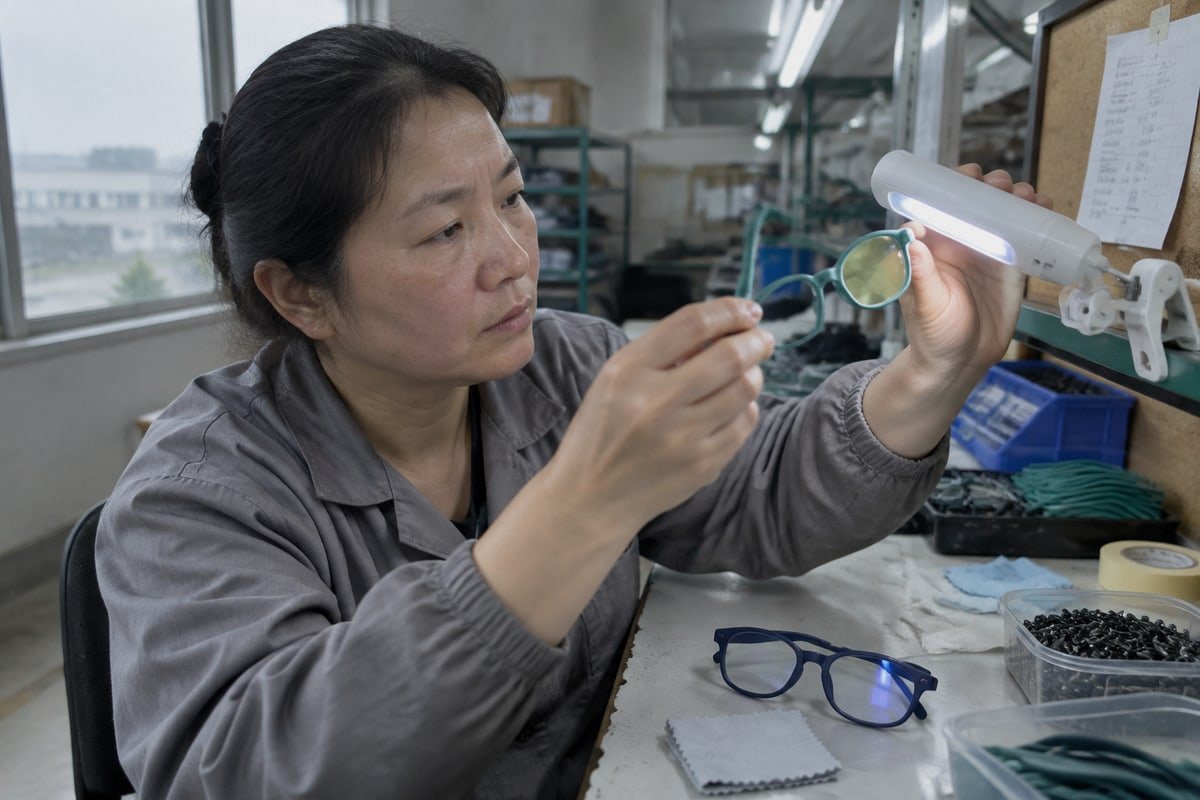
Buyers ask me every week what kids’ anti-blue-light glasses actually block. Vague answers cost brands trust and returns. So I opened our factory’s lens test notes to explain wavelengths clearly.
Kids’ anti-blue-light glasses use lens pigments that absorb blue light or coatings that reflect it, cutting transmission of short-wavelength visible light. The wavelengths that matter most are 400–450 nm high-energy blue-violet light and the 460 nm band linked to melatonin suppression.
Not all blue light is the same. The label on the box tells you very little. The wavelength range and the transmission curve tell you almost everything. In this article I will walk through how the lenses work, which bands matter for sleep and which for comfort, how to check a supplier’s claims, and which materials keep the glasses safe on a child’s face.
How do blue-light filtering lenses actually work in kids' glasses?
Last month our QC team held two lens samples up to a white LED. One looked faintly yellow, the other flashed blue. Both were labeled as blue-light blocking.
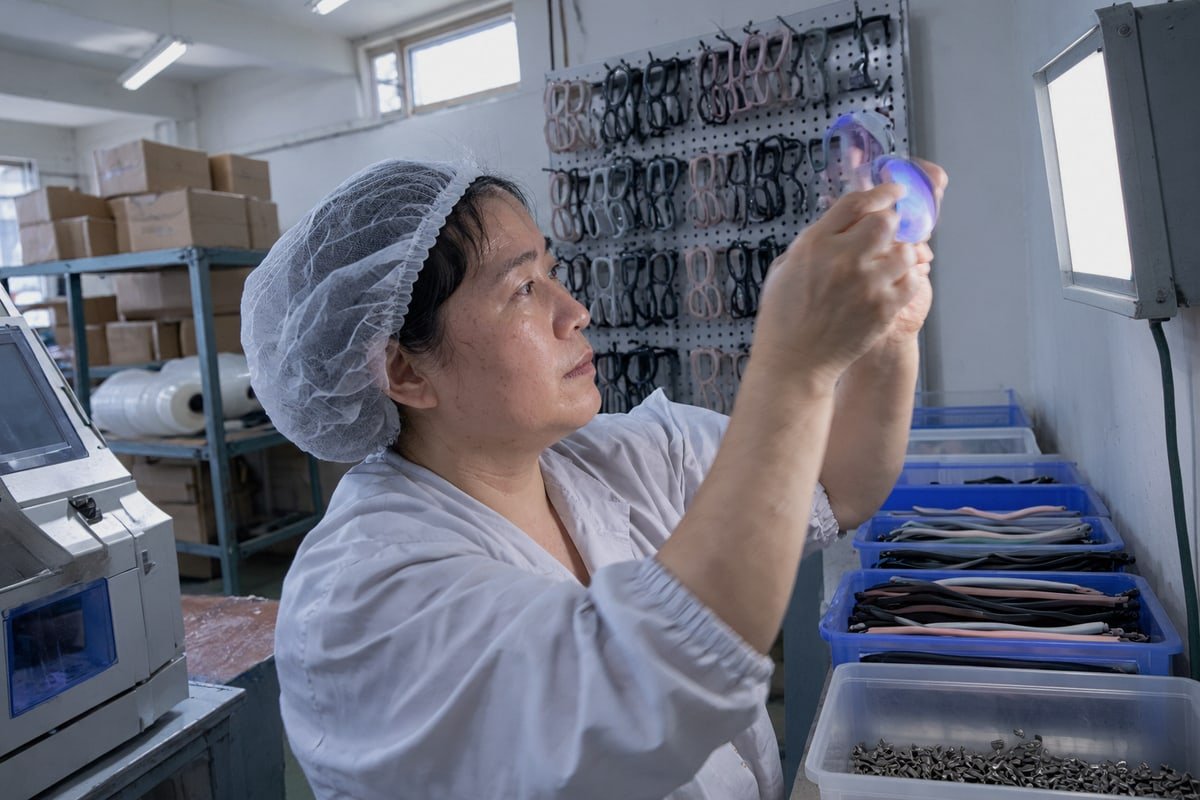
Blue-light filtering lenses in kids' glasses work in two ways. Absorptive lenses carry a pigment inside the material that soaks up short wavelengths, giving a faint yellow tint. Reflective lenses use a multi-layer coating on the surface that bounces blue light away, showing a blue sheen.
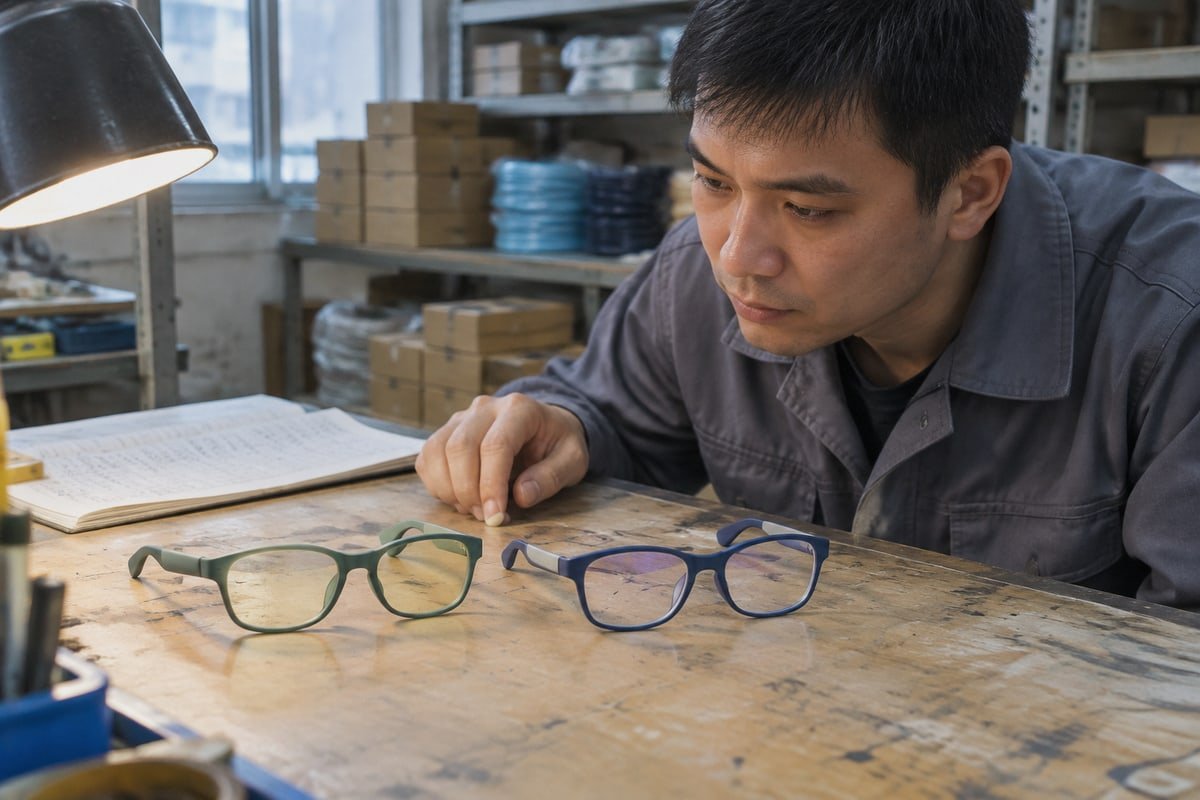
The two samples on our bench were not doing the same job. That is the first thing I want a brand buyer to understand. The luz visible 1 runs from roughly 400 nm (violet) to 700 nm (red). Blue light sits at the short, high-energy end, usually defined as about 400–495 nm. A filtering lens simply lowers how much of that end passes through to the eye. How it does that changes the look, the cost, and the performance.
Absorption versus reflection
| Método | Where it works | How it looks | Typical strength | Trade-off |
|---|---|---|---|---|
| Absorptive pigment | Dentro del material de la lente | Pale yellow to amber tint | Can block a large share of 400–500 nm | Stronger blocking means a deeper yellow tint |
| Reflective coating | Thin multi-layer film on the lens surface | Clear lens with a blue or violet sheen | Usually a lighter filter, often around 10–30% in the blue band | The visible sheen can be mistaken for strong blocking |
| Combined | Pigment plus coating | Light tint with a faint sheen | Balanced daytime option | Higher lens cost |
The teal-green frame in our range uses the first approach. Its pale yellow lens has the pigment mixed into the material, so the filtering does not wear off with scratches. The navy soft-touch frame uses the second approach. Its lens looks clear head-on, but you see a blue reflection at an angle. That is the coating sending part of the blue band back out.
Why the anti-reflective coating matters too
Here is something many brand buyers miss. A good part of the comfort a child reports from these glasses does not come from blue filtering at all. It comes from the recubrimiento antirreflectante 2 layered on the same lens. That coating cuts screen glare and visual noise. Glare, dry eyes, and long focus distance are the main drivers of digital eye strain, often called computer vision syndrome. So when a parent says the glasses "feel easier," the AR layer is often doing much of the work. I always spec AR on both sides of a kids' lens for this reason.
Lens tint technology and color learning
Deep amber lenses block more, but children still need accurate percepción del color 3 for reading charts and craft work. Lens tint technology now allows a lighter daytime tint that keeps colors close to natural, with stronger tints saved for evening use. When I develop a kids' style, I ask the buyer which use case they are selling. That decision drives which lens goes in the frame.
Which blue-light wavelengths should I prioritize blocking for children's eye safety?
There is a trade-off I weigh on every lens spec: block more of the 400-450nm range and the lens turns yellower, which parents dislike for color-based learning.
Prioritize two bands. For retinal safety and high-energy exposure, focus on 400–450 nm blue-violet light, the highest-energy visible light reaching the retina. For sleep, target 447–484 nm, peaking near 460 nm, where melatonin suppression is strongest. Daytime lenses filter lightly; evening lenses block more.
Wavelength matters more than the word "blue." When I sit down with a product manager, I split the blue band into the parts below. Each one links to a different claim, and a different lens.
The spectrum, broken into useful pieces
| Band | Common name | Por qué importa para los niños | Which lens type targets it |
|---|---|---|---|
| 380–450 nm | HEV light (high-energy visible), blue-violet | Highest energy visible light reaching the retina; the focus of retinal and macular health discussions | Absorptive pigment lenses, moderate tint |
| 400–455 nm | Blue-violet | Overlaps HEV; the range most product claims quote as "harmful" | Same as above |
| 447–484 nm | Melatonin suppression 4 window | Sensitivity for melatonin production suppression peaks near 460 nm | Amber evening lenses, or narrow-band 460 nm filters |
| 465–495 nm | Blue-turquoise | Supports daytime alertness and a healthy circadian rhythm; usually should not be fully blocked | Light daytime filters leave most of this open |
| Around 480 nm | Melanopsin peak | Target of newer melanopsin-specific filters aiming to regulate sleep with less yellow tint | Emerging specialized lenses |
Why children are the case that matters
A child's crystalline lens is highly transparent. It lets far more short-wavelength light reach the back of the eye than an adult lens does. This is why the retinal safety 5 argument centers on children, and why I never treat a kids' lens as a shrunken adult lens. It is also why I remind buyers that the sun, not the tablet, is the strongest source of blue light. Our two-tone black-and-sky-blue frame ships with a polarized UV400 clip-on for exactly this reason. Outdoor protection is part of the same strategy.
The objection I hear most, and how I answer it
Procurement managers often push back. They read that pediatric and eye-care bodies are skeptical, and that the best studies show little to no short-term difference in digital eye strain and no proven long-term eye disease prevention for healthy children. They are right, and I say so. Then I explain where the evidence is stronger: acute melatonin suppression under evening light is well documented, and it peaks close to 460 nm. That gives a brand an honest, narrow claim. Position the product for evening screen time, homework under bright LEDs, and children with light sensitivity or migraine. Do not position it as a medical necessity for every child. That middle ground sells better and survives scrutiny.
How can I verify blue-light blocking performance when sourcing from a manufacturer?
A procurement manager from Australia once sent me three competing spec sheets. Each claimed it blocks blue light. None listed a wavelength range or a transmission curve.
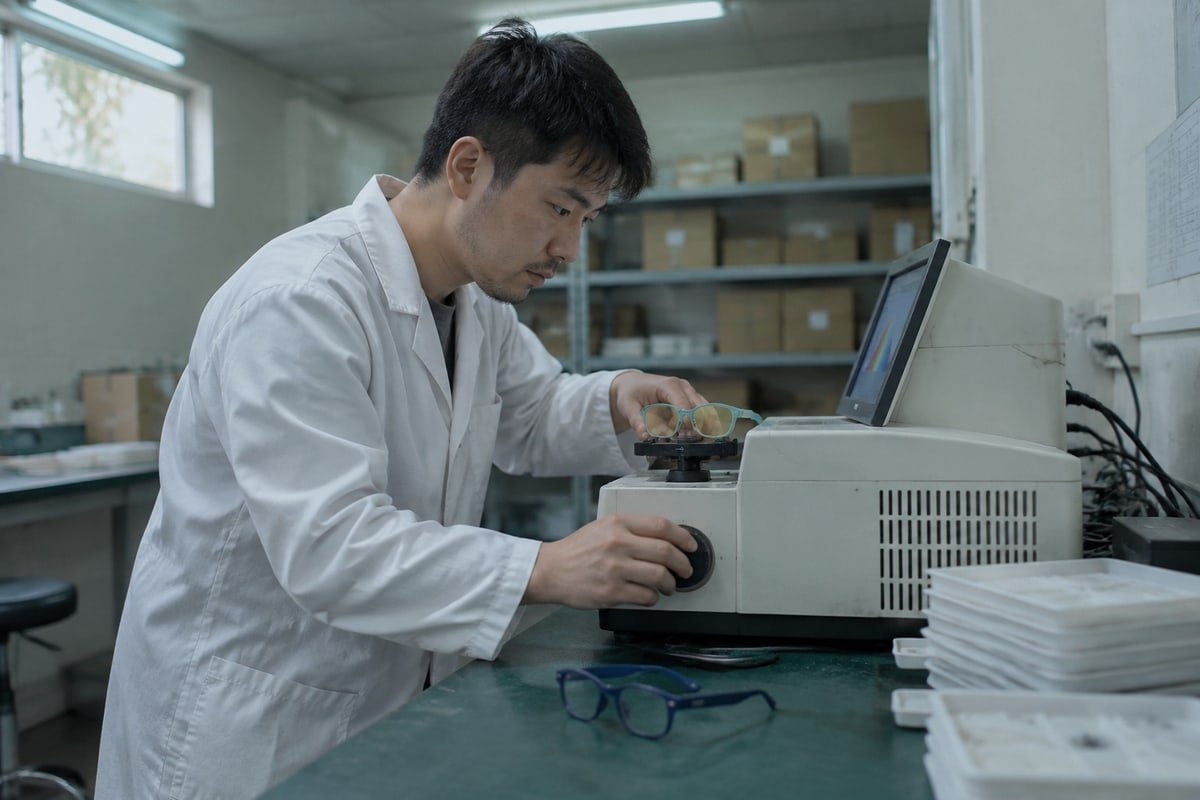
Verify performance by requesting a spectral transmission curve, not a headline percentage. Ask which band the percentage covers, such as 400–470 nm or 460–480 nm, and at what points. Then confirm with a spectrometer test on production samples, plus UV400 verification for sun lenses.
A single number sells well and tells you little. "Blocks 50% of blue light" could mean 50% at 420 nm and almost nothing at 460 nm. It could also be an average across 400–500 nm that hides a weak spot right where sleep claims live. The transmission curve shows the whole picture. I ask every buyer to insist on it, and we supply it for our own lenses.
Un proceso de verificación paso a paso
- Define the claim first. Decide whether you are selling daytime comfort or evening sleep support. The band you verify depends on that answer.
- Request the curve. Ask the supplier for a spectral transmission chart across at least 380–500 nm, in 5 or 10 nm steps.
- Read the key points. Check transmission at 420 nm, 450 nm, 460 nm, and 480 nm. Compare them to the marketing claim.
- Check the color side. Note transmission above 500 nm and the lens color coordinates. A lens that blocks strongly but turns everything orange may fail your retail audience.
- Test production, not just prototypes. Pigment concentration and coating thickness can drift between batches. Pull random samples from the finished lot for spectrometer testing.
- Verify UV400 on sun lenses. Any clip-on or sunglass version should show near-zero transmission below 400 nm.
- Document it in the QC record. We keep lens test records with each order in our 5S-managed workshop, so a buyer can trace a batch back to its test.
How to read common product claims
| Claim as advertised | What it likely means | Pregunta a hacer |
|---|---|---|
| Blocks up to 54% of blue light between 400–470 nm | A moderate daytime filter, probably lighter at the upper end | What is transmission at 460 nm specifically? |
| Blocks 98%+ of 460–480 nm | A strong evening lens, almost certainly amber | How much color shift does this cause for a child? |
| Amber lens blocks 89–99.9% of 400–500 nm | Near-total blocking, sleep-oriented | Is this safe and practical for daytime school use? |
| Blocks blue light | No usable information | Which band, what percentage, and can I see the curve? |
The honest supplier will answer these without hesitation. The rest of the sourcing process is normal eyewear QC: hinge cycling, drop tests, frame flex, and packaging checks. But the lens curve is the step that separates kids' anti-blue-light glasses that do what the box says from ones that only look the part.
What lens and frame materials should I choose for safe, comfortable kids' anti-blue-light glasses?
Fifteen years of making children's frames taught me one hard lesson: a lens that filters perfectly is useless if the frame pinches and the child pulls it off.
Choose impact-resistant lenses with built-in blue-light pigment and an anti-reflective coating. Pair them with flexible TR90 frames and soft TPEE temples that bend without snapping. Add UV400 sun lenses or a polarized clip-on, since sunlight is the strongest blue-light source.

Filtering is only half of the product. A child wears these glasses during homework, on the sofa, and sometimes while running through the house. The materials decide whether the glasses survive, and whether the child keeps them on long enough to matter.
Frame materials compared
| Material | Where we use it | Strengths for kids | Precauciones |
|---|---|---|---|
| TR90 | Front frames, full optical frames | Lightweight, flexible, holds shape, resists impact | Needs correct wall thickness to stay flexible without warping |
| TPEE | Temples on TR90 fronts, full sunglass frames | Very soft, bends almost flat, gentle on ears and temples | Softer feel means color and finish must be controlled carefully |
| Rigid acetate or standard plastic | Rarely for young children | Premium look | Can crack on impact and pinch at the hinge |
Nuestro TR90 fronts with TPEE temples are the combination I recommend most for optical and blue-light styles. The front holds the lens in true alignment. The temples flex when a child grabs them, then return to shape. Both materials are environmentally friendly and light enough for small faces. The matte soft-touch finish on our navy frame is a good example. It feels warm, not slippery, and resists the fingerprints that glossy frames collect.
Lens choices that fit the material
Absorptive pigment lenses pair best with these flexible frames because the filter is inside the lens, not on a coating that can chip when the frame flexes. I still add an anti-reflective coating for glare and comfort. For sun versions, I use UV400 lenses, polarized where the buyer wants glare control. The clip-on system on our two-tone frame lets one optical frame serve both indoor screen time and outdoor play. Brands like that because it turns one product into two use cases.
Where the technology is heading
Buyers ask about emerging lenses, and I keep a watch on them. Circadian-adaptive lenses aim to increase filtration as the day progresses. Melanopsin-specific filters target the 480 nm peak with less yellow tint. Some premium substrates claim to dampen the micro-flicker of LED backlights. Hybrid lenses combine blue-light filtering with peripheral defocus for myopia management. These are early-stage and costly today, but I expect the hybrid category to shape children's optical frames over the next few years.
Starting without heavy tooling
Most new brands do not need a custom mold on day one. We keep around 800 existing styles, and a buyer can choose a frame, pick the lens filter level, and add custom colors, logos, packaging, and accessories. That lets a kids' brand test the market with lower risk, then invest in a fully custom shape once sales data comes in.
Conclusión
Wavelength, not the label, decides what kids' anti-blue-light glasses do. Specify the band, verify the curve, and build on flexible frames. We're ready to help you develop yours.
Interested in sourcing the products mentioned in this article? See details and request a quote here:
Notas al pie
1. Educational resource explaining the properties and wavelength ranges of the visible light spectrum. ↩︎
2. Technical overview of the construction and function of anti-reflective coatings on optical lenses. ↩︎
3. Scientific resource detailing the biological mechanisms of human color vision and perception. ↩︎
4. Authoritative medical source explaining the link between blue light exposure and melatonin suppression. ↩︎
5. Professional ophthalmology association discussing the impact of blue light on children’s retinal health. ↩︎
Más artículos que te podrían gustar

¿Buscas un socio confiable en gafas para niños?
Explore más de 800 estilos listos y soporte OEM/ODM completo adaptado a su marca.
Ponte en contacto English
  Español de México
  Deutsch
  Français
  日本語
日本語  العربية
  Português do Brasil