How Do I Ensure Kids’ Optical Frames Meet Legal Requirements in All Sales Regions?

Making sure kids’ optical frames meet legal requirements in every sales region is the question our factory in Taizhou hears most from new buyers FDA drop ball test 1. One missed rule can freeze an entire shipment at customs. Worse, a recall for a children’s product can destroy a young brand’s reputation overnight. The good news is that compliance becomes manageable once you break it into three layers: product safety, materials, and sales rules.
To ensure kids’ optical frames meet legal requirements in all sales regions, classify the product correctly, test to each market’s safety and chemical standards (CPSIA, EN ISO 12870, AS/NZS), verify supplier certificates through accredited labs, apply correct labeling, and keep technical documentation ready before shipping.
That is the short answer. But each of those steps hides real detail. Below, I walk through the four questions buyers ask us most often, region by region, so you can build your own compliance checklist with confidence.
What Safety and Optical Standards Should I Check Before Selling in a New Country?
A buyer from Australia once asked us to quote a kids' frame before telling us whether it would ship with sun lenses or clear demo lenses. Our team stopped the quote. That single detail changes which standards apply, and it changes them completely.
Before entering a new country, check three things: the product safety standard for that category (EN ISO 12870, ANSI Z80.3, or AS/NZS 1067), impact resistance requirements like the FDA drop ball test, and any age-specific pediatric rules, such as South Korea's standard for children 13 and under.

The biggest mistake I see is assuming there is one global "kids' eyewear standard." There is not. Compliance depends on where you sell, whether the frame is prescription or non-prescription, and whether it is marketed as everyday eyewear, sunglasses, or protective eyewear. Each answer triggers a different rulebook.
The Three Layers of Compliance
Every market applies rules in three layers. First, product safety standards cover mechanical strength, hinge durability, and impact resistance testing. Second, chemical and material requirements limit substances like lead, nickel, and phthalates. Third, sales and labeling rules govern how the product reaches the child. Miss any layer and you are not compliant, even if the other two are perfect.
Key Standards by Region
| Región | Core Standard | Extra Requirements for Kids |
|---|---|---|
| Estados Unidos | Claridad óptica e impacto para gafas sin graduación 2, 21 CFR 801.410 drop ball test | CPSIA 3 third-party testing, Children's Product Certificate |
| Unión Europea | EN ISO 12870 4 (frames), EN ISO 12312-1 (sunglasses) | REACH compliance, nickel release, cadmium limits, CE marking 5 |
| Reino Unido | Same standards, plus UKCA marking | Opticians Act restrictions on dispensing to under-16s |
| Australia/Nueva Zelanda | AS/NZS 1067 for sunglasses and fashion spectacles | Mandatory UV protection standards for sun lenses |
| South Korea | National children's safety standard | Applies specifically to frames and sunglasses for children 13 and under |
Note the split between optical frames and sunglasses. A clear-lens frame in the EU sits under EN ISO 12870. Add tinted UV400 lenses and market it as sunglasses, and it may fall under the PPE Regulation with CE marking obligations. The claim you print on the packaging can raise the regulatory bar. In the US, spectacle frames carry a medical device classification with the FDA, yet children's frames also sit under consumer-product law at the same time. Both apply. Neither replaces the other.
How Can I Verify My Supplier's Compliance Certificates Are Genuine and Up to Date?
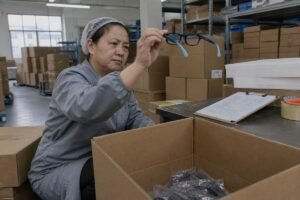
Early in my fifteen years in this industry, I watched a European importer lose a season because a competitor's "test report" turned out to cover a different frame model entirely. That lesson shaped how we now document every one of our roughly 800 styles.
Verify certificates by checking the issuing lab's accreditation, matching the report's model number and material to your exact product, confirming the test date is recent and covers current regulations, and contacting the laboratory directly to authenticate the report number.

A certificate is only as good as the questions you ask about it. Fraudulent or outdated reports are one of the biggest hidden risks in cross-border eyewear sourcing. Here is the verification process I recommend to every buyer who visits our workshop.
Un proceso de verificación de cinco pasos
- Check the laboratory. Only accept reports from accredited third-party labs recognized in your destination market. Ask for the lab's accreditation number and look it up yourself.
- Match the report to the product. The model number, frame material, and color batch on the report must match what you are actually buying. A TR90 frame report does not cover an acetate frame. A report for adult sizing does not automatically cover a kids' version.
- Check the date and the standard version. Regulations change. A REACH compliance 6 report from several years ago may miss substances added to the restricted list since then. Ask when the test was last renewed.
- Authenticate directly. Most major labs let you verify a report number through their website or by email. This takes ten minutes and catches forgeries.
- Audit the factory, not just the paper. Certificates prove one sample passed one test on one day. A factory audit shows whether production is consistent. Our 5S-managed workshop welcomes buyer audits precisely because paperwork alone should never be the whole story.
One objection I often hear: "Testing every batch is too expensive for a small brand." I understand the concern. But you do not need to retest everything constantly. You need a clear testing plan tied to material changes, new colorways, and regulation updates. When we run OEM projects, we flag exactly which changes invalidate an existing report so buyers only pay for testing that actually protects them. Keep every certificate, test report, and technical documentation file organized in one place — a digital compliance platform helps once you sell in multiple regions.
Which Material and Labeling Requirements Differ Between My Key Export Markets?
The trade-off we weigh on every new kids' frame is simple: the softer and more flexible the material, the more carefully we must document its chemistry. That is exactly why we standardized on TPEE y TR90 7 — flexible enough for active kids, clean enough to pass hazardous materials testing in strict markets.
Material rules differ mainly on chemical limits: the US restricts lead and phthalates under CPSIA, the EU adds nickel release and cadmium limits under REACH, and labeling differs on marks (CE, UKCA), tracking labels, age grading, and country-of-origin requirements.

Materials and labels are where regional fragmentation bites hardest. A frame that passes every US chemical test can still fail EU nickel-release limits if the hinge screws or decorative parts were never checked. Let me break down both dimensions.
Chemical and Material Restrictions Compared
| Requisito | Estados Unidos | Unión Europea / Reino Unido | Australia / NZ |
|---|---|---|---|
| Lead content | CPSIA limits for children's products | REACH restrictions | Consumer law safety obligations |
| Phthalates | CPSIA restricted list | REACH restricted list | Monitored under general safety rules |
| Liberación de níquel | Not the primary focus | Explicit release limits for skin-contact parts | Follows international practice |
| Cadmio | Restricted in children's products | Explicit content limits | Restricted |
| BPA | Increasing scrutiny for children's items | Scrutinized under REACH | Scrutinized |
Environmentally friendly base materials make this table much less frightening. TPEE and TR90, when sourced from controlled suppliers, avoid many problem substances by design. The risk usually hides in the small parts: metal cores, hinge screws, coatings, and printed decorations. We test those separately.
Labeling Essentials by Market
| Labeling Element | EE. UU. | UE | Reino Unido |
|---|---|---|---|
| Conformity mark | Not applicable | CE marking where required | UKCA marking 8 |
| Tracking label | Required on children's products | Batch traceability expected | Batch traceability expected |
| Age grading / warnings | Choking hazard warnings where relevant | Age and safety warnings | Age and safety warnings |
| Country of origin | Required | Required | Required |
| UV claim accuracy | Must match tested performance | Must match tested performance | Must match tested performance |
One nuance on UV claims: if you print UV400 on packaging, the lenses must genuinely block 100% of UVA and UVB. Tint alone is not UV protection. We laminate this rule into every OEM packaging review, because an inflated UV claim can push a simple fashion frame into a stricter sunglasses category and expose your brand to enforcement action.
How Do I Work With My Manufacturer to Stay Ahead of Changing Regulations?
A Japanese buyer taught me something valuable during a packaging review a few years back: she asked not what our frames complied with today, but how we would tell her when that changed. That question reframed compliance for me — it is a relationship, not a document.
Work with your manufacturer by agreeing on a regulatory monitoring routine, requiring notification of any material or design change, scheduling periodic retesting, sharing destination-market updates both ways, and building post-market feedback loops so emerging safety concerns reach the factory quickly.

Regulations for children's products only move in one direction: stricter. Enforcement on children's items is tightening in the US, chemical lists keep expanding in Europe, and online marketplaces increasingly demand upfront proof of compliance before listing. A manufacturer who treats compliance as a one-time checkbox will eventually cost you global market access. Here is how a working partnership should function.
Build a Shared Compliance Rhythm
Set a fixed review cadence — quarterly works for most brands. In each review, cover three questions. Has any regulation changed in your sales regions? Has the factory changed any material, supplier, or process? Do any test reports expire before the next review? At our factory, we log every raw-material batch and colorant against the styles that use them, so when a buyer asks "does this change affect my SKU," we can answer specifically rather than vaguely.
Make Design Changes Trigger Compliance Checks
This is the rule buyers skip most often. A new temple color, a different rubber tip supplier, or a slightly modified hinge can invalidate prior testing. Agree in writing that the factory must notify you before implementing any change, and that you jointly decide whether retesting is needed. This costs almost nothing and prevents the most common compliance failure we see.
Close the Loop After Sale
Post-market surveillance sounds corporate, but for a kids' brand it is simple: track returns, complaints, and marketplace reviews for safety signals, and feed them back to the factory. When a buyer reports that a hinge loosens after months of playground use, that insight should reach our engineers, not just customer service. Some sellers argue this is the retailer's job alone. In practice, brands that share field data with their factory fix issues in the next production run instead of the next recall.
Conclusión
Compliance for kids' optical frames is layered but learnable: classify correctly, test to each region's standards, verify certificates, label accurately, and partner with a factory that monitors change with you.
Notas al pie
1. Details the impact resistance test for lenses in eyeglasses and sunglasses as required by the FDA. ↩︎
2. Establishes standards for nonprescription sunglasses and fashion eyewear requirements. ↩︎
3. Official information on the Consumer Product Safety Improvement Act, covering children’s product safety. ↩︎
4. Specifies fundamental requirements and test methods for unglazed spectacle frames. ↩︎
5. Official information on the CE marking, indicating conformity with EU health, safety, and environmental protection requirements. ↩︎
6. Explains the European Union regulation for Registration, Evaluation, Authorisation and Restriction of Chemicals. ↩︎
7. Provides an overview of thermoplastic elastomers, a material category including TPEE, often used alongside TR90 in eyewear. ↩︎
8. Official UK government guidance on the UKCA marking, the conformity mark for products placed on the Great Britain market. ↩︎
Más artículos que te podrían gustar

5 de agosto de 2026
Bio-Based vs Regular Cellulose Acetate: What's the Difference for Kids' Frames?

5 de agosto de 2026
How Recyclable Are Kids' Optical Frame Materials, and What Eco-Friendly Alternatives Exist?
5 de agosto de 2026
Do Kids Optical Frames Whiten or Age in Storage, and How to Control Warehouse Conditions?
¿Buscas un socio confiable en gafas para niños?
Explore más de 800 estilos listos y soporte OEM/ODM completo adaptado a su marca.
Ponte en contacto English
  Español de México
  Deutsch
  Français
  日本語
日本語  العربية
  Português do Brasil