How to Ensure Durable Country-of-Origin Marking on Kids Sunglasses from China for Australian Customs?
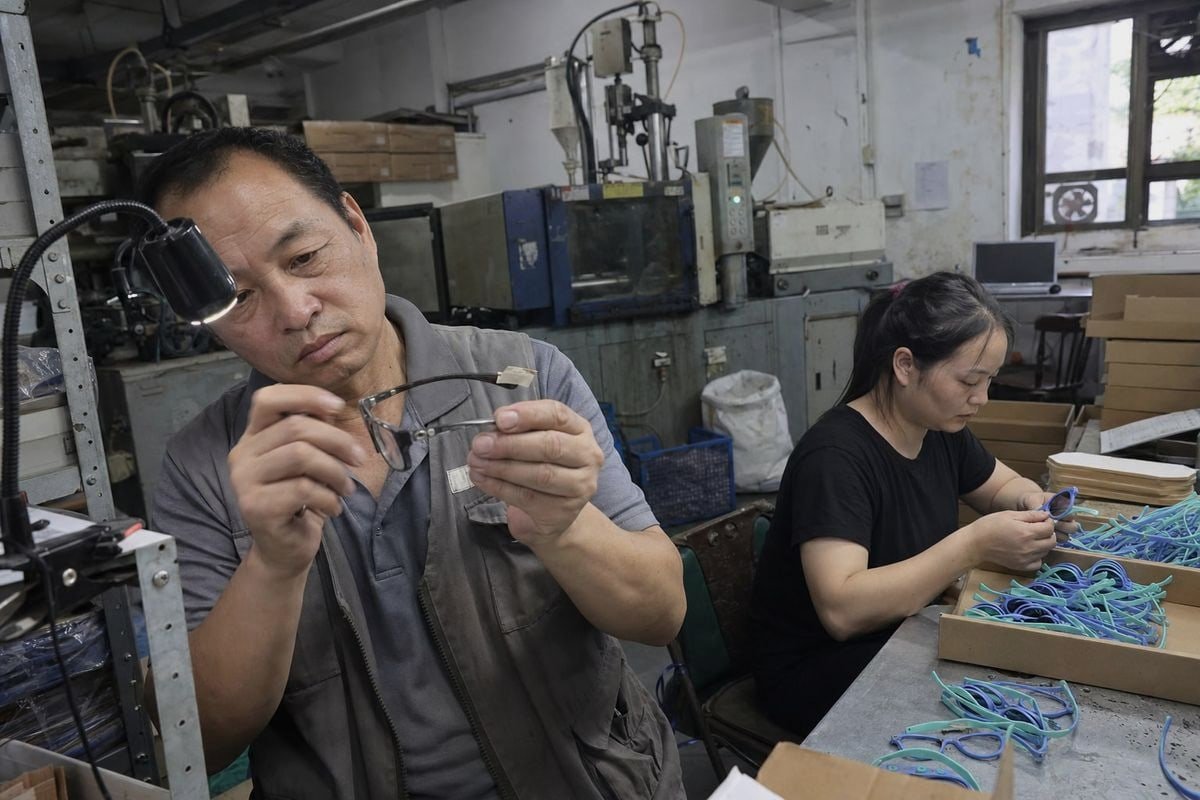
Durable country-of-origin marking on kids sunglasses from China sounds simple until a shipment stalls at the border. On our production line in Taizhou 1, we’ve seen a peeled sticker undo months of work — delayed goods, angry retailers, lost launch windows. The fix is treating origin marking as a permanent product feature, not an afterthought.
To ensure durable country-of-origin marking on kids sunglasses from China for Australian customs, require a permanent “Made in China” mark in legible English on the frame or inner temple — molded, laser-engraved, or pad-printed — applied as permanently as practicable, then verify it with approved samples and pre-shipment inspection photos.
That is the short answer. Below, I walk through the marking methods that actually last, how to verify compliance before shipping, where to place the mark, and which quality checks to demand.
What Country-of-Origin Marking Methods Actually Last on Kids Sunglasses Without Fading or Peeling?
A few years back, a buyer sent us a competitor's frame where the origin sticker had curled off in transit. Our engineers keep that frame on a shelf as a reminder of what not to do.
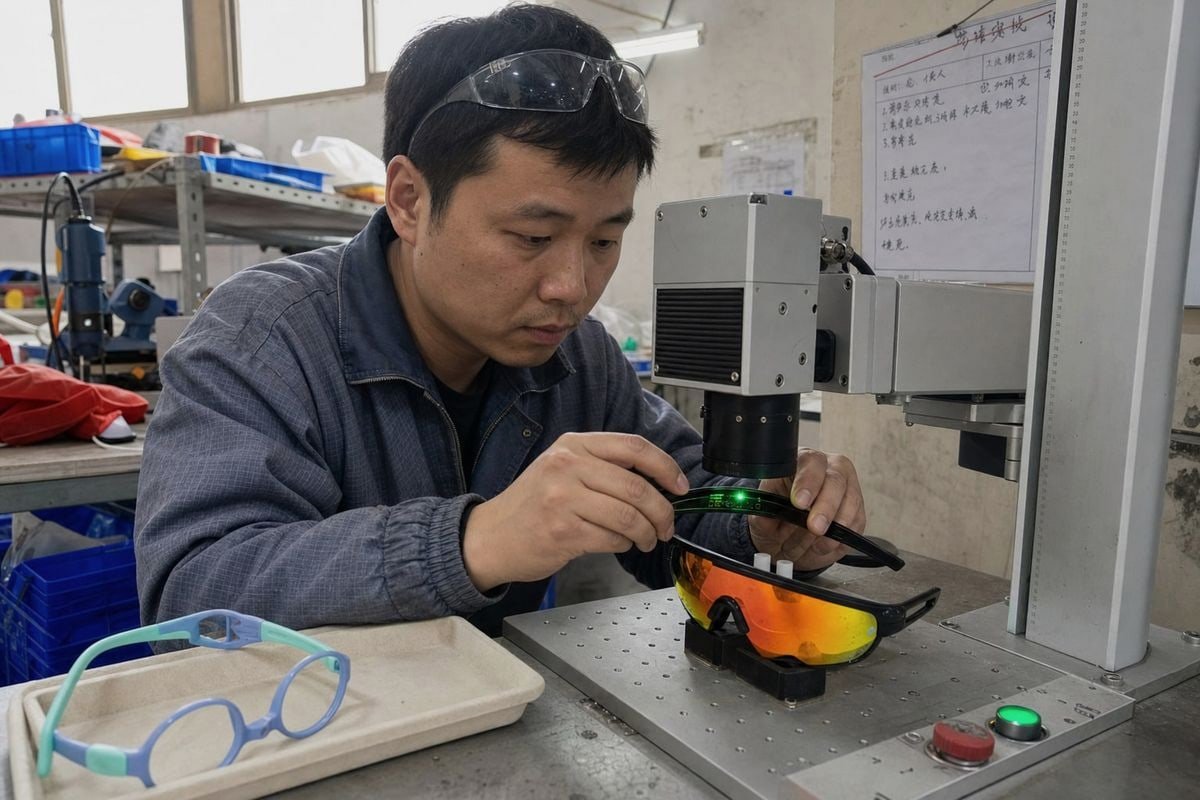
The most durable origin marking methods for kids sunglasses are in-mold marking fused during injection molding, laser engraving on the temple, and pad printing with abrasion-resistant ink. Adhesive stickers and swing tags alone are not permanent enough to satisfy Australian customs expectations.
Australian rules use the phrase "as permanent as practicable." That wording matters. It means the mark must survive export handling, warehouse storage, retail display, and normal use by an active child. Not every method clears that bar. Here is how I rank the common indelible marking methods we use for TR90 and TPEE frames, from strongest to weakest.
The Durability Hierarchy for Frame Marking
| Método | How It Works | Durabilidad | Mejor para |
|---|---|---|---|
| In-mold / embossed marking | Text is molded into the frame during injection | Permanent for the product's life | High-volume TR90 or plastic frames |
| Laser engraving for eyewear | Laser etches or color-changes the material surface | Very high; immune to rub-off | TR90, acetate, dark or translucent frames |
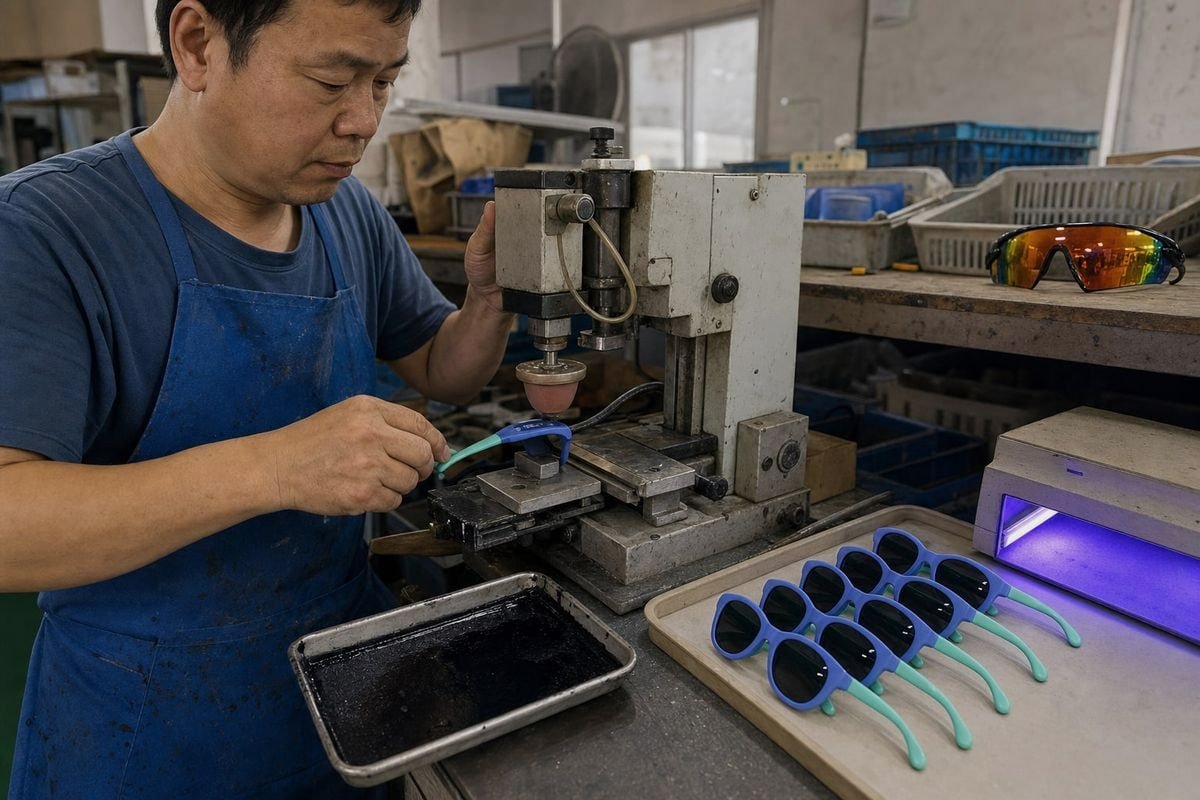
| Pad printing on frames | Ink is transferred onto the temple, then cured | High if ink and curing are correct | Curved temples, small runs, multiple colors |
| Permanent adhesive labels | High-adhesion label on a protected surface | Moderate; can peel over time | Supplementary marking only |
| Sticker or swing tag | Removable label on lens or packaging | Low; falls off easily | Never as the sole origin mark |
For glossy sport shields like our wraparound styles, sub-surface laser marking 2 works well on translucent frames because the text sits inside the plastic, protected from abrasion. For soft-touch kids frames — like our periwinkle-and-mint round styles with flexible TPEE temples — molded text is the safest choice, because flexible material flexes constantly and printed ink can crack if the ink system is wrong.
One more point that matters for children's products specifically. Kids chew on temple tips. If you choose pad printing, insist on non-toxic ink systems 3 consistent with toy-safety chemical expectations. A durable mark that leaches unsafe substances trades a customs problem for a recall problem.
How Do I Confirm My Chinese Manufacturer's Marking Meets Australian Customs Requirements Before Shipping?
The trade-off I weigh with every new Australian client is speed versus certainty. Skipping sample approval saves a week; a rejected shipment at the border costs far more. We never recommend the shortcut.
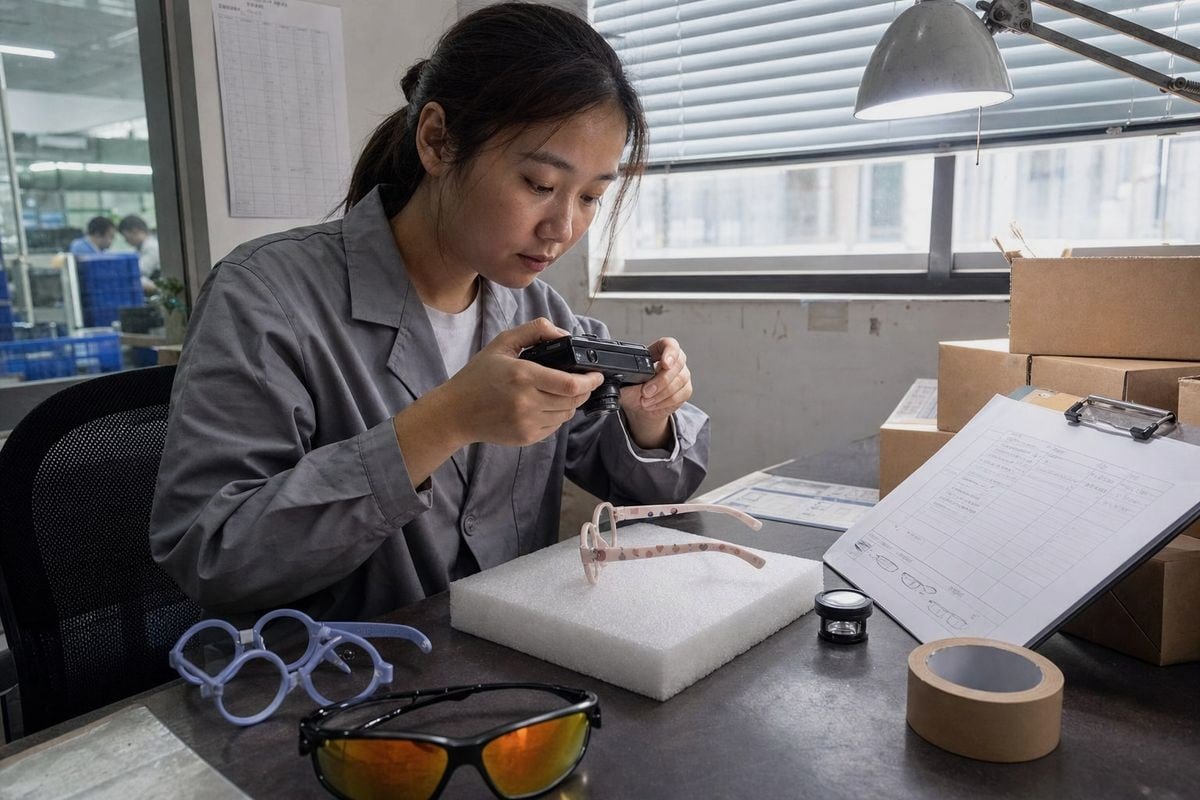
Confirm compliance before shipping by writing the exact origin wording, location, size, and method into your purchase specification, approving a pre-production sample, and requiring close-up pre-shipment photos of the marking on random units. Verify the wording reads "Made in China" in legible English.
Australian Border Force 4 compliance for imported goods rests on the Commerce (Trade Description 5s) Act and its regulations. In plain English: when goods must carry a trade description, it must be in English, in prominent and legible characters, and applied as permanently as practicable. Vague wording, tiny text, or a mark hidden under a hinge can all cause problems. False or misleading origin claims also breach Australian Consumer Law, which brings its own penalties beyond customs delays.
So how do you turn legal language into a supplier instruction? Here is the process we follow with our own B2B clients.
A Five-Step Verification Workflow
- Write the specification. State the exact wording — usually "Made in China." Specify the mandatory trade description in English, the marking method, the minimum character height, and the exact position on the frame.
- Approve artwork. Review the marking layout on the technical drawing before molds or printing plates are made.
- Approve a physical sample. Check legibility with the naked eye. If you need magnification to read it, it is too small.
- Demand pre-shipment photo evidence. Ask for close-up photos of the marking on randomly selected units from the actual production batch, not the golden sample.
- Retain documentation. Keep the spec, approval emails, and inspection report. If questions arise at the border, this paper trail speeds resolution.
Also confirm your supplier understands the product safety labeling side. Origin marking is one layer; the sunglasses standard adds more, which I cover in the QC section below. A supplier who only talks about origin stickers is telling you they do not know the Australian market. When we onboard a new Australian brand, we walk both layers through in one artwork review, because a single integrated marking plan is far less error-prone than two separate ones.
Which Part of the Frame Should Carry the Origin Marking Without Compromising Comfort or Safety?
An Australian procurement manager once asked us to move an origin mark off the inner temple because she worried it would irritate her toddler customers. It was a fair question — and it shaped how we position marks on flexible frames today.
Place the origin marking on the inside of the temple arm or temple tip, the industry-standard eyewear location. It stays visible for inspection without disassembly, avoids the skin-contact pressure zones, and never touches the lens area or the child's face.
Placement is where comfort, safety, and compliance meet. A mark that is prominent enough for an inspector must not create a sharp edge, a raised ridge, or a rough patch against a child's skin. Children's frames are small, temples are narrow and curved, and flexible materials move. All of this shapes where the mark can go.
Placement Options Compared
| Location | Inspection Visibility | Comfort Risk | Our View |
|---|---|---|---|
| Inner temple arm | High — visible when temples open | Low if molded text is shallow | Best all-round choice |
| Temple tip (inner side) | Alta | Low, but avoid the ear-contact curve | Good for slim temples |
| Inside of frame front | Moderate — small space on kids sizes | Muy bajo | Good secondary spot |
| Nose bridge area | Low — cramped and curved | Higher; contacts skin directly | Avoid |
| Lens surface | High but temporary | Ninguno | Never for origin; stickers come off |
On our sport-style wraparound shields, the wide temple arm gives generous space for engraved or molded text, so legibility is easy even at small character sizes. On compact round kids frames with soft TPEE temples, we keep molded characters shallow — deep enough to read clearly, shallow enough that a child never feels them. That balance took us several mold iterations to standardize, and it is now part of our default tooling spec across our style library.
Two practical safety rules we apply on every children's frame. First, no marking within the direct skin-pressure zone behind the ear. Second, no raised lettering on inner surfaces; recessed or flush marks only. A compliant mark should be invisible to the child wearing the glasses and obvious to the inspector examining them.
What Quality Checks Can I Request to Make Sure Every Unit Passes Australian Border Inspection?
The lesson that reshaped our QC checklist came from a mixed-batch problem years ago: one injection machine produced frames with faint molded text because of mold wear. Since then, marking legibility has been a standing checkpoint at our 5S-managed workshop, not an occasional spot check.
Request an AQL-based pre-shipment inspection covering marking legibility, adhesion or rub-off testing, correct English wording, placement consistency, and the full AS/NZS 1067.1:2016 labeling package — lens category, supplier identity, and usage information — verified with photos before the goods leave China.
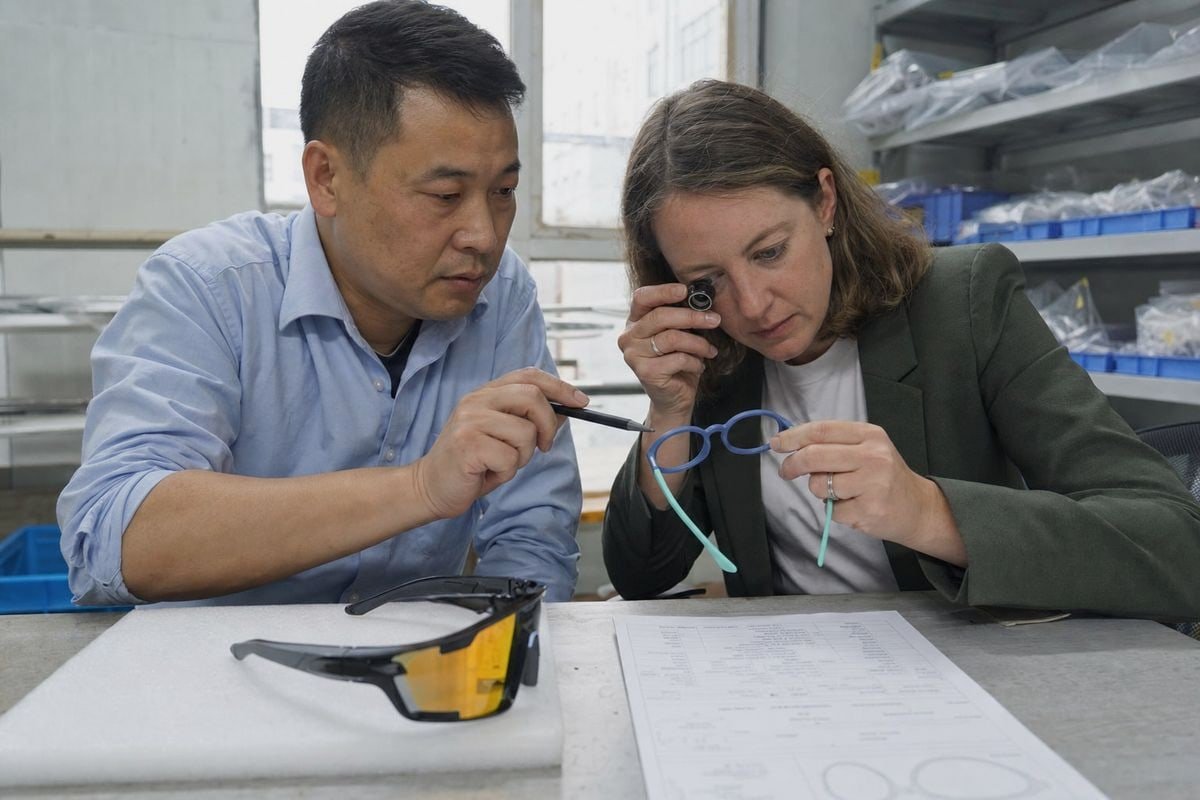
Passing the border is not only about the origin mark. Sunglasses sold in Australia fall under a mandatory safety standard, and children's sunglasses draw extra scrutiny because they are a child-safety product. AS/NZS 1067.1:2016 6 standards require clear marking or labeling of the manufacturer or supplier identity, the lens category number, the category description and usage information, plus any required warnings. Your inspection scope should treat origin marking and product safety labeling as one workflow, because customs seizure of goods or retail-level compliance action can follow a failure in either layer.
The Inspection Checklist to Send Your Supplier
| Comprobar | What to Verify | Pass Criteria |
|---|---|---|
| Origin wording | "Made in China" in English | Exact wording, no abbreviations or translations only |
| Legibility | Character clarity at arm's length | Readable without magnification |
| Durabilidad | Rub test with cloth and light solvent | No smearing, fading, or removal |
| Adhesion (if labels used) | Tape pull and edge-lift check on permanent adhesive labels | No lifting or peeling |
| Placement consistency | Same location across random units | Matches approved sample |
| Lens category label | Category number and description | Present on product or point-of-sale label as required |
| Categoría de lente 0–4 con descripción de categoría | Brand or supplier name marked | Legible and consistent |
| Packaging alignment | Carton, inner box, and product marks agree | No conflicting origin statements |
Ask for this as part of a standard AQL random-sampling inspection 7, either by your own agent or a third-party service. Insist that inspectors photograph the marking on units pulled from different cartons, not one convenient display piece. In our experience exporting to twenty-plus countries, batch-to-batch drift — mold wear, a new ink lot, a rushed reprint — is the real enemy of consistency, and random sampling is the only way to catch it.
Finally, verify on arrival. Open cartons from different pallets and confirm the marks survived the voyage. A mark that fades between Ningbo and Melbourne was never as permanent as practicable in the first place.
Conclusión
Durable country-of-origin marking protects your shipment, your brand, and your launch dates. Specify permanent marking, approve samples, inspect before shipping, and verify on arrival — every time.
Notas al pie
1. Background on Taizhou, a major Chinese eyewear manufacturing hub referenced in the article. ↩︎
2. Background explanation of laser engraving technology used for durable frame marking. ↩︎
3. ISO sets international standards relevant to material safety in children’s product ink systems. ↩︎
4. Official agency enforcing customs and trade-description compliance for imports into Australia. ↩︎
5. WTO reference on rules of origin, directly relevant to trade description requirements. ↩︎
6. Standards Australia is the authoritative source for the AS/NZS sunglasses safety standard. ↩︎
7. Explains the AQL statistical sampling method used for pre-shipment quality inspections. ↩︎
Más artículos que te podrían gustar
1 de agosto de 2026
¿Debería la fábrica encargarse del embalaje y etiquetado de las gafas de sol para niños, o utilizar un proveedor designado?
1 de agosto de 2026
Almacén propio vs. Cumplimiento directo del proveedor: ¿Qué reduce los costos de devolución para las marcas de gafas de sol para niños?
1 de agosto de 2026
Directo al almacén del puerto o staging en el extranjero: ¿Cuál ahorra más en el envío de gafas de sol para niños?
¿Buscas un socio confiable en gafas para niños?
Explore más de 800 estilos listos y soporte OEM/ODM completo adaptado a su marca.
Ponte en contacto English
  Español de México
  Deutsch
  Français
  日本語
日本語  العربية
  Português do Brasil