How Should Display Props and Sales Materials Factor Into Kids Optical Frames Wholesale Pricing?
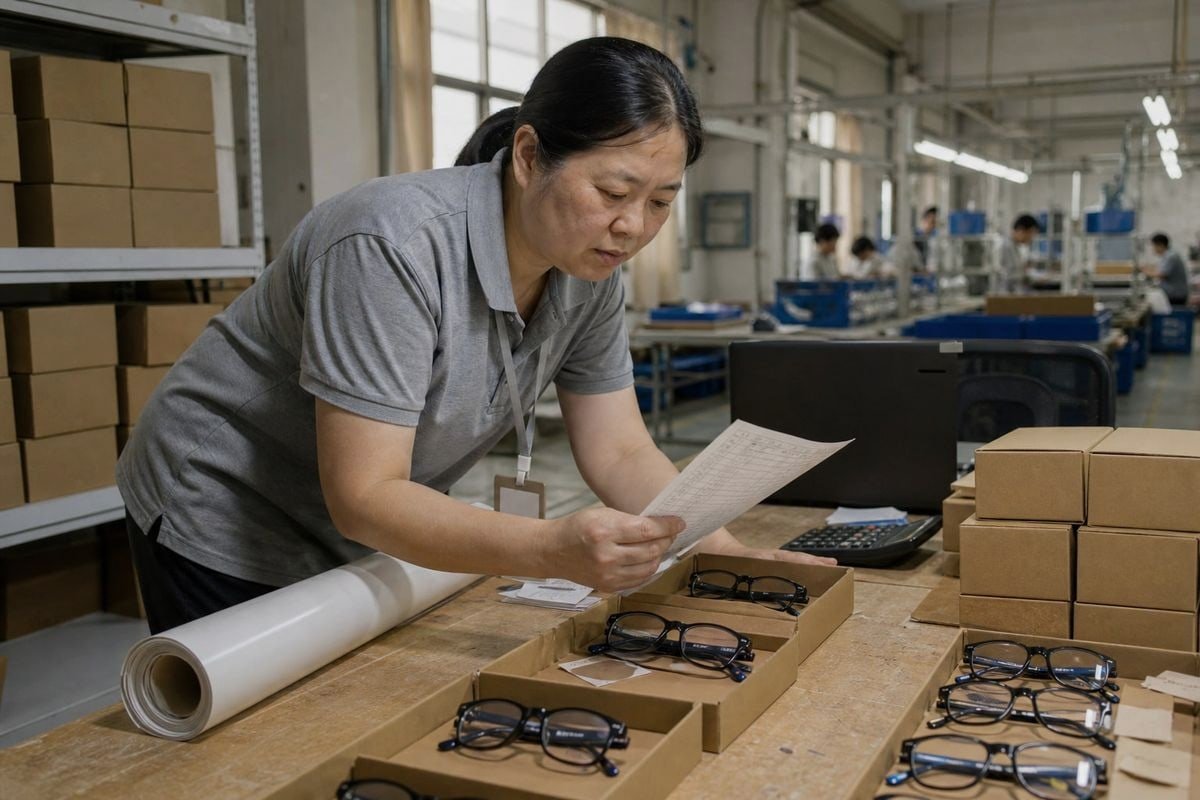
Kids optical frames wholesale pricing rarely stops at the frame itself. Many buyers we work with at our Taizhou factory learn this only after their first shipment arrives.
Display props and sales materials should be treated as part of your total landed cost in kids optical frames wholesale pricing, typically adding 5–15% to your merchandising budget. Separate frame cost from presentation cost, then decide whether you absorb it, negotiate vendor support, or raise retail price.
The math sounds simple. In practice, it changes how you pick suppliers, set retail markup 1, and negotiate. Let me walk through each part.
What Display Props and POS Materials Should I Expect From a Kids Optical Frames Supplier?
A buyer from Australia once asked me why her competitor's kids section looked "more expensive" with similar frames. The answer was not the frames. It was the display support behind them.
A capable kids eyewear supplier should offer counter display stands, branded trays, hang tags, posters, shelf talkers, and retail-ready packaging. Many factories also provide digital assets like product photos and lifestyle images. Some include these free above certain order volumes; others quote them separately.
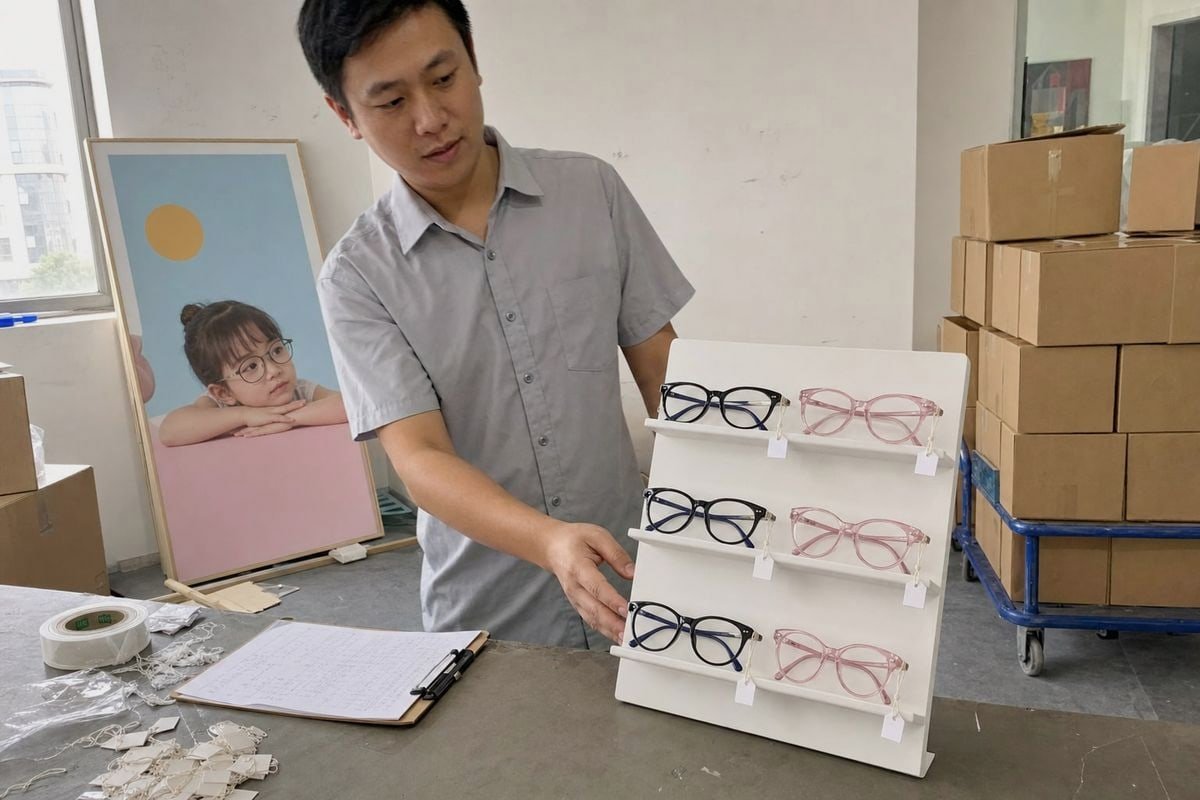
En nuestros quince años fabricando pediatric eyewear 2, we have shipped far more than frames. Buyers who succeed at retail usually request a merchandising package alongside their frame order. Here is what you should realistically expect, and what each item typically does for you.
The Standard Merchandising Package
| Marca del producto | Typical Purpose | Usually Included? |
|---|---|---|
| Counter display stands | Hold 6–12 frames at point of sale | Often, above MOQ thresholds |
| Hang tags and stickers | Communicate durability standards and UV protection | Yes, with custom packaging orders |
| Posters and shelf talkers | Signal brand story to parents | Sometimes, on request |
| Branded cases and cloths | Add perceived value per unit | Yes, quoted per piece |
| Digital assets (photos, videos) | Support e-commerce and virtual try-on | Increasingly standard |
Why Kids Frames Need More Support Than Adult Frames
Children's frames must convince two audiences at once. The child wants color and fun. The parent wants proof of safety, flexible frame materials like TR90 and TPEE 3, and warranty support. Signage does that convincing before your staff ever speaks. Industry research on children's eyewear marketing found point-of-purchase materials 4 were rated the most effective method by 36% of respondents, ahead of special promotions at 28%. That is a strong argument for asking your wholesale suppliers what POS support they actually provide before you compare unit prices.
Also ask about digital merchandising. High-resolution images and 3D models now matter as much as physical optical displays if you sell online. We prepare these for our OEM clients because a frame without good imagery simply does not convert on a product page.
How Do Display Props and Sales Materials Affect My Wholesale Pricing?
There is a trade-off we discuss with almost every new importer: a lower quoted unit price with zero presentation support, or a slightly higher price with retail-ready merchandising built in. The cheaper quote often costs more in the end.
Display props and sales materials affect wholesale pricing in two ways: they add direct cost to your landed cost per frame, and they lift perceived value, conversion, and average sale price at retail. Budget them explicitly, then choose a pricing model that recovers the spend.

The cleanest way to think about this is to separate product economics from presentation economics. Product economics covers the frame's wholesale price, freight, duties, and breakage allowance — the true landed cost. Industry guidance suggests these hidden costs can add 15–30% to a quoted base price. Presentation economics covers fixtures, signage, props, and the staff time to maintain them. Optical merchandising sources estimate an effective display setup runs roughly $100–$500, and it is reusable, not disposable.
Three Pricing Models Compared
| Model | How It Works | Mejor para |
|---|---|---|
| Cost-plus with merchandising allocation | Retail price = landed cost + standard 2.5x–3x retail markup + a per-frame share of display spend | Retailers who want every cost visible |
| Value-based pricing 5 | Set price at fair market value; use visual merchandising to justify it | Premium or private label eyewear lines |
| Vendor-assisted margin | Supplier funds displays and POS; retailer keeps standard markup with lower overhead | Buyers negotiating volume programs |
A common objection I hear: "Display costs are overhead, not product cost — keep them out of the frame price." I understand the appeal. It keeps unit pricing transparent and comparison easy. But for kids lines, this view understates the real cost of selling the frame. Presentation directly shapes what parents will pay. Good merchandising has been shown to boost both frame sales and average sale price. If a $2 per-frame merchandising allocation lifts your sell-through and supports a $10 higher retail ticket, ignoring it is not transparency. It is leaving profit margins on the table.
One caution: apply the 2.5x–3x markup as a starting point, not a rule. Test what your local market will bear.
Can I Get Custom-Branded Display Stands Without Raising My MOQ or Cost?
When we developed a private label program for a European baby brand, their biggest fear was that asking for branded counter stands would double their minimum order quantity. It did not — because we structured the request the right way.
Yes, in many cases. Factories with existing display tooling can brand standard stands with your logo at low or no extra cost once you meet a reasonable minimum order quantity. Fully custom-shaped fixtures cost more, so negotiate branded standard stands first.
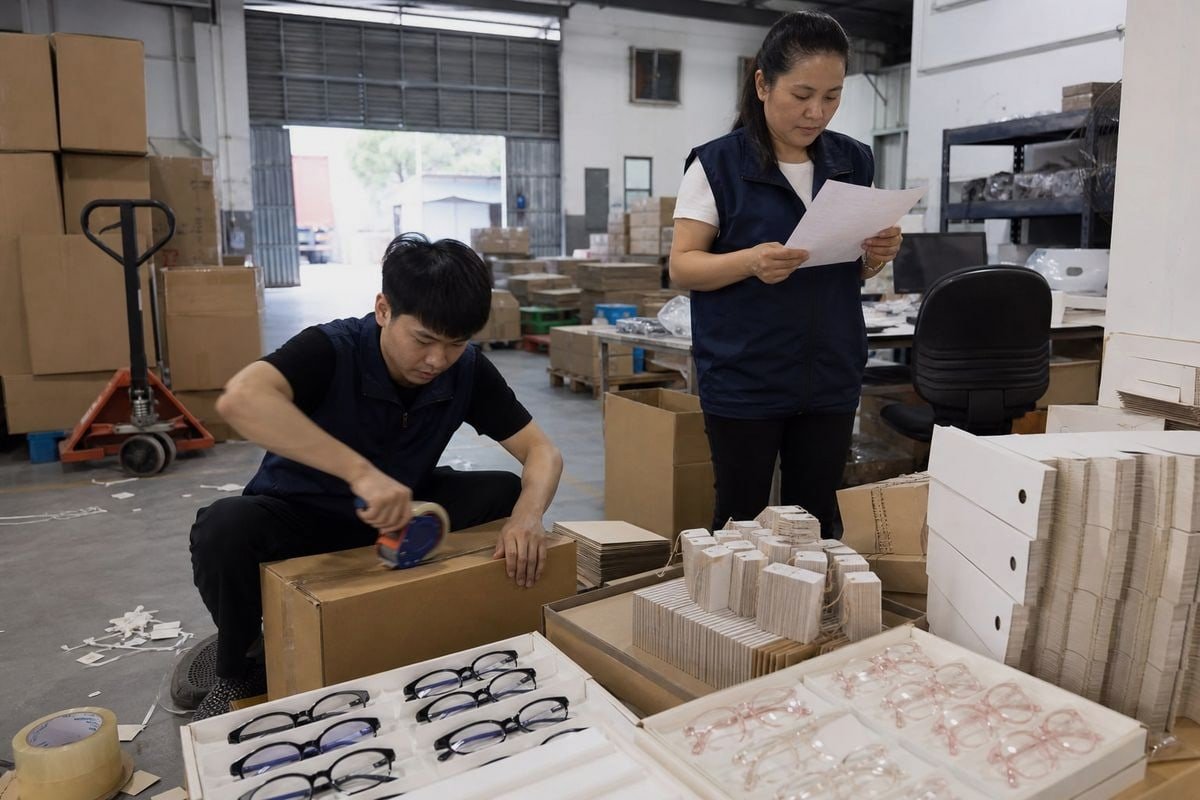
The key distinction is between customizing an existing stand and creating a new one from scratch. At our factory, we hold around 800 existing frame styles, and we apply the same logic to displays. A stock acrylic or cardboard stand printed with your logo needs no new mold. A fully custom fixture — a themed character stand, an interactive touchscreen unit — needs tooling, and tooling needs volume to amortize.
How to Negotiate Display Support Step by Step
- Ask what stock display options exist. Most established wholesale suppliers have standard counter stands ready to brand.
- Bundle the request with your frame order. Suppliers say yes more often when displays ride along with a confirmed purchase, not as a standalone ask.
- Offer commitment, not just volume. A planned reorder schedule can unlock display support without raising your MOQ on frames.
- Split custom tooling costs. If you truly need a unique fixture, propose sharing the mold cost or amortizing it across two or three orders.
- Request digital assets in the same negotiation. Photos, lifestyle images, and AR-ready files cost the factory little and help you online immediately.
For our flexible TR90 frames with TPEE temples, we often suggest a "bend test" demo prop — a sample frame mounted so parents can twist it in-store. It costs almost nothing to produce, yet it demonstrates durability better than any poster. Ask your supplier for demonstration props like this. They are the cheapest merchandising you will ever buy, and they directly support a premium price position for pediatric eyewear.
How Do I Know If Sales Materials Are Worth Adding to My Wholesale Order?
Early in my export career, I watched a distributor order beautiful branded stands, then bury them in a cluttered kids corner with five competing manufacturers' POP pieces. The lesson stuck: merchandising only pays when it is measured and kept clean.
Sales materials are worth adding when their per-frame cost is recovered through measurable gains in conversion, average sale price, or sell-through. Track sales before and after installation, keep displays uncluttered, and cut any material that does not move numbers within one season.
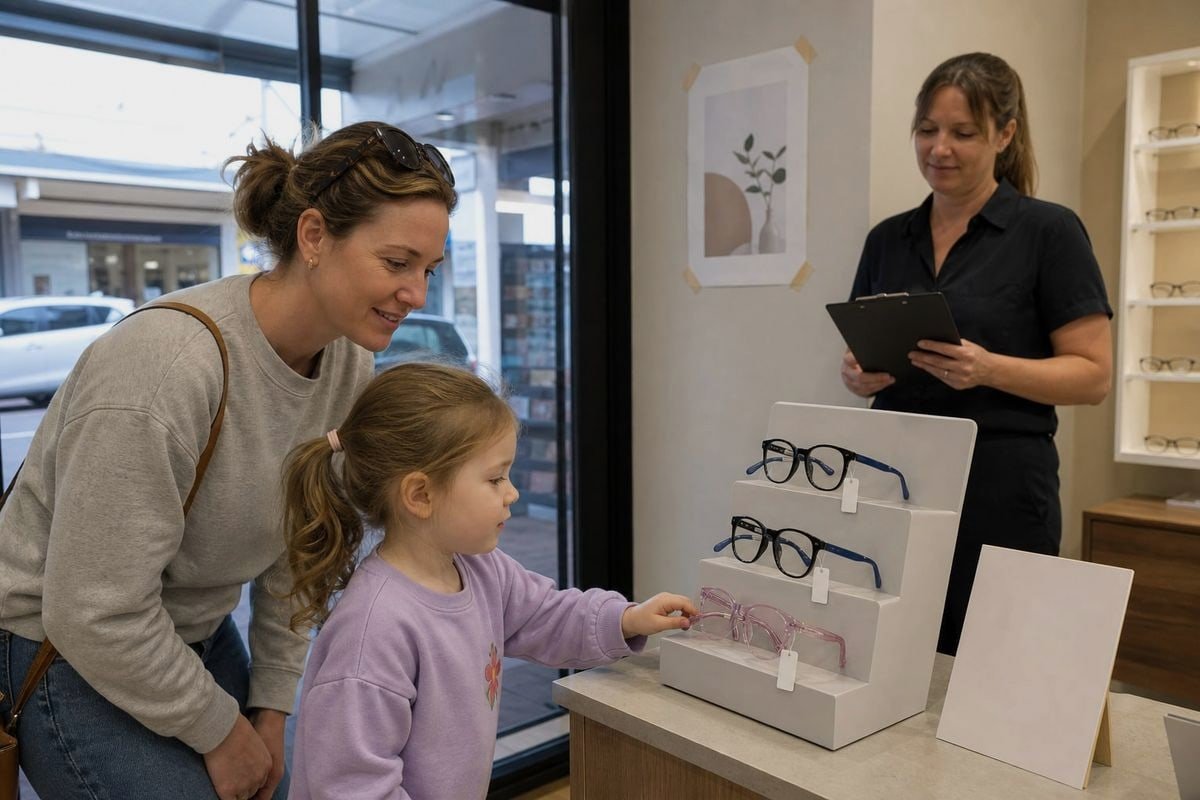
Treat every display prop like an investment with an expected return, not decoration. The evaluation is straightforward if you set a baseline first. Record your kids-frame units per week, average ticket, and capture rate before the materials go in. Then compare after four to eight weeks.
A Simple ROI Check
| Métrica | Before Display | Target After | What It Tells You |
|---|---|---|---|
| Kids frames sold per week | Línea de base | +10–20% | Conversion impact |
| Average sale price | Línea de base | +5–15% | Perceived value impact |
| Frames handled per visit | Línea de base | Higher | Engagement with the display |
| Per-frame merchandising cost | Calculated | Falling per unit | Payback progress |
Watch for Over-Merchandising
More is not better. Optical retail guidance is blunt about this: eliminate clutter and keep internal marketing consistent. A crowded kids section with mixed POP pieces signals "discount bin" to parents, even when the frame quality supports premium pricing. Remember the merchandising rule of value tiers — crowded frames read as cheap; lifted, spaced frames with clean props read as premium.
Also match materials to age group. Younger children's frames belong lower and within reach, with signage about durability standards and warranty. Teen frames can sit at eye level with style-led visuals. Seasonal angles like back-to-school displays work well, but rotate them out on time. Stale seasonal props hurt credibility. Finally, if sustainability is part of your brand story, signage highlighting environmentally friendly frame materials gives eco-conscious parents a concrete reason to accept a higher price tier.
Conclusión
Display props and sales materials are not extras. Price them into your landed cost, negotiate supplier support, keep displays clean, and measure results — merchandising is strategy, not decoration.
Notas al pie
1. Explains the definition and calculation of retail markup in business. ↩︎
2. Provides context on the specific considerations for children’s eyeglasses. ↩︎
3. Found a working, relevant URL on the original domain that compares TR90 and TPEE for kids’ sunglasses. ↩︎
4. Defines point-of-purchase materials and their function in retail marketing. ↩︎
5. Explains value-based pricing as a strategy focused on customer perception. ↩︎
Más artículos que te podrían gustar
5 de agosto de 2026
Bio-Based vs Regular Cellulose Acetate: What's the Difference for Kids' Frames?

5 de agosto de 2026
How Recyclable Are Kids' Optical Frame Materials, and What Eco-Friendly Alternatives Exist?
5 de agosto de 2026
Do Kids Optical Frames Whiten or Age in Storage, and How to Control Warehouse Conditions?
¿Buscas un socio confiable en gafas para niños?
Explore más de 800 estilos listos y soporte OEM/ODM completo adaptado a su marca.
Ponte en contacto English
  Español de México
  Deutsch
  Français
  日本語
日本語  العربية
  Português do Brasil